
Ever wondered why your kitchen knives lose their "bite" even after a few swipes on a steel rod? The secret to a high-performance kitchen lies in understanding the fundamental difference between whetstone sharpening and honing rods. While a honing rod is your essential daily companion for realigning a folded edge-keeping a straight blade true without removing actual steel-the whetstone is the undisputed heavyweight champion for achieving a professional, razor-sharp finish. By using various grit levels to physically grind away dull metal and reshape the bevel, whetstones restore the structural integrity of your blade, ensuring it glides through produce with effortless, surgical precision that a simple honing steel just can't replicate.
| Feature | Whetstone Sharpening | Honing Rod |
|---|---|---|
| Primary Action | Abrasive metal removal to create a new edge. | Realignment of the existing microscopic "burr." |
| Resulting Sharpness | Professional, razor-sharp restoration. | Maintenance of current edge "bite." |
| Frequency | Every 3-6 months (depending on use). | Before or after every use (Daily). |
| Skill Level | High; requires consistent angle control. | Low; quick and easy to master. |
| Material Options | Water stones, Oil stones, Diamond plates. | Stainless steel, Ceramic, Diamond-coated. |
| Time Required | 15-30 minutes per blade. | 10-20 seconds per blade. |
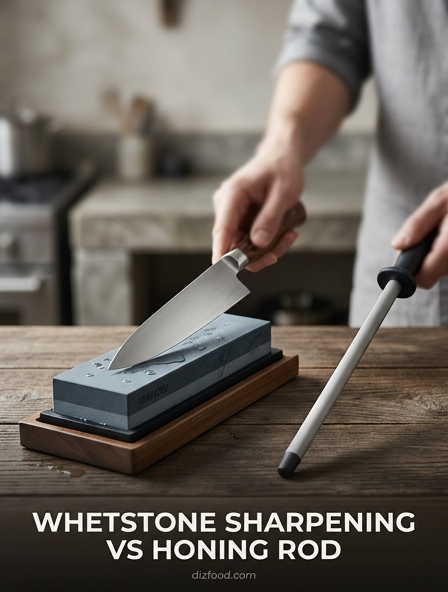
The Difference Between Sharpening and Honing Explained
In the culinary world, the terms sharpening and honing are frequently used interchangeably, yet they represent two distinct physical processes that affect a knife's edge in different ways. Understanding this distinction is the foundation of proper knife maintenance. Sharpening is a subtractive process where metal is physically ground away from the blade's edge to create a brand-new, sharp apex. This is necessary when the edge has become blunt, rounded, or chipped from extensive use. Without removing material, it is impossible to restore the geometry required for a clean cut.
Honing, conversely, does not typically remove a significant amount of metal. Instead, it focuses on maintenance and alignment. As a knife is used against a cutting board or through food, the microscopic "teeth" of the edge-known as the apex-begin to fold over or curl to one side. This is called a rolled edge. While the blade is still technically "sharp" in terms of its thinness, the misalignment makes it feel dull because the edge is no longer striking the food directly. Honing pushes these microscopic fibers back into a straight line, restoring the cutting efficiency without the need for grinding. To summarize the primary differences:
- Sharpening: Uses abrasives to remove metal, creates a new edge, and is performed infrequently.
- Honing: Realignment of the existing edge, removes little to no metal, and is performed frequently.
- Tools: Sharpening usually requires whetstones; honing utilizes a honing rod or steel.
When to Choose a Whetstone Over a Honing Rod
Choosing between a whetstone and a honing rod depends entirely on the current state of your knife's edge. If you find that your knife is struggling to bite into the skin of a tomato or requires significant downward pressure to slice through an onion, the edge has likely reached a point of dullness that a honing rod cannot fix. In this scenario, a whetstone is the only solution. The whetstone provides the necessary grit to grind away the old, fatigued metal and establish a fresh, keen edge that can actually penetrate fibers.
A whetstone is also the mandatory choice for repairing structural damage. If your knife has visible nicks, chips, or a broken tip, a honing rod will only exacerbate the problem by catching on the imperfections. Furthermore, different types of steel require different approaches. High-carbon Japanese steel is often too hard and brittle for a traditional ribbed steel honing rod, as the rod can cause micro-chipping. For these premium blades, a whetstone is preferred even for minor touch-ups. Consider the following criteria when deciding:
- Blade Condition: If the blade is truly dull or damaged, use a whetstone.
- Maintenance Frequency: If the blade was sharpened recently but feels slightly "off," use a honing rod.
- Steel Hardness: Harder steels (60+ HRC) generally favor whetstones or ceramic rods over steel rods.
- Geometry: To change the angle of the edge, a whetstone is required.
How Whetstones Remove Metal to Create a New Edge
The physics of a whetstone revolves around abrasion. Whetstones are composed of abrasive particles-such as aluminum oxide or silicon carbide-bonded together. When a steel blade is rubbed against the stone with water or oil as a lubricant, the harder particles of the stone cut into the softer metal of the knife. This process creates a "slurry" of discarded metal and stone particles, which acts as an additional polishing agent. By maintaining a consistent angle, the user grinds down both sides of the blade until they meet perfectly at a point.
A critical part of this process is the formation of a "burr" or "wire edge." As you sharpen one side, the metal eventually becomes so thin that it folds over to the opposite side. This microscopic flap of metal indicates that you have reached the very edge of the blade. The process is then repeated on the other side, and progressively finer stones are used to polish away the burr and refine the surface. The grit of the stone determines how much metal is removed:
| Grit Category | Grit Range | Primary Purpose |
|---|---|---|
| Coarse | 200 - 800 | Repairing chips and re-profiling very dull edges. |
| Medium | 1000 - 3000 | Standard sharpening and establishing the basic edge. |
| Finishing | 4000 - 8000+ | Polishing, removing the burr, and refining to razor sharpness. |
Maintaining Blade Alignment With a Honing Rod
A honing rod, often mistakenly called a "sharpening steel," serves as the primary tool for daily maintenance in a busy kitchen. Because the edge of a kitchen knife is ground to such a fine point, it is inherently fragile at a microscopic level. Even under normal use against a wooden or plastic cutting board, the very tip of the edge will begin to deviate from its vertical axis. This misalignment causes the knife to slide off surfaces rather than cutting into them. Honing is the act of dragging the blade along a hard rod to stand those microscopic "teeth" back up.
The technique involves holding the rod vertically or at an angle and swiping the blade from heel to tip. Because the rod is harder than the knife steel, the pressure applied forces the rolled edge back into alignment. This does not make the knife "sharper" in the sense of removing metal to make it thinner; rather, it makes the existing sharpness accessible again. Regular honing can extend the time between whetstone sessions by months, as it prevents the edge from folding over so far that it eventually breaks off. It is an essential habit for anyone using softer Western-style knives, which are more prone to rolling than their harder Eastern counterparts.
Comparing Knife Sharpening Frequency and Technique
Frequency and technique are the two areas where sharpening and honing diverge most sharply. Honing is a high-frequency, low-intensity activity. Professional chefs often hone their knives several times a day, sometimes even between different tasks, to ensure the edge remains perfectly centered. For the home cook, honing once every two or three uses is usually sufficient to maintain a pleasant cutting experience. The technique requires a light touch; excessive pressure on a honing rod can actually damage the edge by causing it to ripple or deform.
Sharpening is a low-frequency, high-intensity task. Depending on the volume of cooking and the quality of the steel, a knife typically only needs to be sharpened on a whetstone every three to six months. Sharpening requires significant focus and a highly consistent angle-usually between 15 and 20 degrees. The technique involves a "push-pull" motion across the stone, ensuring the entire length of the blade receives equal treatment. While honing can be done in seconds, a proper whetstone session can take 15 to 30 minutes per knife. The following list outlines the typical maintenance schedule for a standard kitchen knife:
- Daily/Every Use: Quick honing (5-10 strokes per side) to maintain alignment.
- Quarterly: Full sharpening session on a medium-grit whetstone (1000 grit).
- As Needed: Use of a coarse stone (400 grit) if the blade sustains a visible chip.
- Optional: Weekly stropping on leather for a mirror-polished finish.
The Pros and Cons of Using a Sharpening Stone
Whetstones are widely considered the gold standard for knife maintenance among enthusiasts and professionals alike. The primary advantage is control. Because you are manually guiding the blade across a flat surface, you can choose the exact angle and finish you desire. This allows for a level of precision that pull-through sharpeners or electric machines cannot match. Furthermore, whetstones are incredibly versatile; they can be used for everything from heavy-duty repairs on cleavers to fine-tuning the delicate edge of a yanagiba. A high-quality whetstone can also last a lifetime if properly cared for, making it a cost-effective long-term investment.
However, the use of sharpening stones comes with a significant learning curve. It takes practice to develop the muscle memory required to hold a consistent angle throughout the sharpening stroke. Beginners often struggle with "rounding" the edge by varying their angle too much. Additionally, the process is time-consuming and can be messy, as it requires water or oil and creates a slurry. For those who want an instant fix with zero effort, the whetstone can be intimidating. Despite these drawbacks, the results-an edge that can effortlessly shave hair or slice through paper-are generally considered worth the effort by those who value their culinary tools.
Why a Honing Rod Cannot Fix a Dull Knife
The most common mistake home cooks make is trying to "sharpen" a completely dull knife with a honing rod. This is physically impossible because of the lack of abrasive power. A standard steel honing rod is designed to be smooth or slightly ribbed; its purpose is to push metal, not remove it. If the edge of the knife has become rounded or "blunted" through wear, there is no longer a sharp apex to align. Running a blunt blade over a honing rod is like trying to straighten a bent nail that has no point-it might be straighter, but it still won't penetrate anything.
Over-honing a dull knife can actually make the situation worse. By repeatedly applying pressure to a blunt edge, you may cause the metal to work-harden or even flake off in microscopic pieces, creating a ragged edge that is harder to fix later on a stone. When a knife has lost its "bite," the geometry of the V-shape at the edge has been lost. Only the abrasive action of a whetstone can grind away the rounded shoulders of the edge to reveal the sharp point beneath. Recognizing when a rod has reached its limit is crucial for maintaining the longevity of your cutlery and preventing frustration during food preparation.
Whetstone Grits vs Honing Rod Materials
The effectiveness of your maintenance routine is dictated by the materials you choose. Whetstones are categorized by "grit," which refers to the density and size of the abrasive particles. Lower numbers indicate larger, coarser particles that remove metal quickly, while higher numbers indicate smaller particles for polishing. A balanced home kit usually consists of a 1000-grit stone for general sharpening and a 6000-grit stone for finishing. In contrast, honing rods come in three primary materials, each suited for different tasks:
- Stainless Steel: The most common type, featuring longitudinal ridges. It is effective for soft Western steels but can be too aggressive or ineffective on very hard blades.
- Ceramic: These are slightly abrasive, meaning they actually do a tiny amount of sharpening while honing. They are excellent for hard Japanese steels and provide a very smooth finish.
- Diamond: Coated with diamond dust, these rods are highly abrasive. They are almost a hybrid tool, capable of sharpening a knife quickly, but they remove metal and can leave a very coarse edge.
When selecting a rod, it should always be harder than the knife you are honing. If the knife is harder than the rod, the knife will simply cut into the rod, potentially damaging both tools. Ceramic rods are generally the most versatile for modern kitchens with a mix of high-end and standard cutlery.
Achieving a Razor Sharp Edge at Home
To achieve a professional-level edge at home, consistency is the most important factor. The process begins by soaking your whetstones (if they are "water stones") until bubbles stop rising. Place the stone on a non-slip base and identify your target angle-usually 15 degrees for Japanese knives and 20 degrees for Western knives. A helpful tip for beginners is to use a stack of two pennies to gauge the height at which the spine should be held above the stone. Using steady, even pressure, sweep the blade across the stone, ensuring the entire edge from the heel to the tip makes contact.
Once you feel a consistent burr along the entire length of the blade, flip the knife and repeat on the other side. After the 1000-grit stone has established the edge, move to a higher grit (3000 or 6000) to polish. At this stage, use lighter pressure to remove the burr rather than creating a new one. The final test of a razor-sharp edge is the "paper test." A truly sharp knife should be able to slice through a vertically held piece of printer paper with no snagging or tearing. This level of sharpness not only makes cooking more enjoyable but also significantly safer, as a sharp knife is less likely to slip during use.
Best Practices for Long Lasting Knife Performance
Even the best sharpening routine can be undermined by poor daily habits. To ensure your knives stay sharp for as long as possible, you must consider the surfaces they interact with and how they are stored. Using the right cutting board is paramount; wood, bamboo, or high-quality plastic provide a "giving" surface that absorbs the impact of the blade. In contrast, cutting on glass, marble, or ceramic will dull a knife almost instantly because these materials are harder than the steel itself, causing the edge to collapse or chip upon contact.
Cleaning and storage are equally important. You should never put high-quality knives in a dishwasher, as the high heat, harsh detergents, and movement can damage the handle and dull the edge. Always hand-wash with mild soap and dry immediately to prevent corrosion. For storage, avoid throwing knives into a cluttered drawer where they can bump against other metal tools. Instead, use a magnetic strip, a knife block, or individual edge guards (sheaths). By following these steps, you minimize the frequency of sharpening needed:
- Use only wood or plastic cutting boards.
- Hand-wash and dry knives immediately after use.
- Store knives in a way that protects the edge from contact.
- Hone regularly to maintain alignment.
- Avoid using knives for tasks they weren't designed for (like prying or cutting frozen food).


Comments