
Understanding Microscopic Edge Alignment
To appreciate the function of a honing rod, one must examine the knife edge at a microscopic level. The apex of a high-quality kitchen knife is incredibly thin, often tapering to a width of only a few microns. As this edge strikes a cutting board or encounters resistant food fibers, the force causes the thin strip of steel to deviate from its central axis. This phenomenon, known as "rolling," occurs even with premium high-carbon steels. When the edge rolls, it no longer presents a sharp, singular point of contact to the ingredient.
Microscopically, a rolled edge looks like a wave or a series of bent teeth. While the steel is still technically sharp, the folded metal creates significant drag, making the knife feel dull to the user. Honing is the process of using a hardened rod to physically push these microscopic fibers back into a straight, vertical line. By realigning the metal without removing significant material, the rod restores the blade's original geometry. This ensures that the sharpest part of the steel is once again the first thing to touch the food, providing that effortless "bite" expected from a professional tool.
The Science of Steel Deformation
Steel deformation in the kitchen is primarily categorized into elastic and plastic deformation. When a knife edge meets a surface, it initially flexes-this is elastic deformation, and the steel usually snaps back. However, repeated impacts lead to plastic deformation, where the steel stays bent. The thinness of a kitchen knife's apex makes it particularly susceptible to this lateral folding. Because most kitchen knives are tempered to a specific hardness, usually measured on the Rockwell scale (HRC), the choice of honing rod must account for the metal's resistance to being moved.
If a blade is too soft, it rolls frequently; if it is too hard, it may chip instead of bending. The honing rod works through frictional contact and pressure, coaxing the bent molecules of the steel back into their intended orientation. This mechanical realignment does not involve the grinding away of the blade's shoulder but rather the restorative manipulation of the existing edge. Understanding this distinction is vital for maintaining the structural integrity of the knife over years of heavy use, preventing the premature thinning of the blade profile that occurs with over-sharpening.
Honing vs Sharpening Differences
It is a common misconception in the culinary world that honing and sharpening are the same task. While both aim to improve cutting performance, their mechanical processes and effects on the blade's lifespan are fundamentally different. Sharpening is an abrasive process that removes metal to create a brand-new edge, whereas honing is a maintenance process that realigns the existing edge.
| Feature | Honing | Sharpening |
|---|---|---|
| Action | Realignment of the edge | Removal of metal/grinding |
| Frequency | Daily or before every use | Every 6 to 12 months |
| Tool Used | Steel or Ceramic Rod | Whetstone or Electric Sharpener |
| Blade Impact | Extends life of the edge | Resets the edge geometry |
Using a sharpening stone too frequently will eventually wear the knife down to the thicker part of the blade, a condition known as being "behind the edge." Conversely, relying solely on a honing rod when the edge has truly gone blunt will yield no results, as there is no longer a defined apex to realign.
Daily Maintenance for Peak Performance
Incorporating a honing rod into your daily kitchen routine is the single most effective way to maintain peak cutting performance. Professional chefs often hone their knives every time they pick them up, ensuring that the very first cut is as precise as the last. For the home cook, honing after every few uses is sufficient to prevent the cumulative effects of edge rolling. Consistent maintenance reduces the physical effort required for prep work, making tasks like mincing herbs or dicing onions significantly more fluid.
- Store the honing rod in an accessible location, such as a knife block or a wall magnet.
- Clean the rod frequently to remove any tiny metal shavings or food oils that may have accumulated.
- Commit to 4-6 strokes per side to maintain the alignment without overworking the metal.
- Wipe the knife blade with a cloth after honing to ensure no microscopic steel particles remain on the surface.
By making this a habit, you create a feedback loop where you become more attuned to the condition of your tools. You will begin to feel the subtle difference in how the blade glides through the air and enters the food, allowing for adjustments before the knife becomes frustratingly dull.
Restoring the Knife Burred Edge
A burr is a microscopic feather of metal that forms on the edge of a blade during the sharpening process or through heavy use. While a burr can feel sharp to the touch, it is structurally weak and will quickly fold over, leading to inconsistent cutting. In the context of maintenance, a "false edge" or a burred edge can occur when the metal has been pushed too far to one side. The honing rod serves as the primary tool for managing this delicate area of the blade.
Through alternating strokes on the rod, the user effectively "centers" the burr, forcing it to stand upright or, in the case of a sharpening burr, helping to break it off cleanly. This process of refinement is what creates that razor-sharp finish. Without proper burr management via honing, a knife may feel "toothy" or snag on soft skins like those of tomatoes or peppers. A well-honed edge is smooth and continuous, allowing the weight of the knife to do the majority of the work during the slicing motion.
Improving Kitchen Cutting Precision
Precision in the kitchen is not just about aesthetic uniformity; it is about even cooking and texture. A knife with a misaligned edge tends to wander, drifting to the left or right of the intended cut line. This is especially prevalent when performing fine tasks like julienning carrots or chiffonading basil. When the edge is perfectly true and centered through regular honing, the blade tracks straight through the ingredient, providing the cook with total control over the thickness and angle of each slice.
Furthermore, a honed edge creates cleaner cell-wall breaks in vegetables and proteins. When a dull or rolled edge "crushes" its way through an onion, it releases more enzymes that cause eye irritation and lead to faster oxidation of the food. A precisely honed blade shears through the cells cleanly, preserving the integrity of the ingredient, reducing moisture loss, and improving the final presentation of the dish. This level of precision is only achievable when the blade's apex is maintained in a state of perfect vertical alignment.
Extending Time Between Professional Sharpening
Professional sharpening involves the removal of steel, which incrementally shortens the lifespan of a knife. High-end cutlery is an investment, and frequent grinding can lead to a "bolster-heavy" knife where the profile of the blade changes over time. Honing acts as a preventative measure that significantly delays the need for abrasive sharpening. By keeping the existing edge straight and functional, you can often go months or even a year longer between stone sessions than you would otherwise.
This extension is not just a matter of convenience; it is a matter of metallurgical preservation. Every time a knife is put to a stone, the "life" of that blade is reduced. A user who masters the honing rod can maintain a high level of sharpness while removing only the absolute minimum amount of material over the years. This practice ensures that the knife remains thin behind the edge, preserving its original cutting geometry and balance. For the budget-conscious cook or the collector of fine Japanese cutlery, the honing rod is the most important tool for protecting the value and utility of their kit.
Techniques for Consistent Blade Realignment
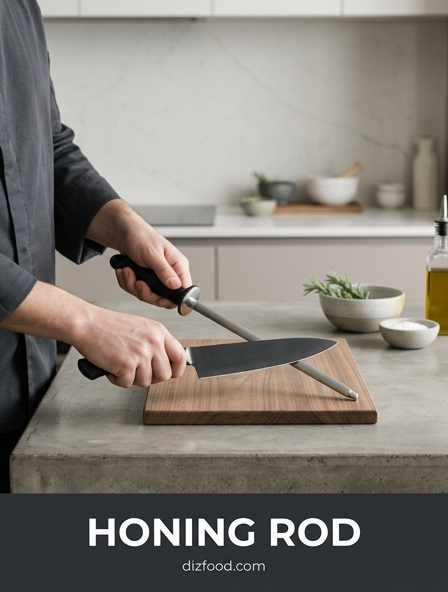
Achieving a perfectly honed edge requires a combination of correct angle, consistent pressure, and fluid motion. The goal is to mimic the factory bevel of the knife, which is typically between 15 and 20 degrees for most Western knives, and 12 to 15 degrees for Japanese blades. Consistency is more important than speed; while television chefs often hone with rapid-fire movements, a slower, deliberate stroke is far more effective for the average user to ensure the entire length of the blade is addressed.
- Hold the rod vertically with the tip planted firmly on a damp towel to prevent slipping.
- Place the heel of the knife against the top of the rod at the desired angle.
- Pull the knife downward and toward your body in a sweeping arc, ensuring the tip of the knife reaches the bottom of the rod.
- Repeat the motion on the opposite side of the rod to ensure even realignment.
- Use light pressure; the weight of the knife is often enough to move the microscopic edge.
By following these steps, you avoid the common mistake of rounding the edge or creating a new, incorrect bevel. Proper technique ensures that the rod does its job of straightening without causing additional damage to the apex.
Selecting the Right Honing Material
The material of your honing rod must be harder than the steel of your knife to be effective. Not all rods are created equal, and choosing the wrong one can lead to disappointing results or even damage to the blade. There are three primary materials used in modern kitchen environments: stainless steel, ceramic, and diamond. Each serves a slightly different purpose based on the hardness of the knives being maintained.
| Material | Hardness Level | Best For |
|---|---|---|
| Ribbed Steel | Standard | German/Western knives (HRC 54-58) |
| Smooth Steel | Medium | Daily alignment without abrasion |
| Ceramic | High | Hard Japanese knives; light sharpening |
| Diamond | Very High | Extremely dull knives; heavy abrasion |
For most home cooks, a ceramic rod offers the best of both worlds, as it is hard enough to handle modern high-carbon steels while being smooth enough to prevent excessive metal removal. Conversely, a traditional ribbed steel rod is excellent for softer Western steels, as the ridges help to "pull" the edge back into alignment with minimal effort.
Safety Benefits of a True Edge
It is a paradoxical truth in the kitchen that a sharp knife is safer than a dull one. When a knife edge is rolled or misaligned, it lacks the ability to "bite" into the surface of the food. This causes the blade to slide or skitter across the skin of an ingredient, such as a tomato or an onion, often directing the force toward the user's fingers. A honed knife, by contrast, engages the surface immediately, allowing for controlled and predictable movement. This reduces the need for the excessive downward pressure that often leads to accidents.
- Reduced Slippage: A straight edge catches the food surface immediately.
- Less Fatigue: Minimal force is required, preventing hand cramps and loss of grip.
- Predictable Pathing: The blade follows the intended line rather than wandering.
- Cleaner Cuts: In the event of a minor nick, a clean cut from a sharp knife heals much faster than a jagged tear from a dull one.
Safety is ultimately about control. By using a honing rod to ensure the edge is always in its optimal state, the cook maintains maximum command over the tool. This creates a more relaxed and secure environment for everyone in the kitchen.


Comments