
If you're chasing that perfect, punchy flavor in your cooking, the debate between a peppercorn grinder and a mortar and pestle is more than just kitchen aesthetics-it's about how you release the volatile oils trapped inside your spices. While a high-quality pepper mill offers unmatched convenience and a consistent, adjustable grind for everyday seasoning, the traditional mortar and pestle remains the king of flavor extraction, using brute force to crush and bruise seeds rather than simply slicing them. Whether you need a quick dusting of heat over a salad or a complex, hand-ground curry paste, understanding the mechanical differences between these tools ensures you're unlocking the maximum aromatic potential of your peppercorns every time you hit the kitchen.
| Feature | Peppercorn Grinder | Mortar and Pestle |
|---|---|---|
| Mechanism | Burr-style shearing/slicing | Impact crushing and bruising |
| Flavor Profile | Clean, sharp, and uniform | Robust, oily, and full-bodied |
| Texture Control | Adjustable (Fine to Coarse) | Manual/Variable (Rustic) |
| Speed & Ease | Instant, one-handed operation | Labor-intensive, slow process |
| Versatility | Dry peppercorns/salts only | Seeds, herbs, garlic, and pastes |
| Best Use Case | Table finishing and garnishing | Deep-flavor cooking and marinades |
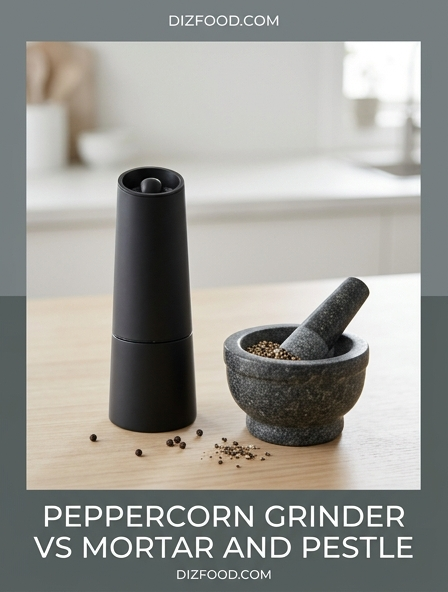
Peppercorn Grinder vs Mortar and Pestle Overview
The culinary world remains divided between the mechanical precision of the modern peppercorn grinder and the ancient, tactile efficiency of the mortar and pestle. At its core, the choice between these two tools dictates how a cook interacts with spices and the resulting flavor profile of a dish. The peppercorn grinder, or pepper mill, is a dedicated device designed specifically to shear dried peppercorns through a rotating mechanism, usually made of ceramic or hardened steel. It represents the height of convenience, allowing for immediate seasoning with a simple twist of the wrist.
In contrast, the mortar and pestle is one of the oldest kitchen implements in human history, consisting of a heavy bowl and a handheld club. While the grinder is a specialized instrument, the mortar and pestle is a multi-purpose tool that relies on downward force and friction to pulverize ingredients. Materials play a significant role in the performance of both. Grinders often feature wooden or plastic housings with adjustable burrs, whereas mortar and pestle sets are typically carved from heavy granite, marble, molten glass, or unglazed ceramic. Understanding the fundamental mechanics of these tools is the first step in mastering spice application:
- Peppercorn Grinder: Utilizes a burr mill mechanism to cut spices into uniform sizes.
- Mortar and Pestle: Uses crushing and grinding motions to break down cell walls.
- Portability: Grinders are ideal for table service; mortar and pestle sets are stationary heavy-duty prep tools.
Ultimately, the grinder offers speed and consistency, while the mortar and pestle provides a sensory connection to the ingredients, allowing the cook to feel the texture change beneath their hand as they work.
The Culinary Difference Between Crushing and Grinding
While the terms "crushing" and "grinding" are often used interchangeably in casual conversation, they describe two distinct physical processes that yield different chemical results. A peppercorn grinder functions by shearing the spice. As the peppercorn passes through the metal or ceramic teeth of the burr, it is sliced into smaller fragments. This mechanical cutting action exposes the dry interior of the peppercorn but does little to alter the physical state of the volatile oils trapped within the fibers. The result is a clean, sharp heat that is consistent across the entire dish.
The mortar and pestle, however, works through a combination of impact and abrasion. When you press the pestle into the peppercorns, you are crushing the cell walls. This "bruising" action is much more aggressive than shearing. By smashing the structure of the spice, the mortar and pestle forces the essential oils to the surface, creating a "wet" spice paste or a highly aromatic powder. This process releases a more complex bouquet of flavors, as the oils are allowed to mingle before they even hit the pan. For many chefs, the difference is noticeable: the grinder provides a spicy "bite," whereas the mortar and pestle provides a deep, floral resonance. Crushing is often preferred for heavy seasonings where the pepper is meant to be the star, while grinding is favored for subtle layers of heat where precision is required.
Consistency and Texture Control in Spice Preparation
One of the primary advantages of a high-quality peppercorn grinder is the ability to achieve perfect consistency. Most modern mills are equipped with an adjustment knob that tightens or loosens the gap between the grinding burrs. This allow the user to switch from a fine, dust-like powder to a cracked, coarse texture with a single turn. This level of calibration is nearly impossible to replicate manually, making the grinder the superior tool for recipes where uniform particle size is essential for even distribution and mouthfeel.
The mortar and pestle offers a different type of control-the control of the "human eye." While it is much harder to get every single piece of pepper to be exactly the same size, the mortar and pestle excels at creating a variegated texture. This "irregular" grind is often sought after in rustic cooking, where a mix of fine powder and larger, crunchy bits adds complexity to a crust or a rub. However, achieving a truly fine powder in a mortar requires significant physical effort and time. The following table compares the texture capabilities of both tools:
| Feature | Peppercorn Grinder | Mortar and Pestle |
|---|---|---|
| Uniformity | High; consistent sizing. | Low; varying particle sizes. |
| Fine Grind | Effortless via adjustment. | Labor-intensive. |
| Coarse Grind | Adjustable and quick. | Ideal for "cracked" pepper. |
For a smooth sauce, the grinder's uniformity prevents unwanted grit. For a steak rub, the mortar's varied texture provides a more interesting crust.
Maximizing Essential Oil Release for Better Flavor
Peppercorns contain volatile organic compounds, primarily piperine for heat and various terpenes for aroma. These compounds are locked inside the peppercorn's protective hull. The moment a peppercorn is broken, these oils begin to oxidize and dissipate. This is why pre-ground pepper often tastes like "dust" compared to freshly cracked pepper. However, even between the grinder and the mortar and pestle, the amount of oil release differs significantly due to the physics of the tool.
The mortar and pestle is objectively superior for oil extraction. Because the action involves grinding the spice against a rough stone surface, the friction generates a small amount of heat and massive amounts of pressure. This pressure ruptures the microscopic oil sacs within the spice, effectively "emulsifying" the flavors. If you smell the result of a mortar-crushed peppercorn versus a grinder-shredded one, the mortar-crushed version will almost always smell more pungent and floral. The grinder, by contrast, minimizes the surface contact between the tool and the spice, meaning the oils stay largely trapped within the individual shards. For high-heat cooking where you want the pepper oils to infuse into a fat or oil, the mortar and pestle provides a significant head start in flavor development. If you are looking for the most aromatic experience possible, the manual labor of the pestle is rewarded with a depth of flavor that a mechanical blade simply cannot unlock.
Speed and Convenience for Everyday Kitchen Use
In a busy kitchen environment, convenience often dictates tool selection. The peppercorn grinder is the undisputed king of efficiency. Most models are designed for one-handed or quick two-handed operation, allowing a cook to season a boiling pot or a searing piece of meat without breaking their rhythm. There is no setup time; you simply pick up the mill and twist. Furthermore, grinders serve a dual purpose as both a preparation tool and a table service accessory, allowing diners to customize their own seasoning levels at the end of the meal.
The mortar and pestle, by comparison, is a commitment. It requires a stable work surface, two hands, and a certain amount of physical exertion. It is not a tool you reach for to add a "pinch" of pepper to a morning egg. Cleanup also presents a hurdle; while a pepper mill rarely needs cleaning (other than an occasional exterior wipe), a mortar and pestle must be washed or brushed out after every use to prevent the oils from turning rancid or cross-contaminating the next set of spices. For the daily home cook, the grinder is the practical choice for 90% of tasks. The mortar and pestle is reserved for "event" cooking-the slow Sunday sauce, the hand-mixed dry rub, or the authentic curry paste where the extra three to five minutes of labor is factored into the culinary process. When speed is the priority, the mechanical advantage of the grinder's internal gearing cannot be beaten.
Versatility Beyond Peppercorns in Your Kitchen
When considering the value of a kitchen tool, versatility is a key metric. Here, the peppercorn grinder is quite limited. Because its mechanism is calibrated specifically for the size and hardness of peppercorns, using it for other items can be risky. Oily seeds like flax or sesame can clog the burrs, while larger spices like allspice or star anise may not fit into the feeding mechanism at all. Some high-end grinders can handle salt, but many use carbon steel mechanisms that will rust if exposed to salt crystals, requiring a dedicated ceramic mill instead.
The mortar and pestle, however, is perhaps the most versatile tool in the culinary arsenal. It is not limited by the shape or moisture content of the ingredient. You can use it to:
- Pulverize garlic and ginger into a smooth, flavorful paste.
- Crush whole nuts or seeds for salads and garnishes.
- Muddle herbs and sugar for cocktails or infusions.
- Grind large, oddly shaped spices like cinnamon sticks or cloves.
- Emulsify ingredients for small batches of pesto or aioli.
While the grinder is a "specialist," the mortar and pestle is a "generalist." If space is at a premium and you can only own one tool for spice processing, the mortar and pestle offers the widest range of applications. However, if your primary need is strictly the frequent addition of pepper to meals, the grinder's specialization makes it the more ergonomic choice for that specific task.
Maintenance and Longevity of Manual Spice Tools
The lifespan of these tools depends heavily on their construction materials and how they are maintained. A peppercorn grinder is a mechanical device with moving parts. Over time, the burrs-whether ceramic or steel-will eventually dull. In cheaper models, the internal plastic components or the spring tension may fail, rendering the unit useless. To maintain a grinder, one must ensure it stays dry; moisture inside the chamber can cause peppercorns to swell and jam the mechanism. Cleaning usually involves grinding a small amount of dry white rice through the mill to soak up residual oils and dislodge stuck particles.
The mortar and pestle is virtually indestructible, provided it is made of stone or heavy ceramic. A solid granite mortar can easily last several generations, becoming a kitchen heirloom. Maintenance involves more frequent washing but less mechanical troubleshooting. For unglazed stone versions, one must "season" the tool before its first use by grinding dry rice into a powder to remove any stone grit. Because there are no springs, screws, or gears, there is nothing to break. The main risk is dropping it, as the heavy stone can crack or damage flooring. In terms of long-term value, the mortar and pestle is a one-time investment, whereas even a high-quality pepper mill may eventually require part replacements or sharpening after years of heavy use. For the cook who values "buy it for life" equipment, the simplicity of stone wins over the complexity of the machine.
Traditional Methods Versus Modern Grinding Technology
The choice between these tools often reflects a cook's philosophy. The peppercorn grinder is a product of the industrial and post-industrial age, emphasizing precision, speed, and clean lines. Modern technology has introduced electric grinders that operate at the touch of a button, utilizing high-torque motors to process spices in seconds. These tools are designed for the modern lifestyle where time is a luxury and consistency is a hallmark of quality. They represent the evolution of the kitchen into a space of high-efficiency "laboratories."
The mortar and pestle represents a connection to tradition and the sensory experience of cooking. There is an auditory and haptic feedback to using stone-the sound of the crunch and the resistance of the spice-that a mechanical grinder hides behind its housing. Many traditional cuisines, such as Thai, Mexican, and Indian, view the mortar and pestle (or similar tools like the molcajete or sil-batta) as non-negotiable. They argue that the heat and speed of modern electric grinders can actually "scorch" delicate spices, altering their flavor profile. Using a manual mortar allows for a low-temperature extraction that preserves the brightest notes of the spice. While modern technology offers ease, the traditional method offers a level of soulful engagement with the ingredients that many enthusiasts find essential to the art of cooking. It is a debate between the "perfection" of the machine and the "character" of the hand-crafted.
Choosing the Right Tool for Specific Recipes
The best tool often depends on the specific requirements of the dish being prepared. Not all recipes benefit from the same type of pepper application. Fine, consistent grinds are usually preferred for light sauces, soups, or delicate proteins like fish, where you want the heat to be integrated without seeing large black specks. For these scenarios, the grinder is the appropriate choice. Its ability to produce a fine mist of pepper ensures that the seasoning does not overwhelm the visual presentation or the texture of the dish.
Conversely, recipes that demand a "crust" or a bold spice presence require the mortar and pestle. For example:
- Steak au Poivre: Requires coarsely cracked peppercorns to create a pungent, crunchy exterior.
- Cacio e Pepe: Traditionally benefits from toasted peppercorns that are then crushed to release maximum oil into the cheese sauce.
- Dry Rubs for BBQ: A mix of fine and coarse particles helps the rub adhere to the meat while providing bursts of flavor.
- Chai Tea Spices: Hard spices like peppercorns and cardamom pods need the heavy impact of a pestle to open up for steeping.
If you are finishing a salad at the table, reach for the grinder. If you are starting a complex curry or a marinated roast, the mortar and pestle will provide a superior flavor base. Most professional kitchens keep both tools on hand to ensure they can meet these varying textural needs.
Final Comparison for the Ultimate Flavor Experience
In the final analysis, neither tool is objectively "better" in every category; rather, they are complementary. The peppercorn grinder is the tool of precision and convenience, perfect for the final seasoning of a dish or for quick daily meals. The mortar and pestle is the tool of flavor extraction and versatility, essential for deep-prep tasks and recipes where the spice is a primary ingredient. To achieve the ultimate flavor experience, a cook should choose based on the desired "aggressiveness" of the flavor and the required texture.
If your goal is to release the maximum amount of aromatic oils and you have the time to spare, the mortar and pestle is the winner. If you need a consistent, fine grind for a delicate sauce or want to season your food at the table, the grinder is the superior option. Many culinary experts suggest that the "sweet spot" for a well-equipped kitchen is to own a high-quality manual burr grinder for everyday use and a heavy granite mortar and pestle for specialized tasks. By matching the tool to the technique, you ensure that the humble peppercorn can reach its full potential, whether as a subtle background note or the bold centerpiece of a meal. Ultimately, the best flavor comes from fresh spices, and both tools are far superior to using pre-ground alternatives.

Comments