
The Science of Spice Cell Rupture
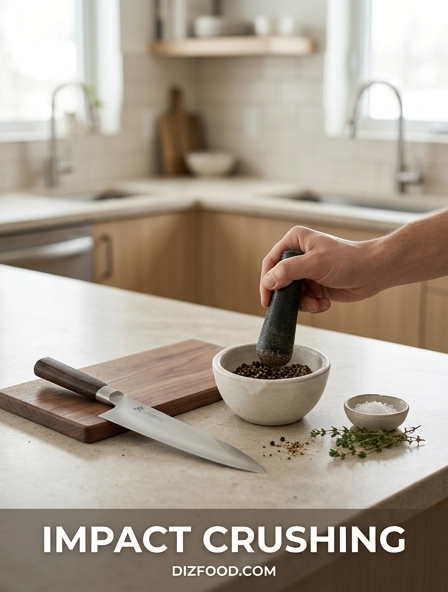
The process of impact crushing in a culinary context focuses on the sudden, forceful disintegration of spice cell walls. Most spices are the dried seeds, barks, or roots of plants, containing microscopic vacuoles filled with concentrated oils. When a pestle strikes these materials, it delivers a sharp wave of kinetic energy that overcomes the structural tension of the cellulose. Unlike gradual pressure, which might simply flatten the spice, impact creates high-velocity fractures that cause these cells to burst simultaneously. This immediate rupture ensures that the chemical precursors stored within the plant material are instantly exposed to the atmosphere.
- Cellular Decompression: The rapid release of internal pressure.
- Fissure Propagation: How cracks travel through the crystalline structure of dried spices.
- Enzymatic Activation: The interaction between released fluids and oxygen.
This biological breakdown is fundamental to the development of a spice's flavor profile. Without the total rupture of the cell wall, the most potent aromatic compounds remain trapped within the fibrous matrix, resulting in a duller, less vibrant culinary experience. Impact crushing ensures that the maximum number of cells are breached in the shortest possible time.
Impact Crushing vs Thermal Grinding
The primary distinction between manual impact crushing and high-speed mechanical grinding lies in the generation of heat. Electric grinders utilize blades rotating at thousands of revolutions per minute, which creates significant friction. This friction generates thermal energy that can reach temperatures high enough to "cook" or volatilize the delicate oils before they ever reach the dish. Impact crushing, however, is a cold process that preserves the original chemical state of the spice.
| Feature | Impact Crushing | Thermal Grinding |
|---|---|---|
| Temperature | Ambient/Low | High/Frictional |
| Oil Retention | Maximum | Partial Loss |
| Particle Size | Irregular/Textured | Uniform/Fine |
By avoiding the thermal degradation associated with motorized blades, impact crushing ensures that the volatile aromatic compounds-those most susceptible to heat-remain intact. This results in a flavor that is brighter, more nuanced, and truer to the original spice's botanical profile, whereas thermal grinding often leads to a bitter or "burnt" undertone in sensitive spices like cumin or coriander.
Maximizing Essential Oil Release
The goal of any spice preparation is to liberate the essential oils that contain the concentrated essence of the plant. Impact crushing achieves this through a specific sequence of physical actions that maximize oil yield. When a heavy object strikes a spice, it creates a localized area of extreme pressure. This pressure forces the oils out of their protective sacs and onto the surface of the fragmented particles. Because the action is manual, the cook can observe the "bloom" of the oils as they turn the dry spice into a slightly damp, aromatic paste.
- Structural Collapse: Initial strike breaks the outer husk.
- Internal Expression: Subsequent impacts squeeze oils from inner layers.
- Emulsification: The movement of the pestle blends released oils with fine particles.
This method ensures that the oils are not just released, but are also distributed across the surface area of the spice. This provides a more immediate hit of flavor when the spice is introduced to heat or liquid in the cooking process. The manual control allowed by impact crushing ensures no oil is wasted or left trapped in uncrushed segments.
Preserving Volatile Flavor Compounds
Volatile flavor compounds are the chemicals responsible for the aroma and complex top notes of spices. These compounds are highly unstable and begin to evaporate the moment they are exposed to air or heat. Impact crushing is uniquely suited to preserving these elements because it allows for "just-in-time" preparation. By crushing spices immediately before use, the window for evaporation is minimized. The heavy, blunt force of impact avoids the "shredding" action of blades, which often aerosolizes these compounds into the air rather than keeping them within the spice mass.
Furthermore, the irregular shapes created by impact crushing help to "trap" some of these volatiles within the crevices of the particles. While a finely ground powder has a massive surface area that loses flavor rapidly, impact-crushed spices maintain a balance of large and small fragments. This structural diversity acts as a reservoir for flavor, releasing notes gradually during the cooking process rather than all at once. This leads to a more sustained and layered flavor profile in the finished dish, providing both immediate impact and long-lasting depth.
The Role of Kinetic Energy
Kinetic energy is the driving force behind effective impact crushing. In the kitchen, this energy is a product of the mass of the tool-typically a heavy pestle-and the velocity at which it is brought down. Unlike steady pressure, which relies on gradual deformation, kinetic energy creates an "impulse" that shatters brittle materials. This is particularly effective for spices with hard outer shells, such as black peppercorns or cardamom pods. The energy transfers through the spice, causing it to fail at its weakest points, which are often the cell junctions containing the most flavor.
- Mass: Heavier tools require less velocity to achieve the same crushing force.
- Velocity: Faster strikes create sharper fractures in the spice structure.
- Distribution: The concave shape of a mortar focuses energy back toward the center.
When the pestle hits the spice, the energy is absorbed and converted into the work of breaking chemical bonds and physical structures. This efficient transfer of energy means that even the hardest spices can be reduced to a usable form without the need for excessive mechanical heat, keeping the chemical integrity of the ingredient intact for superior culinary results.
Structural Integrity and Aroma Retention
Aroma is arguably the most important aspect of spice usage, and it is directly tied to the structural integrity of the particles. When spices are pulverized into a fine, uniform powder by a machine, the structural walls are completely obliterated, leaving the oils fully exposed to oxidation. Impact crushing, however, creates a mixture of particle sizes. This variety is crucial for aroma retention. Larger fragments protect their internal aromatic stores, while smaller fragments provide the initial scent. This creates a "time-release" effect for the aroma, which is vital for dishes that require long simmering times.
The jagged, irregular edges produced by impact also provide more "nooks" where aromatic oils can cling. In a smooth powder, these oils often coat the surface and then dissipate. In an impact-crushed spice, the oils are often held within the cracked matrix of the spice itself. When you smell a freshly crushed spice, you are experiencing the results of this structural disruption. The aroma is more robust because it contains a full spectrum of molecules, from the lightest top notes to the heaviest base notes, all preserved by the deliberate and controlled application of manual force.
Enhancing Texture Through Manual Force
Texture is often overlooked in spice preparation, yet it plays a vital role in the mouthfeel of a dish. Impact crushing allows the cook to customize the texture to suit the specific needs of a recipe. Whether you require a coarse crack for a steak au poivre or a finer paste for a curry, manual force provides a level of granularity that machines cannot easily replicate. The variation in particle size creates "flavor bursts" during consumption, as the teeth encounter different concentrations of spice fragments.
- Coarse: Ideal for crusts and rubs where a crunch is desired.
- Medium: Perfect for sauces and stews to provide consistent flavor.
- Fine: Best for dry seasonings where immediate integration is needed.
By varying the intensity and number of strikes, the cook can manipulate the physical presence of the spice. This manual control ensures that the spice doesn't just disappear into the liquid, but instead provides a tactile element that complements the other ingredients. The jagged nature of impact-crushed spices also allows them to adhere better to the surfaces of meats and vegetables, ensuring that the seasoning stays where it is intended throughout the cooking process.
Superior Surface Area Optimization
The relationship between surface area and flavor extraction is a key principle in culinary science. Impact crushing optimizes this surface area in a way that is superior to standard grinding. While grinding creates a high surface-area-to-volume ratio, it often does so by creating uniform spheres or dust. Impact crushing creates irregular, multi-faceted shards. Geometry tells us that these irregular shapes have a higher surface area than smooth, rounded particles of the same volume. This increased surface area allows for more efficient interaction between the spice and the cooking medium, whether it be oil, water, or fat.
| Shape Type | Surface Complexity | Extraction Speed |
|---|---|---|
| Uniform Sphere | Low | Moderate |
| Impact Shard | High | Fast |
| Pulverized Dust | Extreme | Instant/Fleeting |
This optimization means that the flavor is extracted more completely and more rapidly. When these shards are added to hot oil (tempering), the irregular surfaces create more points of contact for the fat to pull out the fat-soluble flavor compounds. This leads to a more efficient use of spices, requiring less raw material to achieve a more profound flavor impact.
Traditional Methods and Modern Flavor
The use of a mortar and pestle for impact crushing is one of the oldest culinary techniques, yet it remains relevant because of the specific flavor profile it produces. Modern flavor science confirms that the "bruising" action of traditional impact crushing develops flavors that high-speed blades simply cannot. When spices are crushed traditionally, the heavy stone or ceramic surfaces do more than just break the spice; they facilitate a minor degree of cold-milling. This blends the different parts of the spice-the oils, the fibers, and the resins-into a cohesive whole before they even hit the pan.
- Material Choice: Granite and marble provide the necessary weight for impact.
- Frictional Heat: Minimal heat is generated, keeping flavors "raw" and bright.
- Human Control: The ability to stop at the exact moment of peak aroma.
Traditional methods favor a holistic flavor release. In modern cooking, where "freshness" and "authenticity" are prized, the ability to replicate these complex flavor profiles is essential. By returning to impact crushing, chefs can unlock a depth of flavor that is often lost in the convenience of pre-ground or machine-processed ingredients, bridging the gap between ancient wisdom and modern culinary excellence.
Achieving Culinary Depth with Impact
The ultimate goal of using impact crushing is to achieve a level of culinary depth that is otherwise unattainable. Depth is the result of layered flavors that reveal themselves over time during the eating experience. Because impact crushing preserves the full spectrum of aromatic compounds and creates a variety of particle sizes, it naturally provides this layering. The smaller particles provide the "top notes" that hit the palate immediately, while the larger fragments release their flavor slowly, providing "base notes" that linger. This creates a more sophisticated and satisfying dish.
In addition to flavor, impact crushing contributes to the visual and tactile depth of a dish. The presence of hand-crushed spices signals a level of care and attention to detail. It changes the way the spice interacts with light and liquid, often creating a more vibrant color in the finished sauce or rub. By mastering the science of impact, a cook moves beyond simple seasoning and begins to engineer the very structure of flavor. This results in food that is not just seasoned, but transformed, offering a complexity and richness that defines high-level gastronomy.




Comments