
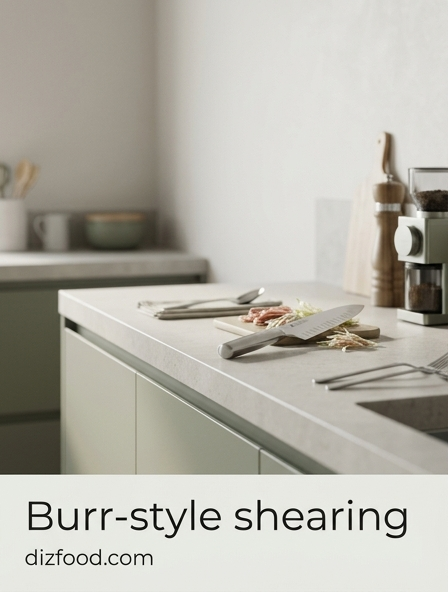
The Mechanics of Burr Style Shearing
Burr-style shearing operates on a principle of precision geometry rather than blunt force. Unlike standard impact methods, this process utilizes two revolving abrasive surfaces, known as burrs, which are positioned at a specific distance from one another. One burr remains stationary while the other rotates, drawing the spice or peppercorn into a narrowing channel. The teeth or grooves carved into the burrs are designed to "shear" the material, essentially slicing it into uniform pieces as it passes through the gap.
The mechanical advantage of this system lies in its ability to regulate the flow of the material. Because the spice must pass through the predefined space between the burrs to exit the mill, the size of the final product is strictly controlled by the distance between these two surfaces. This ensures that the material is not subjected to redundant processing once it reaches the desired dimensions.
- Stationary Burr: Provides the fixed cutting edge for consistent resistance.
- Rotating Burr: Driven by manual or motorized force to pull material through.
- Shear Grooves: Specially angled channels that slice rather than crush.
- Exit Gap: The final clearance determining the maximum particle size.
Uniformity vs Conventional Crushing Methods
Conventional crushing methods, such as those used in a mortar and pestle or a basic hammer mill, rely on compression and impact to break down spices. This often results in a wide variance of particle sizes, ranging from fine dust to large, uncracked chunks. In contrast, burr shearing provides a level of uniformity that is essential for both flavor balance and aesthetic presentation. By maintaining a constant gap, the burr mill prevents the "over-processing" of smaller particles while ensuring larger pieces are reduced to the correct specification.
The difference in output can be quantified by observing the particle distribution after processing. High-quality burr mills produce a tight cluster of sizes, whereas crushing methods yield a broad, unpredictable spectrum. This technical superiority is why professional kitchens prioritize shearing for high-end spice preparation.
| Feature | Burr Shearing | Conventional Crushing |
|---|---|---|
| Particle Size | Highly Uniform | Irregular / Varied |
| Physical Action | Slicing/Shearing | Impact/Compression |
| Control Level | Micrometer Precision | Manual Estimation |
Preserving Essential Spice Oils Through Shearing
The primary goal of grinding spices is to release the aromatic compounds and essential oils stored within their cellular structures. However, the method of release significantly impacts the quality of the final flavor. Burr-style shearing is designed to cut through the spice with minimal trauma to the surrounding tissues. By slicing the spice, the mill opens the oil glands cleanly, allowing the flavor to remain concentrated within the granules until they are introduced to the heat of the cooking process or the moisture of the palate.
Crushing methods, by comparison, often squeeze the spice, forcing the oils out prematurely onto the surface of the grinder or into the air as volatile vapors. This leads to a loss of potency and a shorter shelf life for the ground spice. Shearing ensures that the internal chemistry of the spice remains intact, preserving the delicate top notes of peppercorns, coriander, and cumin that would otherwise be lost to the environment during a more violent grinding process.
Precision Texture for Gourmet Table Seasoning
In gourmet dining, texture is as vital as taste. Burr-style shearing allows chefs and diners to tailor the "mouthfeel" of seasonings to match specific dishes. A fine, sheared dust might be appropriate for a delicate cream sauce, while a coarse, cracked texture provides a necessary crunch and a concentrated burst of heat for a seared steak. The precision of the burr mechanism ensures that even at the coarsest settings, the edges of the spice are sharp and defined rather than jagged or pulverized.
The visual appeal of sheared spices is also superior. When peppercorns are sheared, they retain a variegated color profile with distinct flakes of dark husk and white interior. This creates a professional finish that enhances the visual complexity of the plate. Common applications for this precision include:
- Coarse Malabar pepper for crusting proteins.
- Medium-ground sea salt for consistent moisture extraction in vegetables.
- Fine-sheared nutmeg for seamless integration into pastries and desserts.
- Uniformly cracked coriander for brightening citrus-based marinades.
Adjustable Settings for Particle Consistency
One of the most significant advantages of the burr shearing system is the ability to adjust the output with mechanical precision. Most high-end burr mills utilize a threaded shaft and a tensioning spring to move the burrs closer together or further apart. This adjustment is often marked by "clicks" or indexed steps, allowing the user to replicate the exact same grind size every time. This repeatability is essential for consistency in recipe development and commercial food production.
The adjustment process typically follows a logical sequence to ensure the mechanism is not damaged and the consistency is maintained:
- Clear the burr chamber of any remaining spice debris to allow for free movement.
- Engage the adjustment knob to move the rotating burr toward the stationary burr for a finer grind.
- Loosen the knob to increase the gap for a coarser, sheared output.
- Perform a brief test pass to verify the particle size against the desired standard.
- Lock the setting to prevent drift during high-volume usage.
Minimizing Heat Friction and Flavor Volatility
Heat is the enemy of spice quality. Rapidly spinning blades or high-pressure crushing generates significant thermal energy through friction. If the temperature of the spice rises too high during the grinding process, the volatile oils begin to evaporate or oxidize before they even reach the food. Burr-style shearing minimizes this heat generation by operating at lower speeds and utilizing the sharp edges of the burrs to reduce the amount of work required to break the material apart.
Ceramic and stainless steel burrs are specifically chosen for their thermal properties. Ceramic burrs, in particular, are poor conductors of heat, ensuring that the friction generated by the shearing action does not transfer to the spice. This cool-grinding process is critical for sensitive aromatics like cardamom or cloves, which can lose their nuanced floral notes if subjected to the high-heat environments typical of motorized blade grinders. By keeping the spice cool, burr shearing protects the chemical integrity of the ingredient.
Structural Integrity of Burr Sheared Spices
When viewed under magnification, the structural difference between crushed and sheared spices is stark. Sheared spices exhibit clean, flat surfaces and sharp angles, resembling tiny geometric blocks. This structural integrity is a direct result of the shearing action, which cuts through the cellulose and lignin of the spice rather than shattering it. These clean cuts maximize the surface area relative to the volume without creating an excess of "fines"-the microscopic dust that causes bitterness and clumping.
Maintaining this structure is beneficial for several reasons:
- Predictable Dissolution: Uniform shapes dissolve or release flavor at a steady rate in liquids.
- Reduced Oxidation: Cleanly cut surfaces expose less surface area to oxygen than the jagged, shattered edges of crushed spices.
- Improved Flow: Sheared particles move past each other more easily, preventing the mill from clogging.
- Enhanced Aroma: The internal oils are trapped behind clean cell walls until the moment of consumption.
Why Blade Grinders Fail Consistency Tests
Blade grinders, common in many home kitchens, operate like high-speed blenders. They use a dull metal blade to strike the spices at thousands of revolutions per minute. This process is inherently random; some particles are struck multiple times, becoming fine dust, while others may hide in the corners of the chamber and remain almost whole. This leads to a "bimodal" or "multimodal" distribution of particle sizes, which is detrimental to the cooking process.
In a blade grinder, the user has no mechanical control over the size of the output, relying instead on timing. The longer the motor runs, the finer the average size becomes, but the inconsistency remains. Large "boulders" in the mix will fail to release flavor in time, while the "fines" will over-extract and potentially burn. Furthermore, the high-speed impact generates significant heat, which compromises the spice's aromatic profile. Burr mills solve every one of these issues by replacing random impact with a controlled, geometric shearing path.
The Science of Even Particle Distribution
In the culinary sciences, the goal of grinding is to achieve a narrow Gaussian distribution of particle sizes. This means that if you were to graph the sizes of the ground spice, the majority would fall within a very tight range around the target size. Burr-style shearing is the only tabletop technology capable of achieving this curve reliably. Even distribution ensures that every morsel of food receives the same level of seasoning intensity, preventing "hot spots" or bland patches.
| Metric | Blade Grinder Output | Burr Mill Output |
|---|---|---|
| Size Variance | High (30% - 300% deviation) | Low (<10% deviation) |
| Extraction Rate | Uneven / Unpredictable | Linear / Controllable |
| Dust Percentage | Significant (often >15%) | Negligible (<2%) |
This scientific precision is particularly important for chemical reactions in cooking, such as the curing of meats or the infusion of oils, where the rate of surface area contact dictates the speed and quality of the reaction.
Professional Standards for Tabletop Spice Preparation
In professional hospitality, the choice of spice mill is a reflection of the establishment's standards. Burr mills are the industry standard for tabletop service because they offer durability and a superior user experience. Unlike cheap plastic grinders, professional burr mills are constructed from high-carbon steel or hardened ceramics, designed to maintain their sharp shearing edges over thousands of uses. This longevity ensures that the grind quality does not degrade over time, providing the same precision on the thousandth use as the first.
To maintain these standards, professional maintenance routines usually involve:
- Regular disassembly to inspect the burr teeth for wear or chips.
- Dry cleaning using a stiff brush to remove resinous spice buildup.
- Periodic adjustment calibration to ensure the gap remains true to the indexed settings.
- Selection of specific burr materials (e.g., stainless steel for peppercorns, ceramic for salts) to prevent cross-contamination and corrosion.
By adhering to these mechanical principles, chefs ensure that the final touch on a dish-the seasoning-is executed with the same rigor as the primary cooking process.


Comments