
Elevating your culinary creations starts with how you handle your aromatics, and the debate between a mortar and pestle versus an electric spice grinder often comes down to the science of flavor extraction. While an electric grinder offers unmatched speed and a powdery consistency through high-speed shearing, it often generates heat that can dissipate volatile oils before they ever hit your pan. In contrast, the ancient method of using a mortar and pestle relies on crushing and bruising the cell walls of spices, which effectively releases the deep, resinous oils and creates a complex flavor profile that blades simply can't replicate. Whether you prioritize the artisanal, textured results of hand-mashing for a vibrant pesto or the streamlined efficiency of a motorized blade for bulk batches, choosing the right tool is the first step toward unlocking the full sensory potential of your spice cabinet.
| Feature | Mortar and Pestle | Electric Spice Grinder |
|---|---|---|
| Mechanism | Manual crushing & friction | High-speed blade shearing |
| Flavor Impact | Maximizes essential oil release | Consistent but loses oils to heat |
| Texture | Variable (coarse to paste) | Uniform, fine powder |
| Heat Level | Zero heat (preserves aromatics) | High friction (can scorch spices) |
| Versatility | Dry spices, wet pastes, & nuts | Strictly dry ingredients |
| Best For | Purists, curries, & small batches | Efficiency & daily coffee/pepper |
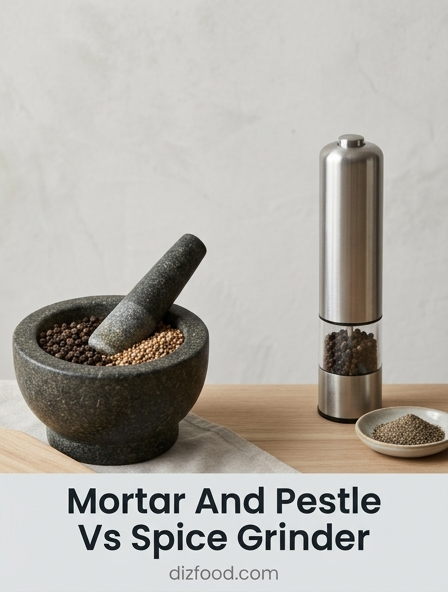
Choosing Between a Mortar and Pestle or Spice Grinder
In the modern kitchen, the debate between ancient tradition and contemporary convenience is nowhere more apparent than in the choice between a mortar and pestle and an electric spice grinder. This decision often dictates the depth of flavor and the aromatic profile of a dish. For many home chefs, the choice depends on their personal culinary philosophy: do they value the tactile, rhythmic process of manual labor, or do they prioritize the speed and uniformity offered by modern technology? Each tool possesses distinct advantages that cater to different cooking styles and ingredient types.
The mortar and pestle, a tool that has remained virtually unchanged for millennia, relies on physical force and friction. It is often favored by purists who believe that the slow extraction of flavor cannot be replicated by machinery. Conversely, the electric spice grinder, typically a motorized unit with spinning blades, offers a solution for the busy cook who needs to process large quantities of spices in seconds. When deciding between the two, one must consider the following factors:
- The desired texture of the final product, ranging from coarse cracked peppercorns to fine powders.
- The type of ingredients being used, specifically whether they are dry seeds or oily aromatics.
- The time available for meal preparation and the physical effort the cook is willing to exert.
- The specific flavor profile required by the recipe, as crushing and slicing produce different chemical releases.
Ultimately, the "better" tool is the one that aligns with the specific needs of the recipe at hand. While a grinder may excel at creating a uniform dry rub for a large brisket, the mortar and pestle is unsurpassed when crafting a small batch of pungent garlic paste or bruising fresh herbs for a delicate sauce.
The Science of Crushing Versus Slicing Spices
The fundamental difference between a mortar and pestle and a spice grinder lies in the mechanical physics applied to the spice. An electric grinder utilizes high-speed stainless steel blades that act like miniature machetes, slicing through the spices at thousands of revolutions per minute. This "slicing" action creates a vast amount of surface area very quickly, which is ideal for creating a fine, uniform powder. However, because the blades cut through the material, they often leave many of the internal oil glands intact within the smaller fragments, unless the spice is pulverized into an extremely fine dust.
In contrast, the mortar and pestle works through the application of crushing and shearing forces. When you press the pestle against the mortar wall, you are effectively "exploding" the plant cells. This process, known as trituration, is much more effective at rupturing the volatile oil glands found in spices like cumin, coriander, and cardamom. Rather than simply making the spice smaller, the mortar and pestle forces the essential oils out of the cellular structure, allowing them to coat the rest of the mixture and emulsify with other ingredients.
The scientific result of crushing is a more cohesive and intense flavor profile. Because the oils are physically squeezed out, the aroma is immediate and powerful. Slicing, while efficient, can sometimes result in a "flatter" flavor because the oils remain trapped within the microscopic slices of the spice. For dishes where the spice is the star, the crushing method provides a chemical advantage that slicing simply cannot match.
How Manual Grinding Preserves Essential Oils
Essential oils are the lifeblood of spices, containing the volatile compounds responsible for aroma, heat, and complex flavor notes. These oils are highly sensitive to environmental factors, particularly heat and oxidation. Manual grinding in a mortar and pestle is a "cold" process. Because the movement is slow and deliberate, the friction generated is minimal. This ensures that the temperature of the spice remains stable, preventing the most delicate aromatic compounds from evaporating before they ever reach the cooking pot.
When using a mortar and pestle, the chef has direct tactile feedback. You can feel the resistance of the spice as it breaks down and smell the immediate release of fragrance. This sensory connection allows the cook to stop the process the moment the oils are sufficiently released. In many cases, the physical pressure also allows the oils to mix with a pinch of salt or a drop of oil added to the mortar, which acts as a carrier and preservative for those volatile flavors.
- The slow speed prevents the "flash-off" of aromatic top notes.
- Physical pressure ensures maximum rupture of oleoresin glands.
- The lack of airflow during the heavy crushing process reduces immediate oxidation.
- The heavy stone or ceramic material of the mortar acts as a heat sink, keeping ingredients cool.
For spices like fennel or star anise, which rely on delicate anethole oils, the manual method ensures that the sweet, licorice-like scent remains concentrated in the paste or powder rather than being dissipated into the kitchen air by the high-speed centrifugal force of an electric motor.
Efficiency and Speed of Electric Spice Grinders
While the mortar and pestle offers artisanal quality, the electric spice grinder is the undisputed champion of efficiency and speed. In a high-volume kitchen or for a cook preparing a multi-course meal, the time saved by an electric motor is significant. Most electric grinders can transform a tablespoon of hard peppercorns or cinnamon bark into a fine powder in less than ten seconds. This speed is not just about convenience; it allows for the rapid preparation of complex spice blends like garam masala or ras el hanout, which may require dozens of different ingredients.
The efficiency of the electric grinder also extends to the consistency of the grind. For recipes that require a perfectly smooth texture-such as certain baking applications or delicate sauces-the high-speed blades provide a level of uniformity that is physically exhausting to achieve by hand. Furthermore, electric grinders are designed to handle the hardest spices, such as dried ginger or nutmeg, which can be difficult to manage in a mortar without significant forearm strength.
However, this speed comes with a trade-off. The motor generates heat, and the spinning blades create a localized "wind" that can carry away some of the lighter aromatic particles. Despite this, for the majority of everyday cooking tasks where spices are being added to a long-simmering stew or a high-heat stir-fry, the efficiency of an electric grinder makes it an indispensable tool for the modern home chef who values their time as much as their flavor.
Achieving Texture Control for Culinary Precision
Precision in texture is a hallmark of professional cooking. The mouthfeel of a dish can be completely altered by the size of the spice particles. A mortar and pestle provides unparalleled control over this variable through tactile feedback. The chef can see and feel exactly when the peppercorns have reached a "cracked" state versus a "coarse" state. This is particularly important for dishes like Steak au Poivre, where the crunch of the pepper is a vital component of the experience.
Electric grinders, while powerful, often struggle with coarse textures. Because the blades spin so fast, the window between "partially whole" and "completely pulverized" is often less than a second. This makes it difficult to achieve a consistent medium-coarse grind, as some spices will be turned to dust while others remain largely intact. To achieve precision with a grinder, one must use a "pulse" technique, which requires a practiced hand to avoid over-processing.
The following table illustrates the typical texture outcomes for both tools:
| Texture Goal | Mortar and Pestle Performance | Spice Grinder Performance |
|---|---|---|
| Cracked/Coarse | Excellent; easy to stop at the right moment. | Poor; creates uneven chunks and dust. |
| Medium Grind | Good; requires moderate physical effort. | Fair; requires careful pulsing. |
| Fine Powder | Labor Intensive; requires significant time. | Excellent; achieves powder in seconds. |
| Wet Paste | Ideal; binds ingredients perfectly. | Not Recommended; moisture can damage motor. |
For those who enjoy experimenting with the textural layers of a dish, the mortar and pestle is the more precise instrument, whereas the grinder is the tool of choice for standardized fine powders.
Impact of Heat on Ground Spice Potency
One of the most overlooked aspects of spice preparation is the role of temperature. Electric spice grinders operate using high-RPM motors that generate a surprising amount of heat in a very short period. This heat is transferred directly to the metal blades and the plastic or metal grinding chamber. When spices are subjected to this heat, the volatile compounds-the very things that provide flavor-begin to cook or evaporate. This is often referred to as "bruising" the flavor in a negative sense, as the high temperature can turn sweet spices bitter or cause pungent spices to lose their "bite."
In contrast, the mortar and pestle is an isothermal tool. Stone, ceramic, and heavy glass are excellent at absorbing and dissipating any small amounts of heat generated by friction. This keeps the spices at room temperature throughout the process. For heat-sensitive spices like mustard seeds or saffron, maintaining a cool temperature is essential for preserving the chemical integrity of the spice. When you smell a strong aroma coming from an electric grinder, you are actually smelling flavor leaving the spice; with a mortar and pestle, that flavor stays trapped within the oils on the surface of the tool and the ingredients.
Furthermore, the prolonged heat in a grinder can cause oily spices to "gum up," creating a sticky residue that is difficult to clean and further degrades the flavor of the spice. By choosing a manual method, you ensure that the spice's potency remains intact until it hits the pan, ensuring that the full spectrum of the ingredient's character is represented in the final dish.
Versatility for Pastes and Dry Spice Blends
Versatility is perhaps the strongest argument for the mortar and pestle. Unlike most electric spice grinders, which are strictly limited to dry ingredients, the mortar and pestle is a multi-purpose vessel capable of handling liquids, fats, and solids simultaneously. This allows the cook to create emulsified pastes, such as Thai curry paste, pesto, or aioli. By pounding garlic, chilies, and herbs together with oil or salt, you create a cohesive flavor base where the individual components are chemically bonded. The electric grinder is generally incapable of this, as adding moisture to the chamber can seize the motor or create a mess that is impossible to pour out.
However, the electric grinder excels at the specific task of dry blending. When making a dry rub for barbecue or a large jar of seasoned salt, the grinder can mix and pulverize multiple dry ingredients into a perfectly homogenous powder. This ensures that every teaspoon of the blend has the exact same ratio of ingredients, which is difficult to achieve manually with a mortar and pestle, where heavier seeds might settle at the bottom.
- Mortar and Pestle: Best for wet pastes, bruising herbs, emulsifying dressings, and small-batch dry spices.
- Spice Grinder: Best for large-batch dry rubs, pulverizing hard barks (cinnamon), and creating uniform powders for baking.
A kitchen equipped with both tools allows the chef to move seamlessly between a dry spice rub for a roast and a fresh, vibrant pesto for a side dish, utilizing the strengths of each tool for their respective tasks.
Cleaning and Maintenance Comparison for Kitchen Tools
Maintenance is a practical consideration that affects how often a tool is used. The mortar and pestle is generally considered "indestructible" but requires specific cleaning techniques depending on its material. Porous stone mortars, like those made of granite (molcajetes) or unglazed ceramic, can retain the flavors of previous ingredients. While this "seasoning" is prized by some, it can be a disadvantage if you are moving from a pungent garlic paste to a sweet cinnamon sugar. Cleaning usually involves warm water and a brush, as soap can be absorbed into the stone. A common trick for deep cleaning a mortar is grinding dry white rice to lift out oils and odors.
Electric grinders present a different set of challenges. Because they have electrical components and sharp blades, they cannot be submerged in water. Cleaning typically involves wiping the chamber with a damp cloth or using a small brush to dislodge particles from under the blades. Over time, the plastic lids can become cloudy from the abrasive action of the spices, and the motor may eventually fail. Furthermore, the "cross-contamination" of flavors is a significant issue in grinders, as it is nearly impossible to remove every microscopic particle of a strong spice like cloves before grinding something else.
Ultimately, the mortar and pestle is easier to maintain over a lifetime, often becoming a family heirloom. The electric grinder is a high-convenience, medium-durability appliance that will eventually require replacement but offers a simpler "day-to-day" cleaning routine for dry ingredients.
Capacity Limits for Small and Large Batches
Capacity is the primary logistical constraint when choosing between these two tools. The electric spice grinder is designed for speed and volume. It can easily process a quarter-cup of spices in a single cycle. This makes it the only viable choice for holiday baking, preparing large gifts of spice blends, or seasoning big cuts of meat. Using a mortar and pestle for such volumes would be physically taxing and take significantly longer, potentially leading to an inconsistent grind as the bottom layers become over-processed while the top layers remain whole.
Conversely, the electric grinder performs poorly with very small amounts. If you only need a half-teaspoon of toasted cumin for a single bowl of soup, the blades of a grinder may not even make contact with the seeds, simply blowing them around the chamber. In this scenario, the mortar and pestle is vastly superior. It can grind even a single peppercorn or a few threads of saffron with total efficiency. The manual tool is the master of "just-in-time" flavoring, allowing you to prepare the exact amount needed for a single dish without any waste.
For the home chef, the "correct" tool often depends on the scale of the meal. A large mortar and pestle can handle medium batches, but the electric grinder remains the king of bulk preparation. Having both in the kitchen ensures that whether you are cooking for one or for twenty, you have the appropriate tool to manage the volume of spices required.
Final Verdict for the Home Chef's Kitchen
When the dust (or spice powder) settles, the choice between a mortar and pestle and an electric spice grinder is not a matter of one being superior to the other, but rather which is most appropriate for the specific culinary task. The mortar and pestle is the soul of the kitchen-it is a tool of flavor, texture, and tradition. It is indispensable for anyone who wants to make authentic pastes, preserve the volatile oils of their spices, and enjoy a tactile connection to their ingredients. Its ability to crush and emulsify makes it a versatile powerhouse for both wet and dry applications.
However, the electric spice grinder is the engine of the kitchen. It provides the speed, efficiency, and uniformity required for modern life and complex spice blending. For dry rubs, baking, and large-scale meal prep, the grinder saves valuable time and energy that can be redirected elsewhere in the cooking process. It is a tool of convenience that does not sacrifice too much quality for the average daily meal.
The ideal home kitchen should ideally house both. Use the mortar and pestle when you have the time to savor the process and want to extract the maximum aromatic potential from your spices. Reach for the electric grinder when you need a fine powder in seconds or are preparing a large batch of seasoning. By understanding the science and the strengths of each, you can elevate your cooking, ensuring that every spice you use is processed to its highest potential.


Comments