
Choosing between a classic Western-style chef's knife and the agile Japanese Santoku often comes down to your personal rhythm in the kitchen. While the chef's knife features a curved belly ideal for the traditional rock-chop motion, the Santoku offers a flatter edge and a thinner blade, perfecting the push-cut technique for precise, paper-thin slices. Both serve as versatile, all-purpose workhorses capable of tackling everything from mincing delicate herbs to dicing stubborn root vegetables, but understanding their subtle differences in weight, balance, and edge geometry is the key to mastering your daily meal prep with effortless confidence.
| Feature | Chef's Knife (Western) | Santoku Knife (Japanese) |
|---|---|---|
| Blade Shape | Curved "belly" for rocking motion. | Straighter edge for up-and-down slicing. |
| Standard Length | 8 to 10 inches (longer reach). | 5 to 7 inches (compact control). |
| Blade Thickness | Thicker, heavier spine for durability. | Thinner, lighter blade for precision. |
| Edge Angle | Wide 20°-22° (double bevel). | Acute 12°-15° (single or double bevel). |
| Tip Design | Sharp, pointed tip for piercing. | "Sheepsfoot" curve for safety/strength. |
| Best Used For | Disjointing meat and heavy-duty dicing. | Fine julienne, dicing, and delicate fish. |
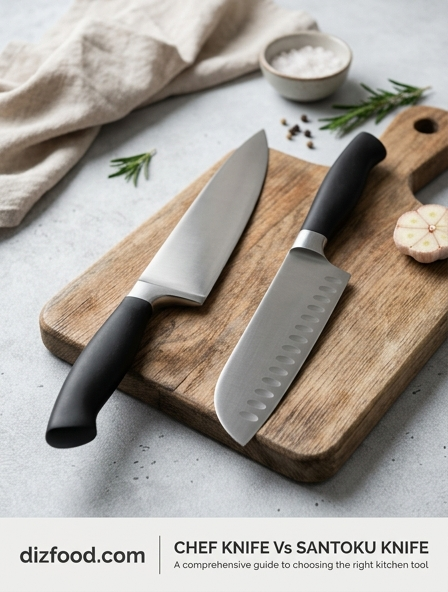
Chef Knife vs Santoku Knife Key Differences Explained
The culinary world is often divided between the traditions of the West and the East, a distinction most visible in the comparison between the Chef knife and the Santoku knife. The Western Chef knife, primarily rooted in German and French cutlery traditions, is designed as a heavy-duty, multi-purpose tool capable of handling everything from thick meats to fibrous vegetables. In contrast, the Santoku knife is a Japanese innovation that translates to "three virtues" or "three uses," referring to its proficiency in slicing, dicing, and mincing. While both serve as the primary "all-purpose" tool in a kitchen, their engineering reflects different philosophies of food preparation.
- Origin: Chef knives hail from Europe (Germany/France), while Santoku knives originated in Japan.
- Blade Length: Chef knives typically range from 8 to 12 inches; Santoku knives are shorter, usually 5 to 7 inches.
- Edge Profile: Chef knives feature a curved "belly" for rocking, while Santoku knives have a flatter edge for vertical chopping.
- Versatility: The Chef knife excels at heavy-duty tasks; the Santoku is optimized for precision and speed with vegetables and fish.
Choosing between them often depends on the user's specific culinary habits. Those who frequently work with large proteins and utilize a rocking motion may prefer the heft of a Chef knife. Conversely, home cooks who prioritize thin, clean slices of vegetables and fish often find the Santoku more agile and less fatiguing for daily meal preparation.
Anatomy of the Western Chef Knife and Japanese Santoku
Understanding the physical construction of these knives reveals why they perform differently during prep work. The Western Chef knife is characterized by its robust build, often featuring a full tang and a thick bolster. The bolster is the transition point between the blade and the handle, providing a finger guard and adding significant weight to the center of the tool. This construction is designed for durability, allowing the knife to withstand the pressure of cutting through small bones or dense squashes without chipping or bending.
| Feature | Western Chef Knife | Japanese Santoku |
|---|---|---|
| Bolster | Thick, provides weight and safety. | Usually absent or very minimal. |
| Spine | Thicker, tapers to a sharp point. | Thinner, curves down toward the tip. |
| Tang | Commonly full tang for balance. | Varies; often hidden or partial tang. |
| Weight | Heavier, forward-balanced. | Lightweight, balanced at the handle. |
The Santoku, by comparison, often lacks a bolster, allowing the user to sharpen the entire length of the blade from heel to tip. The "sheep's foot" tip of the Santoku is its most distinctive anatomical feature; the spine curves downward to meet the edge, creating a blunt-looking point that is exceptionally safe and easy to control. This thinner profile allows for more delicate work, though it makes the knife more susceptible to damage if used on frozen foods or bones.
Blade Shape and Edge Geometry Comparison
The most functional difference between these two kitchen staples lies in the geometry of the blade edge. A traditional Chef knife features a prominent curve, or "belly," that starts at the midpoint and sweeps upward to a sharp, pointed tip. This geometry is essential for the "rocking" technique, where the tip remains in contact with the cutting board while the heel moves up and down. The edge is usually double-beveled, sharpened to an angle of 20 to 22 degrees on each side, providing a sturdy edge that retains its sharpness even after hitting a bone.
The Santoku knife employs a much flatter edge profile with very little curvature. This design is intended for a "push-cut" or "up-and-down" motion rather than rocking. Furthermore, the edge geometry of a Santoku is typically much steeper, sharpened to an angle of 10 to 15 degrees. This creates a significantly sharper blade capable of making paper-thin slices with minimal effort. While some modern Santokus are double-beveled to appeal to Western markets, traditional versions might feature a single bevel, which offers unparalleled precision for decorative garnishes and uniform vegetable cuts. This thinner edge requires more frequent honing but offers a level of finesse that a thicker Chef knife cannot replicate.
Rocking Motion vs Push Cut Techniques
Mastering the use of these knives requires adopting the specific cutting technique for which each was designed. The Chef knife is the king of the "rocking motion." Because of its curved blade, the user can maintain a rhythmic flow, keeping the front third of the knife anchored to the board. This is particularly effective for mincing garlic, herbs, or shallots into a fine paste. The weight of the knife does much of the work, allowing the user to process large volumes of produce with a steady, rolling cadence.
- Rocking (Chef Knife): Keep the tip on the board, lift the handle, and roll the blade through the food.
- Push Cutting (Santoku): Move the knife forward and down in a single stroke, then lift it completely off the board.
- Draw Cutting (Santoku): Pull the blade toward your body to slice through delicate proteins like raw fish.
The Santoku encourages a "push cut" or a "tap-chopping" style. Since the blade is flat, it makes full contact with the cutting board almost instantly. This prevents the "accordion effect," where vegetables remain connected by a thin skin because the curve of a Chef knife didn't reach the board. For many, the Santoku technique feels faster and more precise for linear tasks like julienning carrots or dicing onions. However, it lacks the fluid momentum of the rocking motion, which can make it slightly more tiring for repetitive tasks like mincing large bunches of parsley.
Weight and Balance Which Knife Feels Better in Hand
The subjective "feel" of a knife is often the deciding factor for most home cooks and professionals. A Western Chef knife is intentionally designed to be substantial. The presence of a full bolster and a thick spine gives the knife a forward-heavy balance. This weight is an advantage when tackling resistive foods; gravity assists the blade in falling through a thick cabbage or a heavy cut of meat. For users with larger hands, the girth of the handle and the overall mass provide a sense of security and power.
In contrast, the Santoku is prized for its "nimbleness." It is significantly lighter than a Chef knife of the same quality, primarily because the blade is thinner and the overall length is shorter. The balance point is typically located at the bolster-less junction of the blade and handle, making it feel like an extension of the hand rather than a separate tool. This lightweight nature reduces wrist fatigue during long prep sessions. People with smaller hands or those who find the 8-inch Chef knife intimidating often prefer the compact, balanced feel of the Santoku. The lack of a bolster also allows for a "pinch grip" that feels more intimate and controlled, allowing for micro-adjustments during intricate slicing tasks.
Best Kitchen Tasks for a Traditional Chef Knife
The Chef knife is the undisputed workhorse of the kitchen, designed to handle the "heavy lifting" that might damage more delicate Japanese blades. Its pointed tip is not just for show; it is an essential tool for piercing through tough skins or performing precision tasks like removing the silverskin from a tenderloin. The strength of the heel on a Chef knife allows it to act almost like a light cleaver, making it the better choice for disjointing a chicken or hacking through the thick stems of kale and broccoli.
- Butchery: Breaking down whole chickens or slicing through thick steaks.
- Large Produce: Splitting pumpkins, watermelons, or large heads of cabbage.
- Mincing: Rapidly processing herbs and aromatics using the rocking technique.
- Tough Roots: Cutting through dense sweet potatoes or ginger.
Because the steel is often slightly softer and the blade is thicker, the Chef knife is less prone to "micro-chipping" when it hits a hard surface. This durability makes it the ideal tool for a fast-paced environment where the cook might not have the time to be exceptionally precious with their equipment. If your cooking style involves high-heat searing of large meats and hearty stews with root vegetables, the Chef knife is your most reliable companion.
When to Reach for a Santoku Knife Over a Chef Knife
The Santoku knife shines in scenarios where precision, aesthetics, and clean cuts are the priority. Its name, "three virtues," highlights its excellence in slicing, dicing, and mincing, particularly when dealing with vegetables, fruit, and boneless proteins. Because the blade is thinner, it creates less friction as it passes through food, which prevents delicate items like tomatoes or strawberries from being crushed under the weight of the knife. This makes it the superior choice for creating uniform slices for salads or stir-fries.
- Precision Slicing: Creating translucent slices of cucumber or radish.
- Soft Proteins: Slicing raw fish for sashimi or thin strips of chicken for stir-fry.
- Small Workspaces: The shorter blade is easier to maneuver in cramped kitchens or on small cutting boards.
- Fine Dicing: Executing perfect brunoise or mirepoix with vertical speed.
Furthermore, the Santoku is often the better choice for those who find the length of a traditional Chef knife difficult to manage. The shorter blade brings the hand closer to the food, which can improve accuracy for novice cooks. If your diet is vegetable-heavy or focuses on light proteins like fish and poultry, the Santoku will likely feel more efficient. It is also the preferred tool for "scooping" food off the board; its wide blade acts as a convenient spatula to transport chopped ingredients into a pan.
Understanding the Granton Edge and Blade Dimples
One of the most recognizable features found on many Santoku knives-and some modern Chef knives-is the Granton edge. This refers to the series of small, oval depressions or dimples ground into the side of the blade. Named after the Granton Knife Company in England, which first patented the design, these dimples serve a functional purpose beyond their aesthetic appeal. When slicing through moist or starchy foods, such as potatoes, cucumbers, or raw meat, a vacuum can often form between the flat surface of the blade and the food, causing the slice to stick to the knife.
The Granton edge works by creating small pockets of air between the food and the steel. This air gap breaks the suction, allowing the food to fall away easily from the blade after each cut. This is particularly beneficial during high-speed chopping, as it prevents the "clogging" of the blade that can slow down a cook and lead to messy, uneven cuts. While the dimples do not make the knife itself sharper, they improve the efficiency of the slicing action. In recent years, this feature has become so popular that manufacturers have begun adding it to Western Chef knives, though it remains a hallmark of the Santoku design, where clean release is essential for maintaining the integrity of delicate slices.
Durability and Steel Hardness Comparison
The performance of these knives is largely dictated by the type of steel used in their construction. Western Chef knives are typically made from "softer" stainless steel, often falling between 56 and 58 on the Rockwell Hardness Scale (HRC). While "soft" might sound like a disadvantage, it actually provides "toughness." This means the steel is more flexible and less likely to crack or chip if it strikes a bone or a hard cutting board. It is easier to sharpen at home but requires more frequent maintenance with a honing rod to keep the edge aligned.
| Metric | Western Steel | Japanese Steel |
|---|---|---|
| Rockwell Hardness | 56-58 HRC (Softer) | 60-63+ HRC (Harder) |
| Edge Retention | Moderate; needs frequent honing. | High; stays sharp for a long time. |
| Brittleness | Low; very durable. | High; prone to chipping. |
| Maintenance | Easy to sharpen. | Requires whetstones and skill. |
Japanese Santoku knives often utilize high-carbon steel or "super steels" like VG-10, which are much harder, ranging from 60 to 63 HRC. This hardness allows the blade to be ground to a much finer, sharper angle that stays sharp for a significantly longer period. However, the trade-off is brittleness. A hard Santoku blade is more likely to chip if it is twisted or if it hits something hard. Consequently, the Santoku requires a more disciplined user who understands that the knife is a precision instrument, not a general-purpose prying or hacking tool.
How to Choose the Best All Purpose Knife for Your Style
Choosing between a Chef knife and a Santoku ultimately comes down to personal ergonomics and the types of food you prepare most often. There is no "superior" knife, only the one that feels right in your hand. If you are a cook who enjoys a rhythmic, meditative rocking motion and you often prepare heavy stews, roasts, or large vegetables like butternut squash, the Western Chef knife is likely your best bet. Its durability and weight will provide the necessary power to move through tough ingredients with confidence.
On the other hand, if you value precision, lightness, and speed, the Santoku may be your ideal match. It is perfect for those who eat a lot of stir-fry, salads, and seafood, where clean, thin cuts are paramount. Consider your hand size as well; many people with smaller hands find the 7-inch Santoku much more approachable than a traditional 8-inch or 10-inch Chef knife. If possible, visit a specialty cutlery shop and hold both styles. Pay attention to the balance point and how the handle fits your grip. For many home cooks, the best solution isn't choosing one over the other, but rather owning both: a sturdy Chef knife for the heavy-duty tasks and a razor-sharp Santoku for the delicate, high-precision work that makes a dish look professional.

Comments