
Superior Bowl Contouring for Maximum Yield
The primary advantage of a high-quality flexible pastry scraper lies in its ability to conform perfectly to the internal geometry of mixing bowls. Unlike rigid metal spatulas that only contact a small surface area at any given time, a silicone or plastic scraper bends to match the specific radius of the container. This unique mechanical property ensures that every gram of expensive ingredients-from Madagascar vanilla bean paste to high-grade European butter-is utilized rather than left clinging to the sides. When a baker uses a scraper that achieves total surface contact, they maximize their yield and maintain the precise ratios required for sensitive recipes.
- Total surface contact across variable bowl radii
- Elimination of "dead zones" where dry flour often hides
- Enhanced speed when clearing large industrial mixing bowls
- Reduction in the physical force required to strip a bowl clean
By effectively "squeegeeing" the interior of the vessel, the scraper ensures that the final volume of batter matches the calculated expectations of the recipe. This precision is particularly vital in professional environments where consistency across multiple batches is the benchmark for quality control and cost management.
Gentle Folding Techniques for Aerated Batters
For delicate preparations such as soufflés, sponge cakes, or French macarons, the preservation of incorporated air is paramount. The pastry scraper is the ideal tool for the "fold and turn" method because its wide surface area can lift large volumes of batter without the shearing force that causes deflation. By sliding the thin, flexible edge down the side of the bowl and turning the mixture over itself, the baker integrates ingredients with minimal agitation. This technique ensures that the protein structures and air bubbles created during whisking remain intact, resulting in a superior rise and crumb structure in the finished product.
- Insert the scraper vertically along the edge of the bowl.
- Sweep the scraper across the bottom, lifting the bottom layer upward.
- Rotate the bowl 45 degrees and repeat the gentle "cut and fold" motion.
- Continue until no streaks of unmixed ingredients remain.
Traditional spoons or heavy paddles often collapse the delicate foam of whipped egg whites. In contrast, the lightness and broad face of a pastry scraper provide the necessary finesse to maintain the structural integrity of the most aerated mixtures.
Minimizing Ingredient Waste in the Kitchen
In a professional kitchen, ingredient waste translates directly into lost revenue. The pastry scraper serves as a critical tool for economic efficiency, ensuring that nothing of value is discarded during the transition from mixing to baking. Whether dealing with thick ganaches, sticky caramel, or heavy doughs, the scraper clears the bowl so thoroughly that the remaining residue is often negligible. This level of efficiency is nearly impossible to achieve with a standard spoon or a rigid knife, which often leave behind significant percentages of the total mixture.
| Ingredient Type | Waste with Spoon | Waste with Scraper |
|---|---|---|
| Thick Cake Batter | ~5-8% | <1% |
| Sticky Caramel | ~10% | ~1.5% |
| Light Mousse | ~4% | <0.5% |
Beyond the direct financial impact, minimizing waste also contributes to a more sustainable kitchen environment. By extracting every possible ounce of product, chefs honor the labor and resources involved in producing the raw materials while ensuring their final yields remain profitable and predictable across every production cycle.
The Ergonomic Advantage of Flexible Silicone
Ergonomics play a vital role in the longevity and comfort of a baker's career. Flexible silicone pastry scrapers are designed with a focus on hand health, offering a soft grip that reduces the strain associated with repetitive scraping and mixing motions. Unlike metal tools that can be cold, slippery, or vibrate against the hand, silicone provides a natural dampening effect and a non-slip surface. The flexibility of the tool also means the wrist does not have to be positioned at extreme angles to reach the bottom of deep bowls; the tool bends so the arm can stay in a more neutral, relaxed position.
Furthermore, the weight-to-surface-area ratio of a modern scraper is optimized for efficiency. High-quality silicone is heat-resistant, often up to 500 degrees Fahrenheit, allowing the tool to be used in hot pots for making custards or tempering chocolate without the handle becoming uncomfortably warm. This versatility, combined with the lightweight nature of the material, prevents hand fatigue during long shifts involving hundreds of repetitions. Choosing a tool that works with the natural mechanics of the human hand ensures both better performance and better physical well-being for the culinary professional.
Efficient Transfer from Bowl to Pan
Moving batter from a heavy mixing bowl into individual cake pans or muffin tins can be a messy and imprecise process. The pastry scraper acts as a bridge between these two stages, offering a level of control that traditional pouring lacks. By using the scraper to guide the flow of the batter, bakers can prevent drips and spills that would otherwise burn onto the edges of the pans or the oven floor. The tool's ability to "cut" through the batter also allows for cleaner breaks when filling molds, ensuring that each unit receives an identical amount of product.
- Prevents accidental drips on the pan rims which cause smoke during baking
- Allows for the "funneling" of batter into narrow openings
- Facilitates the quick movement of thick doughs that do not pour naturally
- Reduces the need for heavy lifting by guiding the mixture with precision
This efficiency is especially beneficial when working with viscous mixtures like brownie batter or thick cookie dough. Instead of struggling with a heavy bowl and a clumsy spoon, the baker uses the scraper to direct the mass with surgical accuracy, resulting in a cleaner workspace and more uniform baking results.
Comparing Flexible Scrapers to Metal Spatulas
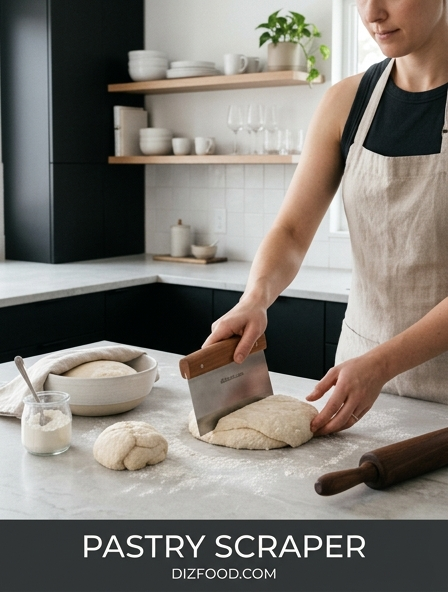
While both tools have their place in the pastry kitchen, they serve very different primary functions. Metal spatulas are generally prized for their rigidity and sharp edges, making them ideal for cutting dough on a bench or scraping dried flour off a wooden work surface. However, when it comes to interior bowl work and delicate mixing, the flexible scraper is objectively superior. The choice between the two often depends on whether the baker is working on a flat surface or within a curved vessel, and whether the material being handled is resilient or fragile.
| Feature | Flexible Scraper | Metal Spatula |
|---|---|---|
| Bowl Contouring | Excellent | Poor |
| Bench Scraping | Moderate | Excellent |
| Heat Resistance | High (Silicone) | High (Steel) |
| Weight | Very Light | Heavy |
A metal spatula can damage the surface of plastic or coated bowls, whereas a silicone scraper is safe for all finishes. In the modern kitchen, the flexible scraper is the preferred choice for batter preparation, while the metal version remains the king of the wooden prep table.
Precision Smoothing for Even Baking
An uneven batter surface leads to uneven baking, with thin spots overcooking and thick spots remaining raw. The pastry scraper is an essential tool for achieving a perfectly level surface once the batter has been transferred to the pan. Because the scraper has a long, straight edge that can also flex, it can be used to "screed" the top of the batter, much like a mason levels concrete. This ensures that the heat of the oven penetrates the mixture at a uniform rate, resulting in a flat cake top that requires less trimming before decoration.
- Deposit the batter into the center of the baking pan.
- Use the flat edge of the scraper to push the batter toward the corners.
- Hold the scraper at a slight angle and sweep it across the surface.
- Rotate the pan and repeat until the top is visually level and smooth.
This process is particularly important for sheet cakes and brownies where a consistent height is required for portioning. By taking a few extra seconds to smooth the batter with a scraper, the baker eliminates the "doming" effect and ensures a professional, high-quality finish every time the oven door opens.
Streamlining the Post-Prep Cleanup Process
Cleaning up after a heavy baking session is often the most time-consuming part of the job. The pastry scraper significantly streamlines this process by acting as the first line of defense against stubborn residue. By thoroughly scraping out every bowl, whisk, and attachment before they reach the sink, the baker prevents thick batters and glues from clogging the drain or drying into hard crusts. A bowl that has been properly scraped requires much less hot water and detergent to become fully sanitized, making the entire kitchen operation more environmentally friendly and faster.
Because most modern pastry scrapers are made from high-grade silicone or heat-resistant plastics, they are also exceptionally easy to clean themselves. They lack the rivets, wooden handles, or seams where bacteria and old food can hide. Most are dishwasher safe, able to withstand the high temperatures of commercial sanitation cycles without warping or degrading. By integrating the scraper into the cleaning workflow-using it to clear surfaces and vessels before the washing stage-bakers save significant time and effort, allowing them to focus more on the craft of baking and less on the drudgery of the dish pit.
Versatility Across Liquid and Thick Mixtures
A high-quality pastry scraper is not limited to cake batters; its utility extends across the entire spectrum of culinary viscosities. From the thin, liquid consistency of crepe batter to the dense, heavy mass of a high-hydration sourdough, the scraper adapts to the task at hand. Its ability to both scoop and spread makes it a multi-functional powerhouse that can replace several other tools in a cramped kitchen environment. The flexibility allows for the handling of delicate mousses, while the structural integrity of the core is often strong enough to turn heavy bread doughs during the bulk fermentation stage.
- Liquid: Smoothing out thin glazes and flood icings.
- Creamy: Folding whipped cream into chocolate ganache.
- Dense: Incorporating inclusions like nuts or dried fruit into thick cookie dough.
- Tacky: Managing sticky bread doughs without adding excess flour.
This versatility is why the scraper is often the first tool a professional pastry chef reaches for. It bridges the gap between a whisk and a spoon, providing the control of a hand with the hygiene and efficiency of a precision-engineered kitchen implement. Whether the mixture is pourable or moldable, the scraper provides the necessary leverage and contact.
The Essential Tool for Professional Batter Handling
Ultimately, the pastry scraper is defined by its ability to provide the baker with total control over their medium. In the professional world, where precision, speed, and waste reduction are the three pillars of success, this tool is indispensable. It represents the intersection of material science and culinary tradition, offering a modern solution to the age-old problem of efficiently moving and mixing ingredients. From the initial folding of the flour to the final smoothing of the pan, the scraper is present at every critical juncture of the baking process, ensuring that the chef's intent is perfectly translated into the final product.
To master the use of the pastry scraper is to master the physics of the kitchen. It requires an understanding of tension, curvature, and material resistance. While it may appear to be a simple piece of silicone or plastic, its impact on the quality of the crumb, the height of the rise, and the profitability of the bakery is profound. For anyone serious about the art of pastry, the flexible scraper is not just an accessory; it is the fundamental instrument that makes high-level execution possible, day after day, batch after batch.

Comments