
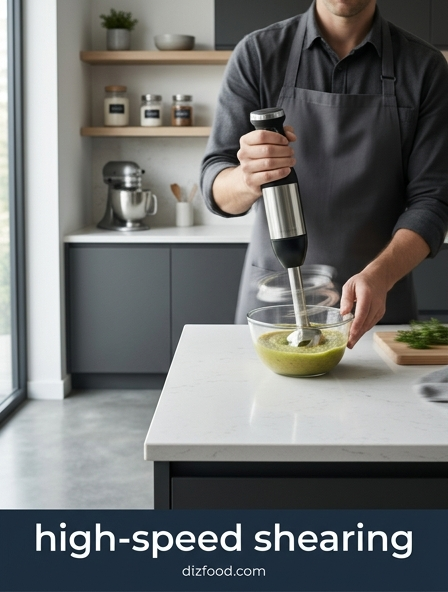
Defining High Speed Shearing Mechanics
High-speed shearing in a culinary context refers to the application of intense mechanical force to food particles through rapidly rotating blades. This process relies on the principle of velocity gradients within a liquid or semi-solid medium. As the blade spins at thousands of revolutions per minute, it creates a high-velocity zone at the tip, while the surrounding fluid remains relatively slower. This difference in speed generates shear stress, which effectively tears apart molecular structures and physical aggregates.
The mechanics involve several key factors that determine the efficiency of the shear:
- Blade Tip Speed: The absolute velocity at the furthest edge of the cutter.
- Stator Interaction: The gap between the blade and the container wall or a specialized cage.
- Viscosity Management: How the resistance of the food product influences the energy transfer.
By mastering these mechanics, chefs can manipulate the physical state of ingredients far beyond the capabilities of manual whisking or traditional chopping. The result is a fundamental change in the rheology of the food, leading to unique textures and physical stability in complex mixtures.
The Role of Blade Velocity in Emulsification
Emulsification is the process of dispersing two immiscible liquids, such as oil and water, into a stable mixture. High blade velocity is critical in this transformation because it provides the kinetic energy required to overcome surface tension. When the blades reach high RPMs, they shatter large droplets into microscopic spheres, increasing the total surface area of the dispersed phase. This allows emulsifiers-like lecithin in egg yolks or mustard-to coat the droplets more effectively, preventing them from coalescing.
The relationship between velocity and stability is often measured by the following parameters:
| Velocity Level | Droplet Size | Emulsion Stability |
|---|---|---|
| Low (1,000-3,000 RPM) | Large / Macroscopic | Low / Temporary |
| Medium (5,000-10,000 RPM) | Fine / Visible | Moderate |
| High (20,000+ RPM) | Sub-micron | High / Permanent |
Without sufficient velocity, the mechanical force cannot break the interfacial tension, leading to a "broken" sauce. High-speed shearing ensures that the kinetic energy is distributed uniformly, resulting in a creamy, shelf-stable finish.
Structural Breakdown and Texture Refinement
The refinement of texture through high-speed shearing is a hallmark of modern gastronomy. By applying shear force to fibrous vegetables, tough proteins, or gritty starches, the cellular walls are obliterated. This process releases intracellular fluids and reduces solid matter to a size that the human palate perceives as perfectly smooth. For instance, a traditional pea puree may retain a grainy mouthfeel due to cellulose skins, but high-shear processing renders these fibers undetectable.
Texture refinement involves three distinct stages of structural breakdown:
- Disintegration: The initial tearing of large chunks into smaller fragments.
- De-agglomeration: Breaking down clusters of particles that stick together via molecular bonds.
- Polishing: The final reduction of particles to a uniform, microscopic diameter.
This systematic breakdown is essential for creating "veloutés" and "soups" that possess a silk-like sheen. The intense friction also helps in hydrating hydrocolloids, ensuring that thickeners are activated without forming lumps, further contributing to a refined and luxurious dining experience.
Maximizing Nutrient Extraction Through Shear
High-speed shearing does more than change texture; it enhances the nutritional profile of the food by increasing the bioavailability of vitamins and minerals. Most plant-based nutrients are locked within rigid cellulose cell walls that the human digestive system cannot fully break down. By utilizing high-shear forces, these cell walls are mechanically ruptured before consumption, releasing the phytonutrients, antioxidants, and enzymes contained within.
This extraction process is particularly effective for:
- Chlorophyll: Released from leafy greens for denser nutrient density.
- Carotenoids: Liberated from fibrous vegetables like carrots and bell peppers.
- Lipid-Soluble Vitamins: Better absorbed when the shearing process integrates them with healthy fats.
Because the process is rapid, it minimizes the exposure of sensitive nutrients to oxygen and heat, which can occur during prolonged cooking. Consequently, the chef can deliver a dish that is not only aesthetically pleasing and flavorful but also optimized for health. This mechanical pre-digestion allows for a more efficient uptake of essential compounds by the body.
Efficiency Gains in Professional Food Prep
In a high-volume professional kitchen, time is the most valuable commodity. High-speed shearing technology significantly reduces the "mise en place" duration by performing tasks in seconds that would otherwise take minutes or even hours of manual labor. The efficiency gains are realized not just in the speed of the blades, but in the consistency of the output, which reduces the need for re-working batches or straining final products through fine-mesh sieves.
| Task | Manual/Standard Method | High-Speed Shear Method |
|---|---|---|
| Herb Oil Infusion | 24 Hours Steeping | 2 Minutes Shear |
| Nut Butter | 15-20 Minutes | 3 Minutes |
| Smooth Puree | Sieve + 10 Mins | 60 Seconds |
The reduction in prep time allows kitchen staff to focus on more complex creative tasks. Furthermore, the high-energy input often generates enough friction to heat sauces directly in the vessel, consolidating the blending and tempering steps into a single efficient workflow. This multitasking capability streamlines the entire production line.
Shear Force and Particle Size Reduction
The physics of particle size reduction is governed by the intensity of the shear force applied to the medium. When the shear rate exceeds the structural integrity of a solid particle, fracture occurs. In culinary applications, achieving a particle size below 40 microns is the threshold for "smoothness," as the human tongue cannot distinguish individual particles at that scale. High-speed shearing achieves this by creating turbulent flow regimes where particles collide at high velocities.
Key factors influencing particle reduction include:
- Impact Force: The direct collision of the blade against the ingredient.
- Cavitation: The formation and collapse of vapor bubbles that release shockwaves.
- Hydraulic Shear: The force exerted by the liquid moving at different speeds.
This multi-faceted approach ensures that even resilient materials, like spice seeds or dried husks, are pulverized into a fine suspension. The result is a homogenous fluid that exhibits superior flavor release, as the increased surface area allows the taste buds to interact with more of the ingredient simultaneously.
Advanced Homogenization in Modern Sauces
Modern sauces often rely on complex interactions between fats, liquids, and stabilizers. Advanced homogenization via high-speed shearing allows for the creation of textures that were previously impossible, such as aerated foams that hold their shape or ultra-stable vinaigrettes that never separate. This is achieved through the uniform distribution of all components, ensuring that no single ingredient dominates the physical structure of the sauce.
The process of homogenization typically follows these steps:
- Coarse Blending: Mixing ingredients into a rough state.
- High-Shear Activation: Applying RPMs to break down molecules and activate stabilizers.
- Thermal Equilibrium: Allowing friction to warm the sauce to the ideal serving temperature.
- De-aeration: Slowing the speed to remove unwanted bubbles for a glossy finish.
Chefs use this technology to incorporate hydrocolloids like xanthan gum or agar-agar with precision. The high-shear environment ensures these agents are hydrated instantly and dispersed without clumping, leading to sauces with exceptional "cling" and a clean, vibrant flavor profile that is not masked by excessive starch or flour.
Impact of High RPMs on Ingredient Consistency
Consistency is the hallmark of a professional kitchen, and high RPM (revolutions per minute) equipment is the primary tool for achieving it. When blades rotate at speeds exceeding 20,000 RPM, the sheer intensity of the environment ensures that every batch of a recipe is identical in texture and color. This eliminates the variability inherent in hand-chopping or using lower-powered equipment where "pockets" of un-processed ingredients might remain.
The impact of high RPMs manifests in several ways:
- Color Vibrancy: Rapid processing prevents oxidation, keeping green sauces bright.
- Flavor Uniformity: Aromatics are dispersed evenly so every spoonful tastes the same.
- Stability: Higher energy inputs create stronger molecular bonds in emulsions.
However, the chef must also manage the heat generated by these high RPMs. While friction can be used to cook a sauce, it can also dull the flavor of delicate herbs if over-processed. Precision control over the duration of the high-speed cycle is therefore essential to balance the benefits of consistency with the preservation of fresh, volatile flavor compounds.
Streamlining Workflow with High Speed Blending
Integrating high-speed blending into the kitchen workflow transforms how a line operates. Rather than having multiple stations for grinding, whisking, and straining, a single high-shear station can handle all these functions. This consolidation reduces the footprint of equipment needed and simplifies the cleanup process, as most high-speed blenders feature self-cleaning cycles that utilize their own shear force to dislodge food particles from the blades.
Operational benefits include:
- Reduced Tool Switching: One machine performs the work of a mortar and pestle, whisk, and sieve.
- Scalability: Easily scale recipes from small tastings to large banquet portions without losing quality.
- Waste Reduction: Total pulverization means less ingredient waste is strained out and discarded.
By streamlining these tasks, the kitchen staff can maintain a faster pace during service. The ability to "order-fire" a fresh emulsion or a perfectly smooth coulis in under a minute ensures that the final plate reaches the guest with its texture and temperature perfectly intact.
Future Applications of Culinary Shear Technology
The evolution of culinary shear technology is moving toward even greater precision and the integration of secondary forces. We are beginning to see the crossover of laboratory-grade equipment into the kitchen, such as ultrasonic homogenizers and high-pressure valve homogenizers. These tools allow chefs to create "nano-emulsions," where flavor particles are so small they can penetrate food surfaces more deeply or create entirely new sensations on the palate.
Future trends may include:
- Smart Shear: Sensors that adjust blade speed based on real-time viscosity feedback.
- Vacuum Shearing: Processing ingredients in a vacuum to eliminate oxidation entirely.
- Cryo-Shearing: Combining ultra-low temperatures with high shear for unique frozen textures.
As these technologies become more accessible, the boundaries of food science and art will continue to blur. The focus will shift from simply "blending" to "molecular engineering," where the chef can manipulate the physical properties of ingredients at a microscopic level to evoke specific emotional and sensory responses from the diner.





Comments