
Ever wonder why your homemade salads often turn out soggy while restaurant greens stay perfectly crisp? The secret lies in how you handle moisture after washing. In the showdown of Salad Spinner vs. Paper Towel Drying, we dive into which technique truly delivers that satisfying, long-lasting crunch. While a salad spinner leverages centrifugal force to whisk away water droplets without bruising delicate leaves, the paper towel method offers a manual, space-saving alternative that's surprisingly effective for small batches. Whether you are a dedicated meal-prepper looking for efficiency or a minimalist trying to save cabinet space, understanding the mechanics of moisture removal is the ultimate key to elevating your leafy greens from limp to legendary.
| Feature | Salad Spinner | Paper Towel Method |
|---|---|---|
| Drying Efficiency | 95-98%; removes hidden moisture via force. | 70-80%; surface drying only; leaves damp pockets. |
| Processing Speed | Ultra-fast; 15-30 seconds per batch. | Slow; requires manual patting or rolling time. |
| Leaf Integrity | High; protects leaves from bruising/crushing. | Moderate; manual pressure can damage delicate herbs. |
| Sustainability | Eco-friendly; reusable plastic/stainless steel. | Low; creates significant single-use paper waste. |
| Storage Footprint | Bulky; requires dedicated cabinet/shelf space. | Minimal; fits in any drawer or small rack. |
| Best For... | Large families, meal prepping, and hardy greens. | Single servings, small kitchens, and camping. |
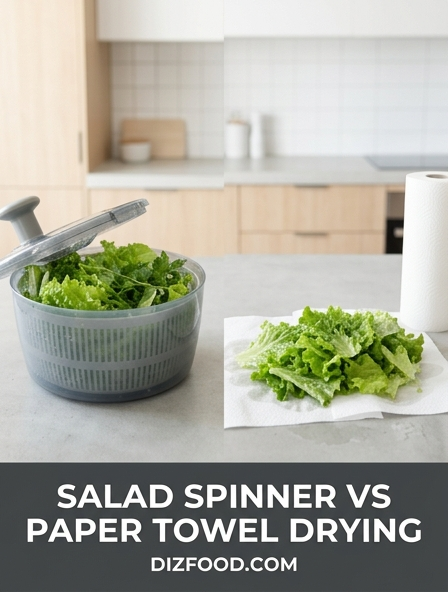
Salad Spinner vs Paper Towel Drying Efficiency
When evaluating the efficiency of drying leafy greens, the primary objective is to remove moisture without damaging the cellular structure of the plant. A salad spinner utilizes high-velocity rotation to create centrifugal force, which effectively flings water droplets away from the leaves and into an outer catch basin. This method is highly efficient for processing large volumes of greens simultaneously, ensuring that every leaf-including the deep crevices of curly kale or frisée-is reached by the drying action. Because the greens remain suspended in a perforated basket, they are not sitting in the extracted water, which prevents re-absorption.
In contrast, paper towel drying relies on manual absorption and capillary action. To achieve a similar level of dryness, one must lay the leaves flat and press them between sheets or roll them gently. While this can be effective for small quantities, it lacks the mechanical consistency of a spinner. Furthermore, paper towels can quickly become saturated, losing their effectiveness and requiring multiple replacements to finish a single head of lettuce. In terms of sheer output and time management, the salad spinner remains the superior choice for high-efficiency kitchen workflows.
- Spinner: Best for high-volume batches and intricate leaf shapes.
- Paper Towels: Suitable for small garnishes or single servings.
- Residual Moisture: Spinners typically leave less surface water than manual blotting.
The Science of Centrifugal Force vs Manual Absorption
The physics behind salad drying involves two distinct mechanical processes: centrifugal force and absorption. A salad spinner operates on the principle of inertia. As the internal basket spins rapidly, the water on the leaves wants to continue moving in a straight line. The basket's mesh walls redirect the leaves but allow the water to escape through the holes. This process is highly effective because it acts on the water at a microscopic level, stripping away droplets that are held to the leaf surface by surface tension. Because the force is applied uniformly, the leaves are rarely bruised during the process.
Manual absorption via paper towels functions through the porous nature of cellulose fibers. When the towel makes contact with the wet leaf, the water is drawn into the paper's matrix. However, this method is limited by the contact area. Water trapped in the folds of a leaf will not be absorbed unless the paper makes direct contact with it. This often leads to "wet spots" in the final salad. Additionally, the manual pressure required to ensure the towel absorbs the water can lead to mechanical stress on the greens, potentially rupturing cell walls and leading to premature wilting. Science suggests that the non-contact nature of centrifugal force is more conducive to maintaining the integrity of delicate organic matter.
Maintaining Maximum Crispness and Leafy Green Texture
Texture is the hallmark of a high-quality salad, and moisture is the enemy of crispness. If water remains on the surface of the greens, it accelerates the breakdown of the leaf's cuticle. In a salad spinner, the air circulation combined with the centrifugal action removes moisture so thoroughly that the leaves retain their natural turgor pressure. This pressure is what gives greens like Romaine or Little Gem their satisfying crunch. By removing almost all surface water, the spinner ensures that the leaves stay "breathable" and do not become soggy in storage.
Paper towels, while absorbent, can sometimes be too aggressive. The act of patting or rubbing greens can cause bruising, which releases enzymes that lead to browning. However, paper towels do have a specific advantage in long-term storage. Many chefs recommend wrapping slightly damp greens in a dry paper towel before refrigerating. This provides a humidity-controlled micro-environment where the towel absorbs excess moisture released by respiration while keeping the air around the leaves humid enough to prevent dehydration. Therefore, while the spinner is best for the initial drying, the paper towel serves a secondary purpose in texture maintenance over time.
| Metric | Salad Spinner | Paper Towel |
|---|---|---|
| Bruising Risk | Low | Medium to High |
| Surface Dryness | Excellent | Moderate |
| Cellular Integrity | Maintained | Vulnerable to pressure |
Environmental Sustainability and Reducing Paper Waste
In the modern kitchen, sustainability is an increasingly important factor when choosing tools and methods. The use of paper towels for drying salad represents a significant source of household waste. Since these towels are often saturated with water and organic residue after use, they are rarely recyclable and frequently end up in landfills. For a household that consumes salad daily, the cumulative environmental footprint of single-use paper products can be substantial. Even if compostable towels are used, the energy required for production and transport remains a concern.
The salad spinner, conversely, is a durable good designed for years of repeated use. Most spinners are made from BPA-free plastics or stainless steel, materials that have a higher initial carbon footprint but break even quickly due to their longevity. By eliminating the need for disposable paper products, the spinner aligns with a "zero-waste" or "low-impact" lifestyle. While it does require water for cleaning, this is generally negligible compared to the water used in the industrial manufacturing of paper. For those looking to reduce their kitchen's ecological impact, investing in a mechanical drying solution is a clear win for the environment.
Long Term Cost Comparison of Kitchen Drying Tools
When considering the financial aspect of kitchen equipment, one must look past the initial purchase price to the total cost of ownership. A high-quality salad spinner typically costs between $25 and $60. This is a one-time investment that, if maintained properly, can last a decade or more. The cost per use decreases every time a salad is prepared, eventually reaching a fraction of a cent. There are no recurring expenses associated with a spinner other than the minimal cost of soap and water for cleaning.
Paper towels represent a recurring "subscription" cost. A standard roll of premium paper towels can cost between $1.50 and $3.00. If a cook uses three to four sheets per salad, a single roll might only last for ten to fifteen salads. Over the course of a year, a daily salad eater could easily spend over $70 on paper towels specifically for drying greens. This exceeds the cost of even the most expensive salad spinners within the first twelve months. When viewed through a multi-year lens, the salad spinner is the significantly more economical choice for the budget-conscious home cook.
- Initial investment: Spinner is higher ($30+) vs Towels ($2).
- Annual cost: Spinner is $0 vs Towels ($50-$100).
- Breakeven point: Usually within 6 to 8 months of regular use.
Best Methods for Drying Delicate Herbs and Microgreens
Delicate herbs like cilantro, parsley, and chervil, as well as fragile microgreens, require a nuanced approach to drying. These plants have thin cell walls and a high surface-area-to-volume ratio, making them prone to wilting and crushing. A salad spinner can be used for these items, but it must be operated with care. Low-speed spinning is essential to prevent the herbs from being pinned too forcefully against the basket, which can cause them to snap or lose their essential oils. For microgreens, the spinner is often the only way to remove water from their dense, tangled stems without turning them into a sodden mass.
However, for very small quantities of herbs, the paper towel method is often preferred by professional chefs. Laying herbs out in a single layer on a towel and allowing them to air dry-or very gently rolling them into a "cigar" shape-allows for precision. This method ensures that the delicate leaves are not battered. If the herbs are intended for a garnish where visual perfection is paramount, the manual control of a paper towel prevents the "bruised" look that can sometimes occur in a high-speed centrifugal device. The choice depends entirely on the volume and the intended final presentation of the dish.
Speed and Convenience for Large Scale Meal Prep
For those who engage in weekly meal prep or are cooking for a large family, speed is the most valuable currency. Preparing three or four heads of lettuce at once is a daunting task using paper towels. The process would involve clearing significant counter space, laying out rows of towels, and manually drying each batch. This is not only time-consuming but also creates a massive amount of physical waste and clutter in the kitchen. The sheer logistics of manual drying make it impractical for anything beyond a side salad for two.
The salad spinner excels in high-volume scenarios. A large-capacity spinner can wash and dry an entire head of lettuce in under sixty seconds. Because the spinner also doubles as a colander, the user can rinse the greens directly in the basket, drop it into the bowl, and spin immediately. This streamlined workflow reduces the number of steps and the total time spent at the sink. For meal preppers, the spinner also offers the benefit of keeping the greens in the basket for a few minutes to air-dry further before they are moved into storage containers, ensuring maximum longevity for the week ahead.
Kitchen Storage Space and Tool Utility Considerations
One of the primary arguments against the salad spinner is its footprint. Spinners are notoriously bulky, often taking up a significant amount of cabinet or pantry space. In a small apartment kitchen, dedicating a large cubic area to a single-use tool can be a deterrent. Paper towels, by contrast, are usually already present in the kitchen and require no additional storage dedicated specifically to the task of drying greens. For the minimalist or the space-constrained cook, the "no-tool" approach of using towels is often seen as a logistical necessity.
However, modern salad spinner designs have attempted to address these concerns. Many models now feature flat lids that allow for stacking, or collapsible baskets made of silicone that fold down to a fraction of their original size. Furthermore, a salad spinner is often a multi-functional tool. The outer bowl is frequently attractive enough to be used as a serving bowl for the salad itself, and the inner basket functions as a standard colander for draining pasta or rinsing vegetables. When these multiple uses are considered, the "wasted space" argument becomes less compelling, as the spinner replaces at least two other common kitchen items.
Impact on Dressing Adhesion and Salad Flavor
The culinary reason for drying salad greens is often overlooked: flavor dilution and oil repulsion. Salad dressings are primarily emulsions of oil and acid (like vinegar or lemon juice). Water is the natural enemy of oil. If a leaf is even slightly damp, the dressing will slide right off and pool at the bottom of the bowl. This results in a salad that tastes bland at the top and overly acidic or salty at the bottom. To achieve "dressing adhesion," the surface of the leaf must be as dry as possible so the oil can coat the cuticle of the plant uniformly.
Centrifugal drying is superior for flavor because it removes the "hidden" water trapped in the textures of the leaf. Paper towels often leave a thin film of moisture that is imperceptible to the eye but enough to repel a vinaigrette. Furthermore, when greens are properly dried in a spinner, the flavors of the produce itself are more concentrated. There is no excess water to wash away the delicate bitterness of arugula or the sweetness of butter lettuce. In the world of professional cooking, a dry leaf is considered a prerequisite for a balanced and flavorful dish, making the spinner an essential tool for the flavor-focused chef.
Final Verdict Choosing the Best Salad Drying Method
After examining efficiency, science, cost, and culinary impact, the salad spinner emerges as the superior overall method for the vast majority of kitchen scenarios. Its ability to remove moisture thoroughly via centrifugal force ensures better dressing adhesion, superior crispness, and a longer shelf life for the greens. From a financial and environmental perspective, the spinner is a one-time investment that eliminates the recurring waste of paper products, making it the more responsible choice for the long term. While it does require more storage space, its multi-functionality as a colander and serving bowl mitigates this drawback.
However, the paper towel method retains a niche role in the kitchen. For the occasional cook who rarely prepares greens, or for the chef working with highly delicate, expensive microgreens that require a tender touch, the paper towel offers a level of precision and low entry cost that the spinner cannot match. Ultimately, for any household that consumes salad more than once a week, the salad spinner is an indispensable tool that pays for itself in both quality of food and savings on disposables. The final choice should be based on the volume of produce handled and the value placed on the final texture of the greens.
| Factor | Winner |
|---|---|
| Drying Speed | Salad Spinner |
| Flavor Retention | Salad Spinner |
| Eco-Friendliness | Salad Spinner |
| Small Space Storage | Paper Towel |
| Delicate Herbs | Paper Towel |


Comments