
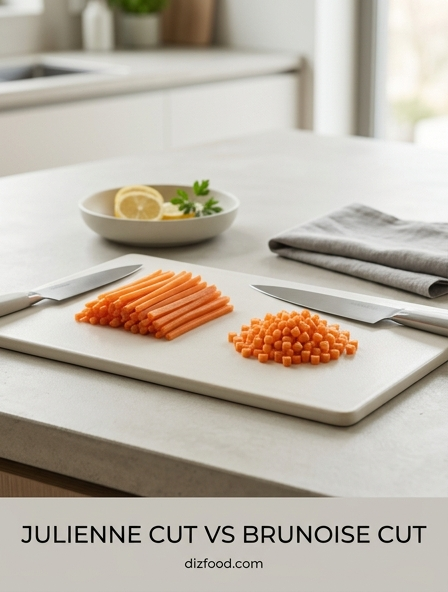
Mastering precision knife skills is the secret bridge between a home-cooked meal and a professional culinary masterpiece. Whether you are aiming for the elegant, matchstick-thin strips of a Julienne or the tiny, uniform dice of a Brunoise, these fundamental French techniques are about more than just aesthetics-they ensure even cooking and a sophisticated mouthfeel. While a Julienne provides a delicate crunch perfect for stir-fries and fresh garnishes, the Brunoise-essentially a tiny cube derived from those very strips-is the gold standard for refined sauces and aromatic bases. Understanding the relationship between these two cuts will not only elevate your plating but also sharpen your technical discipline in the kitchen, allowing you to transform simple vegetables into high-end culinary components.
| Feature | Julienne Cut | Brunoise Cut |
|---|---|---|
| Visual Shape | Long, thin matchsticks | Tiny, uniform cubes |
| Dimensions | 1/8" x 1/8" x 2 inches | 1/8" x 1/8" x 1/8 inch |
| Technical Origin | The "mother" cut | Secondary cut (made from Julienne) |
| Primary Use | Salads, slaw, stir-fries | Consommés, fine sauces, garnish |
| Cook Time | Rapid (2-4 minutes) | Near-instant / Melting texture |
| Skill Level | Intermediate precision | Advanced technical accuracy |
Understanding Julienne and Brunoise Knife Cuts
In the world of professional culinary arts, precision is not merely an aesthetic choice; it is a fundamental requirement for consistent cooking and presentation. Among the most essential techniques taught in culinary schools worldwide are the julienne and brunoise cuts. These French terms describe specific shapes and sizes that serve as the building blocks for countless recipes, from delicate consommés to vibrant stir-fries. Mastering these cuts allows a chef to control the surface area of the ingredients, ensuring that every piece of vegetable in a pan cooks at exactly the same rate.
The relationship between julienne and brunoise is sequential. You cannot achieve a perfect brunoise without first mastering the julienne. These techniques rely on the ability to transform irregular, organic shapes-like a round carrot or a bulbous onion-into geometric prisms. This process of "squaring off" the vegetable might seem wasteful to a novice, but the trimmings are typically reserved for stocks and purees, ensuring no ingredient goes to waste. Understanding the hierarchy of these cuts is the first step toward professional-grade knife work.
By learning these standards, a cook gains a universal language. When a recipe calls for a julienne, it implies a specific mouthfeel and visual rhythm. When it demands a brunoise, it signals a need for subtlety and refinement. These cuts are more than just chopping; they are a discipline that separates the home cook from the trained chef, providing a foundation for advanced culinary creations.
Defining the Classic Julienne Matchstick Dimensions
The julienne cut, often referred to as the "matchstick" cut, is defined by its long, thin, rectangular shape. Standard culinary dimensions for a classic julienne are approximately 1/8 inch by 1/8 inch by 2 inches (3mm x 3mm x 5cm). Achieving this level of precision requires a steady hand and a sharp chef's knife or mandoline. If the strips are cut slightly larger, typically 1/4 inch by 1/4 inch, the cut is referred to as a "batonnet," which serves as the starting point for a standard dice.
| Cut Type | Dimensions (Imperial) | Dimensions (Metric) |
|---|---|---|
| Fine Julienne | 1/16" x 1/16" x 2" | 1.5mm x 1.5mm x 5cm |
| Standard Julienne | 1/8" x 1/8" x 2" | 3mm x 3mm x 5cm |
| Batonnet | 1/4" x 1/4" x 2" to 2.5" | 6mm x 6mm x 5-6cm |
The uniformity of the julienne is vital because it determines how the vegetable interacts with heat. In a quick sauté, a thin julienne will soften and caramelize almost instantly, while a thicker cut would remain raw in the center. Beyond heat transfer, the julienne provides a specific structural integrity to dishes, allowing vegetables to be tangled together in a nest-like fashion or laid out in a clean, linear arrangement on a plate.
The Precision of the Fine Brunoise Dice
If the julienne is the matchstick, the brunoise is the tiny cube that results from it. To produce a standard brunoise, the julienne strips are bundled together and cut perpendicularly into 1/8-inch cubes. This results in the smallest of the formal dice cuts. Because of its diminutive size, the brunoise is used primarily for garnishes, sauces, and stuffings where a smooth, refined texture is desired. A variation known as the "fine brunoise" is even smaller, measuring a mere 1/16 inch on all sides.
The brunoise is prized for its ability to disperse flavor evenly throughout a dish without overwhelming the other ingredients. Because the pieces are so small, they release their aromatic compounds almost immediately when they hit hot fat or liquid. This makes the brunoise an ideal choice for the "aromatic base" of a dish, such as the onions, carrots, and celery in a traditional French mirepoix used for high-end sauces. The visual impact of a perfectly executed brunoise is striking; it appears as a shimmering, colorful confetti that adds a touch of elegance to any plate.
Executing a brunoise requires a high level of focus. If the initial julienne strips are uneven, the resulting cubes will be irregular, leading to a "shaggy" appearance that detracts from the professional look of the food. It is often considered the ultimate test of a cook's patience and technical precision.
How to Turn Julienne Strips Into Brunoise
The transition from julienne to brunoise is a logical progression that requires careful organization of the workspace. Once you have successfully cut your vegetable into uniform julienne strips, the following steps will ensure a perfect dice:
- Align the Strips: Gather a small bundle of julienne strips and align them horizontally on the cutting board. Do not try to cut too many at once; a stack about half an inch wide is usually manageable.
- Secure the Bundle: Use your non-dominant hand in the "claw" position to hold the strips firmly against the board. Ensure your fingertips are tucked away and your knuckles are acting as a guide for the knife blade.
- The Cross-Cut: Using a smooth, rhythmic motion, cut across the bundle at 1/8-inch intervals. Ensure the knife remains perpendicular to the strips to create perfect cubes rather than slanted diamonds.
- Check for Uniformity: Periodically stop to clear the board and check the size of your cubes. If they are becoming too large or thin, recalibrate your hand positioning.
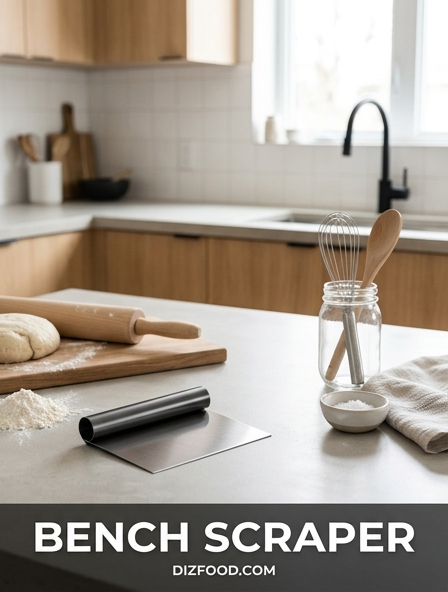
Consistency is more important than speed during this process. Professionals often use a "bench scraper" to move the finished brunoise aside, keeping the cutting surface clear of debris. By maintaining a clean environment and focusing on the alignment of the strips, you ensure that every cube is a mirror image of the next, which is the hallmark of high-level knife skills.
Best Culinary Uses for Julienne Vegetables
The julienne cut is highly versatile and is frequently used in cuisines that emphasize quick cooking and fresh textures. In Asian cookery, particularly in stir-fries, julienned ginger, carrots, and bell peppers are standard. The high surface-area-to-volume ratio allows the vegetables to wilt slightly while retaining a crisp "snap," which is essential for a balanced stir-fry. Because the pieces are long and thin, they can be easily picked up with chopsticks, making them functional as well as beautiful.
In Western kitchens, julienne vegetables are a staple for salads and slaws. Julienned apples or celery root (celeriac) provide a sophisticated crunch that is more refined than a standard grate. They are also used frequently as a bed for roasted meats or fish. For example, a julienne of leeks and carrots can be lightly sautéed in butter and placed under a seared scallop, providing a flavorful and decorative foundation. Additionally, deep-frying julienned vegetables like leeks or potatoes creates "shoestrings" or "straws" that serve as a popular crunchy topping for soups and steaks.
Ultimately, the julienne is chosen when the vegetable needs to stand out as an individual component. It provides a visual line that guides the eye across the plate, making it an excellent tool for modern plating techniques that favor height and movement.
When to Choose Brunoise for Fine Dining
Brunoise is the height of culinary refinement and is almost exclusively used in contexts where texture should be subtle or where visual intricacy is paramount. One of the most classic applications of brunoise is in a clear consommé. In this dish, tiny cubes of colorful vegetables like carrots, leeks, and turnips float in a crystal-clear broth. Because the broth is so simple, the perfection of the brunoise is the primary focus of the dish's aesthetic.
In the world of sauces, a brunoise of shallots or garlic is often sautéed until translucent to form the base of a beurre blanc or a reduction. The goal here is for the vegetable to disappear into the sauce, providing flavor and body without creating large, distracting chunks. Furthermore, brunoise is frequently used as a finishing touch. A sprinkle of brunoise peppers or chives over a savory mousse or a piece of poached fish provides a "micro-garnish" that suggests a high level of care and attention to detail.
Chefs also utilize brunoise when stuffing delicate proteins, such as in a farce for a quail or a rolled sole fillet. The small size ensures the stuffing is compact and cooks at the same rate as the protein. When choosing between cuts, select brunoise when you want the vegetable to be a supporting player that integrates seamlessly into the overall composition of the dish.
Essential Knife Skills for Perfect Uniformity
Achieving uniformity in julienne and brunoise cuts is a physical skill that requires the right equipment and posture. First, the knife must be exceptionally sharp. A dull blade will crush the cell walls of the vegetable, causing it to slip and resulting in jagged, uneven edges. Most chefs prefer a 8-inch to 10-inch French chef's knife or a Japanese Santoku for this type of work, as the flat edge of the blade allows for more contact with the board.
- The Grip: Use a "pinch grip" by holding the bolster of the knife between your thumb and forefinger. This provides maximum control and prevents the knife from wobbling.
- The Anchor: Always create a flat surface on your vegetable first. Slice a thin sliver off one side of a round carrot so it sits flat on the board. This prevents rolling and protects your fingers.
- The Movement: Use a "locomotive" motion-pushing the knife forward and down, then pulling it back. Avoid "chopping" straight down, which can bruise the produce.
- The Guide: Use the "claw" hand to guide the blade. Your knuckles should always be further forward than your fingertips, creating a safe wall for the side of the knife to slide against.
Consistent practice is the only way to build the muscle memory required for these cuts. Start slowly, focusing on the geometry of each piece rather than the speed of your hand. Over time, the rhythm will become second nature, and the uniformity of your cuts will improve dramatically.
Comparing Texture and Mouthfeel in Cooking
The choice between julienne and brunoise significantly alters the "mouthfeel" of a dish-the physical sensation of the food in the mouth. A julienne cut offers a structural, fibrous experience. Because the pieces are long, they require more chewing, which allows the diner to experience the flavor of the vegetable more intensely and for a longer duration. This makes julienne ideal for raw applications where the "crunch" is a desired feature of the dish's personality.
Conversely, a brunoise cut offers a more delicate, almost melting sensation. Because of the tiny size, the vegetable offers very little resistance to the bite. When cooked into a sauce or a risotto, the brunoise pieces act as little bursts of flavor that integrate with the liquid components. This creates a cohesive, smooth experience where no single ingredient stands out too harshly against the others. It is often described as a "velvety" texture in the context of soups and purees.
In professional cooking, the choice is often dictated by the balance of the dish. If a dish is soft and creamy (like a poached fish), a julienne garnish can add a necessary textural contrast. If a dish is already complex and chunky (like a rustic stew), a brunoise might be used to add a top-note of flavor without adding more bulk. Understanding how shape influences the eating experience is a key component of recipe development.
The Best Vegetables for Julienne and Brunoise
Not all vegetables are suited for these precise geometric cuts. The best candidates are firm, dense vegetables that can hold their shape when sliced thinly. Root vegetables are the gold standard for practicing these techniques because they are relatively inexpensive and have a consistent internal structure. However, with the right technique, even softer vegetables can be julienned or brunoised.
| Vegetable | Suitability | Best Use |
|---|---|---|
| Carrots | Excellent | Standard practice, salads, soups |
| Celery | Good | Aromatics, mirepoix, Waldorf salad |
| Potatoes | Excellent | Shoestring fries, hash browns |
| Bell Peppers | Moderate | Stir-fries, colorful garnishes |
| Zucchini | Moderate | Quick sautés (avoid the seedy core) |
When working with peppers or zucchini, it is important to remove the soft, seedy centers and work only with the firm outer "walls." For onions, the process is slightly different; instead of squaring off the vegetable, the chef utilizes the natural layers of the onion to create a brunoise, cutting horizontally and vertically toward the root. Generally, any vegetable that is too brittle (like radishes) or too soft (like tomatoes) will be difficult to julienne without specialized tools like a mandoline.
Master Your Knife Technique for Professional Results
Mastering julienne and brunoise is a journey from clumsy, irregular pieces to perfect, uniform shapes. The hallmark of a professional is not just the ability to make one perfect cut, but the ability to make five hundred perfect cuts in a row. This level of consistency is what allows a restaurant to serve the same high-quality dish to every guest, regardless of who is working the line that night.
To reach this level, you must focus on the "prep" phase. Always start by squaring off your vegetables into "planks." A plank is a flat, rectangular slice of the vegetable. Once you have a stack of uniform planks, you can easily cut them into julienne strips. This systematic approach-turning a cylinder into a block, then into planks, then into strips, and finally into cubes-is the secret to speed and accuracy. Many beginners skip the squaring-off step to save food, but this leads to "wedged" pieces that won't cook evenly.
Finally, remember that knife skills are a perishable skill. Even professional chefs practice their cuts regularly to maintain their edge. By treating every carrot you chop as an opportunity to practice your julienne and brunoise, you will eventually develop the speed and precision necessary to excel in any kitchen environment. The discipline required for these cuts will translate into better organization and cleaner work habits across all aspects of your cooking.

Comments