
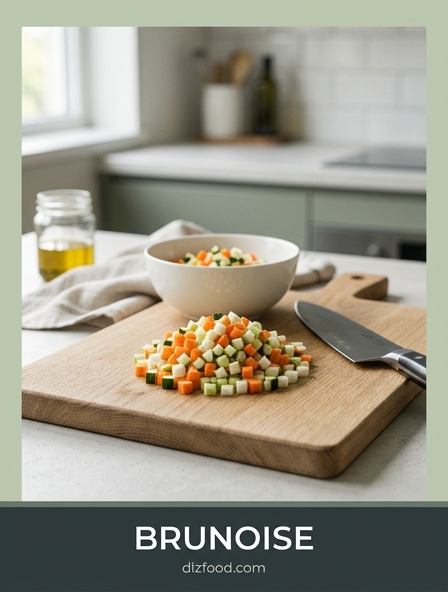
Mastering the Fundamentals of the Brunoise Cut
The brunoise is widely considered the hallmark of a disciplined chef, representing the smallest standard cube in classical French cuisine. To achieve a perfect brunoise, one must first produce a precise julienne, which is then turned and cut again to create tiny, uniform cubes measuring exactly 3 millimeters or 1/8th of an inch on all sides. This technique is not merely about aesthetics; it is about demonstrating total control over the blade and the medium. Aspiring culinary professionals spend hours practicing on root vegetables to ensure every single piece is identical.
- Standard Dimensions: 3mm x 3mm x 3mm
- Primary Tool: 8-inch or 10-inch Chef's Knife
- Common Applications: Garnish for consommé, aromatic bases, and fine sauces
- Skill Level: Advanced / Professional
Mastering this cut requires patience and a sharp eye for geometric precision. While larger cuts allow for slight variances, the brunoise leaves no room for error. If the cubes are inconsistent, they will cook at different rates and disrupt the visual harmony of a high-end dish. Consistent practice on firm vegetables like carrots or turnips is the most effective way to internalize the spatial requirements of this fundamental skill.
Essential Tools for Precision Vegetable Dicing
Achieving a professional-grade brunoise is nearly impossible without the correct set of tools. The most critical component is a high-carbon stainless steel chef's knife that can hold a razor-sharp edge. A dull blade will crush the cell walls of the vegetable rather than slicing through them cleanly, leading to jagged edges and moisture loss. Additionally, a stable, flat cutting board-preferably wood or high-density plastic-provides the necessary surface for high-speed precision work.
| Tool | Purpose in Brunoise |
|---|---|
| Chef's Knife | The primary tool for squaring, julienning, and dicing. |
| Honing Steel | Used frequently to maintain the blade's alignment. |
| Bench Scraper | Efficiently moves the tiny cubes without damaging them. |
| Damp Cloth | Placed under the board to prevent slipping during use. |
Beyond the knife and board, many chefs utilize a mandoline for the initial "planking" stage to ensure absolute thickness consistency before moving to the knife for the final cuts. A ruler may also be employed by students to verify the 3mm dimensions until their muscle memory is fully developed. Maintaining your tools is as important as the technique itself.
From Julienne to Brunoise Step by Step
The transition from a whole vegetable to a pile of perfect brunoise is a logical, multi-stage process. Each step builds upon the accuracy of the previous one, meaning a mistake in the initial squaring phase will be magnified in the final result. By following a structured approach, a cook can minimize waste while maximizing the yield of usable cubes. The process requires a steady hand and a rhythmic cutting motion.
- Wash and peel the vegetable, removing any irregular outer layers.
- "Square off" the vegetable by slicing the sides to create a rectangular block.
- Slice the block lengthwise into thin planks exactly 3mm thick.
- Stack the planks and slice them into thin strips, known as julienne.
- Rotate the julienne strips 90 degrees and cut crosswise into 3mm cubes.
During the final cross-cut, it is vital to keep the bundle of julienne strips tightly aligned. Using the "claw" grip with your non-dominant hand ensures that the knife stays vertical and the strips do not slide apart. If the strips move, the resulting cubes will be slanted or irregular, necessitating further trimming and increasing food waste.
Selecting the Best Produce for Fine Cuts
Not all vegetables are suitable for the brunoise technique. Because the cut is so small, the vegetable must have a dense, firm structure that can withstand multiple passes of the knife without collapsing or bruising. Soft or fibrous produce will often tear, resulting in a mushy texture that lacks the crisp definition required for professional presentation. Chefs typically select "hard" vegetables for this purpose to ensure the edges of each cube remain sharp and distinct.
- Carrots: Excellent for color and structural integrity.
- Celery: Provides a distinct crunch but requires peeling to remove strings.
- Parsnips and Turnips: Firm white vegetables that show off precision well.
- Leeks: Use only the firm white and light green parts for fine dicing.
- Onions: Require a specific method involving horizontal and vertical tension.
Temperature also plays a role in produce selection and preparation. Working with chilled vegetables can often result in cleaner cuts, as the cold firms up the natural sugars and starches within the plant. When selecting produce at the market, look for items that are heavy for their size and free of soft spots, as these will provide the most reliable results on the cutting board.
The Role of Uniformity in Refined Sauces
In high-level gastronomy, the brunoise cut serves a dual purpose: it acts as a flavor base and an elegant garnish. In refined sauces like a classic beurre blanc or a clear consommé, uniformity is paramount. When the vegetable pieces are exactly the same size, they release their essential oils and aromatic compounds into the liquid at the same rate. This prevents one flavor from overpowering others and ensures that the texture remains consistent throughout the dining experience.
- Consommés: Tiny cubes provide a visual "jewel" effect in clear soup.
- Mignonette: Vital for raw oyster toppings where texture balance is key.
- Beurre Blanc: Infuses the butter sauce with subtle aromatics without bulk.
- Vinaigrettes: Small dices stay suspended longer in the emulsion.
If the pieces were uneven, smaller bits would dissolve into the sauce while larger pieces would remain crunchy and distracting. The visual appeal of a perfectly uniform brunoise floating in a translucent liquid signals to the diner that the kitchen operates with a high level of technical proficiency. It transforms a simple sauce into a sophisticated element of the final dish.
Knife Skills and Safety for Professional Prep
Executing a brunoise requires high-speed repetitive movements, which makes safety protocols and proper knife grip essential. A professional chef uses the "pinch grip," grasping the bolster of the knife between the thumb and index finger for maximum control. The other hand must always use the "claw" technique, tucking fingertips inward and using the knuckles as a guide for the blade. This prevents accidental nicks and allows for the extreme precision necessary for 3mm cuts.
- Always keep the tip of the knife in contact with the board when possible.
- Maintain a sharp edge; a dull knife is more likely to slip and cause injury.
- Work in a clean, uncluttered space to maintain focus and rhythm.
- Use a bench scraper to move product; never slide the knife edge across the board.
Safety also involves ergonomic posture. Standing with feet shoulder-width apart and maintaining a straight back prevents fatigue during long prep sessions. Because the brunoise is so labor-intensive, chefs must remain mindful of their form. Fatigue leads to sloppy cuts and, eventually, mistakes that can result in injury or wasted product. Consistency in safety leads to consistency in the final culinary output.
Elevating Plate Presentation with Miniature Garnishes
The visual impact of a brunoise garnish is significant, as it adds a level of intricacy that suggests luxury and meticulous care. These tiny cubes act like colorful confetti, providing a pop of color and texture without overwhelming the main component of the plate. When used as a garnish, the brunoise is often blanched briefly in salted water to brighten its natural hue and then shocked in ice to stop the cooking process, ensuring the colors remain vibrant.
- Color Contrast: Red peppers or carrots against creamy white sauces.
- Symmetry: Arranging cubes in precise lines or patterns.
- Subtlety: Enhancing a dish without adding excessive volume.
- Texture: Adding a delicate "snap" to otherwise soft purees.
In modern plating, the brunoise might be scattered organically or placed with tweezers for absolute precision. Because they are so small, these garnishes are particularly effective in appetizers and seafood dishes where delicacy is prized. The ability to produce a perfect brunoise is often what separates a standard cook from a fine-dining chef, as it demonstrates an appreciation for the smallest details that contribute to a dish's success.
Consistency in Size for Even Cooking Results
Beyond the visual and technical aspects, the primary scientific reason for a brunoise is heat transfer. The surface-area-to-volume ratio of a 3mm cube allows for incredibly rapid and even cooking. When sautéing a brunoise of mirepoix, the vegetables soften and caramelize almost instantly. If the cuts were uneven, the smaller pieces would burn before the larger pieces had finished softening, leading to bitter off-flavors in the finished dish.
| Cut Size | Cooking Time (Sauté) | Recommended Use |
|---|---|---|
| Brunoise (3mm) | 30-60 Seconds | Fine sauces, garnishes |
| Small Dice (6mm) | 2-3 Minutes | Soups, stews, sautés |
| Medium Dice (12mm) | 5-7 Minutes | Roasts, hearty soups |
This predictability is essential in a fast-paced professional kitchen. A chef needs to know that when they toss a handful of brunoise vegetables into a pan, they will be perfectly cooked in under a minute. This level of control allows for precise timing of complex dishes where multiple components must reach the plate at the same peak moment of quality.
Common Mistakes to Avoid in Precision Cutting
Even experienced cooks can struggle with the brunoise if they become complacent or rush the process. One of the most common errors is failing to "square off" the vegetable properly at the beginning. If the initial block is not a perfect rectangle, the subsequent planks and strips will be trapezoidal, making it impossible to achieve square cubes. Another frequent mistake is "rocking" the knife too much, which can result in pieces that are thicker on one side than the other.
- Using a dull knife that tears the vegetable fibers.
- Applying too much downward pressure instead of a slicing motion.
- Allowing the julienne strips to fan out during the final dicing.
- Ignoring the "taper" of the vegetable, leading to inconsistent thickness.
To avoid these pitfalls, it is important to focus on the "reset" between each cut. After slicing a plank, ensure it is perfectly flat before cutting the next. When dicing the julienne, use your guide hand to keep the strips compressed. Speed should only be increased once the geometry of the cut is perfect. In the world of precision cutting, slow and accurate is always better than fast and sloppy.
Advanced Techniques for High Volume Kitchens
In high-volume environments such as banquet halls or large hotels, producing gallons of brunoise manually can be prohibitively time-consuming. To maintain quality while increasing output, chefs often employ specialized techniques and equipment. This might include using a commercial mandoline with a julienne attachment to handle the first two stages of the cut, leaving only the final cross-cut to be performed by hand. This hybrid approach ensures consistency while significantly reducing labor hours.
- Batch Processing: Squaring all vegetables before moving to the next stage.
- Stabilization: Using custom jigs or containers to hold strips together.
- Specialized Blades: Utilizing thin-profile Japanese knives for less resistance.
- Prep Stations: Dedicated areas with optimized heights for long-duration cutting.
Furthermore, high-volume kitchens often repurpose the "trimmings" from the squaring process for stocks, purees, or family meals to ensure a zero-waste environment. While machines can assist, the final check is always performed by a human eye. Even in a kitchen serving hundreds of guests, the standard for a brunoise remains the same: a perfect, tiny cube that reflects the skill and dedication of the culinary team.

Comments