
Mastering Santoku Knife Geometry
The Santoku knife, often referred to as the "three virtues" tool, possesses a unique geometry that distinguishes it from the traditional Western chef's knife. Its most defining characteristic is the sheep's foot blade profile, which features a nearly straight cutting edge and a spine that curves down to meet the point. This design is specifically engineered to facilitate a push-cutting motion rather than the rocking motion common with curved European blades. Because the edge is flatter, it maximizes contact with the cutting board, allowing for clean, decisive cuts through vegetables, proteins, and fruits.
- Blade Length: Typically ranges between 5 to 7 inches for agility.
- Edge Angle: Usually ground to a sharper 12-15 degrees.
- Spine Width: Thinner than a standard bolster-heavy knife.
Understanding this geometry is the first step toward precision. The lack of a significant "belly" or curve means the user does not need to lift the handle high to complete a slice. Instead, the blade remains relatively parallel to the board, utilizing its entire length efficiently. This structural design is what makes the Santoku the primary instrument for the specialized push-cut technique in modern kitchens.
Anatomy of the Push Cut Motion
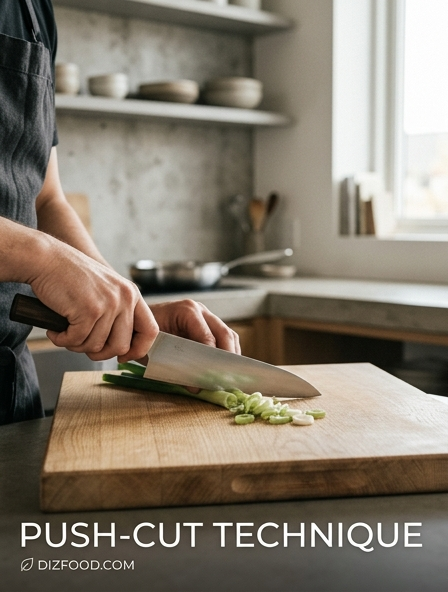
The push cut is a fundamental culinary technique characterized by a simultaneous forward and downward movement. Unlike the rock-chop, where the tip of the knife rarely leaves the cutting board, the push cut requires the blade to be lifted entirely or partially before being driven through the ingredient. This motion begins at the heel of the blade and concludes as the knife glides toward the tip, following a diagonal path. This dual-axis movement ensures that the blade's edge shears through the fibers of the food rather than simply crushing them under vertical pressure.
To execute this properly, the chef positions the knife slightly above the ingredient. As the arm moves forward, the blade descends at a controlled angle. This transition is seamless, creating a smooth "gliding" sensation. It is essential to maintain a relaxed grip on the handle to allow the knife's weight to assist in the descent. By mastering the physics of this forward momentum, cooks can achieve high speeds without sacrificing the structural integrity of delicate items like herbs or soft vegetables.
Vertical Force and Precision Control
Precision in push cutting relies heavily on how vertical force is applied and regulated. Because the Santoku's edge is flat, the force is distributed evenly across the section of the blade touching the board. This prevents the "accordion effect," where slices remain attached at the bottom because the curve of a knife missed the final millimeter of contact. By focusing the downward force through the center of the blade, the chef ensures that every stroke results in a complete separation from the bulk of the ingredient.
| Force Component | Role in Push Cutting |
|---|---|
| Downward Pressure | Ensures the blade penetrates through the skin and base of the food. |
| Forward Momentum | Reduces the amount of physical force needed to break fibers. |
| Lateral Stability | Prevents the blade from wobbling or "steering" mid-cut. |
Control is further enhanced by the "claw grip" on the non-cutting hand. The knuckles act as a vertical guide for the flat side of the Santoku blade. This physical feedback allows the chef to apply force confidently, knowing the blade will travel in a perfectly straight, vertical plane every time.
Why Flat Edges Favor Push Cutting
The push-cut technique is inherently optimized for blades with flat or nearly flat edges. While a curved French-style blade is designed to roll along its belly, a flat edge provides a larger "sweet spot" for horizontal slicing. When a chef pushes a flat-edged Santoku forward and down, the entire length of the blade passes through the food at a consistent depth. This is particularly advantageous when processing large quantities of uniform vegetables, such as carrots for julienne or potatoes for frites.
If one attempts to push-cut with a heavily curved blade, only a small portion of the edge makes contact at any given moment, which can lead to uneven cuts or the knife slipping forward unpredictably. The flat profile of the Santoku provides a stable platform that encourages a rhythmic, repetitive motion. This stability is why many professional chefs prefer the Santoku for prep-heavy tasks; the tool is physically aligned with the mechanics of the push-off, ensuring that the kinetic energy of the arm is translated directly into a clean, efficient shear through the ingredient.
Achieving Consistent Uniform Slices
Uniformity in the kitchen is not just about aesthetics; it is critical for even cooking times. The push-cut technique, when paired with a Santoku, is the most reliable way to achieve identical thickness across dozens of slices. Because the blade moves in a linear fashion, it is easier for the cook to calibrate the "step back" of the guiding hand. Each time the knife is lifted for the next stroke, the guiding hand moves a precise distance, creating a consistent thickness that is difficult to replicate with the variable angles of a rocking motion.
- Align the blade flush against the knuckles of your guiding hand.
- Initiate the forward-downward push with a steady tempo.
- Retreat the guiding hand by a measured increment after each stroke.
- Maintain the knife's vertical orientation throughout the entire set.
This method eliminates the tapering often seen in beginner knife work. By keeping the blade perfectly vertical and the push motion consistent, the resulting slices will have parallel faces and uniform dimensions, ensuring that every piece of food in the pan reaches the desired temperature at the exact same moment.
Minimizing Blade Friction on Ingredients
One of the primary challenges in slicing starchy or wet ingredients, such as potatoes or cucumbers, is the vacuum seal that forms between the food and the side of the blade. This suction creates friction, which can disrupt the rhythm of a push cut and cause slices to stick and pile up on the knife. To combat this, many Santoku knives feature a "Granton edge"-a series of hollowed-out divots or scallops ground into the side of the blade. These indentations create small pockets of air between the steel and the food.
The air pockets break the surface tension, allowing the sliced ingredient to fall away easily from the blade. Even without a Granton edge, the push-cut technique itself helps minimize friction. Because the blade is moving forward as it descends, it is "slicing" its way through the cells rather than "wedging" them apart. This dynamic movement, combined with the thin spine of the Santoku, ensures that the blade encounters minimal resistance. Reducing friction not only speeds up the preparation process but also preserves the delicate texture of the food, preventing it from being bruised or torn during the stroke.
Enhancing Kitchen Safety with Controlled Strokes
Safety in the kitchen is often a byproduct of predictability. The push-cut technique is inherently safer than high-speed rocking because the blade stays closer to the cutting board and follows a linear, repetitive path. When rocking a knife, the tip or heel can occasionally lift too high, or the blade can "skate" across the skin of a round ingredient. In contrast, the push cut begins with the blade already in a stable position above or against the food, reducing the likelihood of accidental slips.
Furthermore, because the Santoku lacks a sharp, pointed tip that stays anchored, the chef is forced to be more mindful of the blade's entire edge. By using the knuckles of the guiding hand as a constant reference point, the risk of the blade jumping or tilting is minimized. The controlled nature of the forward-downward stroke allows the cook to stop the motion instantly if the ingredient shifts. This level of mechanical control is vital in high-volume environments where fatigue can lead to lapses in concentration. A disciplined push cut ensures that the knife goes exactly where it is intended, every single time.
Reducing Wrist Fatigue During Prep
Ergonomics play a vital role in long-term kitchen health. Repeatedly rocking a heavy chef's knife requires significant wrist flexion and extension, which can lead to repetitive strain injuries like carpal tunnel syndrome. The push-cut technique shifts the workload from the small muscles and tendons of the wrist to the larger muscle groups of the forearm and shoulder. The motion is driven by the arm moving forward as a unit, while the wrist remains relatively locked in a neutral, strong position.
- Wrist Alignment: Keeps the joint straight to avoid nerve compression.
- Shoulder Engagement: Uses body weight to drive the downward force.
- Knife Balance: Santokus are typically balanced at the bolster for easier handling.
By utilizing the Santoku's lighter weight and flatter profile, the cook can maintain a high output for hours without the "sore wrist" common after traditional chopping. The knife does the heavy lifting through its sharp edge and geometric efficiency, while the chef provides the steady, rhythmic guidance. This ergonomic shift allows for a more sustainable and comfortable workflow during intense preparation periods.
The Science of Clean Food Separation
A "clean cut" is more than just a culinary goal; it is a matter of food science. When a knife shears through an ingredient using a push cut, it minimizes the rupture of cell walls. When cell walls are crushed-as often happens with a dull blade or an improper vertical chop-enzymes and fluids are released prematurely. This is why onions "bleed" and cause more eye irritation when cut poorly, and why herbs turn brown and lose their aromatic oils when bruised by a heavy hand.
The sliding component of the push cut allows the microscopic teeth of the knife's edge to catch and sever the fibers cleanly. This preserves the internal moisture and flavor of the ingredient. For example, a push-cut tomato will retain its juice within its chambers, whereas a crushed tomato will leak onto the board. This precision ensures that the flavors stay in the food until they reach the heat of the pan or the palate of the guest. The science of clean separation is the difference between a dish that tastes vibrant and one that feels muted and watery.
Optimizing Your Santoku Slicing Technique
To truly optimize the push cut, one must consider the harmony between the tool, the surface, and the hand. First, ensure the Santoku is maintained at a razor-sharp level; a dull blade will resist the forward motion and require dangerous amounts of downward pressure. Second, the choice of cutting board is paramount. Wood or soft plastic boards are ideal as they provide a slight "give" that protects the flat edge of the Santoku from chipping or dulling prematurely during the finish of the stroke.
Finally, practice the "glide." Instead of thinking of the cut as two separate movements (push then down), visualize it as a single diagonal arc. Start slowly to build muscle memory, focusing on the sound of the blade meeting the board-a crisp, singular "thwack" rather than a staggered or scraping noise. As your comfort increases, you can increase the tempo while maintaining the same vertical precision. By refining these variables, you transform the Santoku from a mere utensil into a high-performance extension of your hand, capable of executing the most demanding kitchen tasks with grace and efficiency.

Comments