
Ever wondered why some fried dishes have that light, airy, restaurant-quality crisp while others turn out dense and heavy? The secret lies in the battle between Panko and traditional breadcrumbs. While classic breadcrumbs offer a fine, sandy texture ideal for binders, Panko is the "king of crunch," made from crustless bread processed into large, jagged flakes that resist oil absorption. Whether you're aiming for a delicate golden crust on a piece of schnitzel or looking for the perfect filler for meatballs, understanding the structural differences between these two pantry staples is the ultimate game-changer for your home cooking.
| Feature | Panko Breadcrumbs | Traditional Breadcrumbs |
|---|---|---|
| Composition | Crustless white bread (steamed/electrocuted) | Whole loaf (including crusts), toasted |
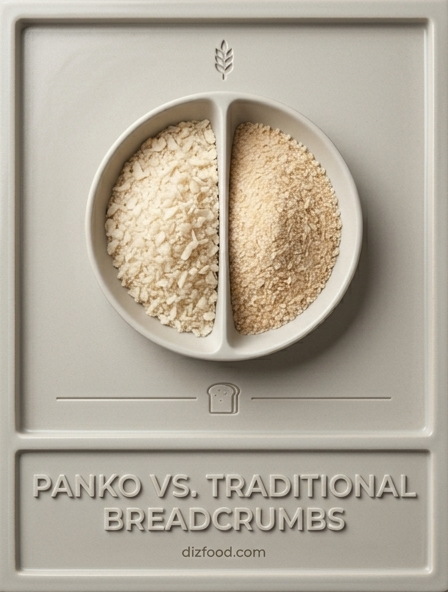
| Texture | Large, jagged, airy flakes | Fine, sandy, uniform granules |
| Oil Absorption | Low; stays light and crisp | High; can become heavy or greasy |
| Browning | Slow; achieves a bright golden hue | Fast; browns deeply and quickly |
| Primary Function | Coating/Topping for maximum crunch | Binding agent for meatballs/meatloaf |
| Density | Low density; more volume per gram | High density; compact and heavy |
What is the Difference Between Panko and Regular Breadcrumbs
Understanding the fundamental differences between Panko and traditional breadcrumbs begins with their origin and composition. Panko, a Japanese-style breadcrumb, is manufactured through a unique process where the bread is baked using an electrical current. This results in a loaf without a crust, which is then processed into large, jagged flakes. Because it lacks the darker, denser crust of a standard loaf, Panko remains bright and uniform in color, typically appearing as translucent white slivers before cooking.
In contrast, traditional or "regular" breadcrumbs are made from various types of toasted bread, including the crusts. This results in a much finer, sand-like texture with a mixture of colors ranging from tan to deep brown. While Panko is almost always unseasoned in its base form, regular breadcrumbs are frequently sold in "Italian style" varieties, pre-mixed with dried herbs like oregano, basil, and garlic powder. The core differences can be summarized by the following characteristics:
- Shape: Panko consists of large flakes; regular breadcrumbs are small granules.
- Crust Content: Panko is crust-free; regular breadcrumbs include the whole loaf.
- Absorption: Panko has a lower moisture content and resists grease; regular breadcrumbs absorb liquids more readily.
- Flavor: Panko is neutral; regular breadcrumbs often carry a toasted, nutty yeast flavor.
These structural differences dictate how each ingredient behaves when exposed to heat and moisture in the kitchen. While they are often used interchangeably in casual cooking, their distinct physical properties mean they serve very different purposes in professional culinary applications.
Texture Comparison Light and Airy vs Dense and Fine
The sensory experience of a dish is heavily influenced by the texture of its coating. Panko is celebrated for its remarkably light and airy profile. Because the flakes are large and irregular, they do not pack tightly together when pressed onto the surface of a protein. This creates air pockets that allow steam to escape during the cooking process, ensuring the interior stays moist while the exterior becomes exceptionally crisp. The "crunch" of Panko is sharp and distinct, providing a structural contrast to soft foods like shrimp or eggplant.
Traditional breadcrumbs offer a completely different mouthfeel characterized by density and uniformity. Their fine, granular size allows them to form a solid, continuous shell around food. This creates a crunch that is more compact and "hard" rather than "crisp." When eaten, regular breadcrumbs provide a consistent, sandy texture that blends more seamlessly into the dish. The choice between the two often comes down to the desired intensity of the crunch.
| Feature | Panko Breadcrumbs | Traditional Breadcrumbs |
|---|---|---|
| Particle Shape | Pointed Shards/Flakes | Round Granules |
| Mouthfeel | Brittle and Light | Crunchy and Solid |
| Surface Area | High (Irregular) | Low (Uniform) |
| Density | Low/Porous | High/Compact |
This comparison highlights why Panko is often preferred for modern fried appetizers, whereas traditional crumbs remain the standard for classic comfort foods where a subtle, integrated crust is desired.
How Manufacturing Methods Affect the Final Crunch
The secret to the superior crunch of Panko lies in a specialized industrial manufacturing method known as "electroleheating." Unlike traditional bread, which is baked in a conventional oven using radiant heat that creates a brown crust, Panko bread is baked by passing an electric current through the dough. This process generates heat from within the dough itself, allowing it to rise and set without ever developing a crust. The resulting loaf is large, white, and incredibly porous.
Once the crustless bread is baked, it is processed through specific grinders that "shred" the bread rather than "crushing" it. This preserving of the bread's cellular structure is vital; it ensures the flakes remain jagged and stiff. Traditional breadcrumbs, however, follow a more standard production path:
- Standard loaves of bread are baked until a full crust forms.
- The bread is thoroughly toasted to remove almost all moisture.
- Mechanical rollers crush the toasted bread into fine, uniform particles.
- The particles are sifted to ensure a consistent grain size.
Because regular breadcrumbs are crushed, the air cells within the bread are flattened. This is why traditional crumbs feel much heavier and "dustier" than Panko. When fried, the preserved air cells in Panko expand slightly, whereas the crushed regular crumbs remain dense. This manufacturing divergence is the primary reason why Panko stays crunchy for longer periods, even after the food has begun to cool down on the plate.
Best Culinary Applications for Panko Breadcrumbs
Panko's unique structure makes it the "gold standard" for any dish where a high-definition crunch is the priority. Because the flakes are larger, they provide more surface area for the heat to hit, making them ideal for quick-frying or high-heat roasting. They are the essential ingredient in Japanese Tonkatsu (fried pork cutlets) and Ebi Furai (fried shrimp), where the goal is a thick, spiky, golden-brown coating that shatters upon impact.
Beyond deep frying, Panko is an excellent choice for oven-baked dishes. When tossed with a small amount of melted butter or olive oil and sprinkled over a gratin or mac and cheese, Panko browns beautifully without becoming soggy. Its lightness allows it to sit on top of creamy sauces without sinking into them. Some of the most effective uses for Panko include:
- Seafood Coatings: Ideal for delicate fish fillets and scallops.
- Casserole Toppings: Provides a crisp contrast to soft, baked textures.
- Vegetable Fries: Works perfectly for zucchini fries or blooming onions.
- Schnitzels: Offers a modern, lighter alternative to traditional breading.
Chefs also prefer Panko when they want to showcase the flavor of the primary ingredient. Because Panko is essentially flavorless and does not absorb as much oil, the taste of the shrimp, chicken, or vegetable remains the star of the show, unburdened by a heavy, greasy breading layer.
Why Traditional Breadcrumbs Excel as a Binding Agent
While Panko wins in the crunch department, traditional breadcrumbs are the undisputed champions of the "binder" world. In recipes like meatballs, meatloaf, or crab cakes, the goal of the breadcrumb is to absorb moisture and fat, creating a cohesive structure that prevents the meat from falling apart. Regular breadcrumbs, with their fine, sand-like consistency, distribute evenly throughout a mixture, ensuring every bite has a consistent texture.
The higher absorption rate of traditional crumbs is actually an advantage here. As the meat cooks and releases juices, the fine crumbs soak up those liquids, swelling slightly and locking the moisture inside the dish. This prevents the final product from becoming dry or crumbly. The binding process typically involves several key steps:
- Mixing the fine crumbs with a liquid (milk, water, or eggs) to create a panade.
- Integrating the panade into the ground meat or protein.
- Allowing the mixture to rest so the crumbs can fully hydrate.
- Shaping the mixture into balls, patties, or loaves.
Using Panko as a binder can often result in a "chunky" or loose texture because the large flakes do not hydrate as uniformly as the fine powder of regular crumbs. Furthermore, the seasoned varieties of regular breadcrumbs add a foundational layer of flavor to the interior of the meat that Panko lacks. For classic comfort cooking where structural integrity and moistness are paramount, traditional crumbs remain the superior functional choice.
Nutritional Profiles and Calorie Differences
When comparing the nutritional value of Panko and traditional breadcrumbs, the differences are subtle but noteworthy for those tracking their macros. On a gram-for-gram basis, Panko tends to be slightly lower in calories and fats because it is made from simpler ingredients-usually just wheat flour, yeast, and salt. Regular breadcrumbs, especially those processed for long shelf lives, may contain dough conditioners, sugar, and more salt to balance the flavors of the toasted crusts.
However, the way these crumbs are used in cooking significantly impacts their final nutritional impact. Panko's lower density means that a "cup" of Panko weighs less than a "cup" of regular breadcrumbs. Consequently, using Panko can lead to a lower caloric intake simply through volume. Below is a general comparison per 100 grams of product:
| Nutrient | Panko (Plain) | Regular (Plain) |
|---|---|---|
| Calories | ~350-370 kcal | ~390-410 kcal |
| Total Fat | 1g - 2g | 4g - 5g |
| Sodium | 400mg - 500mg | 600mg - 800mg |
| Fiber | ~2g | ~4g |
It is important to note that "Italian Style" regular breadcrumbs will have significantly higher sodium levels due to the added seasonings. For those monitoring heart health, Panko is generally the cleaner option, though regular crumbs often provide slightly more fiber because they include the wheat-based crusts of the bread.
The Role of Oil Absorption in Deep Frying
The behavior of breadcrumbs in hot oil is perhaps the most significant differentiator for fried food enthusiasts. Panko has a "fried-but-not-greasy" reputation that is backed by science. Because Panko flakes are large and have less surface area relative to their volume compared to fine dust, they don't soak up oil like a sponge. The air pockets created by the shards allow oil to drain away more effectively once the food is removed from the fryer.
Regular breadcrumbs, due to their fine and compact nature, create a dense barrier that traps oil within the coating. This can lead to a "heavy" feeling in the mouth and a higher fat content in the final dish. If the oil temperature is not perfectly maintained, regular breadcrumbs will quickly become waterlogged with grease, resulting in a soggy, oily crust. The impact of oil absorption can be observed in several ways:
- Soggy Factor: Regular crumbs turn soft faster as oil cools; Panko stays rigid.
- Caloric Density: Panko-coated foods typically contain less residual oil.
- Coloration: Panko browns more slowly and evenly; regular crumbs can burn quickly due to high surface contact.
This makes Panko the preferred choice for deep-frying delicate proteins like shrimp or thin chicken cutlets. The result is a lighter, cleaner-tasting fried food that feels less indulgent and more refined. For those seeking a healthier alternative to traditional frying, Panko provides a way to achieve high-impact crunch with significantly less fat retention.
Swapping Panko and Traditional Breadcrumbs in Recipes
While they are distinct products, you can often swap one for the other if you adjust your technique. If a recipe calls for traditional breadcrumbs as a coating and you only have Panko, you can use the Panko as-is for a crunchier result, or you can pulse the Panko in a food processor for a few seconds to break the large flakes into a finer powder. This "ground Panko" will mimic the coverage of regular crumbs while maintaining a lighter texture.
Swapping regular breadcrumbs into a recipe that calls for Panko is slightly more difficult, as you cannot "bulk up" fine crumbs into flakes. However, you can improve the results by following these steps:
- Increase the amount of crumbs used by about 25% to account for the lack of volume.
- Toast the regular crumbs in a dry pan for 2 minutes before using to ensure they start off very dry.
- Avoid over-pressing the crumbs onto the food to keep some air in the coating.
- Adjust seasoning, as Panko is usually salt-free while regular crumbs may not be.
When using Panko as a binder in meatballs (where regular crumbs are usually called for), it is helpful to soak the Panko in a tablespoon of milk or water for five minutes before mixing. This softens the rigid shards, allowing them to integrate better into the meat without creating strange "crunchy" pockets inside the soft meatball. Generally, a 1:1 ratio works for binding, but a 1:1.5 ratio (Panko to Regular) is better for coating volume.
Coating Fried Foods for Maximum Crispiness
To get the most out of either breadcrumb, the "Standard Breading Procedure" is essential. This three-step method ensures that the breadcrumbs adhere firmly to the food and don't fall off in the pan. Maximum crispiness is achieved not just by the crumb itself, but by the layers beneath it. For Panko, this process is particularly important because the large flakes need a strong "glue" to stay attached.
The process works by creating a moisture barrier and an adhesive layer. When the food hits the hot oil, the moisture in the egg and flour turns to steam, pushing outward and helping the breadcrumbs crisp up without letting oil seep into the meat. To maximize this effect, consider the following tips:
- Dry the Protein: Always pat meat or vegetables dry with paper towels before starting.
- Season the Flour: Salt and pepper the flour layer to ensure the flavor is built from the inside out.
- The Double Dip: For an extra thick crust, go from flour to egg to crumbs, then back to egg and crumbs again.
- Rest Before Frying: Let the breaded food sit on a wire rack for 10 minutes; this helps the crumbs set.
Using a wire rack after frying is also crucial. If you place Panko-fried food directly onto a flat plate or paper towel, the bottom will steam and lose its crunch. Elevating the food allows air to circulate, keeping the "maximum crispiness" intact on all sides of the dish.
Choosing the Right Breadcrumb for Every Dish
Selecting between Panko and traditional breadcrumbs depends on the specific culinary goal of your recipe. There is no "superior" crumb, only the "correct" crumb for the task at hand. If the dish is centered around a delicate protein that needs to be the star, Panko is usually the right choice. If the dish is a hearty, integrated mixture like a stuffing or a burger, traditional crumbs provide the necessary cohesion and classic flavor profile.
Chefs often keep both in their pantry to handle different styles of cuisine. A quick rule of thumb: choose Panko for "modern and crisp" and traditional for "classic and soft." To help decide, you can refer to this general usage guide for common kitchen tasks:
| Dish Type | Recommended Crumb | Reasoning |
|---|---|---|
| Meatballs/Meatloaf | Traditional | Better moisture retention and binding. |
| Chicken Katsu | Panko | Provides the iconic "spiky" golden crust. |
| Eggplant Parmesan | Traditional | Creates a dense layer that holds up under sauce. |
| Fish Tacos | Panko | Keeps the fish light and provides high contrast. |
| Holiday Stuffing | Traditional | Absorbs broth and butter for a soft texture. |
Ultimately, experimenting with both will help you develop a "feel" for how they react to your specific cooking style. Whether you are aiming for a shattering crunch or a moist, tender interior, the humble breadcrumb is one of the most versatile tools in the kitchen arsenal.

Comments