
Ever wondered why your kitchen suddenly fills with a hazy blue mist when you're searing a steak? Mastering the nuances between an oil's smoke point and its flash point is the ultimate secret to safer, more flavorful high-heat cooking. While the smoke point is your early warning signal-the moment an oil begins to break down, lose its nutritional value, and release acrid-tasting compounds-the flash point is the critical danger zone where volatile vapors can actually ignite. By understanding these thermal thresholds, you can confidently choose the right fats for every technique, ensuring your meals are perfectly browned without the risk of a kitchen fire or a bitter aftertaste.
| Feature | Smoke Point | Flash Point |
|---|---|---|
| Definition | The temperature where oil produces continuous visible smoke. | The temperature where oil vapors can ignite if exposed to a flame. |
| Chemical Change | Fatty acids break down into glycerol and free fatty acids. | Volatile compounds accumulate in enough concentration to burn. |
| Typical Range | 325°F (Butter) to 520°F (Avocado Oil). | Typically occurs around 600°F (315°C). |
| Visual Cues | Steady wisps of bluish-grey smoke and oil shimmering. | Tiny sparks or a brief "flash" of flame over the surface. |
| Impact | Produces acrolein (bitter flavor) and destroys antioxidants. | High risk of a grease fire; structural damage to cookware. |
| Safety Action | Lower heat immediately or remove pan from the burner. | Cover with a lid, turn off heat, and never use water to extinguish. |
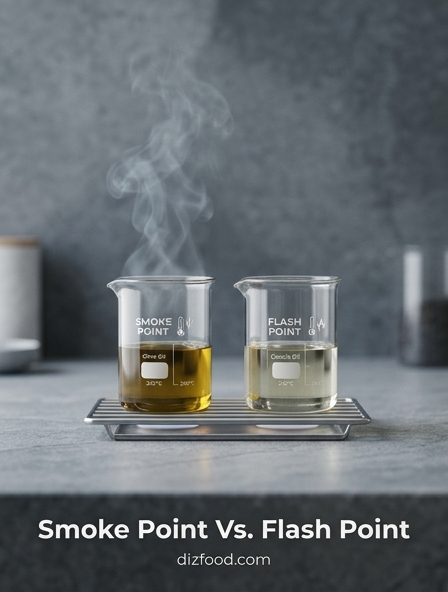
Defining Smoke Point and Flash Point
In the culinary arts, understanding the thermal limits of fats is essential for both flavor development and safety. The smoke point refers to the specific temperature at which a cooking oil or fat begins to break down chemically, resulting in a visible, continuous bluish smoke. At this stage, the fat is no longer simply heating; it is decomposing. This decomposition releases a substance called acrolein, which is responsible for the acrid smell and stinging sensation in the eyes often associated with burnt oil. Each oil possesses a unique smoke point based on its chemical composition and level of refinement.
The flash point is the next critical threshold in the heating process, occurring at a significantly higher temperature than the smoke point. It is defined as the temperature at which the vapors rising from the heated oil become concentrated enough to ignite momentarily when exposed to an open flame or spark. While the oil itself may not be fully on fire at the flash point, these tiny, "flash" flickers serve as a final warning that the oil is nearing its fire point-the stage where the oil sustains a continuous flame. Understanding these definitions helps chefs manage heat levels to ensure that the structural integrity of the fat remains intact during various cooking techniques.
- Smoke Point: The temperature where visible smoke indicates oil breakdown.
- Flash Point: The temperature where volatile vapors can ignite briefly.
- Fire Point: The temperature where the oil sustains a continuous flame.
Chemical Stability of Cooking Oils
The chemical stability of a cooking oil is largely determined by its molecular structure, specifically the arrangement of fatty acids and the presence of impurities. Oils are categorized into saturated, monounsaturated, and polyunsaturated fats. Generally, saturated fats and monounsaturated fats are more resistant to oxidative damage than polyunsaturated fats, which contain multiple double bonds that are easily broken by heat. However, the most significant factor in a kitchen context is the degree of refining. Refined oils have undergone processes to remove free fatty acids, minerals, and enzymes, resulting in a more stable product with a higher smoke point.
Conversely, unrefined or "virgin" oils retain their natural components, which provide flavor and nutritional value but lower the oil's thermal stability. These impurities act as catalysts for decomposition, causing the oil to smoke and degrade at much lower temperatures. When heat is applied, the triglycerides in the oil begin to break apart into glycerol and free fatty acids. The glycerol then further breaks down into acrolein. The following table illustrates the general stability of common fats based on their fatty acid profiles:
| Fat Type | Primary Stability Factor | Relative Stability |
|---|---|---|
| Saturated (e.g., Coconut Oil) | Single bonds, low oxidation | High |
| Monounsaturated (e.g., Avocado Oil) | One double bond, heat resistant | High (if refined) |
| Polyunsaturated (e.g., Flaxseed Oil) | Multiple double bonds, very reactive | Low |
Key Differences Between Smoke and Flash Points
While both terms describe thermal thresholds, the differences between smoke and flash points are characterized by the physical state of the oil and the immediate danger presented. The smoke point is a culinary indicator; it tells the cook that the oil is beginning to lose its nutritional value and flavor profile. It is a gradual process where the oil transitions from a liquid state to a gaseous state of decomposition. Most culinary oils reach their smoke point between 325°F and 520°F. Monitoring the smoke point is a matter of quality control and preventing the formation of harmful free radicals.
The flash point, however, is a matter of fire safety. It typically occurs about 50°F to 100°F higher than the smoke point. At this stage, the oil has reached a degree of volatility where the gases it emits are combustible. Unlike the smoke point, which can be seen as a steady stream of vapor, the flash point is often invisible until an ignition source is introduced. While you can cook at or slightly above the smoke point for brief periods in certain techniques, you must never approach the flash point. The transition from flash point to fire point can happen in seconds, leading to a catastrophic grease fire that cannot be extinguished with water.
- Observation: Smoke point is visible; flash point is often detected only by ignition.
- Safety Level: Smoke point affects food quality; flash point threatens kitchen safety.
- Temperature Gap: Usually a margin of 50-100 degrees Fahrenheit exists between the two.
Safety Risks of Exceeding Flash Points
Exceeding the flash point of a cooking oil is one of the most dangerous occurrences in a kitchen. When oil reaches this temperature, it releases a high volume of flammable vapors. If these vapors come into contact with a gas burner flame or a heating element, they will ignite. This creates a "flash" across the surface of the pan. If the temperature continues to rise just a few degrees further, the oil reaches its fire point, where the surface of the liquid itself catches fire. At this stage, the fire is self-sustaining and generates immense heat, often melting kitchen hoods or igniting nearby cabinetry.
The primary safety risk involves the incorrect reaction to such a fire. Because the oil is well above the boiling point of water, adding water to a grease fire causes the water to sink, instantly vaporize into steam, and expand. This expansion throws burning oil droplets into the air, creating a massive fireball. To mitigate these risks, cooks must be trained in proper suppression techniques. The use of a metal lid to starve the fire of oxygen or the application of a Class K fire extinguisher is necessary. Understanding the flash point is the first line of defense in preventing these life-threatening situations.
- Never leave heating oil unattended on the stove.
- Use a thermometer to monitor temperatures when deep-frying or searing.
- If a flash occurs, immediately turn off the heat source and cover the pan.
- Keep a fire extinguisher specifically rated for grease fires nearby.
How Overheating Impacts Oil Flavor
The flavor of a dish is intimately tied to the integrity of the cooking fat used. When an oil is heated beyond its smoke point, the chemical bonds of the triglycerides rupture, creating new, often unpleasant compounds. The most notable of these is acrolein, which imparts a sharp, bitter, and burnt flavor that can permeate the entire dish. This bitterness is not a "charred" flavor that some find desirable in grilled meats; rather, it is a chemical off-note that masks the natural flavors of the ingredients. Even if the food itself is not burnt, the degraded oil will coat it in a film of rancidity.
Furthermore, many unrefined oils, such as extra virgin olive oil or toasted sesame oil, contain delicate volatile compounds that provide their signature aromas and tastes. Overheating these oils destroys these nuances, leaving behind a flat or soapy sensation. In some cases, the oxidation caused by overheating leads to the development of "painty" or "fishy" aromas, even in vegetable-based fats. This is why professional chefs emphasize using high-smoke-point oils for high-heat techniques like sautéing, while reserving low-smoke-point, flavorful oils for finishing or low-heat dressings. Maintaining the temperature below the smoke point ensures that the oil acts as a flavor enhancer rather than a pollutant.
Identifying the Visible Signs of Oil Degradation
Recognizing the signs of oil degradation is a critical skill for maintaining food quality and safety. While the smoke point is the most obvious indicator, other physical changes occur as oil is repeatedly heated or overheated. One of the first signs is a change in color; as the oil breaks down, it undergoes polymerization and collects carbonized food particles, causing it to turn significantly darker. A deep amber or brown color in an oil that was originally pale yellow is a clear sign that its chemical structure has been compromised and its smoke point has lowered.
Another indicator is the change in viscosity and surface behavior. Degraded oil often becomes "gummy" or thicker than fresh oil. When heated, it may exhibit persistent foaming or bubbling that does not dissipate quickly. This foam is caused by the presence of polar compounds and impurities that reduce the surface tension of the liquid. Finally, the smell of the oil provides a definitive clue; if the oil smells "off," musty, or soapy before it even begins to smoke, it has likely oxidized through exposure to air, light, or previous heat cycles. Using oil in this state will ruin the flavor of the food and increase the risk of smoking at lower-than-expected temperatures.
- Darkening Color: Transformation from clear or light yellow to dark brown.
- Thickening: Increased viscosity and a sticky residue on pan edges.
- Excessive Foaming: Bubbles that stay on the surface during frying.
- Acrid Aroma: A sharp, unpleasant smell even at lower temperatures.
Selecting High Heat Oils for Searing
Searing requires extremely high temperatures, often exceeding 400°F, to trigger the Maillard reaction and create a flavorful crust on proteins. To achieve this without filling the kitchen with smoke, one must select an oil with a high smoke point. These are typically refined oils where the impurities and free fatty acids have been stripped away. Avocado oil is widely considered the gold standard for high-heat cooking, boasting a smoke point of up to 520°F. This high threshold provides a significant safety margin between the cooking temperature and the flash point.
Other excellent choices for high-heat applications include refined safflower oil, rice bran oil, and light olive oil. It is important to distinguish between "light" olive oil and "extra virgin" olive oil; the former is refined and can withstand much higher heat, while the latter is unrefined and will smoke at much lower temperatures. Using the wrong oil for searing not only produces smoke but also creates a sticky, polymerized residue on the pan that is difficult to clean. By matching the oil to the cooking method, you ensure a cleaner cooking environment and better-tasting food.
| Oil Type | Approx. Smoke Point | Best Kitchen Use |
|---|---|---|
| Avocado Oil (Refined) | 520°F (271°C) | Searing, Grilling |
| Safflower Oil (Refined) | 510°F (265°C) | Deep Frying |
| Peanut Oil (Refined) | 450°F (232°C) | Stir-frying |
| Grapeseed Oil | 420°F (216°C) | Sautéing |
Thermal Decomposition of Culinary Fats
The process of thermal decomposition in culinary fats is a complex chemical transformation involving oxidation, hydrolysis, and polymerization. When heat is applied, the energy causes the chemical bonds within the fatty acid chains to vibrate and eventually break. Oxidation occurs when the oil reacts with oxygen in the air, creating hydroperoxides. These hydroperoxides are unstable and quickly break down into smaller molecules like aldehydes and ketones, which are responsible for the rancid flavors and odors found in old or overheated oil. This process is accelerated by the presence of light and certain metals, such as copper or iron, found in some cookware.
Hydrolysis is another form of decomposition that happens when moisture from food is introduced to hot oil. This breaks the ester bonds in the triglycerides, releasing free fatty acids. These free fatty acids are more volatile and lower the smoke point of the oil progressively as it is used. Finally, polymerization occurs when the heat causes the damaged oil molecules to join together into large, heavy clusters. These polymers are what make the oil thick and sticky, eventually forming a varnish-like coating on the cooking surface. Understanding these chemical changes emphasizes why it is important to discard oil that has been heated to its limits, as it is no longer chemically the same substance that was poured out of the bottle.
Preventing Kitchen Fires with Temperature Control
Effective temperature control is the most reliable method for preventing kitchen fires related to oil flash points. The most common cause of grease fires is leaving a pan of oil unattended on a high-heat burner. Because oil has a lower specific heat than water, it heats up very rapidly. A burner set to "high" can take a pan of oil from room temperature to its flash point in a matter of minutes. Utilizing a kitchen thermometer-either a clip-on probe for deep frying or an infrared laser thermometer for surface searing-provides the precision necessary to maintain a safe environment.
In addition to monitoring temperature, cooks should practice proactive heat management. This involves adjusting the flame or heating element before the oil begins to smoke. If you see the oil shimmering or "dancing" in the pan, it is approaching its smoke point and is ready for food. If you see the first wisps of smoke, the heat should be reduced immediately. Furthermore, selecting the right size pan for the job is crucial; a small amount of oil in a very large, thin pan will heat much faster and more unevenly, increasing the risk of localized overheating and reaching the flash point unexpectedly.
- Use a thermometer to maintain oil within the 350°F to 375°F range for frying.
- Reduce heat immediately if you see continuous smoke rising.
- Never fill a pot more than halfway with oil to prevent boil-overs.
- Ensure food is dry before adding to hot oil to prevent steam explosions and splashing.
A Practical Guide to Oil Stability Limits
Mastering the use of oils in the kitchen requires a practical understanding of where their stability limits lie. For everyday cooking, it is useful to categorize oils into heat-intensity tiers. High-heat oils are your "workhorses" for frying and searing. Medium-heat oils, such as unrefined coconut oil or extra virgin olive oil, are best for gentle sautéing or baking, where temperatures typically stay below 375°F. Low-heat or "finishing" oils, like flaxseed, walnut, or high-quality truffle oils, should never be subjected to direct heat, as their smoke points are exceptionally low and their flavors are highly volatile.
Keep in mind that the "effective" smoke point of an oil decreases every time it is reused. As food particles burn and moisture is introduced, the oil's chemical threshold drops. If you are reusing oil for deep frying, you should lower your target temperature by about 10-15 degrees for each subsequent use to avoid hitting the smoke point. By respecting these limits and choosing the right tool for the task, you can achieve perfect culinary results while maintaining a safe, smoke-free kitchen environment. Practical knowledge of these thresholds transforms an average cook into a chef who understands the science of the pan.
- High Heat (Above 400°F): Best for searing, browning, and deep-frying.
- Medium Heat (325°F - 400°F): Suitable for most sautéing and pan-frying.
- Low Heat (Below 325°F): Reserved for sweating vegetables or light poaching.
- No Heat: Reserved for salad dressings and finishing drizzles.



Comments