
Ever found yourself staring at a beautifully set table, wondering which utensil to reach for as the first course arrives? Understanding the nuances between a soup spoon and a dessert spoon is more than just a lesson in formal etiquette; it's about enhancing your dining experience through functional design. While a soup spoon features a deep, circular bowl engineered to carry savory liquids without spills, the dessert spoon offers a more slender, elongated oval shape perfect for slicing through rich cakes or cradling delicate mousses. Mastering these subtle distinctions ensures your next dinner party is both visually sophisticated and ergonomically perfect for every course you serve.
| Feature | Soup Spoon | Dessert Spoon |
|---|---|---|
| Bowl Shape | Deep, perfectly round, or wide oval | Narrow, elongated oval (tapered) |
| Typical Length | 6 to 7.5 inches (Longer handle) | 6 to 7 inches (Standard handle) |
| Capacity | Approx. 15ml (Larger volume) | Approx. 10ml (Intermediate volume) |
| Primary Use | Thin broths, cream soups, stews | Cakes, puddings, custards, grains |
| Table Placement | Far right side (outermost) | Above the plate or inner right |
| Design Focus | Deep basin to prevent liquid spills | Narrow tip for precise, smaller bites |
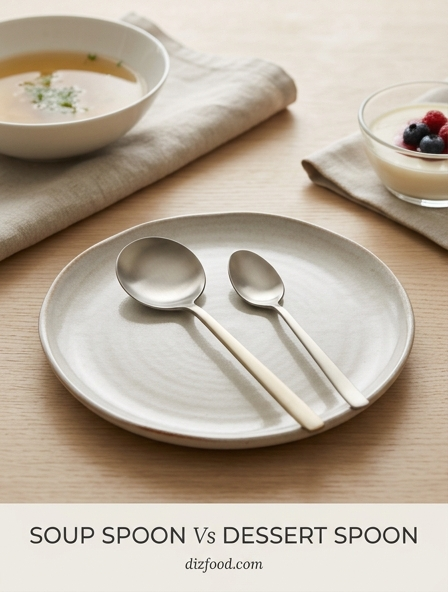
Soup Spoon vs Dessert Spoon Key Differences
In the intricate world of culinary cutlery, the distinction between a soup spoon and a dessert spoon is often a point of confusion for casual diners and home cooks alike. While both utensils are designed to deliver food to the mouth, their structural differences are rooted in the specific textures and temperatures of the foods they are intended to handle. A soup spoon is primarily categorized by its deep, circular bowl, which is engineered to hold liquid without spilling. In contrast, the dessert spoon features an elongated, oval bowl that is more versatile, designed to navigate the denser textures of cakes, custards, and puddings. These differences are not merely aesthetic; they play a critical role in the physics of dining.
When comparing these two pieces of silverware, several key factors immediately stand out:
- Bowl Geometry: Soup spoons are typically perfectly round or nearly round, whereas dessert spoons are tapered and oval.
- Length: A dessert spoon is generally longer than a standard teaspoon but shorter than a dinner spoon, whereas a soup spoon's length can vary depending on whether it is a cream soup or bouillon variety.
- Functional Depth: The "well" of a soup spoon is significantly deeper to accommodate broth and solid ingredients like noodles or vegetables.
- Etiquette: Each spoon holds a specific geographical location on a formal table, dictated by the order of the courses.
Understanding these nuances is essential for anyone looking to master formal table settings or improve their kitchen organization. Choosing the wrong spoon can result in an awkward dining experience, such as struggling to fit a wide soup spoon into a narrow dessert glass or failing to capture enough broth with a shallow dessert utensil.
Anatomy of the Round Soup Spoon
The anatomy of a round soup spoon is specifically tailored for the consumption of liquid-based dishes. The most striking feature of this utensil is its bowl, which is traditionally shaped like a perfect circle. This design allows the diner to approach the liquid from the side of the spoon rather than the tip, which is the proper etiquette for consuming soup. The deep, basin-like curvature of the bowl ensures that a generous amount of liquid is captured in a single dip, maintaining the temperature of the broth as it travels from the bowl to the mouth.
The handle of a soup spoon is often designed with a specific weight distribution to balance the heavy liquid load in the bowl. Most high-quality soup spoons feature a slightly thicker neck-the area where the handle meets the bowl-to prevent bending under the weight of hearty stews or thick chowders. The length of the handle is typically calibrated to rest comfortably against the hand while the bowl sits in a deep tureen or soup plate. In formal collections, you may encounter two specific variations of the round spoon: the larger cream soup spoon and the smaller bouillon spoon. While both share the circular bowl characteristic, the bouillon spoon is noticeably smaller, intended for clear broths served in narrow cups. The circular design is intentional, as it prevents the spoon from being inserted too deeply into the mouth, encouraging a sipping motion instead.
Understanding Dessert Spoon Dimensions
Dessert spoon dimensions occupy a middle ground in the hierarchy of flatware. They are larger than the common teaspoon used for stirring coffee but smaller and more refined than the tablespoon used for serving or eating heavy main courses. Typically, a dessert spoon measures between 7 and 8 inches in total length. This length is crucial because it provides the leverage needed to cut through semi-solid desserts like cheesecakes or dense mousses without requiring a separate knife. The bowl itself is usually about twice the capacity of a standard teaspoon, making it the perfect size for a satisfying "bite" of dessert.
| Feature | Standard Dimension | Comparison to Teaspoon |
|---|---|---|
| Total Length | 180mm - 200mm | Approx. 25% longer |
| Bowl Width | 35mm - 40mm | Noticeably wider |
| Volume | 10ml - 12.5ml | Double the capacity |
The width of the dessert spoon bowl is tapered. Unlike the soup spoon, which maintains a consistent diameter, the dessert spoon narrows at the tip. This allows the user to navigate the corners of a bowl or the layers of a parfait glass with ease. The depth is moderate-deep enough to hold a drizzle of sauce or a scoop of ice cream, but shallow enough that the food can be easily slid off by the lips. This versatility makes the dessert spoon a staple in both formal and informal dining, often doubling as a cereal spoon in many modern households due to its comfortable size and balanced proportions.
Comparing Bowl Shapes and Depths
The shape and depth of a spoon's bowl are the primary indicators of its intended function. The soup spoon's round, deep bowl is a masterpiece of fluid dynamics. By creating a spherical reservoir, the spoon minimizes the surface area of the liquid, which helps retain heat and prevents the liquid from sloshing over the edges. When you submerge a round soup spoon, it acts like a miniature ladle, bringing up a consistent volume of broth and solids. This depth is essential for soups containing large chunks of meat or vegetables, as a shallow spoon would allow the ingredients to tumble out.
Conversely, the dessert spoon utilizes an oval shape with a shallower profile. This shape is designed for "cutting" and "lifting." When eating a piece of cake or a tart, the pointed tip of the oval bowl acts as a leading edge, allowing the diner to break off a piece of the dessert cleanly. The shallower depth ensures that the entire contents of the spoon can be consumed in one go, which is important for sticky or creamy desserts that might otherwise get stuck in a deep, round well. Furthermore, the oval shape is more ergonomic for the mouth when consuming solids, as it mimics the natural opening of the lips more closely than a wide circle does. This subtle difference in geometry significantly alters the mouthfeel and the overall ease of the dining experience, proving that in kitchenware, form always follows function.
Standard Volume and Liquid Capacity
In the context of culinary measurements, volume and capacity are vital, especially when a recipe calls for a "spoonful" of an ingredient. While neither the soup spoon nor the dessert spoon is a legal unit of measure like the metric tablespoon (15ml), they do have standardized capacities in the world of flatware manufacturing. A standard dessert spoon typically holds approximately 10 to 12.5 milliliters of liquid. This is significantly more than the 5 milliliters held by a teaspoon, making it a robust tool for eating. In many British and Commonwealth culinary traditions, the "dessertspoon" is actually used as an informal unit of volume in older recipes, falling exactly between a teaspoon and a tablespoon.
The soup spoon, particularly the cream soup variation, often has a similar capacity to the dessert spoon in terms of raw volume, but its shape makes it feel larger. Because of its circular basin, it can hold a higher "head" of liquid without spilling. A bouillon spoon, being the smaller sibling of the soup family, usually holds around 8 to 10 milliliters. It is important to note that when using these spoons for actual dining, the "usable" capacity is often lower than the total volume to account for the movement of the hand. If you were to fill a dessert spoon to the brim with broth, the oval shape would likely lead to spills from the sides, whereas the round soup spoon is designed to keep that same volume of liquid centered and stable during transport.
Correct Formal Table Setting Placement
Etiquette plays a significant role in where these spoons are placed on a dining table. In a formal multi-course meal, the rule of thumb is to work from the "outside in." The soup spoon is almost always placed on the far right side of the plate, outside of the knives. This is because soup is traditionally served as one of the earliest courses. If there are multiple spoons on the right, the soup spoon will be the one furthest from the plate, unless a fruit course or an appetizer requiring a different spoon precedes it. Its presence on the right signifies that it is a "primary" utensil used during the main progression of the meal.
The dessert spoon, however, follows a completely different set of rules. In a formal European or American setting, the dessert spoon is not placed to the side of the plate. Instead, it is placed horizontally above the dinner plate, with the handle pointing toward the right. Often, it is paired with a dessert fork, which sits just below it with its handle pointing to the left. This "north of the plate" positioning signals to the diner that the utensil is reserved for the final course. In less formal settings, the dessert spoon might be brought out only when the dessert is served, often placed on the right side of the dessert plate itself. Understanding these placements prevents the social faux pas of using a soup spoon for chocolate mousse or, conversely, reaching for the dessert spoon when the lobster bisque arrives.
Best Uses for Large Soup Spoons
Large soup spoons, characterized by their wide, round bowls, are indispensable for specific types of liquid-heavy dishes. Their primary utility lies in their ability to handle "complicated" liquids. For instance, a hearty minestrone or a chunky beef stew requires a spoon that can support both the broth and the bulky ingredients simultaneously. The round bowl provides a stable platform for peas, beans, and diced vegetables, preventing them from rolling off as they might on an oval dessert spoon. Additionally, the large soup spoon is the ideal companion for creamy soups, such as tomato bisque or mushroom cream, where the goal is to savor the texture of the liquid.
Beyond traditional soups, these utensils are excellent for:
- Cereal: The deep bowl is perfect for holding milk and crunchy grains.
- Chili: It manages the thick consistency and various toppings like cheese or sour cream effectively.
- Risotto: While often eaten with a fork, a large soup spoon helps in scooping up the creamy rice and sauce.
- Dumplings: It provides enough surface area to lift a medium-sized dumpling along with its accompanying broth.
The large soup spoon is also functionally superior when dining from wide, shallow soup plates. The circular shape allows the user to "push" the spoon away from themselves to gather the liquid-a hallmark of proper etiquette-without the tip of the spoon catching on the rim of the plate. This makes the dining process smoother and more elegant, particularly in a formal environment where splashing must be avoided at all costs.
Identifying the Oval Dessert Spoon
Identifying an oval dessert spoon in a cluttered silverware drawer is relatively simple once you know what to look for. The primary identifier is the elongated, egg-shaped bowl. Unlike the soup spoon's perfect circle or the teaspoon's small, narrow profile, the dessert spoon looks like a scaled-up, more elegant version of a teaspoon. The bowl is usually quite symmetrical, but it tapers to a soft point at the top. This silhouette is specifically designed to facilitate the consumption of soft foods that require a bit of "nudging" or "cutting" with the side of the spoon.
Another identifying mark is the handle length. Dessert spoons often have a more decorative or slender handle compared to utility-focused soup spoons. Because dessert is the "finale" of the meal, the utensils used for it are often the most ornate in a flatware set. If you hold an oval dessert spoon next to a standard dinner spoon (the one used for the main course), you will notice that the dessert spoon is slightly smaller and lighter. In many modern 5-piece place settings, the spoon that people often mistake for a "large teaspoon" is actually the dessert spoon. Its oval shape is the key to its identity, providing a streamlined profile that is as functional for a crème brûlée as it is for a fruit salad.
Material and Handle Weight Variations
The material composition and weight of soup and dessert spoons greatly influence their durability and the sensory experience of the diner. Most high-quality kitchen utensils are crafted from stainless steel, specifically grades like 18/10, which contains 18% chromium for rust resistance and 10% nickel for a silver-like luster. Because soup spoons are often used with hot liquids, their handles are sometimes designed to be slightly thicker or hollowed to prevent heat conduction, ensuring the handle remains cool to the touch even when the bowl is submerged in boiling broth.
Weight distribution is another critical factor. A well-balanced spoon should feel comfortable in the hand, with the center of gravity typically located just where the handle begins to widen.
- Heavy Forged Spoons: These provide a sense of luxury and are less likely to bend, making them ideal for dense desserts like frozen ice cream.
- Stamped Spoons: Lighter and thinner, these are common in everyday kitchen sets but may feel "flimsy" when used for heavy stews.
- Silver Plating: Often reserved for formal dessert spoons, silver offers a unique "soft" mouthfeel and antimicrobial properties, though it requires more maintenance.
The handle weight of a dessert spoon is often lighter than that of a soup spoon to allow for more delicate movements. Since dessert is often eaten with a lighter touch, a heavy, clunky handle would feel out of place. Conversely, the soup spoon needs a bit of "heft" to feel stable when carrying a full load of liquid across the distance from the bowl to the mouth.
How to Choose the Right Utensil for Every Course
Choosing the right utensil is about matching the tool to the texture of the food. The general rule is: if it is liquid and served in a bowl, reach for the round soup spoon; if it is semi-solid, creamy, or served on a plate, the dessert spoon is your best bet. When hosting a dinner, consider the viscosity of your soup. A thin, clear broth like consommé is traditionally served with a small, round bouillon spoon, while a thick, hearty chowder demands the larger, standard soup spoon. The round shape is essential here because it allows the guest to sip correctly from the side of the bowl.
For the final course, the choice is dictated by the density of the dessert. While a dessert spoon is the "jack-of-all-trades" for sweets, some dishes might require even more specialization.
- Cakes and Tarts: Use the oval dessert spoon for its cutting edge.
- Puddings and Custards: The dessert spoon's capacity is perfect for capturing the right amount of cream.
- Ice Cream: A dessert spoon works well, but a heavier forged spoon is better for very cold, hard scoops.
- Fruit Cocktails: The elongated bowl of the dessert spoon can easily reach the bottom of a glass.
By providing the correct spoon, you enhance the diner's ability to enjoy the meal. A guest trying to eat a delicate panna cotta with a wide, round soup spoon will find the experience cumbersome, just as someone trying to eat a chunky minestrone with an oval dessert spoon will struggle to capture the ingredients. Matching the utensil to the course is the hallmark of a thoughtful host and a knowledgeable cook.

Comments