
If you're tired of watching neon-colored sponges crumble into microplastics after just a few weeks of washing, it's time to rethink your sink setup. Choosing between bamboo dish brushes and traditional plastic scrubbers is a trade-off between modern convenience and long-term sustainability. Bamboo brushes offer a durable, biodegradable alternative with naturally antimicrobial properties and compostable handles that don't sacrifice scrubbing power. On the other hand, while plastic scrubbers are inexpensive and flexible, they often harbor odors and contribute to the growing global waste problem. To help you decide which tool cleans up best, we've compared the essential factors of durability, hygiene, and environmental impact below.
| Feature | Bamboo Dish Brush | Plastic Scrubber |
|---|---|---|
| Material Source | Renewable bamboo & sisal fibers | Petroleum-based synthetics |
| Durability | 3-6 months (High) | 2-4 weeks (Low) |
| End-of-Life | 100% Compostable / Biodegradable | Non-recyclable; adds to landfills |
| Hygiene | Naturally antimicrobial; quick-drying | High bacteria retention; odor-prone |
| Scrubbing Power | Stiff natural bristles for heavy grime | Abrasive but softens quickly |
| Environmental Impact | Zero-waste; no microplastics | Sheds microplastics into waterways |
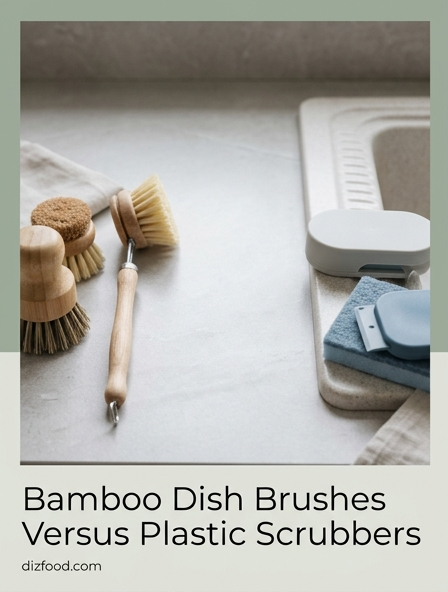
Environmental Impact of Bamboo vs Plastic Scrubbers
The environmental footprint of kitchen tools is a growing concern for modern households. When comparing bamboo dish brushes to plastic scrubbers, the primary differentiator lies in the lifecycle of the materials used. Plastic scrubbers are predominantly derived from petroleum, a non-renewable resource whose extraction and refining processes release significant greenhouse gases into the atmosphere. The manufacturing of synthetic sponges and nylon-bristled brushes is an energy-intensive process that relies on chemical polymers, often resulting in industrial runoff that can contaminate local water supplies.
In contrast, bamboo is a carbon-sequestering powerhouse. As a grass, it grows incredibly fast without the need for pesticides or heavy irrigation. During its growth phase, bamboo absorbs more carbon dioxide and produces more oxygen than an equivalent stand of trees. When a bamboo brush is manufactured, the carbon footprint remains relatively low, especially if the bristles are made from natural fibers like sisal or coconut husk. This creates a "cradle-to-grave" cycle that is significantly more harmonious with the ecosystem.
- Plastic scrubbers contribute to the expansion of landfills and take centuries to decompose.
- Bamboo tools are often carbon-neutral or even carbon-negative over their entire lifespan.
- The production of plastic involves toxic precursors like benzene and ethylene.
- Natural bamboo components are harvested using methods that prevent soil erosion and promote biodiversity.
Durability and Longevity Comparison
Many consumers assume that plastic is the more durable choice because of its synthetic resilience. However, the reality of kitchen wear and tear often tells a different story. Plastic scrubbers, particularly foam sponges and thin nylon brushes, tend to degrade quickly. The bristles on cheap plastic brushes often bend, splay, or melt when exposed to high temperatures, such as when cleaning a hot cast-iron skillet. Once the structural integrity of a plastic scrubber is compromised, it becomes less effective at removing stuck-on food, leading to more frequent replacements.
Bamboo dish brushes are engineered for toughness. The dense grain of the bamboo handle provides a sturdy grip that does not snap under pressure. When paired with high-quality natural bristles, these brushes can withstand rigorous scrubbing and high-temperature water without losing their shape. While bamboo does require a bit of care-such as being allowed to dry between uses to prevent cracking-it often outlasts the average plastic sponge by several months. This longevity makes it a superior choice for those who want a reliable tool that doesn't need to be tossed into the bin every few weeks.
| Feature | Bamboo Brush | Plastic Scrubber |
|---|---|---|
| Heat Resistance | High (Boiling water safe) | Low (Bristles may melt) |
| Handle Strength | Rigid and sturdy | Flexible, prone to snapping |
| Average Lifespan | 3 to 6 months | 2 to 4 weeks |
Natural Antibacterial Properties of Bamboo Brushes
One of the most compelling reasons to switch to bamboo in the kitchen is its inherent biological makeup. Bamboo contains a unique natural bio-agent known as "Bamboo Kun." This substance is naturally resistant to pests and pathogens during the plant's growth, and these properties carry over into the processed wood used for dish brushes. In a kitchen environment where moisture and food particles are constant, having a tool that resists the growth of odor-causing bacteria is a significant advantage over synthetic alternatives.
Plastic scrubbers and sponges are notorious for becoming breeding grounds for bacteria like E. coli and Salmonella. Because plastic is non-porous but the structures of sponges are highly absorbent, they trap moisture and organic matter in "micro-pockets" that are difficult to clean effectively. This leads to that familiar sour smell associated with old kitchen sponges. Bamboo handles, especially when treated with natural oils, are less hospitable to these microbes. Furthermore, natural fiber bristles like union fiber or sisal tend to dry faster than dense synthetic sponges, further inhibiting the moist conditions that bacteria need to thrive. By choosing bamboo, you are opting for a tool that remains fresher for longer and requires fewer harsh chemical sanitizers to keep clean.
The Hidden Problem with Plastic Microplastics
While the visual accumulation of plastic waste in oceans is well-documented, the "hidden" impact of plastic scrubbers occurs every time you wash a dish. As synthetic brushes and sponges are used, the friction against plates and pans causes tiny fragments of plastic to break off. These fragments, known as microplastics, are often less than five millimeters in size. Because they are so small, they easily pass through household drains and bypass municipal water filtration systems, eventually ending up in rivers, lakes, and the ocean.
Once in the aquatic environment, microplastics are ingested by fish and other marine life, entering the food chain and eventually making their way back to human consumers. The environmental impact is staggering, as billions of these particles are released annually from household cleaning activities alone. Bamboo brushes, conversely, utilize natural fibers for their bristles. If a fiber from a sisal or coconut brush breaks off, it is simply a piece of organic matter that will naturally decompose in the water system without leaching toxins or harming wildlife.
- Synthetic sponges shed thousands of microplastic fibers over their short lifespan.
- Microplastics absorb persistent organic pollutants (POPs) in the water, increasing their toxicity.
- Natural fiber brushes are 100% microplastic-free.
- Reducing plastic scrubbers at the source is the only way to prevent this specific type of water pollution.
Sustainable Sourcing and Renewable Resources
Sustainability is not just about how a product ends its life, but how it begins. Bamboo is one of the most renewable resources on the planet. Some species of bamboo can grow up to three feet in a single day, meaning it can be harvested every three to five years without damaging the ecosystem or requiring replanting. Since the root system remains intact, the plant continues to grow after harvest, preventing soil erosion and maintaining the health of the land. This makes it an incredibly efficient crop compared to the timber used for other wood products or the fossil fuels used for plastics.
The sourcing of plastic scrubbers is fundamentally different. Plastic production relies on the extraction of crude oil and natural gas, processes that are inherently destructive to the environment. The supply chain for plastic involves massive refineries and chemical plants that consume vast amounts of energy and water. By choosing bamboo, consumers support an industry that incentivizes the planting of forests rather than the depletion of finite geological resources. It is a transition from a linear "take-make-waste" economy to a circular one that respects the natural limits of the Earth's regenerative capacity.
Biodegradable Disposal vs Plastic Waste
The end-of-life stage for a kitchen scrubber is where the disparity between bamboo and plastic is most stark. When a plastic brush or sponge reaches the end of its utility, its journey usually leads to a landfill. Because most plastic scrubbers are made from mixed materials-such as a plastic handle fused with nylon bristles and metal staples-they are virtually impossible to recycle. In a landfill, these items will sit for hundreds of years, slowly breaking down into smaller pieces but never truly disappearing, all while potentially leaching chemicals into the surrounding soil.
Disposing of a bamboo dish brush is a much more straightforward and eco-friendly process. Most high-quality bamboo brushes are designed to be fully biodegradable. To dispose of one properly, a user can follow these simple steps:
- Remove any metal components (like the wire holding the bristles) with pliers for scrap metal recycling.
- The bamboo handle can be placed directly into a home compost bin or buried in the garden.
- The natural fiber bristles (sisal, coconut, or palmyra) can also be composted alongside food scraps.
- Within a few months to a year, the entire tool will have returned to the earth as nutrient-rich soil.
Scrubbing Power and Cleaning Performance Efficiency
A common misconception is that natural materials cannot match the "scrubbing power" of laboratory-engineered plastics. In practice, bamboo brushes often outperform their synthetic counterparts in heavy-duty cleaning tasks. The bristles used in bamboo brushes are typically sourced from plants like Agave (sisal) or Coconut husks. These fibers are naturally stiff and resilient, providing the necessary abrasion to remove burnt-on food from stainless steel or cast iron without scratching delicate surfaces. Because the fibers are naturally porous, they hold soap and water more effectively than smooth nylon, creating a richer lather that aids in the breakdown of grease.
Plastic scrubbers often rely on harsh, thin bristles that can struggle with grease. Over time, these bristles lose their "spring," becoming flat and ineffective. Bamboo brushes, particularly the short-handled "pot scrubbers," allow the user to apply direct downward pressure, utilizing the strength of the bamboo handle to do the hard work. This ergonomic advantage, combined with the superior texture of natural fibers, ensures that cleaning is both faster and more efficient. Whether you are cleaning a delicate wine glass or a crusty roasting pan, there is a specific bamboo brush configuration designed to handle the task with precision.
Economic Long Term Cost Analysis
At first glance, a bamboo dish brush might seem more expensive than a multi-pack of cheap plastic sponges or a dollar-store scrub brush. However, a long-term cost analysis reveals that bamboo is the more economical choice. Plastic sponges degrade rapidly, often becoming unsanitary or falling apart within two weeks of heavy use. If a household replaces a plastic sponge every two weeks, they may go through 26 sponges a year. Even at a low cost per unit, the annual expenditure adds up, not to mention the hidden "environmental cost" that society pays for waste management.
A single high-quality bamboo brush can last for four to six months with proper care. Many bamboo brush systems also feature replaceable heads, meaning you only need to buy the handle once and can swap out the bristle portion as needed. This modularity significantly reduces the cost over time. When you factor in the durability and the reduced need for chemical cleaners due to the brush's superior mechanical scrubbing action, the bamboo option becomes the clear financial winner for the savvy homeowner.
| Cost Factor | Plastic Sponges (Annual) | Bamboo Brush (Annual) |
|---|---|---|
| Replacement Frequency | 24-26 times | 2-3 times (or head refills) |
| Average Annual Cost | $30 - $50 | $15 - $25 |
| Waste Generated | High (Non-recyclable) | Low (Compostable) |
Health Safety and Chemical Free Cleaning
The safety of materials that come into contact with our food surfaces is paramount. Plastic scrubbers are often manufactured with various chemical additives to give them color, flexibility, or "antibacterial" properties (such as Triclosan). Over time, and especially when exposed to hot water and detergents, these chemicals can leach out of the plastic and onto your dishes. Furthermore, the dyes used in synthetic sponges can bleed out, leaving chemical residues on surfaces where food is prepared. For families looking to reduce their toxic load, the kitchen sink is a critical place to start.
Bamboo brushes offer a chemical-free alternative. A high-quality bamboo brush consists of raw bamboo, natural plant fibers, and perhaps a stainless steel wire or a natural citrus-oil finish. There are no endocrine disruptors like BPA or phthalates to worry about. Using a natural tool allows for a "mechanical clean" rather than a "chemical clean." Because the bristles are so effective at removing debris, users often find they can use milder, biodegradable soaps rather than harsh, concentrated detergents. This creates a safer environment for children and pets and ensures that your "clean" dishes are truly free of synthetic residues.
Final Verdict Choosing the Best Dish Scrubber
When weighing the evidence across environmental impact, durability, health safety, and performance, the choice becomes clear. While plastic scrubbers offer a deceptive convenience and low entry price, they carry significant hidden costs in the form of microplastic pollution, frequent waste, and potential chemical exposure. They are a relic of a "disposable" culture that is increasingly at odds with the needs of our planet and our personal health. Bamboo dish brushes represent a return to high-quality, functional craftsmanship that respects the environment without sacrificing cleaning efficiency.
Transitioning to bamboo is a small but impactful step toward a more sustainable kitchen. The superior scrubbing power, natural antibacterial properties, and the ability to compost the tool at the end of its life make it the gold standard for eco-conscious consumers. By making the switch, you are not only getting a better tool for your dishes, but you are also participating in a larger movement to protect our oceans and reduce our reliance on fossil fuels.
- Choose bamboo for a 100% biodegradable and compostable cleaning solution.
- Opt for brushes with replaceable heads to maximize economic savings.
- Ensure the brush is kept in a dry spot to maintain its longevity.
- Support brands that use sustainably harvested, FSC-certified bamboo.




Comments