
Whether you're a home cook or a seasoned chef, the battle for kitchen efficiency often boils down to two essential tools: the nimble paring knife and the specialized vegetable peeler. While a paring knife offers unmatched versatility for intricate tasks like de-veining shrimp or segmenting citrus, the vegetable peeler is the undisputed champion of speed when it comes to stripping skins from root vegetables and tough-skinned fruits. Understanding the trade-offs between the precision blade-control of a knife and the streamlined, ergonomic efficiency of a peeler is the secret to mastering your kitchen prep speed, allowing you to breeze through mise en place with minimal waste and maximum safety.
| Feature | Vegetable Peeler | Paring Knife |
|---|---|---|
| Prep Speed | Ultra-fast for long, uniform strokes. | Slower; requires manual depth control. |
| Waste Control | Thin, consistent shavings save flesh. | Higher risk of removing usable produce. |
| Safety Profile | High; blade is shielded by a frame. | Lower; requires advanced hand-eye coordination. |
| Versatility | Limited to peeling and shaving ribbons. | High; slices, cores, minces, and trims. |
| Ergonomics | Ideal for large batches; less wrist fatigue. | Best for detail work; can strain on repetitive tasks. |
| Best Use Case | Potatoes, carrots, cucumbers, asparagus. | Berries, citrus, garnishes, and coring. |
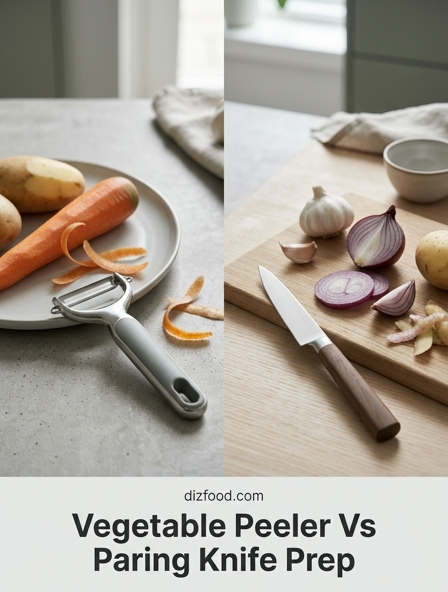
Vegetable Peeler vs Paring Knife Efficiency Comparison
When evaluating the efficiency of kitchen prep, the vegetable peeler often outperforms the paring knife in high-volume environments. The primary advantage of a peeler lies in its specialized design, which features a floating blade that follows the contours of the produce. This allows for a consistent depth of cut and a much faster stroke. For bulk tasks like prepping twenty pounds of potatoes for a mash or stripping carrots for a large salad, a Y-peeler or a swivel peeler can reduce prep time by nearly half compared to using a traditional paring knife.
Conversely, the paring knife offers a different kind of efficiency related to versatility. While it may take longer to peel a single potato, the knife eliminates the need to switch tools for subsequent tasks like removing eyes, dicing, or slicing. In a professional setting, the time spent reaching for and cleaning multiple gadgets can add up. The following table highlights the performance differences across common prep tasks:
| Task | Vegetable Peeler | Paring Knife |
|---|---|---|
| Bulk Skin Removal | High Efficiency | Low Efficiency |
| Irregular Surfaces | Moderate Efficiency | High Efficiency |
| Prep for Slicing | Requires Secondary Tool | Single Tool Solution |
Best Kitchen Tools for Fruit and Vegetable Skin Removal
Selecting the right tool for skin removal depends heavily on the texture, thickness, and shape of the fruit or vegetable. For thin-skinned produce such as carrots, cucumbers, and parsnips, a standard swivel peeler is almost always the superior choice. The dual-sided blade allows for bidirectional movement, which maximizes speed. However, for fruits with delicate skins like tomatoes or peaches, a serrated peeler is necessary to grip the slick surface without crushing the soft flesh underneath.
For thick-skinned or hard produce, the choice becomes more nuanced. A paring knife is often preferred for citrus fruits where the goal is to remove the zest and pith together, or for tough-skinned squashes where a peeler might get stuck. The following list categorizes the best applications for each tool:
- Swivel Peeler: Ideal for long, straight vegetables like carrots and zucchini.
- Y-Peeler: Best for wide-surface vegetables like eggplant and large potatoes.
- Serrated Peeler: Essential for soft-fleshed fruits like plums, tomatoes, and kiwis.
- Paring Knife: Best for thick-skinned items like mangoes, avocados, and citrus.
Ultimately, a well-equipped kitchen should have a variety of peelers to handle different textures, while relying on the paring knife for more robust or intricate skin removal tasks that require significant force.
Precision Cutting and Detailed Prep with Paring Knives
The paring knife is the ultimate precision instrument in a cook's arsenal. While a peeler is designed for surface-level work, the paring knife excels at internal detail and intricate shaping. Because the blade is short-typically between 2.5 and 4 inches-it provides a high degree of leverage and control. This makes it the only viable choice for tasks such as hulling strawberries, coring apples, or deveining shrimp. The tip of the knife acts as an extension of the finger, allowing for surgical accuracy that a peeler cannot replicate.
Detailed prep also includes decorative work, such as fluting mushrooms or creating radish roses. In these instances, the cook holds the produce in one hand and the knife in the other, using the thumb as a guide and a pivot point. This "in-hand" cutting technique is fundamental to classical culinary training. Beyond decoration, the paring knife is essential for removing localized blemishes, such as the eyes of a potato or the bruised spots on a pear, which requires a deep, angled cut that a peeler's flat blade simply cannot achieve. In the world of detailed prep, the paring knife remains the undisputed king of the cutting board.
Speed and Safety Benefits of Using a Vegetable Peeler
One of the most significant advantages of using a vegetable peeler over a paring knife is the inherent safety it provides, particularly for novice cooks or those working at high speeds. The design of a peeler keeps the sharp edge partially shielded or directed away from the hands, significantly reducing the risk of deep lacerations. Because the blade is fixed to a frame, it prevents the tool from slipping into the user's palm, a common injury associated with improper paring knife technique.
In addition to safety, the speed gain is a result of the reduced cognitive load required to maintain a consistent cut. When using a knife, the cook must constantly monitor the angle and pressure of the blade to avoid taking off too much flesh. A peeler handles this automatically. The speed and safety benefits are summarized below:
- Depth Control: Built-in spacers prevent the blade from digging too deep into the produce.
- Ergonomic Motion: Natural pulling or pushing motions are easier to maintain over long periods.
- Reduced Slippage: Many modern peelers feature non-slip rubber grips for better control in wet conditions.
- Surface Contact: The pivoting head maintains constant contact with the food, minimizing wasted motion.
For these reasons, vegetable peelers are the preferred tool in residential kitchens for family meal prep and in professional kitchens during high-pressure prep shifts where safety and velocity are equally prioritized.
Reducing Food Waste Peeling Thin vs Thick Skins
Minimizing food waste is a critical aspect of kitchen economics and sustainability. The vegetable peeler is specifically engineered to remove only the outermost layer of the skin, preserving the nutrient-rich flesh immediately beneath the surface. For produce like potatoes and carrots, where many vitamins are concentrated just under the skin, a peeler ensures that the maximum amount of edible material is retained. A paring knife, even in the hands of a skilled chef, tends to remove thicker strips, resulting in a higher percentage of discarded food.
However, the "waste" factor changes when dealing with thick-skinned produce. For items like butternut squash or pineapple, a peeler may actually be less efficient because it requires multiple passes to get through the tough exterior, often resulting in a ragged surface. In these cases, a paring knife allows for a single, deep, purposeful cut that follows the inner curve of the fruit, often resulting in a cleaner yield. The following table compares the typical waste percentage generated by each tool:
| Produce Type | Peeler Waste (%) | Knife Waste (%) |
|---|---|---|
| Russet Potato | 3% - 5% | 10% - 15% |
| Carrot | 2% - 4% | 8% - 12% |
| Apple | 5% - 7% | 12% - 18% |
When to Choose a Paring Knife for Complex Produce
While the vegetable peeler is a powerhouse for uniform vegetables, it often fails when faced with complex, irregular, or extremely tough produce. A paring knife is the necessary choice for "nobby" vegetables like ginger or sunchokes. The crevices and protrusions of these items are inaccessible to a flat peeler blade. A knife allows the cook to carve around the bumps or trim them off entirely, ensuring that no skin is left in the recesses of the vegetable.
Complex produce also includes items with varying densities. For example, when prepping a celery root (celeriac), the exterior is so thick and hairy that a peeler would likely break or dull instantly. A sturdy paring knife, or even a utility knife, is required to "slaughter" the vegetable, removing the heavy outer rind with downward vertical strokes. Additionally, for small, round items like shallots or garlic, a knife is the only tool that can effectively peel the papery skin while simultaneously trimming the root ends. Choosing a paring knife for these complex tasks ensures that the prep is thorough and that the final product is free of unpalatable skin or tough fibers.
Ergonomic Advantages of Modern Vegetable Peeler Designs
Modern kitchen tool engineering has placed a significant emphasis on ergonomics, particularly for vegetable peelers. Traditional peeling with a knife requires a tight "pinch grip" and repetitive wrist rotation, which can lead to fatigue or exacerbate conditions like carpal tunnel syndrome. In contrast, modern peelers are designed to distribute pressure across the palm and use larger muscle groups in the arm rather than the fine motor muscles of the fingers.
The two most common ergonomic designs are the I-shape (straight) and the Y-shape. The I-shape is excellent for those who prefer a traditional peeling motion away from the body, while the Y-peeler allows for a more natural pulling motion toward the body, which many find more comfortable for large-scale tasks. Key ergonomic features include:
- Over-molded Handles: Soft, thermoplastic grips that provide comfort and prevent slipping even when hands are wet.
- Pivoting Blades: Heads that tilt to accommodate the natural angle of the wrist, reducing the need for awkward positioning.
- Large Diameters: Thicker handles that are easier to grasp for individuals with limited hand mobility or arthritis.
By prioritizing user comfort, these designs allow for longer prep sessions with less physical strain, making the peeler an essential tool for both professional prep cooks and home enthusiasts who value ease of use.
Mastering Knife Skills for Traditional Hand Peeling
Mastering the art of hand peeling with a paring knife is a rite of passage for many culinary students. Unlike the mechanical simplicity of a peeler, hand peeling requires a refined sense of touch and spatial awareness. The technique involves holding the produce in the non-dominant hand and the knife in the dominant hand, with the blade facing toward the user. The thumb of the knife-hand rests on the produce, acting as a stabilizer and controlling the depth of the cut as the hand rotates the vegetable.
This traditional skill is not just about removing skin; it is about learning how to manipulate a blade in three-dimensional space. It teaches the cook how to follow the natural curves of the ingredient, a skill that translates to butchery and more advanced carving. Furthermore, in many traditional cuisines, hand peeling is preferred because it allows the cook to leave a slightly faceted surface on the vegetable, which can be a sign of hand-crafted quality. While it may be slower and produce slightly more waste, the control gained through mastering this technique is invaluable for any cook looking to elevate their precision and versatility in the kitchen.
Versatility of Paring Knives in Professional Kitchen Prep
In a professional kitchen, the paring knife is often referred to as the "second most important knife" after the chef's knife. Its versatility extends far beyond simple peeling. It is used for "tournéing" vegetables-cutting them into consistent, seven-sided football shapes-a classic French technique that ensures even cooking and an elegant presentation. It is also the tool of choice for supremeing citrus, where the knife must slide between thin membranes to release clean wedges of fruit.
The paring knife's utility is further demonstrated in tasks that require a delicate touch and a sharp point. These include:
- Scoring: Creating shallow cuts in the skin of ducks or tomatoes to help them expand or shed skin during cooking.
- Testing Doneness: The thin blade can be inserted into roasting vegetables or meats to check tenderness with minimal damage.
- Opening Packaging: In a fast-paced environment, it is the quickest tool for opening vacuum-sealed bags or boxes.
- Seed Removal: Effortlessly scraping seeds from peppers or vanilla beans.
Because the paring knife can perform these varied functions, it remains a permanent fixture on a chef's belt or in their knife roll. It is a multi-purpose tool that bridges the gap between rough prep and fine finishing work.
Choosing the Right Tool for Every Type of Produce
Deciding between a vegetable peeler and a paring knife ultimately comes down to the specific requirements of the ingredient and the desired end result. A general rule of thumb is to use a peeler for speed, safety, and yield on uniform surfaces, and a paring knife for precision, detail, and complex geometries. When faced with a crate of produce, the cook should assess the skin's thickness, the fruit's shape, and the final application of the ingredient.
To help streamline the decision-making process, consider the following selection criteria based on produce characteristics:
| Produce Characteristic | Recommended Tool | Reasoning |
|---|---|---|
| Long and Straight | Swivel Peeler | Continuous, fast strokes. |
| Small and Round | Paring Knife | Better control and rotation. |
| Tough/Waxy Rind | Y-Peeler or Knife | Requires more downward force. |
| Intricate/Bumpy | Paring Knife | Ability to maneuver around pits. |
By matching the tool to the task, you not only improve the quality of your prep but also make the process more enjoyable. Whether you are a professional chef aiming for perfection or a home cook trying to get dinner on the table, knowing when to reach for the peeler and when to use the paring knife is a fundamental kitchen skill.

Comments