
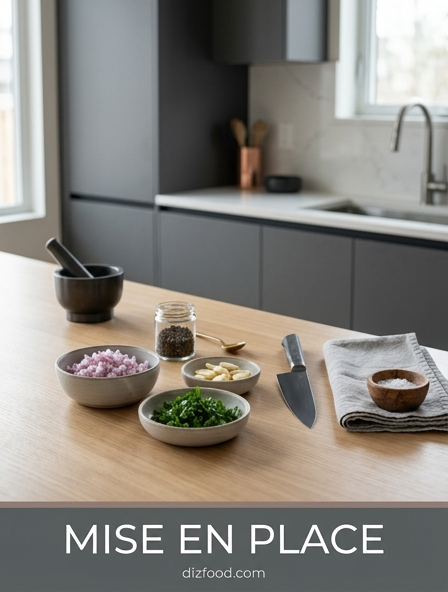
Mastering Precise Dicing Geometry
The foundation of professional mise en place lies in the geometric precision of vegetable cuts. Achieving uniformity is not merely an aesthetic choice; it is a fundamental requirement for even cooking. When ingredients are cut to identical dimensions, they respond to heat at the same rate, preventing a mixture of mushy overcooked pieces and crunchy raw centers. Mastering these shapes requires a deep understanding of the standard culinary dimensions used in high-end kitchens.
| Cut Name | Dimensions (Inches) | Common Use Cases |
|---|---|---|
| Fine Brunoise | 1/16 x 1/16 x 1/16 | Garnishes, consommé |
| Small Dice | 1/4 x 1/4 x 1/4 | Sautés, mirepoix |
| Medium Dice | 1/2 x 1/2 x 1/2 | Stews, hearty soups |
| Large Dice | 3/4 x 3/4 x 3/4 | Roasts, stocks |
To achieve these results, one must first square off the vegetable to create a stable rectangular prism. This removes the rolling hazards of round produce and provides the flat surfaces necessary for consistent planks, batons, and eventually, perfect cubes. This disciplined approach to geometry transforms raw ingredients into a professional components ready for the pan.
Essential Knife Skills for Rapid Prep
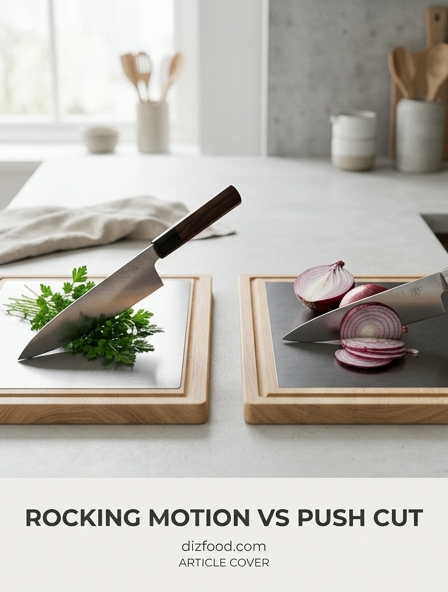
Speed in the kitchen is a byproduct of efficient movement rather than frantic exertion. Developing rapid prep skills starts with the fundamental "claw grip," where the fingertips are tucked inward and the knuckles guide the blade. This safety measure allows the cook to focus entirely on the rhythm of the cut. By utilizing the knife's fulcrum-keeping the tip on the board for a rocking motion or using a smooth push-cut for vertical slicing-you minimize unnecessary lifting and reduce fatigue during long prep sessions.
- The Pinch Grip: Choking up on the bolster for maximum control and leverage.
- The Rocking Motion: Ideal for mincing herbs and small aromatics quickly.
- The Draw Cut: Pulling the blade through delicate items like proteins to prevent tearing.
- Circular Rhythm: Maintaining a steady tempo to automate the dicing process.
Consistency is built through repetition and the elimination of wasted motion. A skilled chef keeps the knife close to the board, utilizing the full length of the edge to ensure clean cuts in a single stroke. As muscle memory develops, the transition between different ingredients becomes seamless, significantly reducing the time spent at the cutting station before service begins.
Strategizing Your Station Layout
A well-organized station, often referred to as the "cockpit," is designed to minimize physical reaching and maximize output. The layout should follow a logical flow of production, typically moving from raw product to the cutting zone, and finally to the finished prep container. By positioning your tools and ingredients in a semi-circle around your primary workspace, you reduce the need to shift your feet or turn your body, which saves time and energy over an eight-hour shift.
- Central Work Zone: Your cutting board should be centered and stabilized with a damp paper towel or non-slip mat.
- Raw Product: Positioned to the non-dominant side (usually the left) for easy retrieval.
- Waste Management: A "scraps" bin placed directly adjacent to the board to keep the surface clear.
- Finished Product: Stacked containers to the dominant side for immediate transfer of processed items.
- Tool Access: Bench scrapers, tasting spoons, and towels within arm's reach.
Effective station management also involves vertical space. Utilizing speed racks or shelving above the station for empty containers ensures that the immediate work surface remains uncluttered. This spatial strategy prevents "prep-blindness," allowing the cook to remain focused on the task at hand without the distraction of a chaotic environment.
Choosing the Right Cutting Boards
The cutting board is the most critical interface in the kitchen, serving as the foundation for every prep task. Choosing the right material depends on the volume of work and the specific ingredients being handled. Professional kitchens prioritize durability, sanitation, and knife edge retention. While wood boards offer a classic feel and are gentle on blades, high-density polyethylene (plastic) boards are the industry standard due to their ability to withstand high-temperature commercial dishwashers and their color-coding capabilities.
| Board Color | Designated Food Group | Reasoning |
|---|---|---|
| Red | Raw Red Meat | Prevent cross-contamination of pathogens | Raw Poultry | Isolating salmonella risks |
| Green | Produce and Fruits | Maintaining freshness and flavor purity |
| Blue | Raw Seafood | Managing specific allergens and odors |
Regardless of the material, size is paramount. A board that is too small leads to crowded prep and increased risk of accidents. A standard 18x24-inch board provides ample space for both the ingredient being worked on and the resulting pile of cuts. Proper maintenance, including regular resurfacing of plastic boards to remove deep grooves, ensures a sanitary surface and a longer lifespan for your cutlery.
Streamlining Ingredient Organization
Organization is the psychological component of mise en place. Once ingredients are processed, they must be grouped and stored in a way that aligns with the cooking sequence. This prevents the frantic search for a specific herb or acid during the heat of service. Grouping ingredients by their "pick time"-the moment they enter the pan-allows for a streamlined transition from prep to execution. For example, all aromatics for a base mirepoix should be stored together, while delicate finishing garnishes are kept separate to maintain their integrity.
Effective organization also utilizes the concept of "kits." If a specific dish requires five distinct components, those components should be stored in a single partitioned tray or a designated area of the reach-in cooler. This reduces the cognitive load on the line cook. Labeling is equally vital; every container should feature the name of the item, the date of prep, and the initials of the cook. This ensures a "First-In, First-Out" (FIFO) rotation, maintaining the highest possible quality and safety standards throughout the kitchen's inventory.
Batch Dicing for Maximum Efficiency
Batch processing is the technique of performing one specific action across a large volume of product before moving to the next step. Instead of washing, peeling, and dicing one carrot at a time, a professional cook performs each action for the entire 50-pound case sequentially. This approach exploits the efficiency of repetitive motion and minimizes the need to switch tools or clean the station mid-task. By focusing on a single mechanical movement, the cook reaches a state of "flow" where speed and accuracy naturally increase.
The sequence for batch dicing usually follows this hierarchy: washing and sanitizing all produce, followed by peeling and topping/tailing, then squaring off all items into planks, and finally stack-cutting them into the desired dice. This method also allows for better waste management, as all peels and scraps are generated at once and can be immediately transferred to the stock pot or compost. By treating prep as an assembly line rather than a series of individual recipes, a kitchen can produce massive quantities of mise en place with a fraction of the labor traditionally required.
Standardizing Prep Container Systems
A chaotic assortment of mismatched bowls and lids is a significant drain on kitchen productivity. Standardizing a container system-using specific sizes like quarts, pints, and sixth-pans-creates a modular environment where everything fits together perfectly. This uniformity allows for efficient stacking in walk-in coolers, maximizing available storage space and providing a clear visual indicator of inventory levels. When every container uses the same lid size, the time wasted searching for matching hardware is completely eliminated.
- Deli Containers: Clear, inexpensive, and excellent for liquids or small quantities of prepped veg.
- Lexans and Cambros: Large-scale storage for bulk prepped items like washed greens or stocks.
- Stainless Steel Hotel Pans: Ideal for high-heat environments and holding items on the line.
- Sixth-Pans and Ninth-Pans: The standard for assembly stations and garnishes.
Standardization also extends to the volume of prep. Using containers with graduated markings allows cooks to track yield and adjust prep lists based on historical usage. By knowing exactly how many "quarts" of onions are needed for a Friday night service, the chef can provide more accurate instructions to the prep team, reducing over-prep and subsequent food waste.
Maintaining a Sharp Edge Daily
A dull knife is a dangerous tool that forces the cook to apply excessive pressure, increasing the likelihood of a slip. Daily maintenance of the knife's edge is a non-negotiable part of mise en place. This process typically involves two distinct stages: honing and sharpening. Honing, performed multiple times a day using a ceramic or steel rod, does not remove metal but rather realigns the microscopic "teeth" of the blade that bend during use. This keeps the knife feeling sharp and sliding through skins with ease.
Actual sharpening on whetstones should occur weekly or monthly depending on the volume of work. This involves grinding the edge to create a new bevel. To check for a functional edge, many cooks use the "tomato test" or "paper test." If a blade cannot slice through a ripe tomato under its own weight, it requires attention. Maintaining a 15-to-20-degree angle during both honing and sharpening is the key to a durable, razor-sharp edge. A sharp knife not only improves safety but also preserves the cellular structure of the food, resulting in better texture and slower oxidation of prepped ingredients.
Minimizing Waste Through Proper Technique
In a professional kitchen, profitability is often measured by what ends up in the trash. Minimizing waste through superior technique is a hallmark of an experienced cook. This begins with the "squaring off" process during dicing. Instead of discarding the rounded edges of a potato or onion, these trims should be reserved for purees, stocks, or staff meals. Using a peeler with a sharp blade ensures that only the thinnest layer of skin is removed, preserving the nutrient-dense flesh underneath. Furthermore, understanding the anatomy of produce-such as using parsley stems for herb oils rather than just the leaves-doubles the utility of a single ingredient.
Proper technique also involves precision in trimming proteins. Removing silver skin or fat caps with a flexible boning knife allows for maximum yield of the primary cut. Every gram of usable product saved adds up over hundreds of covers. Training staff to use bench scrapers instead of their hands to transfer food ensures that 100% of the prepped item makes it into the container. By treating scraps as secondary ingredients rather than garbage, a kitchen can significantly lower its food cost percentage while exercising creative resourcefulness.
Advanced Workflow Sequencing Tactics
Advanced mise en place is as much a mental exercise as a physical one. It involves sequencing tasks based on "passive time" versus "active time." A skilled cook identifies which tasks can run in the background-such as roasting bones for stock, proofing dough, or reducing a sauce-and starts those first. While the heat does the work, the cook engages in active prep like dicing or portioning. This layering of tasks ensures that no minute is wasted and that multiple components of a dish reach completion simultaneously.
Sequencing also considers the "shelf life" of prep. Ingredients that oxidize quickly, like avocados or apples, are scheduled for the very end of the prep list. Conversely, hearty root vegetables or marinades that benefit from time are handled early. This tactical approach requires a comprehensive view of the entire menu. By visualizing the final assembly of each plate before a single knife stroke is made, the cook can organize their day into a series of logical, high-efficiency blocks. This level of strategic planning is what separates a line cook from a chef, transforming a list of chores into a synchronized performance of culinary production.


Comments