
The Foundation of Professional Knife Skills
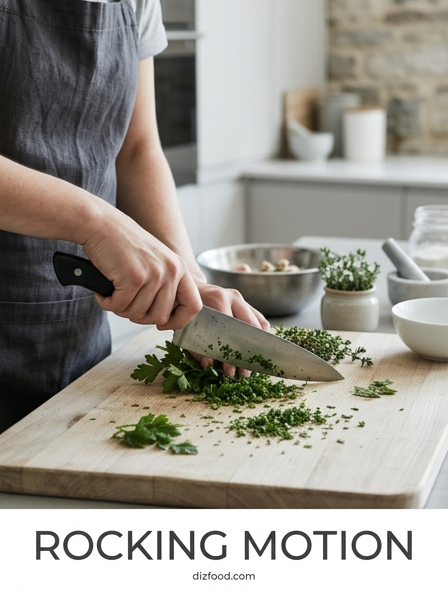
The bedrock of any culinary career begins with the fundamental ability to handle a blade with confidence and intent. Professional knife skills are not merely about speed; they are about safety, efficiency, and the preservation of the ingredient's integrity. When a chef masters the foundational movements, they reduce waste and ensure that every cut contributes to the final texture and presentation of the dish. The rocking motion is the most celebrated of these techniques, providing a stable and rhythmic approach to processing large quantities of herbs, aromatics, and vegetables.
Establishing this foundation requires an understanding of balance and leverage. A cook must learn to use the weight of the knife to their advantage, allowing the steel to do the work rather than relying on brute force. This approach minimizes fatigue during long prep sessions and prevents the repetitive strain injuries often seen in high-volume kitchens. By prioritizing form over speed in the early stages of training, a cook builds the necessary neurological pathways to perform complex tasks instinctively, allowing them to focus on the nuances of the recipe rather than the mechanics of the tool.
Anatomy of the Rocking Motion Technique
The rocking motion technique relies on the specific curvature of a Western-style chef's knife. Unlike a vertical chop, this method maintains constant contact between the tip of the blade and the cutting board, acting as a fulcrum. As the handle is lifted and lowered, the belly of the blade rolls over the ingredient, creating a smooth, shearing action that produces clean cuts without crushing delicate fibers.
- The Pivot Point: The front third of the blade remains grounded, guiding the direction of the cut.
- The Heel Elevation: The rear of the knife is lifted high enough to clear the ingredient before being pushed forward and down.
- The Circular Path: The hand moves in an elliptical or "D" shaped motion rather than a straight up-and-down line.
- The Support Hand: The non-cutting hand stabilizes the food, moving backward in sync with the blade's rhythm.
Understanding these mechanics allows for extreme precision when mincing garlic or chiffonading leafy greens. By keeping the tip grounded, the chef maintains a consistent reference point, which significantly increases safety and reduces the likelihood of the blade slipping or skipping across the board's surface.
Perfecting the Forward Push Cut
While the rocking motion is ideal for mincing, the forward push cut is the preferred method for dicing harder vegetables like carrots, potatoes, and onions. This technique involves moving the knife simultaneously downward and forward. By pushing the blade away from the body as it descends, the chef utilizes the sharpest part of the edge to slice through dense cell structures with minimal resistance. This prevents the "wedging" effect where a blade simply cracks a vegetable apart rather than slicing it.
To perfect the forward push, the chef must maintain a relaxed wrist and a firm grip. The motion should feel like a gentle slide rather than a forceful thrust. As the blade reaches the board, it should be pulled back slightly to reset for the next stroke. This fluid cycle ensures that each slice is identical in thickness. Mastering this cut is essential for creating mirepoix or brunoise, where the uniformity of the pieces dictates the evenness of the cooking process and the final mouthfeel of the sauce or soup.
Essential Blade Grip and Finger Safety
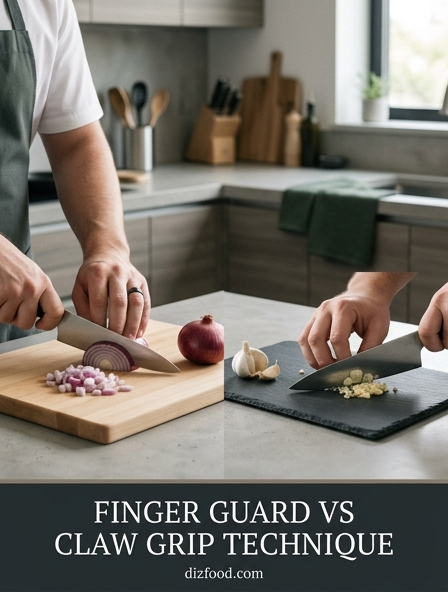
Safety in the kitchen is a direct result of proper hand positioning. The most effective way to control a knife is the "pinch grip," where the thumb and index finger choke up on the bolster of the blade while the remaining fingers wrap around the handle. This provides maximum lateral stability and prevents the knife from twisting during heavy tasks. Simultaneously, the non-cutting hand must adopt the "claw grip" to protect the fingertips.
- Tuck the Tips: Curl the fingertips inward toward the palm so the nails are shielded.
- Knuckle Guide: Use the middle knuckle of the fingers as a vertical fence for the side of the blade to rest against.
- Thumb Position: Keep the thumb tucked behind the fingers to avoid it straying into the path of the edge.
- The Anchor: Maintain a firm but flexible pressure on the ingredient to prevent rolling or sliding.
By using the knuckles as a guide, the chef can safely navigate the blade across the cutting board without ever looking directly at their fingers. This tactile feedback loop is what allows professional cooks to maintain high speeds while ensuring their safety remains uncompromised.
Selecting the Right Knife for Dicing
Not every knife is suited for every task, and the success of a rocking motion depends heavily on the blade's geometry. A traditional French or German chef's knife features a pronounced "belly" or curve, which is specifically designed to facilitate a rocking action. In contrast, Japanese-style knives like the Santoku or Nakiri often have flatter edges, which are better suited for vertical chopping or push-cutting rather than rocking.
| Knife Type | Edge Profile | Primary Motion |
|---|---|---|
| Western Chef's Knife | Curved/Rounded | Rocking and Slicing |
| Santoku | Flat to Slightly Curved | Push-Cutting/Chopping |
| Nakiri | Straight/Flat | Vertical Chopping |
| Cleaver | Heavy/Straight | Forceful Chopping |
When selecting a knife for dicing, consider the weight and balance. A blade that is slightly blade-heavy can assist in the downward phase of the rocking motion, reducing the effort required by the forearm. Furthermore, the height of the blade is important; a taller blade provides more surface area for the knuckles to rest against, which improves safety and control during rapid dicing sequences.
Achieving Uniformity in Culinary Precision
In the culinary world, uniformity is the hallmark of a disciplined chef. When ingredients are cut to the exact same dimensions, they react to heat at the same rate. If a pot contains both large and small dice of potatoes, the small pieces will disintegrate into mush while the large pieces remain raw in the center. Achieving this level of precision requires a disciplined application of the rocking motion, ensuring that the distance the knife travels between each stroke is perfectly consistent.
Beyond cooking times, uniformity affects the aesthetic appeal and the distribution of flavor. A fine brunoise of shallots provides a subtle, even heat to a vinaigrette, whereas uneven chunks would create unpleasant bursts of raw onion flavor. To master this, chefs often practice on low-cost ingredients like potatoes or celery, using rulers or templates until their eyes and hands can instinctively gauge millimeters. This commitment to precision separates home cooking from professional gastronomy, ensuring that every bite the guest takes is balanced and intentional.
Speed and Rhythm in High-Volume Prep
High-volume kitchens demand a level of speed that can only be achieved through rhythmic consistency. Once the mechanics of the rocking motion are mastered, the chef begins to develop a cadence. This rhythm acts as a metronome, allowing the cook to enter a "flow state" where the mind disengages from the individual movements and focuses on the broader task. Speed is a byproduct of this efficiency; it is not achieved by rushing, but by eliminating unnecessary movements and maintaining a steady pace.
To build this rhythm, one should start slowly and maintain a consistent beat, gradually increasing the tempo as the muscle memory solidifies. Breathing plays a crucial role here; maintaining a steady breath prevents the muscles from tensing up, which would otherwise lead to jerky movements and mistakes. In a professional environment, a chef might need to process fifty pounds of onions in a single shift. In such scenarios, the ability to maintain a rhythmic rocking motion is the only way to complete the task accurately and within the allotted prep time.
Common Mistakes in Rocking and Pushing
Even experienced cooks can fall into bad habits that compromise their efficiency or safety. One of the most frequent errors is "lifting the tip." In a true rocking motion, the tip of the knife should never leave the cutting board. When the tip is lifted, the chef loses their pivot point, making the blade unpredictable and increasing the risk of an accidental cut. Another common mistake is using a dull blade, which requires the chef to apply excessive downward pressure, often leading to the knife slipping.
- Hunching Shoulders: Poor posture leads to back pain and reduces the range of motion in the arm.
- Death Grip: Squeezing the handle too tightly causes hand cramps and limits the fluidity of the wrist.
- Inconsistent Support: Failing to move the "claw" hand in sync with the knife leads to uneven slices.
- Siding the Blade: Allowing the blade to tilt horizontally instead of staying perfectly vertical.
Correcting these mistakes early is vital. Chefs should periodically pause their work to check their posture, grip, and the state of their edge. Maintaining a sharp knife and a relaxed body ensures that the rocking motion remains a graceful, sustainable technique rather than a source of physical strain.
Transitioning Between Techniques for Efficiency
A truly skilled culinarian knows when to switch between techniques to maximize efficiency. While the rocking motion is supreme for mincing parsley, it may not be the most efficient way to break down a large butternut squash. Transitioning fluidly between a rocking motion, a forward push cut, and a straight vertical chop allows the chef to adapt to the resistance and shape of different ingredients without breaking their momentum.
For example, when prepping a mirepoix, a chef might use a push cut to create long batons of carrots, then switch to a rapid rocking motion to turn those batons into a fine dice. This transition should be seamless. The ability to evaluate an ingredient and instinctively choose the correct mechanical approach is what defines an advanced cook. It requires a deep understanding of how different cuts affect the surface area of the food. By alternating techniques based on the vegetable's density and the desired final shape, a chef can maintain a high output while ensuring the highest possible quality in their prep work.
Mastering Muscle Memory for Knife Control
The ultimate goal of practicing the rocking motion and various knife techniques is the development of muscle memory. Muscle memory occurs when a task has been repeated so many times that the brain no longer needs to consciously direct the individual muscles involved. In the context of the kitchen, this means the hands can execute perfect juliennes or a precise dice while the chef is simultaneously monitoring a simmering sauce or communicating with their team. This cognitive offloading is essential in the high-pressure environment of a service line.
Mastery is not achieved overnight; it is the result of thousands of repetitions. It is often said that a chef has "eyes in their fingers," referring to the tactile sensitivity developed through years of practice. To reach this level, one must be patient and prioritize form over all else. Every slow, deliberate stroke reinforces the neural pathways. Over time, the hesitation disappears, the grip becomes a natural extension of the arm, and the rocking motion becomes as effortless as breathing, allowing for a level of knife control that appears magical to the uninitiated.

Comments