
Understanding the Claw Grip Fundamentals
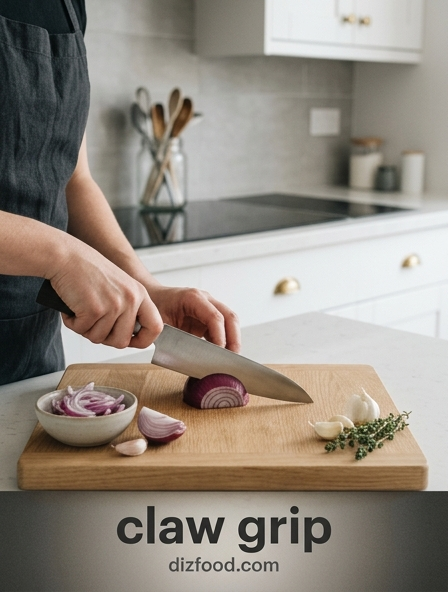
The claw grip is the cornerstone of professional knife skills, serving as the primary defensive posture for the hand not holding the knife. At its core, the technique involves curling the fingertips inward toward the palm, creating a "claw" shape where the nails are shielded from the blade. This position ensures that the flat side of the knife blade rests against the knuckles rather than the vulnerable tips of the fingers. By establishing this physical barrier, a cook can guide the knife with extreme precision while virtually eliminating the risk of accidental cuts.
- Tuck fingertips completely under the first knuckles.
- Keep the thumb tucked behind the fingers to avoid exposure.
- Maintain constant contact between the knife blade and the knuckle surface.
- Use a relaxed but firm tension to hold the food item in place.
Mastering this fundamental shape allows the cook to focus on the rhythm of the cut rather than the proximity of the sharp edge. It transforms the hand into a physical guide, enabling a level of safety that is essential for high-volume kitchen environments where speed and consistency are required throughout long shifts.
Positioning Your Guide Hand for Safety
Properly positioning the guide hand involves more than just curling the fingers; it requires strategic placement on the ingredient to ensure stability. The guide hand acts as both a stabilizer for the food and a track for the knife. To begin, place the ingredient on a stable cutting board, ensuring it does not wobble. If the item is round, such as an onion or potato, slice a small piece off one side to create a flat base. Once the food is secure, place the clawed hand on top, ensuring the middle finger's knuckle is the furthest point forward.
The thumb plays a critical role in this configuration. It should be positioned slightly behind the other fingers, acting as an anchor that pushes the food forward as the cut progresses. This creates a tripod-like stability that prevents the ingredient from sliding out from under the hand. By maintaining this structured positioning, the chef creates a safe zone where the knife can operate efficiently. As you become more comfortable, the guide hand will move in a synchronized crawl backward, maintaining the exact distance needed for uniform slices without ever exposing the fingertips to the descending blade.
Protecting Your Fingertips While Dicing
When dicing smaller ingredients or performing intricate cuts, the risk to fingertips increases due to the reduced surface area of the food. The claw grip must be adjusted to remain effective under these tighter conditions. The primary goal is to ensure that the fingertips never point toward the knife edge. Instead, they should point directly down into the food item, pressing it firmly against the cutting board. This vertical pressure prevents the ingredient from rolling, which is a common cause of slips and injuries during dicing tasks.
- Position the middle finger knuckle as the primary contact point for the knife.
- Curl the index and ring fingers slightly behind the middle finger.
- Ensure the pinky and thumb are tucked inward to avoid "flaring" out.
- Monitor the height of the knife relative to the knuckle to prevent lifting the blade too high.
By focusing on these specific points of protection, even high-speed dicing becomes a controlled and safe process. The knuckles serve as a physical stop, preventing the knife from traveling past the intended point. This tactile feedback allows the chef to maintain a fast pace while keeping their most valuable tools-their fingers-completely out of harm's way.
The Mechanics of Knife Control and Stability
The relationship between the knife and the guide hand is a mechanical partnership. Stability is achieved through the constant contact between the side of the knife blade and the vertical surface of the knuckles. This contact acts as a rail, similar to how a train stays on its tracks. When the blade moves up and down in a rocking motion, it should never lose contact with the guide hand. This ensures that the knife's path is predictable and restricted to a specific plane of motion.
| Mechanical Element | Function in Claw Grip |
|---|---|
| Knuckle Surface | Acts as a vertical guide and safety barrier. |
| Blade Contact | Provides sensory feedback on knife position. |
| Downward Pressure | Stabilizes the food to prevent lateral slipping. |
| Thumb Anchor | Controls the forward movement of the ingredient. |
Maintaining this mechanical link allows for greater leverage. As the knife descends, the pressure from the guide hand keeps the food from shifting, resulting in a cleaner cut. This stability is particularly important when working with tough or fibrous vegetables where more force is required. The claw grip ensures that even if the knife requires extra pressure, the hand remains in a protected, rigid structure.
Achieving Consistent Slices with the Knuckle Guide
Consistency in the kitchen is often the difference between a good dish and a great one. The claw grip facilitates uniform slicing by allowing the chef to use their knuckles as a measurement tool. By moving the guide hand back in precise, incremental steps, the thickness of each slice remains identical. The knife blade slides against the knuckle, and as the hand retreats, it creates a new "stopping point" for the next cut. This rhythmic movement eliminates the need for visual estimation, which is often inaccurate and slow.
- Use the middle knuckle to gauge the thickness of the slice.
- Retreat the hand in small, rhythmic increments for thin slices.
- Maintain a perpendicular angle between the knife and the guide hand.
- Apply steady, even pressure to the ingredient to prevent tapering.
This technique is essential for dishes like potatoes au gratin or vegetable carpaccio, where even cooking depends on identical thickness. Over time, the sensation of moving the hand becomes instinctive. The chef no longer needs to look at the food to know exactly how thick the slice will be, allowing them to maintain awareness of their surroundings in a busy kitchen environment.
Increasing Cutting Speed Through Proper Form
Speed in the kitchen is a byproduct of efficient movement and confidence, both of which are provided by the claw grip. When a cook is worried about cutting themselves, their movements become hesitant and choppy. By mastering the claw grip, that fear is removed, allowing for a fluid, continuous motion. The speed comes from the "rocking" motion of the knife, where the tip rarely leaves the board, and the guide hand moves in perfect synchronization with the blade's rhythm.
As the form becomes second nature, the transition between different ingredients becomes seamless. The guide hand learns to reset quickly, and the "crawl" becomes faster. It is important to remember that speed should never be forced; it should grow naturally out of proper form. Professional chefs focus on the cleanliness of the cut and the safety of the grip first. Once the mechanics are flawless, the speed naturally increases because there is no wasted motion. A proper claw grip allows the cook to enter a "flow state" where the knife and hand move as a single, efficient machine, processing large quantities of produce in a fraction of the time required by an untrained amateur.
Essential Finger Placement for Precision Dicing
Precision dicing, such as creating a fine brunoise, requires an advanced application of the claw grip. In these instances, the fingers must be tightly grouped to hold small pieces of food together. The index, middle, and ring fingers work in unison to create a wide, flat front that the knife can rest against. This grouping provides maximum control over the ingredient, which is crucial when making the horizontal and vertical cuts required for a dice. The thumb must be particularly active here, often tucked tightly against the side of the food to prevent it from fanning out.
- Align the three middle fingers in a straight row.
- Press the fingertips firmly into the ingredient to lock it in place.
- Keep the knife blade perfectly vertical to ensure square edges.
- Use the knuckle of the index finger for the finest adjustments in width.
This level of precision is what separates professional preparation from home cooking. When every piece of a dice is exactly the same size, the food cooks at the same rate and presents beautifully on the plate. The claw grip provides the physical framework necessary to achieve this mathematical precision without sacrificing the safety of the cook's hands.
Common Mistakes in the Professional Claw Grip
Even experienced cooks can fall into bad habits that compromise the effectiveness of the claw grip. One of the most common errors is the "lazy thumb," where the thumb creeps out from behind the fingers and into the path of the blade. Another frequent mistake is the "flying knuckle," where the hand lifts off the food, losing the stabilization that the grip is intended to provide. Identifying and correcting these issues is essential for maintaining a high standard of safety and efficiency.
| Common Mistake | Risk Factor | Corrective Action |
|---|---|---|
| Exposed Thumb | High risk of thumb lacerations. | Actively tuck thumb behind the index finger. |
| Lifting Fingertips | Risk of cutting under the fingernails. | Exaggerate the inward curl of the fingers. |
| Gap Between Blade and Knuckle | Loss of control and inconsistent cuts. | Ensure the blade maintains contact with the skin. |
| Tense Hand Muscles | Fatigue and reduced precision. | Keep the wrist loose and the "claw" relaxed. |
By periodically auditing one's own technique, a chef can ensure they are not taking shortcuts that could lead to injury. Mastery involves a constant return to these basics, ensuring that the claw remains tight, the thumb remains hidden, and the blade remains in contact with the guiding surface at all times.
Daily Drills to Master Your Handling Technique
Mastering the claw grip requires muscle memory, which is best built through consistent, focused practice. Daily drills can help bridge the gap between understanding the concept and executing it instinctively. Using soft, inexpensive ingredients like celery or carrots is an excellent way to practice without the pressure of preparing a final meal. The goal of these drills is to focus entirely on the hand position rather than the speed of the output.
- The "Slow Crawl": Practice moving the guide hand backward in 1mm increments without cutting.
- The "Blind Cut": While maintaining a safe claw, look away from the board to build tactile trust.
- The "Ghost Blade": Move the knife up and down against the knuckles without actually making a cut.
- The "Different Shapes": Practice the grip on various textures, from slippery onions to rolling carrots.
Spending just five minutes a day on these specific drills can significantly improve a cook's confidence. Over time, the hand will automatically find the claw position as soon as it touches an ingredient. This level of automation is what allows professional chefs to work for hours with high-speed precision while minimizing the mental fatigue associated with constant safety monitoring.
Transforming Kitchen Efficiency with Superior Grip
The ultimate goal of mastering the claw grip is to transform the kitchen from a place of potential hazard into an environment of extreme efficiency. When the guide hand is properly trained, the entire workflow of food preparation changes. Prep times are slashed, the quality of the cuts improves, and the physical strain on the cook is reduced. A superior grip allows the chef to utilize the full length of the knife, using the proper rocking or sliding motions that the tool was designed for, rather than the inefficient "chopping" motion common among beginners.
Furthermore, the claw grip fosters a professional mindset. It represents a commitment to the craft and a respect for the tools of the trade. As efficiency increases, the chef finds more time for the creative aspects of cooking, such as flavor balancing and plating, rather than being bogged down by the basic mechanics of preparation. In the end, the claw grip is not just a safety technique; it is the fundamental building block of culinary excellence, enabling speed, precision, and safety in every movement made at the cutting board.

Comments