
Mastering your knife skills is the fastest way to elevate your culinary game, but choosing between the rhythmic rocking motion and the deliberate push cut can make or break your prep's precision. While the rocking motion-characterized by keeping the knife tip grounded-is a favorite for its high-speed efficiency when dicing herbs or aromatics, the push cut offers unparalleled control for uniform slices of dense vegetables and delicate proteins. By understanding the mechanics of how your blade meets the cutting board, you can transition from simply chopping ingredients to crafting them with the exactness of a professional chef, ensuring consistent cook times and a more polished final plate.
| Feature | Rocking Motion | Push Cut |
|---|---|---|
| Pivot Point | Knife tip remains in constant contact with the board. | Blade lifts fully; moves forward and down simultaneously. |
| Best For | Mincing herbs, garlic, and dicing soft aromatics. | Starchy vegetables (carrots, potatoes) and clean protein slices. |
| Blade Profile | Requires a curved "belly" (standard Western Chef's knife). | Works best with flatter profiles (Santoku, Nakiri, or Gyuto). |
| Precision Level | Moderate; prone to "tapered" cuts if rhythm breaks. | High; ensures perfectly vertical, uniform thickness. |
| Primary Benefit | Maximum speed and reduced hand fatigue during bulk prep. | Cleaner edges and better preservation of cellular structure. |
| Skill Curve | Intuitive for beginners; focuses on rhythmic movement. | Requires more intentional wrist and forearm coordination. |
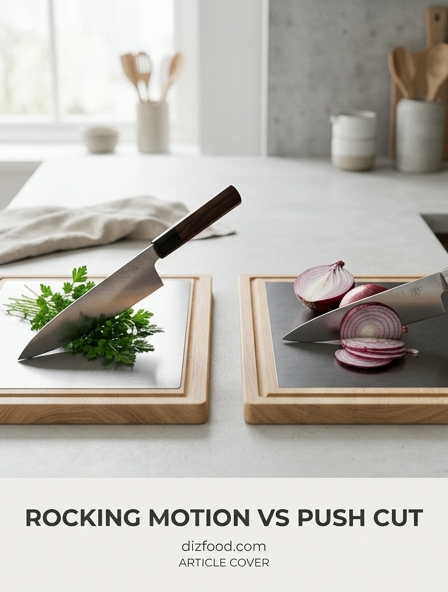
Understanding the Rocking Motion Technique
The rocking motion is a foundational pillar of Western culinary education, characterized by a fluid, rhythmic movement where the tip of the knife rarely leaves the cutting board. This technique utilizes the curved "belly" of a traditional chef's knife as a fulcrum. By keeping the front third of the blade anchored, the chef lifts the handle and moves the blade in a circular or "rocking" arc. This creates a continuous cutting cycle that is highly effective for processing large volumes of ingredients with minimal physical strain on the wrist.
To master this technique, several key elements must be harmonized:
- Pivot Point: The tip acts as the anchor, providing stability and reducing the need for complete blade relocation between cuts.
- Circular Rhythm: The motion is not just up and down, but rather a forward-and-downward stroke that transitions back into a lift.
- Board Contact: Constant contact with the board allows for high-speed processing once a rhythm is established.
- Guidance: The non-cutting hand uses the "claw grip," allowing the knuckles to guide the side of the blade safely.
This method is particularly favored in high-volume commercial kitchens where speed is paramount. Because the knife is always supported by the board, it offers a sense of security and consistent depth of cut. It is the go-to approach for tasks that require fine mincing or rapid dicing of aromatics and sturdy vegetables.
The Mechanics of the Push Cut
The push cut, often associated with Eastern or Japanese blade traditions, involves a more linear and vertical movement than the rocking motion. In this technique, the entire length of the blade moves forward and downward simultaneously. Unlike the rocking motion, the blade typically loses contact with the board entirely between strokes. This allows the chef to utilize the flattest part of the edge, ensuring that the food is sliced cleanly from top to bottom without the risk of "accordion" cuts where the bottom remains attached.
Executing a proper push cut requires a specific sequence of movements to maintain efficiency:
- Initial Lift: Raise the knife high enough to clear the height of the ingredient being processed.
- The Forward Thrust: Move the knife forward and downward at an angle, rather than a straight vertical drop, to engage the sharpness of the edge.
- Clean Release: As the blade meets the board, the slice should be fully separated, followed by a slight pull back to reset.
- Index Finger Placement: Many chefs place their index finger along the spine for added downward pressure and directional control.
The mechanics of the push cut prioritize the integrity of the ingredient's cell structure. Because the blade moves through the food in a single direction, there is less lateral friction, which preserves the texture and prevents bruising in delicate produce. It is a more deliberate movement that trades the raw speed of rocking for sheer precision.
Blade Geometry and Edge Profiles Explained
The effectiveness of a cutting technique is inextricably linked to the physical shape of the knife. Blade geometry determines whether a knife is naturally inclined toward rocking or pushing. Western-style knives, such as the classic French or German chef's knife, feature a pronounced "belly"-a curve that starts at the midpoint and sweeps up to the tip. This curvature is essential for a smooth rocking motion, as it allows the edge to roll across the board.
Conversely, many Japanese knives, like the Nakiri or Santoku, feature a flatter edge profile with little to no belly. These shapes are optimized for push cutting because they maximize contact with the cutting board across the entire length of the blade. Using a flat-edged knife for a rocking motion can cause the tip to dig into the board, while using a highly curved knife for push cutting might lead to incomplete slices.
| Feature | Rocking-Optimized | Push-Optimized |
|---|---|---|
| Edge Profile | Curved/Rounded Belly | Flat or Straight Edge |
| Tip Height | Raised/Swept Up | Dropped or Low-Point |
| Bevel Angle | Thicker (20°) for Durability | Thinner (10-15°) for Sharpness |
| Common Knife | German Chef's Knife | Nakiri or Kiritsuke |
Understanding these geometric differences helps a cook choose the right tool for their preferred style. A heavy, curved blade provides the momentum needed for rocking, while a thin, flat blade offers the surgical precision required for the push cut.
When to Use Rocking Motion for Efficiency
Efficiency in the kitchen is often measured by how quickly a chef can process a large volume of ingredients into a uniform size. The rocking motion shines when dealing with ingredients that require repetitive, fine processing. It is the gold standard for mincing fresh herbs like parsley, cilantro, or chives. Because the tip remains anchored, the chef can fan the blade back and forth across a pile of herbs, reducing them to a fine dust in seconds.
This technique is also highly efficient for the following tasks:
- Mincing Garlic and Ginger: After an initial smash, the rocking motion allows for rapid reduction into a paste.
- Dicing Hard Root Vegetables: Carrots, parsnips, and celery can be processed quickly into mirepoix once they are halved to create a flat surface.
- Heavy Prep Loads: When processing pounds of onions, the rhythmic nature of rocking reduces the cognitive load and hand fatigue.
- Rough Chopping: For nuts or chocolate, the rocking motion provides the leverage needed to break through hard textures.
However, the rocking motion is less ideal for ingredients that are very tall or have a slippery skin, as the angle of the blade changes throughout the stroke. For the most efficient results, the rocking motion should be used on ingredients that have already been stabilized on the cutting board, allowing the chef to focus purely on the speed of the oscillation.
Precision Slicing with the Push Cut
When the visual presentation of a dish is the primary goal, the push cut is the superior technique. This method is designed to create perfectly uniform slices with sharp, clean edges. Because the blade moves forward and down in one clean motion, it shears through the fibers of the food without crushing them. This is particularly important for vegetables with delicate internal structures, such as tomatoes or peppers, where a rocking motion might squish the juice out of the ingredient.
The push cut is essential for various high-precision tasks:
- Julienne and Brunoise: Achieving the exact millimeter measurements required for professional julienne is easier when the blade is flat and consistent.
- Slicing Delicate Proteins: Cold cuts or cooked meats benefit from the single-direction slice of a push cut to prevent tearing.
- Processing Leafy Greens: Chiffonade (finely shredded leaves) is best achieved with a push cut to keep the ribbons from bruising.
- Firm Vegetables: Ingredients like radishes or cucumbers can be sliced into paper-thin rounds with extreme accuracy.
The mastery of the push cut relies on the sharpness of the edge. Because there is less leverage involved than in the rocking motion, the knife must be kept at a razor's edge to glide through the food. This technique allows for a level of control that makes every slice an intentional act of precision, resulting in a more professional and aesthetically pleasing final plate.
Comparing Hand Positioning and Safety
Safety in knife work is a matter of both hand positioning and the stability of the blade. Both the rocking motion and the push cut utilize the "claw grip" for the non-cutting hand, but the interaction between the hand and the blade differs slightly. In the rocking motion, the side of the blade is in constant contact with the middle knuckles of the guiding hand. This contact provides a physical guide that moves with the blade, making it very difficult to cut the fingertips as long as they are tucked back.
In contrast, the push cut requires the guiding hand to be more dynamic. Because the knife leaves the board, there is a brief moment where the guide hand must reposition for the next slice. This requires a high degree of coordination to ensure the knife does not come down on a stray finger. Safety considerations for each include:
- The Anchor Hand: In rocking, the guide hand often stays in one place while the knife pivots. In push cutting, the guide hand "walks" backward with each slice.
- The Pinch Grip: Both techniques should use a pinch grip on the bolster for maximum control, but the push cut often benefits from the index finger on the spine for vertical stability.
- Blade Elevation: Rocking is safer for beginners because the tip stays down. The push cut carries a higher risk if the blade is lifted too high above the knuckles.
Ultimately, the rocking motion is often considered safer for those still developing their proprioception in the kitchen, whereas the push cut demands more focus and a more disciplined guiding hand to prevent accidents during the reset phase of the stroke.
The Best Knives for Rocking vs Push Cutting
The physical characteristics of a knife often dictate which technique will feel more natural. A chef's tool kit usually contains various blades designed to excel in one of these two movements. For those who prefer the rocking motion, weight and curvature are the most important factors. A heavier knife provides the momentum to keep the rock going. For those who favor the push cut, thinness and a flat profile are the priorities to ensure clean separation from the board.
| Knife Type | Preferred Technique | Key Characteristic |
|---|---|---|
| Western Chef's Knife | Rocking Motion | Pronounced curve and heavy bolster |
| Santoku | Hybrid/Push Cut | Slightly curved but mostly flat edge |
| Nakiri | Push Cut | Rectangular blade with a perfectly flat edge |
| Gyuto | Hybrid | A versatile Japanese take on the Western chef's knife |
| Mezzaluna | Rocking Motion | Two-handled blade specifically for herbs |
If you find yourself struggling with a specific technique, the issue may be the knife rather than your skill. A Nakiri will feel awkward and "clunky" if you try to rock it, potentially damaging the edge. Similarly, trying to push-cut with a deeply curved Western blade can result in a rocking sensation that throws off your precision. Selecting the tool that matches the mechanical requirements of the motion is essential for culinary success.
Speed vs Control in Culinary Prep
The debate between the rocking motion and the push cut often boils down to the trade-off between speed and control. The rocking motion is the undisputed champion of speed. By maintaining constant contact with the board and utilizing a circular momentum, a chef can process ingredients with a rapid-fire cadence. This is essential in environments where hundreds of pounds of produce must be prepped daily. However, this speed often comes at the cost of slight variations in slice thickness and a higher likelihood of "bruising" delicate items.
Control, however, is the hallmark of the push cut. Because each movement is a discrete, vertical action, the chef has the opportunity to verify the alignment of the blade before each slice. This leads to a higher level of uniformity. This control is vital for dishes where the ingredients need to cook at exactly the same rate or where the visual alignment of the food is a key component of the dish's appeal.
- Rocking for Speed: Best for mirepoix, stocks, stews, and mincing herbs where uniform appearance is secondary to volume.
- Pushing for Control: Best for garnishes, sushi prep, stir-frys, and salads where every piece is visible to the diner.
Experienced chefs often switch between the two techniques throughout the day. They might use a rocking motion to quickly prep the aromatics for a soup base and then switch to a push cut to create the perfectly square croutons or fine garnishes that will top the finished bowl.
Impact on Edge Longevity and Blade Wear
How you cut significantly impacts how often you need to sharpen your knives. The rocking motion, while efficient, is generally harder on the knife's edge. Because the blade is rolled across the board, it experiences more lateral (sideways) pressure. If the chef is not perfectly aligned, the edge can "roll" or develop micro-chips, especially on harder Japanese steels which are more brittle. Furthermore, the constant scraping of the edge against the board during the pivot can dull the tip and the belly faster.
The push cut is generally more "edge-friendly" because the force is applied vertically. There is very little lateral stress placed on the blade. Since the knife comes straight down and is then lifted, the amount of time the edge spends in contact with the abrasive cutting board is minimized. However, push cutting can still cause wear if the chef uses excessive force, leading to "impact dulling" where the apex of the edge is flattened against the board.
- Rocking Wear: Potential for edge rolling and tip blunting due to constant board contact and pivot friction.
- Pushing Wear: Primarily impact-related; less likely to chip but requires a very sharp edge to remain effective.
- Board Choice: Both techniques benefit from soft wood or rubber boards; hard glass or stone boards will destroy the edge regardless of technique.
To preserve edge longevity, those who rock their knives should focus on a light touch, avoiding unnecessary downward pressure once the cut is complete. Those who push cut should focus on a sliding motion (forward and down) rather than a pure vertical chop to reduce impact force.
Choosing the Right Technique for Your Ingredients
Ultimately, the "best" technique is the one that suits the ingredient on your cutting board. Successful cooks analyze the density, shape, and internal structure of their food before deciding how to approach it. Hard, round, or fibrous ingredients often require the leverage and stability of a rocking motion, while soft, delicate, or layered ingredients respond better to the clean shear of a push cut.
| Ingredient | Recommended Technique | Reasoning |
|---|---|---|
| Onions | Rocking Motion | High volume and requires multiple directional cuts. |
| Tomatoes | Push Cut | Prevents crushing the skin and internal seed cavities. |
| Cilantro/Parsley | Rocking Motion | Allows for the fastest reduction to a fine mince. |
| Potatoes | Push Cut | Provides the flat-faced precision needed for cubes. |
| Scallions | Push Cut | Ensures clean circles without the layers sticking. |
By matching the technique to the ingredient, you not only improve the quality of your food but also make the cooking process more enjoyable and safe. A versatile chef is one who has mastered both movements, allowing them to adapt to any culinary challenge with the appropriate tool and stroke. Whether you are aiming for the rapid-fire efficiency of the rock or the surgical beauty of the push, understanding these nuances is the first step toward true knife mastery.

Comments