
Achieving the perfect harmony between culinary precision and kitchen efficiency is the "holy grail" of modern home cooking. While achieving perfectly uniform vegetable cuts ensures even cooking and a professional aesthetic, the manual labor required can often turn a quick weeknight dinner into a marathon session. Finding your ideal balance involves knowing when to prioritize the meticulous knife work that yields consistent, high-end results and when to leverage high-speed tools like mandolines or food processors for rapid meal prep. By mastering this trade-off, you can elevate your dish quality through predictable textures while reclaiming precious time, ensuring that your cooking remains both an art form and a practical daily habit.
| Feature | Precision Manual Cutting | High-Speed Mechanical Prep |
|---|---|---|
| Prep Speed | Slow (5-12 mins per lb) | Ultra-Fast (<60 secs per lb) |
| Uniformity | High (Adjustable per piece) | Identical (Fixed by blade) |
| Texture Integrity | Superior (Clean cellular cuts) | Moderate (Risk of tearing/bruising) |
| Skill Curve | Years to master technique | Instant; plug-and-play |
| Cleanup Load | Minimal (Knife & Board) | High (Multiple washable parts) |
| Best Application | Slow Roasts & Garnishes | Bulk Salads, Soups & Batches |
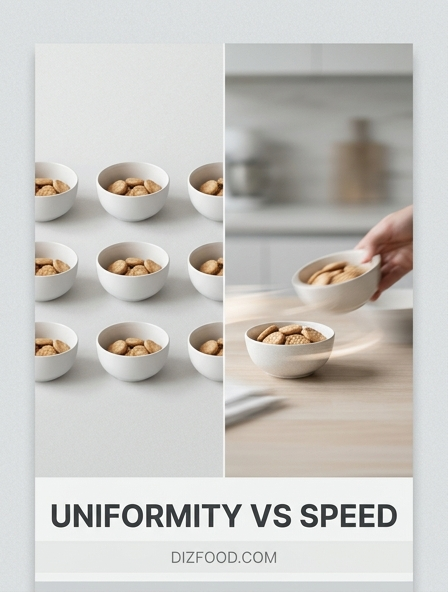
Balancing Standardization and Rapid Deployment
In a high-volume commercial kitchen, the friction between standardization and rapid deployment is a constant operational challenge. Standardization ensures that every plate leaving the pass meets a specific culinary profile, while rapid deployment focuses on the speed of service and minimizing ticket times. When these two forces are balanced, the kitchen operates in a state of flow; when they are not, the result is either a slow, over-engineered service or a fast, chaotic one that compromises the brand's reputation.
To achieve this balance, chefs must implement systems that favor "mise en place" as a form of pre-emptive standardization. By front-loading the technical work-chopping, reducing, and portioning-the line can focus entirely on assembly and execution during the rush. This allows for high-velocity output because the difficult decisions regarding flavor and texture have already been codified into the prep list.
- Standardized Prep Sheets: Detailed lists that ensure every component is prepared to the same specification before service begins.
- Station Templates: Uniform layouts for every workstation to minimize unnecessary movement and cognitive load.
- Cross-Training: Ensuring multiple staff members can execute the same standardized tasks to prevent bottlenecks.
- Digital Ticketing: Using technology to synchronize deployment across different stations simultaneously.
Ultimately, the goal is to create a framework where speed is a byproduct of order rather than a result of frantic effort. When a line cook knows exactly where every ingredient is and the precise heat level required for a dish, they can move faster without sacrificing the integrity of the plate.
The Hidden Cost of Inconsistency in Fast Environments
In the heat of a busy service, it is tempting to cut corners to keep up with a mounting board of tickets. However, inconsistency carries a hidden cost that far outweighs the temporary gains in speed. Every dish that is sent back to the kitchen due to a quality lapse-whether it is an undercooked protein or a poorly seasoned sauce-represents a catastrophic failure in efficiency. A "re-fire" consumes double the ingredients, double the labor, and disrupts the timing of the entire table.
Inconsistency also erodes the morale of the kitchen brigade and the trust of the clientele. When the "fast" approach results in varying portion sizes or presentation styles, the kitchen loses its ability to predict food costs and inventory depletion. This lack of predictability eventually leads to financial leakage and operational friction that can cripple a business over time.
| Inconsistency Factor | Immediate Operational Cost | Long-Term Business Impact |
|---|---|---|
| Uneven Cooking Temps | High rate of returned plates | Negative online reviews and brand damage |
| Varied Portion Sizes | Inaccurate inventory tracking | Shrinking profit margins and food waste |
| Messy Plating | Slowdown at the expeditor station | Perception of low value and poor quality |
By prioritizing uniformity, a kitchen reduces the cognitive burden on the expeditor and the waitstaff. When the output is consistent, the entire system moves with more confidence, reducing the stress that typically leads to errors in fast-paced environments.
Achieving Scalable Uniformity Without Sacrificing Pace
Scaling a kitchen operation-whether it is expanding a menu or opening a second location-requires a level of uniformity that can survive the transition from a single chef's oversight to a distributed management model. The challenge lies in creating systems that are robust enough to maintain quality but flexible enough to handle peak volumes. Scalable uniformity is built on the foundation of simplified, repeatable processes that remove the "artisan" bottleneck.
To maintain pace while scaling, kitchens often utilize specialized equipment and modular workflows. For example, using precision immersion circulators for sous-vide cooking ensures that proteins are perfectly cooked every time, regardless of how busy the grill station becomes. This removes the variable of human error from a high-stakes task, allowing the cook to focus on searing and plating at high speed.
- Recipe Quantization: Converting all measurements to weight (grams) rather than volume to ensure absolute precision across large batches.
- Photographic Plating Guides: Visual aids posted at eye level on every station to ensure visual uniformity without verbal instruction.
- Modular Stations: Designing line setups that can be replicated or expanded based on guest count without changing the workflow.
- Automated Inventory Sync: Using systems that track usage in real-time to prevent shortages during high-velocity periods.
When uniformity is baked into the system through technology and visual cues, the pace of the kitchen can accelerate naturally. The staff no longer has to "think" about the standard; they simply execute within a pre-defined lane of excellence.
Why Speed Without Structure Leads to Technical Debt
In culinary terms, "technical debt" manifests as a disorganized kitchen, neglected equipment, and a lack of standardized recipes. When a kitchen prioritizes speed over structure, it creates an environment where temporary fixes become permanent habits. For instance, a cook might skip the proper cleaning of a sauté pan between orders to save thirty seconds, leading to carbon buildup that eventually ruins the pan and affects the flavor of the food.
This debt accumulates quickly. A kitchen that operates without a structured "clean as you go" policy will eventually hit a wall where the physical environment becomes an obstacle to speed. Grease-slicked floors, cluttered workstations, and dull knives are all forms of debt that must be paid back with interest in the form of accidents, slow prep times, and inconsistent results. Without structure, speed is merely a frantic race toward burnout.
- Accumulated Mess: A cluttered station slows down physical movement and increases the risk of cross-contamination.
- Tool Degradation: Using equipment incorrectly to save time results in frequent breakdowns and high repair costs.
- Knowledge Gaps: When shortcuts are taught instead of standards, new hires lack the foundational skills to problem-solve.
- Inconsistent Flavor Profiles: Lack of structured tasting protocols leads to a gradual drift away from the original recipe.
A structured kitchen may seem slower in the initial phases of prep and setup, but it maintains a higher "cruising speed" throughout the service. Structure provides the safety net that allows for true velocity without the risk of a total operational collapse.
Harmonizing Quality Control with High Velocity Output
The expeditor is the final arbiter of quality control in a kitchen, acting as the bridge between the high-velocity production line and the dining room. Harmonizing quality with speed requires a feedback loop that is instantaneous and objective. In a high-output environment, there is no time for long explanations; quality control must be integrated into the rhythm of the pass through clear signals and non-negotiable standards.
One effective method for achieving this harmony is the use of "checklists at the pass." These are not literal paper lists but mental or visual cues that the expeditor uses to verify every plate. Does it have the garnish? Is the rim clean? Is the temperature correct? By standardizing these checks, the expeditor can process a high volume of plates without letting the quality slip. This ensures that the velocity of the kitchen is matched by the precision of the output.
| QC Checkpoint | Velocity Method | Result |
|---|---|---|
| Plate Appearance | Side-by-side comparison with "Hero" photo | Visual consistency at scale |
| Internal Temperature | Instant-read thermocouples for every protein | Zero-error meat doneness |
| Sauce Consistency | Standardized reduction markers in pots | Uniform flavor and mouthfeel |
When the kitchen staff knows that the expeditor will reject anything below a certain threshold, they naturally self-correct. This internalizes quality control at the station level, allowing the expeditor to focus on timing and coordination rather than constant policing.
The Impact of Process Uniformity on Delivery Timelines
Predictability is the cornerstone of a successful delivery or high-turnover dining model. When processes are uniform, the time it takes to produce a specific dish becomes a fixed variable rather than a moving target. This allows front-of-house staff and delivery algorithms to provide guests with accurate wait times, which is a critical factor in customer satisfaction. If one pasta dish takes six minutes on Tuesday but twelve minutes on Friday, the entire logistics chain breaks down.
Process uniformity eliminates the "chaos factor" that occurs when different cooks use different methods to achieve the same result. By enforcing a strict sequence of operations-such as the exact order in which ingredients are added to a wok-the kitchen can guarantee a synchronized delivery timeline. This is especially important for complex orders involving multiple stations; if the grill and the fry station are not aligned through uniform timing, one part of the order will sit under a heat lamp while the other is still cooking.
- Time-Motion Studies: Analyzing the physical steps of a dish to remove redundant movements that delay output.
- Synchronized Timers: Using station-specific alerts to ensure all components of an order finish simultaneously.
- Standardized Batching: Preparing large-volume items in consistent increments to avoid "running out" during a rush.
Ultimately, uniformity in process leads to a smoother "heartbeat" for the kitchen. When the rhythm is steady, the delivery timelines remain compressed and reliable, even during the busiest periods of the day.
Streamlining Operations Through Consistent Frameworks
Operational streamlining is the process of removing friction from the kitchen environment. The most effective way to achieve this is through consistent frameworks that govern everything from inventory management to the "closing" of a station. A consistent framework provides the staff with a "mental map" of how the kitchen should function, reducing the need for constant supervision and allowing the team to operate autonomously.
Consider the framework of "First In, First Out" (FIFO). When this is applied uniformly across all storage areas, the speed of prep increases because no one has to search for the freshest ingredients or guess which container to use first. Similarly, a consistent framework for station handovers ensures that the night shift leaves the kitchen in the exact state the morning shift expects. This continuity prevents the "morning-after" slowdown where the early crew spends hours fixing the mistakes of the previous night.
- Unified Labeling Systems: Using the same color-coding and dating format on every container in the walk-in.
- Universal Tool Placement: Keeping common tools (tongs, spatulas, towels) in the same relative position at every station.
- Standardized Communication: Using specific "call-backs" and terminology (e.g., "Heard," "Behind") to ensure clear information flow.
When these frameworks are in place, the kitchen becomes a plug-and-play environment. A cook can move from the sauté station to the salad station and immediately understand the operational logic, maintaining high speed despite the change in task.
Identifying the Threshold Between Efficiency and Chaos
There is a thin line between a kitchen operating at peak efficiency and one sliding into chaos. Efficiency is characterized by controlled speed, where every movement has a purpose and the noise level is focused. Chaos occurs when speed exceeds the capacity of the kitchen's underlying systems, leading to "noise" in the form of dropped items, shouted orders, and missed modifications. Identifying this threshold is crucial for a chef or kitchen manager.
The threshold is often reached when the volume of tickets exceeds the "bottleneck" station's capacity. If the grill can only hold ten steaks at a time, trying to push twelve through at a faster pace won't increase efficiency; it will only lead to uneven cooking and panic. Recognizing these physical and systemic limits allows a kitchen to "throttle" its speed effectively-perhaps by slowing down the seating of guests-to ensure that the uniformity of the product is maintained.
- The "Silence" Metric: A quiet kitchen is usually an efficient one; excessive shouting often signals that the system is breaking.
- Error Tracking: A sudden spike in "voids" or "re-fires" is a leading indicator that the kitchen has crossed the chaos threshold.
- Station Backlog: When one station is buried while others are idle, the lack of uniformity in workload is creating a bottleneck.
By monitoring these indicators, management can intervene before the chaos becomes terminal. Maintaining efficiency requires the discipline to stay within the bounds of what the standardized system can handle.
The Role of Uniformity in Long Term Performance
While speed is the metric of a single service, uniformity is the metric of a successful career or business. Long-term performance in the kitchen is built on the ability to replicate success day after day, year after year. This "endurance" is only possible when the kitchen relies on systems rather than the heroics of individual staff members. A kitchen that depends on a single "fast" cook to survive the rush is vulnerable; a kitchen that relies on a uniform system is resilient.
Uniformity also plays a major role in staff retention and the prevention of burnout. When a kitchen is unpredictable and chaotic, the stress levels of the staff remain high, leading to rapid turnover. Conversely, a standardized environment provides a sense of security and mastery. Staff members know what is expected of them, they have the tools to succeed, and they can see a clear path to improvement. This stability fosters a culture of excellence that sustains high performance over the long haul.
| Performance Pillar | Impact of Uniformity | Impact of Randomness |
|---|---|---|
| Staff Retention | Higher; lower stress and clear expectations | Lower; high burnout and frustration |
| Brand Reputation | Reliable quality builds guest loyalty | Inconsistent quality drives guests away |
| Profitability | Controlled waste and predictable costs | High waste and erratic margins |
In the end, the most famous and successful kitchens in the world are not just the fastest; they are the most disciplined. Their long-term performance is a testament to the power of uniformity as a catalyst for sustained speed.
Accelerating Innovation Through Standardized Systems
It is a common misconception that standardization stifles creativity. In reality, a standardized kitchen provides the very foundation required for meaningful innovation. When the "basics"-such as stock production, vegetable cuts, and sauce bases-are perfectly uniform, the chef has the mental bandwidth and the operational stability to experiment with new flavors and techniques. Innovation in a chaotic environment is usually just a "special" that creates more problems than it solves.
Standardized systems allow for "rapid prototyping" of new dishes. Because the kitchen already speaks a common language of measurements and methods, a new recipe can be integrated into the existing workflow with minimal disruption. The staff can apply their standardized skills to a new set of ingredients, achieving a high-quality result on the first attempt. This allows the restaurant to stay relevant in a fast-moving market by pivoting its menu without losing its operational edge.
- Standardized R&D Templates: Using a fixed format for new recipes so they are easily understood by the line.
- Component Reusability: Creating new dishes using existing standardized components to minimize new prep.
- Feedback Loops: Using a uniform system for collecting staff and guest feedback on new items to iterate quickly.
By treating the kitchen as a system of interchangeable parts, innovation becomes an organized process rather than a disruptive event. This allows the kitchen to accelerate its creative output while maintaining the same high velocity and quality that the guests expect.

Comments