
Choosing between tomato concasse and seeded tomato dice can elevate your culinary creations from basic to professional by refining both texture and moisture content. While both methods prioritize removing watery seeds to prevent a soggy dish, the fundamental difference lies in the skin; tomato concasse involves a delicate blanching and peeling process to achieve a luxurious, "naked" tomato, whereas seeded tomato dice keep the skin intact for a rustic, structural bite. Whether you are aiming for a silky, refined sauce or a vibrant, crunchy salsa, understanding these prep styles allows you to tailor the tomato's mouthfeel to the specific needs of your recipe.
| Feature | Tomato Concasse | Seeded Tomato Dice |
|---|---|---|
| Process | Blanch, shock, peel, and seed. | Halve, scoop out seeds, and chop. |
| Texture | Silky, soft, and uniform. | Firm with a slight "snap" from skin. |
| Preparation Time | High (requires boiling/ice water). | Low (knife work only). |
| Skin Status | Completely removed. | Skin remains on the flesh. |
| Best For | Fine sauces, soups, and gourmet garnishes. | Fresh salsas, bruschetta, and salads. |
| Visual Appeal | Refined, elegant, and consistent. | Rustic, vibrant, and structural. |
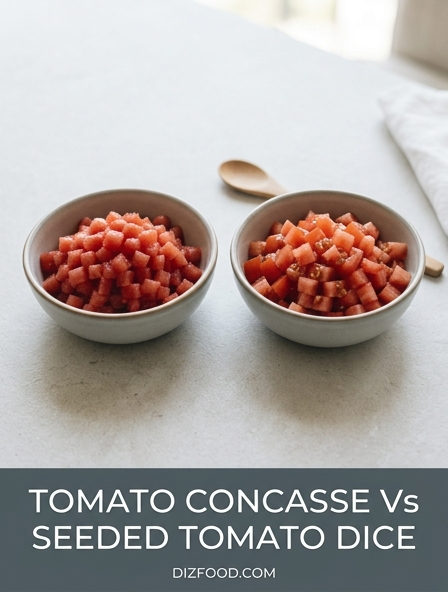
Tomato Concasse vs Seeded Tomato Dice Key Differences
In the professional kitchen, the distinction between tomato concasse and seeded tomato dice lies primarily in the treatment of the skin and the level of refinement required for the end dish. While both techniques involve removing the internal seeds and the surrounding gelatinous liquid to prevent excess moisture, tomato concasse requires the additional step of blanching and peeling. This process results in a soft, uniform flesh that integrates seamlessly into delicate sauces and emulsions. Conversely, seeded tomato dice retain the skin, offering a more rustic texture and a vibrant visual contrast between the red flesh and the skin's sheen.
| Feature | Tomato Concasse | Seeded Tomato Dice |
|---|---|---|
| Skin Status | Removed via blanching | Intact |
| Texture | Soft, tender, and refined | Firm, slightly crunchy |
| Preparation Time | High (requires boiling/ice bath) | Moderate (direct knife work) |
| Best Use | Fine sauces, omelets, purees | Salsas, salads, tacos |
The choice between the two often dictates the mouthfeel of a dish. Concasse is the gold standard for high-end French cuisine where any presence of tough skin is considered a technical flaw. Seeded dice are preferred in preparations where the tomato must hold its shape under heat or when served raw in a chunky preparation where the skin provides structural integrity and a fresh "snap" during consumption.
The Professional Culinary Definition of Tomato Concasse
Derived from the French verb "concasser," which translates to "to crush or grind," tomato concasse is a foundational technique in classical culinary arts. In a professional setting, this term refers specifically to tomatoes that have been peeled, seeded, and chopped to a specific size-typically a small or medium dice. It represents a commitment to purity of flavor and texture, ensuring that neither the indigestible skin nor the bitter, watery seeds interfere with the final composition of a dish. Mastering the concasse is often one of the first tests for culinary students, as it demonstrates precision in knife skills and temperature control.
The standard definition involves a specific sequence of actions:
- Blanching: Submerging the tomato in boiling water for 15 to 30 seconds to loosen the skin.
- Shocking: Immediately placing the tomato in an ice bath to stop the cooking process.
- Peeling: Removing the skin, which should slip off easily without damaging the flesh.
- Seeding: Halving the tomato and removing the locules and juice.
- Chopping: Dicing the remaining flesh into uniform cubes.
A true concasse is valued for its clean appearance and its ability to melt into a sauce without leaving behind any papery debris. In many kitchens, the "concasse" is treated as a mise en place staple, ready to be tossed into a pan at the last second to add acidity, color, and body to a variety of mother sauces and contemporary entrees.
Texture and Taste Profiles of Seeded Tomato Dice
Seeded tomato dice offer a specific sensory experience that differs significantly from their peeled counterparts. By retaining the skin, the dice maintain a structural rigidity that allows them to stand up to heavy dressings or acidic marinades without collapsing. The skin provides a subtle resistance when bitten, which many chefs prefer for raw applications like Pico de Gallo or Bruschetta. From a flavor perspective, the skin often contains a higher concentration of flavonoids and aromatic compounds than the flesh, contributing a "green" or earthy note that can be lost when tomatoes are blanched.
Removing the seeds is the critical step that defines this preparation. By eliminating the watery placental tissue, the chef concentrates the flavor of the tomato walls. This prevents the "bleeding" of tomato juice into other ingredients, which is essential for maintaining the aesthetic of a salad or the crispness of a toasted bread base. The resulting taste profile is bright, clean, and acidic, without the dilution that comes from the tomato's internal moisture. This technique is particularly effective with plum or Roma tomatoes, which have thick walls and lower water content, resulting in a meaty texture that provides a satisfying chew in every bite.
Step by Step Preparation of Traditional Tomato Concasse
Preparing a traditional tomato concasse is a systematic process that requires focus and the right equipment. To ensure the best results, start with ripe, firm tomatoes; overly soft tomatoes will turn to mush during the blanching phase, while underripe ones will lack the necessary flavor and color. The goal is to remove the exterior and interior waste while preserving the integrity of the tomato walls.
- Core and Score: Use a paring knife to remove the stem core. On the bottom of the tomato, lightly score an "X" into the skin. Do not cut deep into the flesh.
- Blanch: Drop the tomatoes into a pot of rapidly boiling water. Watch for the skin to begin curling back at the "X," which usually takes 15 to 45 seconds depending on ripeness.
- Shock: Use a slotted spoon to transfer the tomatoes immediately into a bowl of ice water. This stops the heat from softening the interior flesh.
- Peel: Starting from the "X," pull the skin away. It should slide off in large strips. If it sticks, the blanching time was too short.
- Seed: Cut the tomato in half along its equator. Use your thumb or a small spoon to scoop out the seeds and the surrounding gel.
- Dice: Lay the cleaned flesh flat on the cutting board and cut into uniform strips, then turn and cut crosswise into even cubes.
Following these steps ensures a professional-grade product that is free of skin and seeds, ready for high-end culinary applications.
When to Choose Concasse Over Simple Seeded Dice
Choosing between concasse and simple seeded dice is a decision based on the intended cooking method and the desired level of sophistication. Concasse is the superior choice for any cooked application where the tomato is meant to break down or integrate into a liquid. In a Beurre Blanc or a delicate Velouté, the presence of tomato skins would be a textural distraction, as the heat causes the skin to curl into tough, stringy spirals. Therefore, for refined soups, stews, and sautéed garnishes, the extra effort of peeling is mandatory to maintain a smooth, luxurious mouthfeel.
Conversely, the seeded dice is the logical choice for high-volume environments or rustic dishes where the skin adds a desirable "garden-fresh" aesthetic. If the tomatoes are to be served cold and raw, the skin is rarely an issue for the palate. However, if the dish is a warm pasta sauce or an omelet, the concasse technique is preferred because the heat softens the flesh into a jam-like consistency that coats the other ingredients. Essentially, use concasse for elegance and heat-based integration, and use seeded dice for structural stability and raw applications where speed is a factor in the kitchen's workflow.
The Impact of Tomato Skin on Sauce Consistency
The presence of tomato skin can fundamentally alter the chemistry and consistency of a sauce. Tomato skins are composed of cellulose and lignin, fibers that do not break down during standard cooking temperatures. When a tomato is diced with the skin on and added to a simmering sauce, the heat causes the flesh to dissolve while the skin detaches and curls into small, sharp rolls. These rolls can be unpleasant for the diner and can trap air bubbles, preventing the sauce from achieving a perfectly smooth, glossy finish. For a professional saucier, these skins are considered impurities that detract from the visual clarity of the dish.
Furthermore, the skin acts as a barrier to flavor extraction. In a concasse, the exposed flesh begins to release its natural pectins and sugars immediately upon contact with heat, which helps to thicken the sauce and create a cohesive emulsion. Without the skin, the tomato pieces can be easily "melted" into a fat source like butter or olive oil. In contrast, skins can impart a slight bitterness if cooked for extended periods, especially in high-acid environments. By removing the skin, the chef ensures that the sauce remains sweet and uniform, with a consistent viscosity that coats a spoon evenly without any fibrous interference.
Labor and Efficiency Comparing Concasse and Dicing
In a high-pressure commercial kitchen, time is a finite resource, and the labor required for tomato concasse must be weighed against its culinary benefits. Preparing concasse is a multi-stage process that occupies stove space, requires an ice supply, and demands significant knife time. For a large banquet, producing twenty pounds of concasse can take a prep cook several hours, whereas simple seeded dicing can be accomplished in a fraction of that time since it bypasses the boiling and chilling phases entirely. Chefs must determine if the "up-sell" of a refined texture justifies the labor cost associated with the technique.
- Concasse Efficiency: Best handled in large batches; requires a dedicated station with boiling water and ice.
- Seeded Dicing Efficiency: Faster for "to-order" prep; requires only a sharp knife and a cutting board.
- Waste Factors: Concasse results in more waste (skin and seeds) but a more premium usable product.
- Tool Utilization: Dicing is purely manual, whereas concasse involves the pot and cooling equipment.
To bridge the gap, many modern kitchens use the "concasse" method only for garnishes and specific signature sauces, while utilizing seeded dice for bulk items like salsas or base marinara. Understanding the labor-to-quality ratio is essential for sous chefs managing kitchen labor budgets while maintaining high standards.
Essential Kitchen Techniques for Seeding Fresh Tomatoes
Effective seeding is the common denominator between concasse and seeded dicing, and doing it correctly prevents a "watery" final product. The most efficient professional method involves halving the tomato along its "equator"-horizontal to the stem-rather than vertical through the poles. This orientation exposes all the internal seed cavities (locules) at once. Once the tomato is halved, the seeds can be flicked out with a finger or a small espresso spoon. For high-volume production, some chefs prefer to gently squeeze the halved tomato over a bowl, allowing gravity and light pressure to eject the seeds and juice.
Another advanced technique for seeding is the "filleting" method. In this approach, the chef cuts the tomato into quarters vertically. Using a sharp chef's knife or utility knife, they slide the blade between the outer flesh and the inner seed pod, essentially "skinning" the seeds away from the meat. This results in clean, flat petals of tomato flesh that are much easier to dice into perfect cubes. Regardless of the method, the goal is to remove 100% of the gelatinous "jelly" surrounding the seeds, as this substance contains high levels of moisture that can break an emulsion or make a salad soggy within minutes of preparation.
Culinary Applications for Refined Tomato Concasse
Tomato concasse is most at home in preparations where elegance and subtlety are paramount. One of its most famous applications is in a "Sauce Vierge," a warm Mediterranean sauce made with olive oil, lemon juice, herbs, and concasse. Because the tomatoes are peeled, they soften into the oil without losing their shape, creating a vibrant, chunky texture that complements grilled fish or scallops perfectly. In a classic French omelet, a spoonful of tomato concasse provides a burst of acidity and color that doesn't disrupt the velvety texture of the eggs, whereas skin-on dice would feel out of place and potentially tough.
Other traditional uses include:
- Garnish for Consommé: Tiny, perfect cubes of concasse add visual interest to clear soups.
- Tomato Fondue: A slow-cooked reduction of concasse with shallots and garlic used as a base for tarts.
- Bruschetta Topping: In high-end versions, concasse is used to ensure the topping is soft and easy to eat.
- Pasta Primavera: Added at the very last second to provide a fresh, sweet finish.
By using concasse, the chef demonstrates a high level of technical proficiency and a respect for the diner's experience, ensuring that every component of the dish is as tender and flavorful as possible.
How to Master Consistent Tomato Dice for Garnishes
Consistency is the hallmark of a professional kitchen. When dicing tomatoes for garnish-whether they are peeled for concasse or merely seeded-the goal is to achieve uniform dimensions, such as a 1/4-inch (small dice) or 1/8-inch (brunoise). Achieving this requires a very sharp knife; a dull blade will crush the tomato cell walls, causing them to leak juice and result in a ragged, unappealing appearance. To master the dice, always start by flattening the tomato petals as much as possible on the cutting board. This allows for stable, precise cuts and prevents the knife from slipping on the curved surface.
The technique involves cutting the tomato into long, even strips (julienne) first. Once the strips are aligned, bunch them together and cut perpendicularly to create the cubes. It is vital to use a "locomotive" slicing motion rather than a straight downward chop to maintain the integrity of the flesh. For the best visual impact, ensure that every cube is identical; this uniformity ensures that the garnish cooks at the same rate if heat is applied and provides a professional, geometric beauty when scattered over a finished plate. Finally, always drain the finished dice on a paper towel for a few seconds before plating to remove any residual moisture that could dull the shine of the tomato.


Comments