
Whether you're crafting a refreshing gazpacho or a searing curry, understanding the nuances between dicing bell peppers and chili peppers is essential for balancing mouthfeel and spice. Bell pepper dicing is all about achieving structural uniformity to provide a sweet, crunchy foundation, whereas chili pepper dicing demands a tactical focus on capsaicin management and fine mincing to ensure heat is distributed evenly throughout the dish. By mastering the distinct knife paths for each-prioritizing volume for the bell and potency for the chili-you can elevate your culinary game, ensuring every bite offers the perfect harmony of crisp texture and controlled fire.
| Feature | Bell Pepper Dicing | Chili Pepper Dicing |
|---|---|---|
| Primary Objective | Structural bulk and crisp texture. | Heat distribution and flavor punch. |
| Standard Dice Size | 6mm to 12mm (Medium/Small dice). | 1mm to 3mm (Fine mince/brunoise). |
| Internal Prep | Full removal of seeds and white ribs. | Selective seed/pith removal for heat control. |
| Knife Technique | Flat planks to batons to cubes. | Strategic slicing to avoid skin-side slipping. |
| Safety Priority | General knife safety; low irritant. | Capsaicin oil protection (gloves suggested). |
| Culinary Utility | Aromatic base, salads, and stir-frys. | Garnishes, infusions, and spice layering. |
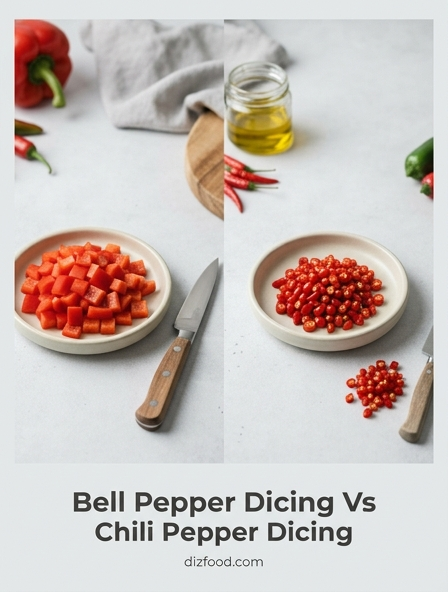
Bell Pepper vs Chili Pepper Dicing Fundamentals
The culinary approach to dicing peppers begins with understanding the intended role of the ingredient within a dish. Bell peppers are primarily utilized for their structural integrity, high water content, and mild, sweet flavor profile. When dicing a bell pepper, the chef focuses on volume and texture, aiming to create uniform pieces that provide a refreshing crunch or a soft, consistent bite in cooked applications. Because they lack capsaicin, the primary concern is removing the fibrous internal ribs and seeds to ensure a clean palate experience.
In contrast, dicing chili peppers is an exercise in precision and potency management. Chilis are used for heat and aromatic complexity rather than bulk. The fundamental goal shifts from creating volume to ensuring the even distribution of heat throughout a recipe. A single large piece of chili can overwhelm a diner, making fine dicing or mincing essential. Furthermore, the presence of capsaicin oil dictates a specific set of handling techniques that are unnecessary when working with bell peppers.
- Bell peppers require high-volume throughput for salads, stir-frys, and stews.
- Chili peppers require meticulous size control to prevent "heat bombs" in a dish.
- Structural stability is key for bell peppers, while surface area exposure is key for chilis.
- Waste management differs, as bell pepper scraps are often saved for stocks, while chili scraps are discarded to avoid excessive heat.
Understanding these foundational differences allows a cook to select the appropriate knife and technique before the first cut is made. While both are members of the Capsicum family, their physical properties demand a tailored approach to preparation that respects both their flavor and their chemical makeup.
Structural Differences Between Bell and Chili Peppers
Analyzing the physical anatomy of peppers reveals why dicing techniques must vary. Bell peppers are characterized by their thick, fleshy walls and large, hollow interior cavities. The pericarp, or the outer wall, is juicy and provides significant resistance to the knife, requiring a sharp edge to pierce the skin without bruising the flesh. The interior features a central placenta where the majority of the seeds are clustered, making them relatively easy to remove in one or two motions.
Chili peppers, such as habaneros, serranos, or Thai birds-eye chilis, possess much thinner walls and a higher concentration of oils. The ratio of skin to flesh is much higher than in bell peppers, and the internal structure is often more compact. In many small chili varieties, the seeds and the capsaicin-rich membranes are distributed along the entire length of the fruit, rather than being concentrated at the top. This requires a more surgical approach to dicing to separate the heat-bearing elements from the flavorful flesh.
| Feature | Bell Pepper | Chili Pepper |
|---|---|---|
| Wall Thickness | Thick (3mm - 6mm) | Thin (1mm - 2mm) |
| Skin Texture | Smooth, waxy, and resilient | Tough, thin, and oily |
| Internal Cavity | Large and mostly empty | Narrow and membrane-heavy |
| Moisture Level | Very High | Moderate to Low |
These structural variations mean that a chef must adjust their grip and pressure. A bell pepper can withstand the weight of a heavy chef's knife, whereas a delicate chili may require the finesse of a paring knife or a smaller utility blade to achieve a clean dice without crushing the cell walls and releasing excess moisture or oil prematurely.
Essential Knife Skills for Large and Small Peppers
The mechanics of dicing are governed by the size and shape of the pepper. For large bell peppers, the "box method" or "plank method" is the standard. This involves removing the top and bottom, then making a single vertical slice to open the pepper into a flat ribbon. Once flat, the pepper can be divided into uniform strips and then cross-cut into cubes. This method ensures that every piece has a consistent thickness and shape, which is vital for even cooking and professional presentation.
Small peppers require a different set of knife skills, often focusing on the "claw grip" to protect fingertips from both the blade and the irritating oils. Because of their cylindrical or tapered shapes, chilis are often sliced lengthwise first to create a flat surface. For the smallest peppers, a rocking motion with the tip of the knife staying in contact with the cutting board is often more effective than the lifting motion used for larger vegetables. This technique, known as "mincing," allows for the extreme fineness required for spicy ingredients.
- Stabilize the pepper by creating a flat side if it is round or irregular.
- Slice into long, thin strips (julienne) while maintaining a firm grip.
- Gather the strips together into a tight bundle.
- Cut perpendicular to the strips to create the final dice.
- For chilis, use the back of the knife to scrape seeds away before the final dice.
Regardless of size, the sharpness of the knife is the most important factor. A dull blade will slide off the waxy skin of a bell pepper or crush the delicate flesh of a chili, leading to uneven cuts and potential injury. Maintaining a consistent angle and using the full length of the blade ensures a clean shear through the skin and flesh.
Safety Protocols for Handling Spicy Chili Peppers
While bell peppers are harmless to the skin and eyes, chili peppers contain capsaicin, a chemical compound that triggers a burning sensation on contact with mucous membranes. Safety protocols are non-negotiable when dicing hot peppers, especially those high on the Scoville scale like habaneros or scotch bonnets. The primary risk is the transfer of oils from the fingers to the eyes, nose, or other sensitive areas long after the kitchen work is finished. To prevent this, professional chefs often employ specific barriers and cleaning routines.
The most effective safety measure is the use of disposable nitrile or latex gloves. Gloves act as a complete barrier, preventing the skin from absorbing the oils. If gloves are unavailable, coating the hands in a light layer of vegetable oil before dicing can provide a temporary shield, as capsaicin is fat-soluble. After dicing, hands should be washed with grease-cutting dish soap rather than standard hand soap, as the latter often fails to break down the stubborn pepper oils. It is also important to sanitize the cutting board and knife immediately after use to avoid cross-contaminating other ingredients.
- Always wear gloves when handling peppers above 5,000 Scoville Heat Units.
- Avoid touching your face, even if you think your hands are clean.
- Use a dedicated plastic cutting board for chilis, as wood can absorb oils.
- Neutralize burns on the skin with milk or yogurt rather than water.
- Discard gloves by turning them inside out to trap the oils inside.
Failure to follow these protocols can lead to significant physical discomfort. In a commercial kitchen, cross-contamination with chilis can also pose a risk to customers with sensitivities or those who did not order a spicy dish, making sanitation a matter of both safety and professional standards.
Mastering the Uniform Bell Pepper Cube
The hallmark of a high-quality bell pepper dice is mathematical uniformity. This is particularly important for dishes like ratatouille, gazpacho, or commercial-grade salads where aesthetics are as important as flavor. To achieve this, the chef must transform the naturally globular and irregular shape of the pepper into a series of flat planes. By "squaring off" the pepper-removing the curved top and the lobed bottom-you are left with a hollow cylinder. When this cylinder is cut and unrolled, it provides a perfect rectangular sheet of flesh.
Once the sheet is laid flat on the cutting board, the white pithy ribs must be carefully shaved away. These ribs are bitter and lack the vibrant color of the skin. After cleaning, the sheet is cut into batons (strips) of a specific width, such as 6mm for a medium dice or 3mm for a small dice. These batons are then lined up horizontally and cut at the same interval to create perfect cubes. This process minimizes waste while maximizing the visual appeal of the final product.
Consistent dicing also ensures that the pepper pieces cook at the same rate. In a high-heat sauté, a stray large piece of pepper will remain raw and crunchy while the smaller pieces become soft and caramelized. By mastering the uniform cube, the chef gains total control over the texture and mouthfeel of the dish, elevating a simple ingredient into a refined culinary component. Practice and patience are required to maintain the exactness of these dimensions across multiple peppers.
Precision Mincing Techniques for Hot Chilis
Mincing hot chilis requires a level of precision that goes beyond standard dicing. Because the intensity of a chili is concentrated in its small mass, the goal is to create pieces so small that they integrate into a sauce, marinade, or dough without being detectable as individual chunks. This is often referred to as a "brunoise" or a fine mince. The process begins by cutting the chili into the thinnest possible longitudinal strips, often no wider than a matchstick. If the chili is particularly small, such as a Thai bird's eye, this may require a very steady hand and a sharp paring knife.
Once the strips are prepared, they are bunched together and sliced crosswise into tiny specks. To achieve an even finer texture, a secondary mincing technique is used: the chef places one hand on the spine of the knife and pivots the blade back and forth in a fan-like motion over the pile of chili. This breaks down the fibers further and ensures that the capsaicin oils are evenly distributed. This technique is common in making salsas, curry pastes, and infused oils where a smooth heat profile is desired.
During this process, the release of volatile oils can become airborne, potentially causing coughing or eye irritation. It is advisable to work in a well-ventilated area and avoid hovering directly over the cutting board. The resulting mince should be almost paste-like in its consistency, allowing it to dissolve into the fats or liquids of a dish, providing a consistent heat that glows in the background rather than sparking in sharp, painful bursts on the tongue.
Seed Removal Strategies for Every Pepper Variety
Seeds are often the most misunderstood part of pepper preparation. In bell peppers, the seeds are generally considered an unwanted textural distraction and are discarded. In chili peppers, the seeds themselves are not actually the source of heat-the capsaicin is concentrated in the white pithy membrane, or placenta, to which the seeds are attached. However, because the seeds are in constant contact with this membrane, they are often coated in oil and carry significant heat. Strategic removal allows the chef to control the spice level of the final dish.
For bell peppers, the most efficient removal strategy is the "coring" method. By inserting a small knife around the stem and pulling, the entire seed pod can often be removed in one piece. For chilis, the strategy depends on the desired heat. If a mild flavor is wanted, the chili is split lengthwise and the back of a small spoon or the tip of a knife is used to scrape out both the seeds and the white veins. If maximum heat is desired, the chili is diced whole, seeds and all.
- Use a spoon to "scoop and clear" the interior of bell peppers for speed.
- Submerge chilis in a bowl of water while removing seeds to prevent oil splatter.
- Tap the side of a cut pepper on the board to shake loose stubborn seeds.
- Avoid rinsing peppers after seeding, as this can wash away flavorful oils.
- Dry-roast whole chilis before seeding to make the skins easier to peel and seeds easier to release.
Mastering these strategies ensures that the final dice is clean and focused on the desired flavor profile. Whether you are aiming for the sweet crunch of a bell pepper or the fiery kick of a habanero, effective seed management is a fundamental step in professional vegetable prep.
Comparing Dice Sizes for Texture and Heat
The size of a pepper dice has a direct correlation to the sensory experience of a dish. For bell peppers, the choice of size usually relates to the cooking time and the desired "presence" of the vegetable. A large dice (approx. 2cm) is appropriate for hearty stews or kebabs where the pepper needs to hold its shape against prolonged heat. A medium dice (approx. 1cm) is standard for mirepoix or sautéed side dishes. A fine dice (3mm) is reserved for garnishes or delicate salads like pico de gallo.
With chili peppers, dice size is the primary lever for controlling heat intensity. A large dice of jalapeño in a stir-fry provides a sudden, intense burst of spice that dissipates quickly. Conversely, a fine mince of the same pepper distributes the capsaicin throughout the entire sauce, creating a sustained, glowing warmth. The smaller the dice, the more surface area is exposed, allowing the oils to emulsify with other liquids in the pan. This is why a recipe might call for "thinly sliced" chilis for a garnish but "minced" chilis for a base paste.
| Dice Type | Dimensions | Best Use (Bell) | Best Use (Chili) |
|---|---|---|---|
| Large Dice | 20mm | Roasts, Kebabs | Pickling, Infusions |
| Medium Dice | 12mm | Stir-fry, Omelets | Chili, Hearty Salsas |
| Small Dice | 6mm | Relish, Stuffing | Taco Toppings |
| Brunoise | 3mm | Fine Garnishes | Sauces, Marinades |
Choosing the correct size is a balance between the physical architecture of the pepper and the chemical impact of its oils. Chefs must consider how the pepper will interact with other ingredients on the spoon to ensure a balanced flavor profile.
Impact of Dicing Styles on Culinary Results
The style of dice chosen can alter the chemical and physical outcome of a recipe. When bell peppers are diced into small, uniform cubes, they release their sugars more quickly during sautéing, leading to better caramelization and a sweeter flavor profile. If they are cut into irregular chunks, the thin edges may burn while the thick centers remain raw, creating a bitter aftertaste. The precision of the cut also impacts the "plate waste"; uniform pieces are more likely to be consumed, whereas large, unsightly skins may be pushed to the side by the diner.
For chilis, dicing style influences the "timing" of the heat. A rough chop results in an uneven spice level, where one bite is mild and the next is overwhelming. This can ruin the balance of a delicate dish like a citrus-based ceviche. Furthermore, the way a chili is cut affects its visual integration. In a clear broth, finely minced chilis act as colorful "jewels" that float evenly, whereas large slices will sink to the bottom. In fermented hot sauces, a finer dice allows for faster bacterial breakdown and a more consistent fermentation process.
Ultimately, dicing is not just about aesthetics; it is about flavor engineering. By manipulating the size and shape of the pepper, the cook controls the rate of moisture loss, the speed of flavor infusion, and the physical distribution of capsaicin. Professional dicing ensures that every spoonful of a dish delivers the exact intended experience, whether that is a subtle bell pepper sweetness or a complex, layered chili heat.
Tools for Efficient Bell and Chili Pepper Prep
Efficiency in pepper preparation is largely dependent on having the right tool for the specific task at hand. For the bulk dicing of bell peppers, a standard 8-inch Chef's knife is the most versatile option. Its weight helps to slice through the thick skin and flesh with a single stroke. However, some chefs prefer a Nakiri-a Japanese-style vegetable knife with a flat profile-because it excels at vertical "push-cuts," making it easy to create perfectly straight batons from bell pepper planks. The flat blade ensures that the skin is completely severed without the need for a rocking motion.
For chili peppers, a smaller utility knife or a 3.5-inch paring knife offers superior maneuverability. These smaller blades allow for the surgical precision needed to remove seeds and membranes from tiny varieties. In high-volume environments, specialized tools can further increase efficiency. A mandoline can be used to create paper-thin slices of larger chilis like jalapeños, though it requires extreme caution. Additionally, pepper corers-serrated cylindrical tools-can be used to pop the stems and seeds out of bell peppers in seconds, significantly reducing prep time for large batches.
- Chef's Knife: Best for high-volume bell pepper dicing and cubing.
- Paring Knife: Essential for de-seeding and mincing small chilis.
- Nakiri Knife: Ideal for precision vegetable work and straight edges.
- Kitchen Shears: Useful for quickly snipping dried chilis into stews.
- Nitrile Gloves: The most important non-cutting tool for chili safety.
Investing in a high-quality hone or whetstone is also vital, as peppers are notoriously hard on knife edges. A sharp blade is safer and more efficient, allowing the chef to focus on the technique rather than the effort of the cut. By combining the correct knife with specialized safety gear, the process of dicing any pepper variety becomes faster, safer, and more professional.

Comments