
Mastering fundamental knife skills is the fastest way to elevate your cooking game and streamline your daily meal prep. By integrating the push cut and rocking motion into your routine, you significantly enhance your kitchen efficiency through improved speed and surgical precision. The push cut is perfect for creating uniform slices of crisp vegetables, ensuring everything cooks evenly, while the rocking motion allows you to glide through fresh herbs with a rhythmic flow that saves both time and effort. Embracing these professional techniques helps you handle ingredients with confidence, making every recipe feel effortless. To decide which method suits your ingredients best, explore the key differences between the Rocking Motion Vs Push Cut.
Mastering the Push Cut Technique
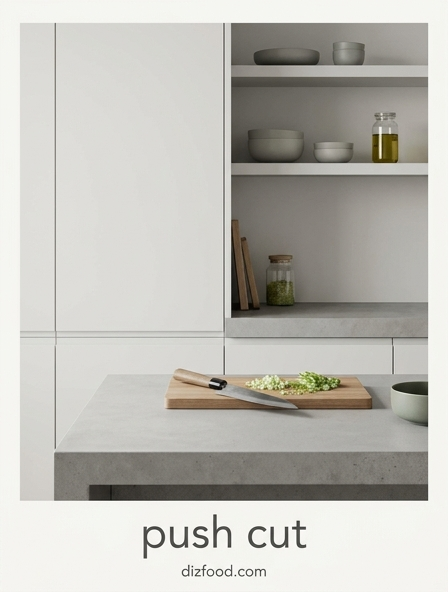
The push cut is a foundational skill in professional culinary arts, characterized by a forward and downward motion that utilizes the entire length of the blade. Unlike a simple vertical chop, the push cut involves moving the knife away from the body as it descends through the ingredient. This horizontal vector allows the microscopic serrations of the knife edge to engage with the food more effectively, resulting in a cleaner separation of fibers. To execute this correctly, the tip of the knife usually leaves the cutting board, making it distinct from the rocking motion often taught to beginners. It requires a firm grip and a stable cutting surface to ensure that the momentum is controlled and deliberate.
- Maintain a relaxed wrist to allow for fluid forward movement.
- Ensure the knife is perfectly perpendicular to the board to avoid slanted cuts.
- Focus on the "away and down" trajectory rather than just pushing straight down.
- Use the non-cutting hand in a claw grip to guide the blade safely.
Mastery of this technique leads to a significant reduction in physical resistance, especially when working with dense root vegetables or fibrous greens. By letting the edge do the work through lateral movement, the chef exerts less downward pressure, preserving the structural integrity of the food and the sharpness of the tool.
Benefits of the Rocking Motion
While the push cut is prized for precision, the rocking motion remains a staple for speed and efficiency when processing herbs, garlic, and smaller aromatics. This technique relies on keeping the tip of the knife in constant contact with the cutting board, using the curved belly of a Western-style chef's knife to act as a fulcrum. The circular, rhythmic movement allows for rapid mincing without the need to lift the heavy heel of the blade repeatedly. This creates a highly stable environment where the knife follows a predictable path, reducing the risk of the blade slipping off the ingredient during high-speed preparation.
| Feature | Rocking Motion | Push Cut |
|---|---|---|
| Blade Contact | Tip stays on the board | Blade leaves the board |
| Best For | Mincing herbs and garlic | Slicing dense vegetables |
| Knife Type | Curved (German/French) | Flat or slightly curved |
The rocking motion is particularly beneficial for reducing the "accordion" effect, where pieces remain attached at the bottom due to incomplete cuts. The rolling action ensures that every part of the blade eventually makes contact with the board, providing a reliable finish for every stroke.
Increasing Prep Speed and Precision
The synergy between speed and precision defines a professional kitchen. Utilizing the push cut allows a chef to establish a consistent rhythm that naturally accelerates as muscle memory develops. Precision is achieved because the forward motion offers better visibility of the product than a vertical chop. Because the knife moves in a consistent arc, the thickness of each slice can be calibrated with minute adjustments of the guiding hand. This method minimizes the "crushing" force often seen in rushed chopping, which can bruise delicate ingredients like scallions or leeks, leading to better flavor retention and visual appeal.
- Align the ingredient vertically to the knife path.
- Establish a steady tempo before attempting to increase speed.
- Keep the knife edge sharp to minimize the force required for each stroke.
- Practice uniform thickness to ensure even cooking times later.
As prep speed increases, the importance of a clean workspace becomes evident. Removing scraps and organized piles allows the push cut to remain uninterrupted. When a chef masters the forward momentum, they spend less time fighting the resistance of the food and more time gliding through the mise en place, resulting in a more efficient and less stressful kitchen environment.
Reducing Hand Fatigue While Dicing
Hand fatigue is a common ailment for those spending hours at the cutting board, often caused by an overly tight grip and excessive downward force. The push cut mitigates this by leveraging the knife's sharpness and the physics of the forward slide. By moving the knife forward as it descends, the blade slices through the material with significantly less resistance than a direct vertical press. This allows the weight of the knife to do a larger portion of the work, requiring less muscular effort from the forearm and hand. Proper ergonomics play a vital role; a pinch grip on the blade provides better control and balance, reducing the strain on the small muscles of the fingers.
Furthermore, maintaining a sharp edge is the most effective way to combat fatigue. A dull blade requires the cook to "muscle" through the food, leading to a cramped grip and sore wrists by the end of the shift. By focusing on a clean, sliding push motion, the repetitive impact on the wrist joint is softened. The energy is directed forward rather than purely downward into the hard surface of the cutting board, resulting in a more sustainable workflow for professional chefs and home cooks alike.
Improving Safety with Proper Mechanics
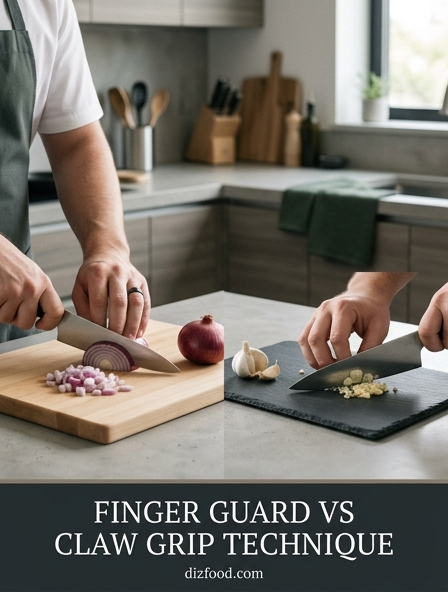
Safety in the kitchen is directly proportional to the control one has over their tools. The push cut, when performed with the correct mechanics, offers a high level of stability. The primary safety feature is the "claw grip" used by the non-cutting hand. By tucking the fingertips inward and using the knuckles as a guide for the side of the blade, the risk of accidental cuts is virtually eliminated. The knife should rest against the flat part of the knuckles, ensuring the sharp edge never comes into contact with the skin. Because the push cut is a controlled, forward motion, it is less likely to result in the blade glancing off a round vegetable compared to a vertical chop.
- Always keep the thumb tucked behind the fingers in the claw grip.
- Ensure the cutting board is secured with a damp cloth or non-slip mat.
- Keep the blade perpendicular to the board to prevent it from sliding sideways.
- Focus on the ingredient, not the knife, once the rhythm is established.
Proper mechanics also involve the height of the work surface. A board that is too high or too low forces the body into awkward angles, reducing control. By standing tall and using the push cut, the chef maintains a clear line of sight and a balanced posture, which are the ultimate defenses against kitchen accidents.
Selecting the Right Knife for Each Cut
The effectiveness of a push cut is heavily influenced by the geometry of the knife being used. While a standard European chef's knife can perform the task, its significant belly curve is more suited for rocking. For the purest push cut experience, many chefs prefer Japanese-style blades such as the Santoku or the Nakiri. These knives feature a flatter edge profile, which means more of the blade makes contact with the cutting board simultaneously during the forward slide. This flat edge ensures that the entire slice is completed cleanly without having to exaggerate the downward angle of the handle.
| Knife Type | Edge Profile | Optimized Technique |
|---|---|---|
| Chef's Knife | Curved/Belly | Rocking and Slicing |
| Santoku | Flatter | Push Cut and Chopping |
| Nakiri | Flat/Straight | Vertical Push Cut |
| Gyuto | Moderate Curve | Versatile/All-purpose |
Steel hardness also plays a role; harder steels found in professional knives hold a finer edge, which is essential for the effortless glide required in push cutting. When selecting a tool, consider the height of the blade; a taller blade like a Nakiri provides more surface area for the knuckles to rest against, enhancing both safety and accuracy during the prep process.
Consistent Dicing for Uniform Cooking
Uniformity is not just an aesthetic choice in professional cooking; it is a functional requirement. When ingredients are diced to the exact same dimensions using a consistent push cut, they respond to heat at the same rate. This prevents the common problem of smaller pieces burning or turning to mush while larger pieces remain raw in the center. The push cut allows for this level of precision because the chef can easily see the thickness of the preceding slice. By maintaining a steady horizontal movement, the knife doesn't "walk" or drift, ensuring that every cube of carrot or potato is a perfect geometric match to the last.
- Square off the vegetable to create flat surfaces.
- Slice into even planks using a forward push motion.
- Stack the planks and cut into uniform batons (julienne).
- Turn the batons and dice into cubes (brunoise or macédoine).
This systematic approach, powered by the push cut, ensures that a mirepoix or a stir-fry cooks evenly. In sauces or soups, uniform pieces also release their flavors simultaneously, leading to a more balanced and refined final dish. Consistency in cutting reflects a disciplined approach to the culinary craft.
Minimizing Edge Wear on Kitchen Knives
How a knife strikes the cutting board significantly impacts how long it stays sharp. Vertical chopping or aggressive rocking can cause the fine edge of a knife to roll or chip due to the concentrated force at the point of impact. The push cut is much gentler on the blade because the force is distributed along the edge as it slides forward. Instead of a direct "thud," the knife makes a softer, sliding contact with the wood or plastic surface. This lateral movement mimics the action of a saw but on a microscopic level, allowing the edge to sever fibers with less trauma to the metal itself.
To further protect the edge, the choice of cutting board is critical. End-grain wood boards are ideal as they allow the knife edge to slip between the wood fibers rather than cutting across them. Avoiding lateral pressure-such as using the knife to scrape food across the board-is also essential. By sticking to the push cut, the chef ensures that the primary force applied to the blade is in its strongest dimension. This practice reduces the frequency of honing and sharpening, extending the life of high-quality cutlery and maintaining a peak performance level throughout the workday.
Streamlining Your Daily Mise en Place
Efficiency in mise en place is the hallmark of an organized cook. Streamlining this process involves more than just fast hands; it requires a systematic approach to every ingredient. Using the push cut across various vegetables creates a predictable workflow. When the technique becomes second nature, the chef can focus on the sequence of tasks-processing the densest vegetables first and delicate herbs last. Because the push cut is so versatile, it reduces the need to switch between different knives or techniques constantly, allowing for a smoother transition from one ingredient to the next on the same cutting board.
- Group ingredients by cutting style to maintain a rhythmic flow.
- Clear the board frequently to keep the "drop zone" unobstructed.
- Use the push cut for bulk items like onions and peppers to save time.
- Maintain a dedicated space for finished products to avoid re-handling.
A streamlined mise en place ensures that when service begins, every component is ready and uniform. The mental clarity gained from a tidy, efficient prep session translates directly into better cooking performance. The push cut is the engine that drives this efficiency, providing a reliable method to tackle mountains of produce with minimal wasted motion.
Transitioning Between Motion Styles Seamlessly
A truly skilled chef is not limited to a single technique but can transition between the push cut, pull cut, and rocking motion based on the ingredient at hand. Seamlessly switching styles allows for maximum efficiency; for example, one might use a push cut to slice a bell pepper into strips and then immediately switch to a rocking motion to mince those strips into a fine dice. This fluidity requires an understanding of where the knife's balance point lies and how to shift the weight from the heel to the tip without breaking the rhythm of the work. It is about adapting to the resistance of the food in real-time.
To practice these transitions, start with an ingredient that requires multiple steps, like a leek. Use a long, slicing pull cut to halve it lengthwise, a series of push cuts to create half-moons, and a quick rocking motion to further refine the size if necessary. The goal is to eliminate pauses between these movements. As the chef becomes more comfortable, the hand naturally adjusts the angle and pressure of the blade. This level of adaptability ensures that the tool is always being used in the most ergonomic and effective way possible, regardless of the culinary challenge presented.

Comments