
Achieving restaurant-quality uniformity when dicing tubers depends entirely on mastering the structural differences between starchy white potatoes and dense, fibrous sweet potatoes. While standard potatoes are relatively soft and easy to glide through, sweet potatoes require more downward force and a strategic "plank-cutting" approach to prevent the blade from slipping on their tough skins. To get fast, consistent results for hashes or stews, always stabilize your vegetable by slicing off a thin longitudinal strip to create a flat base; this simple adjustment minimizes rolling and ensures every cube cooks at the same rate. By matching your knife pressure and grip to the specific density of the tuber, you can significantly reduce prep time while elevating the visual appeal and texture of your finished dish.
| Feature | White Potato Dicing | Sweet Potato Dicing |
|---|---|---|
| Cellular Density | Low to Medium; easy blade penetration. | High/Fibrous; requires significant force. |
| Knife Recommendation | Standard 8" Chef's Knife or Santoku. | Heavy-duty, high-carbon Chef's Knife. |
| Blade Friction | High; starch causes slices to stick to blade. | Low; slices release easily from the metal. |
| Safety Risk | Low; softer flesh allows for controlled cuts. | High; dense flesh can cause blade deflection. |
| Best Technique | Standard "Stack and Slice" method. | "Plank and Square" for maximum stability. |
| Prep Speed | Fast; minimal physical effort required. | Moderate; requires deliberate, forceful cuts. |
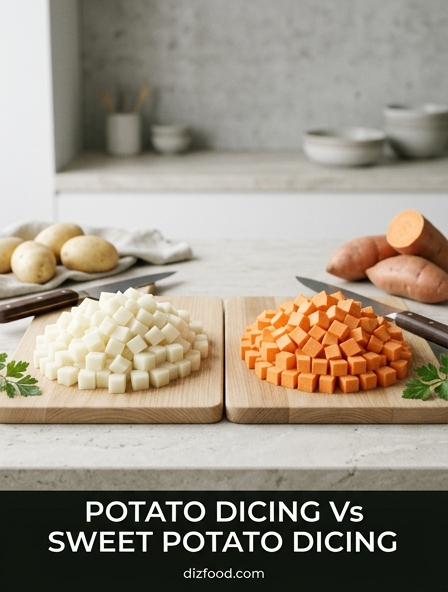
Texture Differences Impacting Dicing Ease
The fundamental challenge in dicing potatoes versus sweet potatoes lies in their internal cellular structure and moisture content. Traditional white potatoes, such as Russets or Yukon Golds, possess a starchy, somewhat brittle texture. When a sharp blade enters a Russet, the starch granules offer moderate resistance before the tuber yields, often resulting in a clean, crisp snap. This makes them relatively easy to transform into uniform cubes, as the knife glides through the flesh with predictable pressure.
In contrast, sweet potatoes are significantly more fibrous and dense. Their lower moisture content and complex carbohydrate structure create a "woody" resistance that can catch a blade mid-stroke. While a standard potato might feel like cutting through cold butter, a sweet potato often feels like cutting through a dense root or soft wood. This textural disparity requires the chef to adjust their physical approach. The skin of a sweet potato is also thicker and more resilient, often requiring a more aggressive initial puncture to begin the dicing process.
- Russet Potatoes: High starch, dry texture, prone to snapping cleanly.
- Yukon Gold: Waxy and smooth, offers the least resistance to dicing.
- Sweet Potatoes: High density, fibrous, requires consistent downward force.
- Red Potatoes: High moisture, can be slippery during the dicing process.
Best Knives for Slicing Dense Potatoes
Selecting the appropriate tool is critical when moving between different types of tubers. For standard white potatoes, a classic 8-inch European-style chef's knife is usually sufficient. The slight curve of the blade allows for a rocking motion that handles the starch well. However, when tackling the heightened density of sweet potatoes, many professionals prefer a Japanese Santoku or a heavy-duty cleaver. The thinner blade profile of a Santoku reduces friction, preventing the "suction" effect where the potato sticks to the side of the metal.
Sharpness is the most important factor in preventing injury and ensuring clean cuts. A dull knife will frequently wedge itself inside a sweet potato, requiring the cook to apply dangerous amounts of force to finish the cut. For those processing large quantities, a knife with a "Grantal edge" (dimples on the side) can help release the starchy suction that often occurs with starchy Russets.
| Knife Type | Best For | Why It Works |
|---|---|---|
| Chef's Knife | Russets & Yukons | Rocking motion handles volume efficiently. |
| Santoku | Sweet Potatoes | Thin blade reduces wedging in dense flesh. |
| Cleaver | Large Sweet Potatoes | Weight provides natural leverage for thick roots. |
| Serrated Knife | Thick-Skinned Tubers | Saws through tough outer skins without slipping. |
Safety Tips for Cutting Sweet Potatoes
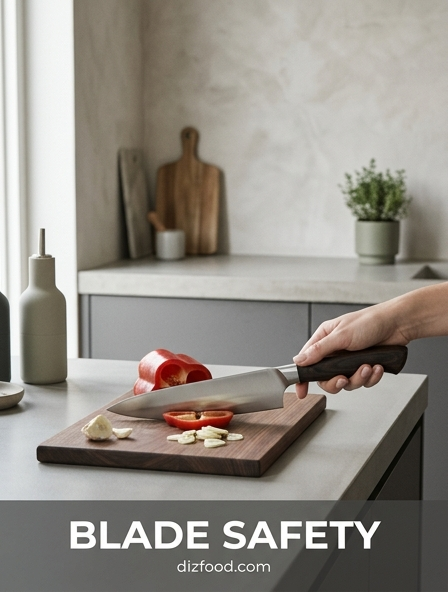
Because sweet potatoes are remarkably hard and often irregularly shaped, they present a higher risk for knife slips than standard potatoes. The round, tapered ends of a sweet potato make it prone to rolling on the cutting board. To mitigate this risk, the first step should always be to create a flat surface. By slicing a small sliver off one side of the potato, you can lay it flat against the board, providing a stable foundation for all subsequent cuts.
Another common safety hazard involves the amount of force required. If a knife becomes stuck, many amateur cooks attempt to wiggle the blade or push down with their secondary hand. This is how accidents happen. Instead, if a blade wedges, lift the potato and the knife together and gently tap them against the board to finish the split, or withdraw the knife and start a shallower cut. Keeping your fingertips tucked in the "claw" position is non-negotiable when dealing with the high-resistance flesh of orange tubers.
- Stabilize the cutting board with a damp paper towel underneath.
- Create a flat "anchor" side by slicing off a longitudinal strip.
- Use a vertical "push-cut" rather than a rocking motion for density.
- Ensure the potato is dry; sweet potato sap can be surprisingly slick.
- Keep your non-cutting hand's knuckles forward to guide the blade.
Mastering Uniform Dice Sizes for Roasting
Uniformity is not just about aesthetics; it is a requirement for even cooking. In the oven, a half-inch cube of potato will roast much faster than a one-inch cube. When mixing sweet potatoes and white potatoes in the same pan, uniformity becomes even more complex because they have different sugar contents and caramelization points. Sweet potatoes brown faster due to their natural sugars, so some chefs choose to dice them slightly larger than the white potatoes to ensure both varieties finish at the same time.
Standard culinary dimensions provide a helpful guide for dicing. A "Small Dice" is typically 1/4 inch, a "Medium Dice" is 1/2 inch, and a "Large Dice" is 3/4 inch. For roasting, the medium dice is generally preferred as it provides enough surface area for crisping while maintaining a fluffy interior. To achieve this, always square off the potato first, turning the round vegetable into a rectangular block. This may seem wasteful, but the trimmings can be saved for mashes or soups, and the resulting cubes will cook with perfect consistency.
- Brunoise: 1/8 inch cubes (used for garnishes and fine hashes).
- Small Dice: 1/4 inch cubes (ideal for quick-cooking breakfast skillets).
- Medium Dice: 1/2 inch cubes (the gold standard for oven roasting).
- Large Dice: 3/4 inch cubes (best for slow-simmered stews).
Comparing Prep Time for Potato Varieties
Efficiency in the kitchen often depends on understanding the time requirements of your ingredients. On average, preparing sweet potatoes takes roughly 30% to 50% longer than preparing the same volume of Russet potatoes. This time difference is attributed to several factors: the difficulty of peeling the thicker skin, the increased physical effort required to slice through the dense core, and the tendency for sweet potatoes to have more irregular, "knobby" shapes that require more careful navigation.
White potatoes, particularly thin-skinned varieties like Red Bliss or Yukon Gold, often do not require peeling at all, which significantly slashes prep time. Even when peeling is necessary, the skin usually falls away in long, effortless strips. Sweet potatoes, however, often have deep crevices and eyes that trap dirt and require detail work with a paring knife. Furthermore, because sweet potatoes oxidize (turn brown or gray) slightly differently than white potatoes, they can be prepped a bit further in advance without immediate water immersion, though water is still recommended for long-term storage.
| Task | White Potato Time | Sweet Potato Time |
|---|---|---|
| Peeling (per lb) | 45 Seconds | 90 Seconds |
| Slicing into Planks | 30 Seconds | 60 Seconds |
| Final Dicing | 60 Seconds | 90 Seconds |
| Total Prep per lb | ~2.5 Minutes | ~4 Minutes |
Step by Step Dicing Techniques Explained
To achieve professional-grade results, one must follow a systematic approach to breaking down the tuber. This method applies to both potato types, though it requires more patience with the sweet variety. The goal is to move from a round, unstable object to a series of uniform cubes through geometric reduction. This prevents the "wedging" effect and ensures every piece has similar dimensions for the frying pan or roasting tray.
- Wash and Peel: Remove all dirt and skin unless the recipe specifically calls for skin-on cubes.
- The Stability Cut: Slice off a thin portion of the long side so the potato sits flat on the board.
- Squaring: Cut off the rounded ends and sides until you have a rectangular "brick."
- Planking: Slice the brick lengthwise into uniform slabs of your desired thickness (e.g., 1/2 inch).
- Batonnet: Stack the slabs and cut them lengthwise again into long sticks, often called "fries."
- The Final Dice: Turn the sticks 90 degrees and cut crosswise into perfect cubes.
This "plank-and-stick" method is the most efficient way to ensure that you don't end up with odd-shaped triangles or slivers that will burn in the oven. For sweet potatoes, ensure your knife is sharp enough to cut through the entire stack of planks at once, or process them one layer at a time to maintain control.
Managing Starch and Moisture While Cutting
One often overlooked aspect of dicing is the "gunk" that builds up on the knife and cutting board. White potatoes are famous for their surface starch. As you dice, a white, milky liquid is released that can make the potato pieces stick to the blade and to each other. This creates a suction that makes dicing dangerous and messy. To manage this, many cooks keep a bowl of cold water nearby, tossing the finished dice into the water immediately to rinse off excess starch and prevent oxidation.
Sweet potatoes have a different moisture profile. Instead of thin starch, they often release a sticky, latex-like sap when cut. This sap can create a tacky residue on the knife that actually increases friction as you work. If you notice your knife is getting harder to pull through the vegetable, wipe the blade with a damp cloth every few minutes. Unlike white potatoes, sweet potatoes don't always need a water soak to stay crisp, but soaking can help remove some of the surface sugars if you want a crispier roasted exterior without premature burning.
- Rinsing: Removes surface starch for cleaner, individual cubes.
- Wiping: Keeps the blade free of sticky sweet potato sap.
- Soaking: Prevents browning and can improve the texture of fried potatoes.
- Drying: Crucial after soaking; wet potatoes will steam rather than roast.
How Density Affects Knife Skills Performance
The density of a sweet potato acts as a test of a cook's technique. When dicing a soft Yukon Gold, a cook can get away with poor form-such as using only the wrist or applying uneven pressure. However, the density of a sweet potato punishes these mistakes. Because the root is so resistant, the cook must engage their entire arm and shoulder to drive the knife down. This "weight-of-the-body" approach is much more efficient and less fatiguing than trying to muscle through with the hand alone.
Furthermore, density affects the "drift" of the blade. In a dense sweet potato, a knife that is not perfectly vertical will tend to wander to one side as it seeks the path of least resistance. This results in tapered cubes that are thick at the top and thin at the bottom. To counter this, the cook must maintain a very firm grip and focus on a slow, deliberate downward press rather than a fast, repetitive chopping motion. Proper knife skills turn the struggle against density into a rhythmic, manageable task.
Tools for Efficient Large Batch Dicing
When preparing potatoes for a large event or a week of meal prep, the manual knife method can become exhausting. For white potatoes, a mandoline slicer is an excellent tool for creating uniform planks and sticks (julienne) very quickly. Because white potatoes are softer, they pass through the mandoline blades with minimal resistance. However, extreme caution is required, and a safety guard is mandatory, as the starch can make the potato slip unexpectedly.
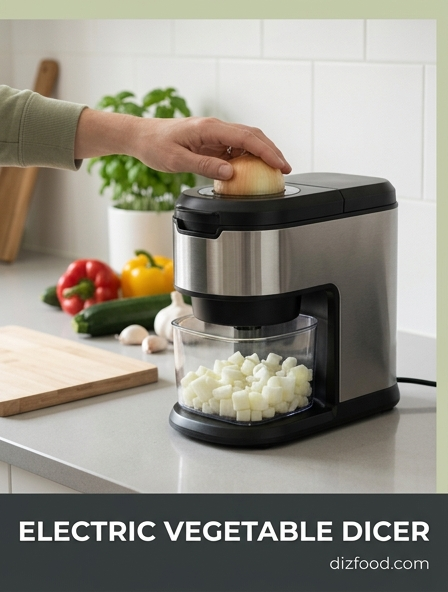
For sweet potatoes, a standard plastic mandoline may struggle or even break under the pressure required. A heavy-duty stainless steel mandoline or a dedicated French fry press is a better option. Another alternative for large batches is the dicing attachment on a high-end food processor. While these don't always produce the "perfect" cubes of a hand-cut dice, they are incredibly efficient for soups or mashes where exact geometry is less important. For the home cook, a "vidalia-style" chopper-where you press a lid down through a grid of blades-can work for white potatoes but often fails against the sheer density of a raw sweet potato.
- Mandoline: Best for uniform slices and sticks of white potatoes.
- French Fry Press: Best for high-volume sweet potato processing.
- Food Processor: Fastest for rough dicing in stews.
- Hand-Dicer: Only recommended for softer, par-boiled tubers.
Choosing the Right Cut for Every Recipe
The final application of the potato should dictate the dicing style. In a hearty beef stew, a large dice (3/4 inch) is ideal for white potatoes because they need to withstand long simmering times without disintegrating into the liquid. Sweet potatoes in the same stew should be cut slightly larger, as they tend to soften more quickly than Russets. If you are making a breakfast hash, a small dice (1/4 inch) is superior because it allows for maximum surface contact with the pan, leading to a crispy exterior and a cooked-through interior in a matter of minutes.
For salads, such as a classic potato salad, a medium dice is preferred for its bite-sized convenience. When dicing for a gratin or a "hash brown" style dish, the consistency of the dice is more important than the size, as varied sizes will lead to a mix of mushy and crunchy pieces. Understanding the culinary goal allows you to choose the most efficient dicing path.
| Recipe | Ideal Cut | Potato Type |
|---|---|---|
| Breakfast Hash | Small Dice (1/4") | Yukon Gold or Sweet Potato |
| Hearty Stews | Large Dice (3/4") | Russet or Red Potato |
| Sheet Pan Roast | Medium Dice (1/2") | Any variety |
| Chowder | Small to Medium Dice | Russet (for thickening) |

Comments