
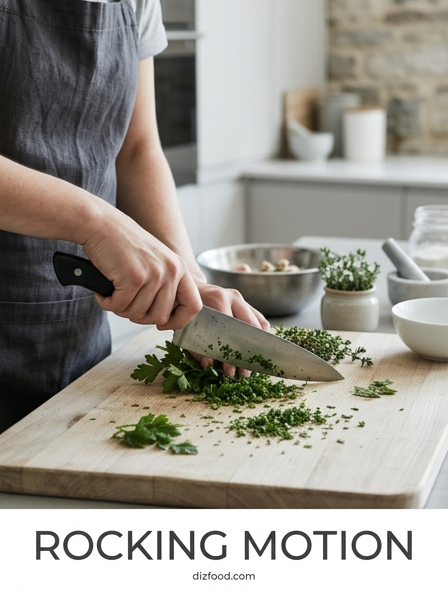
Mastering essential knife skills is the fundamental building block for any aspiring chef looking to elevate their kitchen game. By achieving true culinary precision and consistency, you ensure that every ingredient cooks at the same rate, resulting in balanced flavors and professional presentation. Developing a proper grip and smooth rocking motion not only increases your efficiency but also significantly improves safety during meal prep. Whether you are julienning vegetables or creating uniform cubes, these refined techniques transform simple ingredients into gourmet masterpieces. To truly sharpen your expertise, it is vital to understand the subtle differences in sizing, such as comparing Macedoine vs. Parmentier.
Mastering the Fundamental Grip for Control
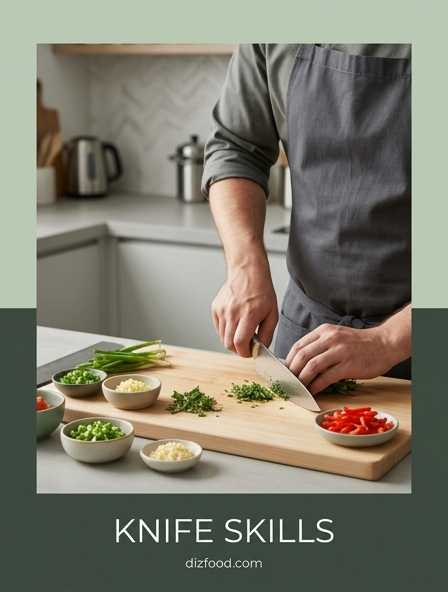
The foundation of all proficient knife work begins with the grip. Moving beyond the common instinct to wrap all fingers around the handle, professional chefs utilize the "pinch grip" to maximize leverage and precision. By placing the thumb and the side of the index finger directly onto the blade's bolster, the knife becomes an extension of the hand rather than a separate tool. This specific placement shifts the center of gravity forward, allowing for more fluid movements and reducing the strain on the wrist during repetitive dicing tasks.
While the pinch grip secures the blade, the remaining three fingers should curl comfortably around the handle to provide stability. This configuration prevents the knife from wobbling or slipping, which is essential when navigating through dense root vegetables or performing high-speed cuts. Mastering this grip requires conscious practice, as it may feel unnatural initially. However, the increased tactile feedback from the blade allows the cook to sense the texture of the food, leading to more controlled and confident strokes that are necessary for professional-level results.
Selecting the Ideal Chef Knife for Dicing
Choosing the correct instrument is paramount for achieving clean, uniform cuts. A standard eight-inch chef knife is typically the preferred choice for dicing due to its versatile length and the slight curve of its edge, which facilitates a smooth rocking motion. When selecting a knife, weight and balance are the most critical factors to consider. A well-balanced knife should feel neutral in the hand, with the weight distributed evenly between the blade and the handle, preventing premature fatigue during long prep sessions.
- Blade Material: High-carbon stainless steel is ideal for maintaining a sharp edge while resisting corrosion.
- The Bolster: A thick bolster provides a transition point between the blade and handle, offering protection and a comfortable resting spot for the pinch grip.
- Tang Construction: A full tang, where the metal extends to the end of the handle, ensures durability and superior balance.
- Blade Geometry: A thinner "spine" reduces friction, allowing the blade to pass through firm vegetables without wedging.
Investing in a high-quality forged knife rather than a stamped one often results in better edge retention and a more substantial feel, which is beneficial for the repetitive downward force required for dicing.
The Anatomy of a Perfect Uniform Dice
In the culinary world, dicing is not merely about cutting food into smaller pieces; it is about mathematical precision. A perfect dice ensures that every cube is identical in size and shape, which is the hallmark of a skilled practitioner. This uniformity is categorized into three primary standard sizes used in professional kitchens. Achieving these dimensions requires a systematic approach, starting with "squaring off" the vegetable to create a rectangular block, or a "poids," before proceeding with further cuts.
| Dice Type | Standard Dimensions | Common Culinary Uses |
|---|---|---|
| Large Dice (Carré) | 3/4 inch x 3/4 inch | Stews, slow-cooked roasts, and mirepoix for stocks. |
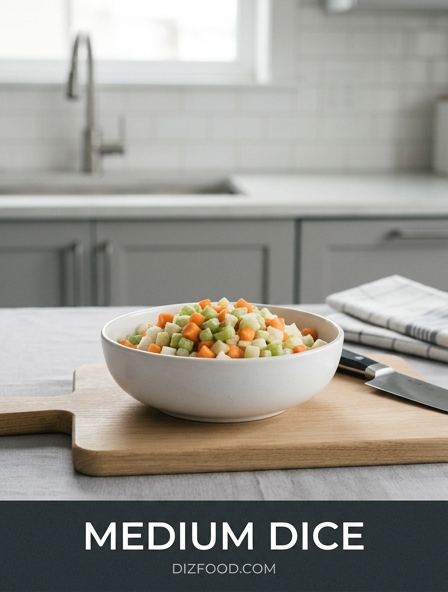
| Medium Dice (Parmentier) | 1/2 inch x 1/2 inch | Potato salads, hearty soups, and sautéed medleys. |
| Small Dice (Macédoine) | 1/4 inch x 1/4 inch | Garnish, refined sauces, and delicate vegetable sides. |
Maintaining these specific measurements is vital because irregular shapes lead to uneven cooking. A small cube will turn to mush in the time it takes for a larger cube to soften, compromising the integrity of the final dish.
Essential Safety Techniques and Hand Placement
The most critical safety element in knife skills is the "claw grip" used by the guiding hand. By tucking the fingertips inward and using the knuckles as a guide for the side of the blade, you create a physical barrier that prevents the edge from coming into contact with your skin. The thumb should be tucked behind the other fingers, acting as a stabilizer for the ingredient being cut. This technique allows the knife to glide safely against the flat surface of the knuckles while keeping the vulnerable tips of the fingers far from the sharp edge.
In addition to hand placement, maintaining a stable cutting surface is essential for preventing accidents. A damp paper towel or a non-slip silicone mat placed under the cutting board ensures the surface does not slide during use. Always keep your focus on the task at hand; distractions are the primary cause of kitchen injuries. When moving the knife, keep the tip on the board whenever possible to maintain a constant anchor point. By combining the claw grip with a stable board and a steady rhythm, you create a secure environment that allows for both speed and safety.
Maintaining Blade Sharpness for Precise Cuts
A sharp knife is significantly safer and more efficient than a dull one. When a blade is dull, it requires more downward pressure to penetrate the skin of a vegetable, increasing the likelihood of the knife slipping and causing injury. Precise dicing is only possible when the blade can slice through cell walls cleanly rather than crushing them. To maintain a professional edge, a dual-pronged approach involving both honing and sharpening is necessary for any serious home cook or professional chef.
- Honing: Use a ceramic or steel honing rod frequently to realign the microscopic teeth of the blade that bend during use.
- Sharpening: Use a whetstone periodically to remove metal and create a fresh, sharp edge. This is typically done at a 15 to 20-degree angle.
- Cleaning: Hand wash and dry knives immediately. Dishwashers subject blades to high heat and harsh chemicals that dull the edge.
- Storage: Use a magnetic strip or knife block to prevent the edges from clashing against other metal utensils in a drawer.
Consistent maintenance ensures that the knife remains a reliable tool, allowing for the effortless precision required for complex tasks like the brunoise or fine julienne.
Step by Step Guide to the Brunoise Technique
The brunoise is the finest standard dice in French cuisine, producing tiny cubes that measure exactly 1/8 inch on each side. This technique is often used for garnishes or aromatics where a subtle texture and rapid flavor release are desired. Achieving a perfect brunoise is a testament to a chef's discipline and technical mastery. It begins with the preparation of a precise julienne, which serves as the foundation for the final tiny cubes. The process requires a very sharp knife and a high degree of focus to maintain the minute dimensions across every single cut.
- Squaring: Peel and square off the vegetable to create a flat, rectangular block.
- Slicing: Cut the block into thin longitudinal slices exactly 1/8 inch thick.
- Julienne: Stack the slices and cut them into thin matchsticks, also 1/8 inch wide.
- The Final Dice: Bundle the matchsticks together and cut across them at 1/8 inch intervals to create the cubes.
This method results in a visually stunning, uniform product that cooks almost instantly. Because the surface area is so high relative to the volume, a brunoise is ideal for imparting intense flavor into butter sauces or as a refined topping for consommé.
Optimizing Your Cutting Board Workflow
Efficiency in the kitchen is often determined by how well you manage your workspace. A cluttered cutting board leads to mistakes and slows down the preparation process. To optimize your workflow, establish a clear system for handling ingredients, scraps, and finished products. This is often referred to as "mise en place," meaning "everything in its place." By organizing your station before you even pick up your knife, you can focus entirely on the mechanics of the cut rather than searching for space to work.
Start by placing your cutting board in the center of your station with three bowls nearby: one for the whole ingredients, one for the finished dice, and one for compost or scraps. Always clear your board of debris between tasks; even a single peel can cause your vegetable to roll and compromise your safety. Keep the board dry, as moisture can make vegetables slippery and dangerous. Furthermore, arrange your station so that you move from one side to the other in a linear fashion, minimizing unnecessary hand movements. This disciplined approach not only speeds up prep time but also improves the overall quality of your culinary output.
Achieving Consistency for Even Cooking Results
The primary reason professional chefs insist on uniform dicing is not just for aesthetics, but for the science of heat transfer. When pieces of a vegetable are various sizes, they cook at different rates. Small pieces will overcook and disintegrate while the larger pieces remain raw in the center. This inconsistency ruins the texture of a dish and prevents the flavors from harmonizing correctly. By mastering the dice, you ensure that every morsel reaches the ideal state of doneness at the exact same moment, resulting in a superior dining experience.
Consider a vegetable soup where carrots and potatoes are the main components. If the potatoes are cut into medium dice and the carrots into small dice, the carrots will disappear into the broth before the potatoes are tender. Uniformity allows for predictable results, enabling the cook to time the addition of ingredients perfectly. Consistency also affects the mouthfeel of the dish. A spoonful of stew is far more satisfying when the textures are balanced and intentional, showcasing a level of care that separates a casual meal from a professionally executed culinary creation.
Professional Methods for Dicing Round Vegetables
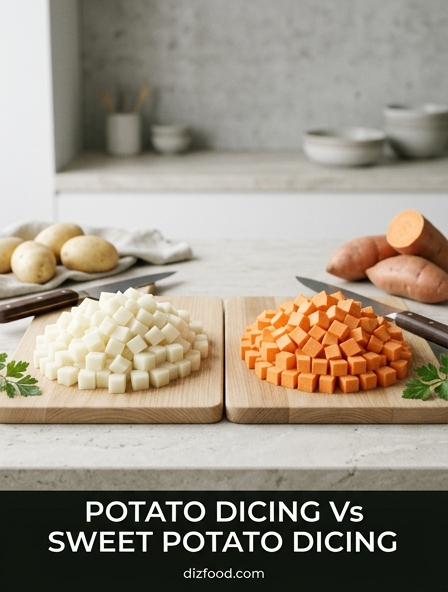
Working with round vegetables like onions, potatoes, and beets presents a unique challenge because their natural shape makes them prone to rolling. The professional secret to handling these ingredients safely is to create a flat base as the very first step. By slicing off a small portion of one side, you provide a stable surface that anchors the vegetable to the cutting board. This eliminated movement is the key to preventing the knife from slipping and ensures that every subsequent cut is made on a firm foundation.
For an onion, the technique involves keeping the root end intact to hold the layers together while you make vertical and horizontal cuts. This internal structure allows you to maintain control until the very last dice is completed. For spherical root vegetables, the "squaring off" method is most effective. By turning a round potato into a rectangular prism, you lose a small amount of product (which can be saved for mash or stock), but you gain the ability to produce perfectly uniform cubes. This transition from organic, unstable shapes to geometric, stable forms is the hallmark of professional vegetable preparation and a prerequisite for high-level precision.
Elevating Presentation Through Culinary Precision
Culinary precision transforms a simple ingredient into a visual masterpiece. In fine dining, the visual appeal of a dish is considered just as important as its flavor profile. Sharp, clean edges on a dice reflect light differently than rough, torn edges, giving the food a vibrant and polished appearance. Precision cuts signal to the guest that the chef possesses a high level of discipline and respect for the ingredients. Whether it is a colorful medley of peppers or a delicate garnish of shallots, the uniformity of the dice creates a sense of order and elegance.
Beyond the individual components, precision allows for better "plating architecture." When vegetables are cut into identical cubes, they can be stacked, molded, or spread with intentionality. This control enables the creation of geometric patterns and clean lines that are impossible to achieve with rustic, uneven cuts. Ultimately, elevating your presentation through knife skills is about the pursuit of excellence. It shows a commitment to the craft that enhances the overall sensory experience, making the meal feel more luxurious and thoughtfully prepared. By mastering these fundamental skills, you transition from simply cooking food to practicing the art of gastronomy.

Comments