
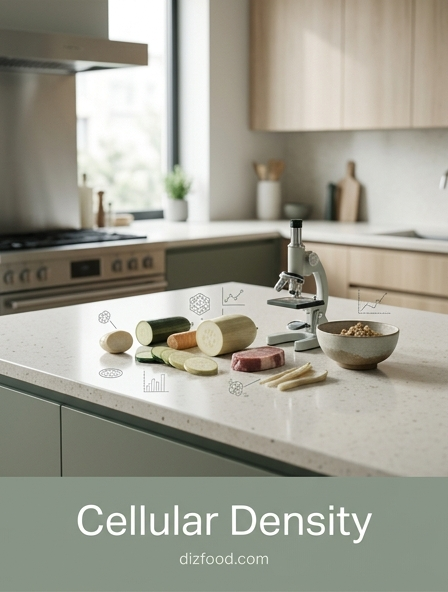
Understanding Tuber Cellular Architecture
The internal structure of a tuber is a complex matrix of parenchyma cells designed for nutrient storage. These cells are characterized by their thin primary walls and a high concentration of amyloplasts, which house starch granules. The density of a tuber is primarily determined by the ratio of these starch deposits to the surrounding aqueous cytoplasm and intercellular air spaces. When examining tubers like the Russet potato or the taro root, we observe a tightly packed cellular arrangement that minimizes air gaps, resulting in a heavy, solid mass.
This architectural framework dictates how the vegetable reacts to mechanical stress and thermal processing. The cohesion between individual cells is maintained by the middle lamella, a layer rich in pectic polysaccharides. In high-density tubers, this pectin layer is often more robust, requiring significant force to bypass. Understanding this layout is essential for culinary applications, as the distribution of solids and water influences everything from the "mouthfeel" of a puree to the structural integrity of a chip. The arrangement of these cells creates a microscopic scaffolding that supports the entire weight of the plant's energy reserves.
Physics of Knife Pressure on Dense Tissues
When a blade contacts a dense tuber, it initiates a process of localized compression followed by shear failure. The amount of pressure required to penetrate the surface is directly proportional to the cellular density and the surface tension of the vegetable's skin. As the edge of the knife enters the tissue, it acts as a wedge, displacing cells laterally. In highly dense specimens, there is very little room for cellular compression, meaning the force applied must be sufficient to rupture the cell walls immediately.
- Initial Resistance: The point where the blade encounters the epidermis and requires a sharp peak force.
- Frictional Drag: The resistance felt as the sides of the blade move through the internal starch matrix.
- Cleavage Plane: The path of least resistance where the tissue splits ahead of the actual edge.
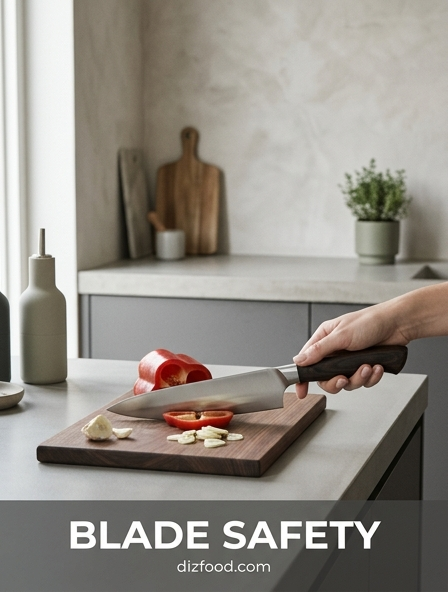
If the pressure is inconsistent, the blade may deflect, leading to uneven cuts or potential injury. Managing this physics involves utilizing the entire length of the blade to distribute the load, ensuring that the downward force is balanced by a forward or backward slicing motion to reduce the total energy required to sever the tough pectin bonds.
Cell Wall Strength and Dicing Uniformity
The ability to achieve perfectly uniform cubes depends heavily on the structural integrity of the cell walls. In vegetables with high cellular density, the rigidity of the cellulose fibers provides a stable medium for precise dicing. When a knife slices through a carrot or a parsnip, the cell walls must resist collapsing under the weight of the blade. If the walls are too weak, the vegetable will crush rather than cut, leading to jagged edges and loss of internal fluids.
Uniformity is not merely an aesthetic concern; it ensures that each piece of produce has the same surface-area-to-volume ratio, which is critical for even cooking. Dense tubers provide the mechanical resistance necessary for the blade to maintain a straight trajectory. By understanding the strength of the middle lamella-the "glue" holding the cells together-chefs can predict how much resistance to expect. This resistance is what allows for the creation of sharp corners and straight lines, which are the hallmarks of professional knife work in dense, root-based produce.
Relationship Between Density and Blade Resistance
The resistance a chef feels when cutting through a vegetable is a direct measurement of its cellular density and moisture content. High-density produce, such as sweet potatoes or beets, offers significant "push-back" against a knife edge. This occurs because the blade must physically displace a high concentration of solid matter per square millimeter. The more starch and fiber packed into the cells, the greater the mechanical energy required to move the blade through the medium.
| Vegetable Type | Density Level | Blade Resistance |
|---|---|---|
| Zucchini | Low | Minimal |
| Yukon Gold | Medium | Moderate |
| Sweet Potato | High | Significant |
| Butternut Squash | Very High | Extreme |
To mitigate this resistance, the blade must be maintained at an extremely high level of sharpness. A dull blade increases the surface area of contact, which significantly raises the friction. In high-density tissues, this friction can generate heat and cause the blade to stick, a phenomenon known as "suction," which complicates the cutting process and requires more physical exertion.
Achieving Precision in Root Vegetable Cubing
Precision cubing in root vegetables requires a systematic approach to neutralizing the inherent instability of dense, rounded shapes. Because root vegetables are often asymmetrical, the first step is always to create a "flat" by removing a small longitudinal slice. This stabilizes the vegetable against the cutting board, preventing the rolling motion that often leads to accidents when dealing with high-resistance tissues. Once stabilized, the tuber is sliced into uniform planks, then batons, and finally cubes.
- Square the vegetable by removing the rounded sides to create a rectangular prism.
- Slice the prism into planks of the desired thickness, maintaining even pressure.
- Stack the planks and cut them into strips, or "batons."
- Gather the batons and cut crosswise to produce perfect cubes.
The high cellular density of root vegetables actually assists in this process by preventing the pieces from sliding or deforming under the pressure of the knife. This structural rigidity allows the cook to maintain tight tolerances and produce the exact geometric shapes required for high-end culinary presentations.
Mechanical Stress and Starch Granule Integrity
The act of cutting is, at its core, an application of mechanical stress that can impact the vegetable at a microscopic level. When a knife is sharp, it cleanly severs the cell walls, leaving the starch granules within the cells largely intact. However, if the blade is dull or if the pressure applied is excessive and blunt, the cells are crushed rather than cut. This rupture releases the starch granules and enzymes into the surrounding environment before the cooking process even begins.
In high-density tubers, the liberation of excess starch can lead to a sticky, gummy texture on the surface of the cut pieces. This is particularly noticeable in potatoes, where released amylopectin can cause the cubes to adhere to one another during roasting or frying. Maintaining the integrity of the starch granules through clean, decisive cuts ensures that the interior of the vegetable remains fluffy while the exterior can crisp up effectively. Precision in cutting is therefore not just about shape, but about the chemical and textural outcome of the final dish.
Optimizing Downward Force for Firm Tubers
Cutting through firm, high-density tubers like rutabagas or large carrots requires an optimization of downward force to ensure safety and efficiency. Rather than relying solely on muscular strength, a chef must use the weight of their body and the leverage of the knife. The "rocking motion" common with chef knives is often less effective for very dense tubers than a "push-cut" or a "pull-cut" that utilizes the entire arm. By placing the non-cutting hand on the spine of the blade, one can apply a controlled, vertical force that helps the edge bite into the dense tissue.
The angle of the blade also plays a critical role. A steep angle provides more "bite," but increases the risk of the blade becoming wedged. A shallow, more acute angle allows the blade to slide through the cells with less resistance but requires a harder steel to maintain the edge. For the densest produce, using a heavy-duty cleaver or a thick-spined chef's knife provides the necessary momentum to overcome the initial cellular resistance, allowing the weight of the tool to do the majority of the work.
Structural Integrity Variations Across Tuber Species
Not all tubers are created equal in terms of their mechanical properties. Variations in species lead to significant differences in cellular density and fiber distribution. For instance, the Cassava root contains highly lignified fibers that run through its center, creating a different resistance profile than the more homogenous Russet potato. Beets, on the other hand, possess a concentric ring structure of vascular bundles that can make them feel "woody" if they are harvested too late in the season.
These variations dictate the preparation method. A high-density sweet potato may require parboiling to soften the cell walls before high-heat roasting, whereas a lower-density radish can be sliced thinly and served raw to capitalize on its crisp, aqueous cell structure. Understanding these species-specific traits allows a cook to adjust their knife technique-using more of a slicing motion for fibrous tubers and a direct chopping motion for those with a more uniform, starchy matrix. The structural integrity is the roadmap for how the ingredient should be handled on the cutting board.
Impact of Moisture Content on Shear Force
The relationship between cellular density and moisture content is defined by turgor pressure. Turgor pressure is the force of the water inside the cell pushing against the cell wall. In a fresh, highly hydrated tuber, this pressure is high, making the vegetable "crisp." When a knife hits a turgid cell, the cell wall is under tension and snaps easily, requiring less shear force to initiate a clean break. This is why a fresh carrot snaps loudly, while an older, dehydrated one bends and feels "rubbery."
As moisture content decreases, the cellular density effectively increases in terms of toughness, as the cell walls become more flaccid and difficult to sever. The blade must work harder to cut through the limp cellulose, often leading to tearing rather than slicing. To restore the ideal cutting conditions for high-density produce, one can submerge the vegetables in an ice-water bath. This rehydrates the cells, restores turgor pressure, and significantly reduces the shear force needed for precision cutting, making the produce behave more predictably under the blade.
Advanced Cutting Techniques for High Density Produce
To master high-density produce, advanced techniques beyond the basic chop must be employed. One such technique is the "horizontal plane" cut, used for breaking down large squashes or oversized yams. By making a series of shallow, controlled scores before committing to a deep cut, the chef can manage the release of internal tension within the tuber. Another technique involves the use of specialized tools like the Mandoline, which uses a fixed blade to provide consistent, high-speed shearing that minimizes the time the blade is in contact with the dense tissue.
- The Rolling Cut: Ideal for long, dense vegetables like carrots to create faceted surfaces for even roasting.
- The Japanese Katsuramuki: A technique of paper-thin sheeting that requires extreme control over cell wall resistance.
- The Oblique Cut: Maximizes surface area on dense roots to speed up the penetration of heat.
These methods rely on an intuitive understanding of how the vegetable will split. By applying force at specific angles relative to the grain of the vegetable, a chef can bypass the densest parts of the cellular architecture, resulting in cleaner cuts and a more refined culinary final product.

Comments