
Deciding between a mandoline slicer and a manual box grater can transform your meal prep from a tedious chore into a streamlined process, but the "best" choice depends entirely on your kitchen goals. While a mandoline is a precision powerhouse designed for achieving paper-thin, professional-grade uniform slices and delicate julienne cuts, the classic box grater remains the versatile workhorse for everyday tasks like shredding blocks of cheddar or zesting citrus. If you prioritize lightning-fast speed and surgical consistency for salads and gratins, the mandoline is your ideal match; however, for those who value multi-functional durability, safety, and a tool that handles everything from carrots to hard cheeses without a complex setup, the box grater is the ultimate dependable companion.
| Feature | Mandoline Slicer | Manual Box Grater |
|---|---|---|
| Primary Function | Precision slicing, julienne, and waffle cuts. | Shredding, grating, zesting, and rough slicing. |
| Uniformity | Ultra-consistent; adjustable thickness levels. | Variable; dependent on manual pressure/angle. |
| Safety Profile | High risk; requires a hand guard or cut-glove. | Lower risk; stable base, but watch fingertips. |
| Versatility | Specialized for vegetables and firm fruits. | Multi-tasker (cheese, chocolate, ginger, veg). |
| Prep Speed | Rapid; ideal for high-volume batch prep. | Moderate; requires more physical effort. |
| Maintenance | Flat/compact; requires careful blade cleaning. | Bulky shape; dishwasher safe but takes space. |
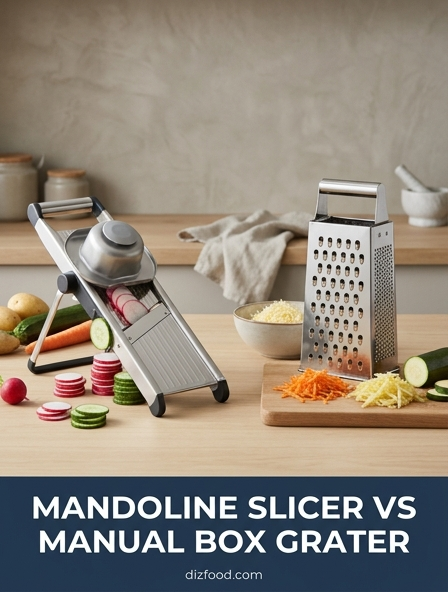
Mandoline Slicer vs Box Grater Comparison
The culinary world offers a variety of tools designed to transform whole vegetables and cheeses into specific shapes and sizes. Among the most fundamental of these are the mandoline slicer and the manual box grater. While they may seem to perform overlapping tasks, their mechanics and intended outcomes are significantly different. The mandoline is a precision instrument consisting of a flat surface with a sharp, stationary blade. Users slide food across this surface to produce identical slices. In contrast, the box grater is a multi-sided upright tool featuring various perforated patterns that shred, zest, or roughly slice food items as they are moved against the holes.
Choosing between these two depends largely on the specific requirements of a recipe and the desired aesthetic of the finished dish. The mandoline excels in tasks requiring exactness, such as creating paper-thin potato chips or uniform vegetable ribbons. The box grater, however, remains the "Swiss Army knife" of food preparation, capable of handling everything from hard parmesan cheese to soft tomatoes or zesty citrus peels. Understanding the fundamental differences in their design is the first step toward optimizing your kitchen workflow. Below is a brief overview of their primary attributes:
- Mandoline: Fixed blade design, adjustable thickness settings, focuses on uniformity and speed for slices.
- Box Grater: Multi-sided configuration, various hole sizes, focuses on volume shredding and diverse textures.
- Application: Mandolines are preferred for presentation-heavy dishes, while box graters are staples for everyday ingredient prep like taco toppings or baking.
Precision Cutting vs Versatile Food Prep
When it comes to the level of control over the final product, the mandoline slicer is the undisputed champion of precision. High-end models allow chefs to adjust the blade height to sub-millimeter increments, making it possible to achieve translucent slices that would be impossible to replicate with a knife or a standard grater. This precision is essential for dishes like vegetable carpaccio, gratins, or dehydrated fruit snacks where even cooking times depend entirely on consistent thickness. Because the blade is locked in a single position, every pass yields the exact same result, ensuring professional-grade presentation every time.
The box grater, while less precise, offers a level of versatility that a mandoline cannot match. A standard four-sided grater provides a large shredding surface, a fine shredding surface, a zester, and a rough slicing slot. This allows a cook to prepare an entire meal-from shredding potatoes for hashbrowns to grating cheese for a topping and zesting a lemon for garnish-using only one tool. While the "slicing" side of a box grater is often mediocre compared to a mandoline, its ability to handle different textures makes it an indispensable general-purpose tool. The following table highlights the strengths of each regarding specific preparation tasks:
| Task | Mandoline Slicer | Box Grater |
|---|---|---|
| Paper-Thin Slicing | Excellent / Adjustable | Poor / Fixed Thickness |
| Coarse Shredding | Requires Julienne Blade | Excellent / Standard Side |
| Citrus Zesting | Not Capable | Excellent / Fine Side |
| Hard Cheese | Good for Shavings | Excellent for Fine Dust |
Safety Features and Risk Factors
Safety is the most critical consideration when comparing these two tools, as both utilize extremely sharp surfaces that can cause significant injury if mishandled. The mandoline slicer is often cited as one of the most "dangerous" tools in a home kitchen. Because the user moves the food at high speed toward a fixed, razor-sharp blade, the risk of a finger slip is high. To mitigate this, most mandolines come with a safety hand guard or a "food pusher" designed to keep fingers away from the blade. Additionally, many professional chefs recommend wearing a cut-resistant Kevlar glove when using a mandoline to provide an extra layer of protection against the inevitable "end-of-vegetable" slip.
The box grater is generally considered safer, but it is certainly not without risk. The primary hazard with a grater is the "knuckle buster" effect, where the user's hand comes into contact with the sharp perforations as the piece of food gets smaller. However, the motion of grating is typically more controlled and slower than the rapid sliding motion used on a mandoline. To ensure safety across both tools, users should follow these standard protocols:
- Always use the provided food guard, even if it feels cumbersome or leaves a small amount of food un-sliced.
- Focus entirely on the task at hand; distractions are the leading cause of kitchen lacerations.
- Store tools with blades covered or in a way that they cannot be accidentally touched when reaching into a drawer.
- Discard the "nub" of the vegetable or finish it with a knife rather than trying to grate it down to nothing.
Achieving Uniform Slices vs Shredded Textures
The visual and textural outcome of your food is heavily influenced by which tool you select. The mandoline is designed for "clean cuts." This means the cellular structure of the vegetable is sliced through cleanly, which preserves the moisture and provides a crisp mouthfeel. Whether you are aiming for a classic French julienne, a matchstick cut, or a wide ribbon, the mandoline provides a flat, smooth surface that reflects light and looks sophisticated on the plate. This uniformity is not just about looks; it is also about science. Uniform slices cook at the same rate, preventing the frustration of having some potato slices burnt while others remain raw.
In contrast, the box grater produces "shredded" textures. The perforations on a grater act like tiny teeth that tear through the food. This creates a larger surface area on the shredded pieces, which is ideal for melting cheese or extracting juices from vegetables like zucchini or carrots. For example, when making a carrot cake, the shredded texture of a box grater allows the carrot to soften and meld into the batter more effectively than a clean slice would. Similarly, shredded cheese from a box grater melts more evenly than thick slices because of the increased air gaps and surface area. Ultimately, if you want your ingredients to maintain their individual identity, use the mandoline; if you want them to integrate into a larger mixture, use the grater.
Prep Speed and Workflow Efficiency
Efficiency in the kitchen is often measured by how quickly one can move from raw ingredients to a finished dish. The mandoline slicer is built for high-volume speed. Once the thickness is set and the safety guard is in place, a cook can slice through a dozen cucumbers or a bag of potatoes in a matter of minutes. The repetitive, linear motion is highly ergonomic, allowing for a rhythm that a manual knife or a box grater cannot replicate. For large gatherings, catering events, or meal prepping for the week, the mandoline is a massive time-saver that reduces labor-intensive chopping to a few quick swipes.
However, the box grater can be more efficient for small, singular tasks. If you only need a handful of shredded cheddar for a single omelet, the setup and subsequent cleanup of a box grater are often faster than assembling a complex mandoline with multiple attachments. The box grater requires no adjustment; you simply grab it and go. Furthermore, because the box grater is a self-contained unit, it often collects the food inside its "box" structure, keeping the cutting board cleaner. The workflow choice often comes down to the scale of the task:
- High Volume: Mandoline is superior for processing large quantities of the same item.
- Variable Tasks: Box grater is faster for switching between grating, zesting, and coarse shredding.
- Setup Time: Box graters have zero setup; mandolines may require blade changes and calibration.
Cleaning Ease and Dishwasher Safety
Maintenance is often the deciding factor for home cooks when choosing a tool. The box grater can be notoriously difficult to clean by hand. Small bits of cheese or fibrous vegetable strands can become trapped in the sharp perforations, requiring a stiff brush and careful scrubbing to remove. However, most stainless steel box graters are completely dishwasher safe, allowing the high-pressure water and heat to sanitize the tool effectively. The main risk with dishwasher use is the potential for other utensils to clink against the grater, potentially dulling the small teeth over several years of use.
Mandoline slicers require more delicate handling. Many mandolines are constructed with plastic frames and high-carbon steel blades. While some plastic components may be dishwasher safe, it is generally recommended to hand wash the blades. The harsh detergents and high heat of a dishwasher can quickly dull the razor-sharp edge of a mandoline, rendering it useless for thin slicing. Cleaning a mandoline also requires extreme caution, as you must wipe the blade without cutting your sponge-or your fingers. To clean safely, always wipe from the back of the blade toward the edge, or use a long-handled dish brush. Drying the tool immediately is also vital to prevent rust spots on the blade, which can occur even on stainless steel models if left in a damp environment.
Kitchen Storage and Compact Design
In a modern kitchen where drawer and cabinet space are at a premium, the physical footprint of these tools matters. The mandoline slicer is generally the more storage-friendly option. Most mandolines are designed with a flat profile, allowing them to slip easily into a shallow utensil drawer or stand upright in a narrow cabinet gap. Some models even feature folding legs that collapse to a thickness of less than two inches. Because they are elongated and thin, they are easy to "tuck away," making them ideal for apartment dwellers or those with minimal counter space.
The box grater, by definition, is a bulky 3D object. Its hollow, rectangular shape takes up a significant amount of cubic space in a cupboard. It cannot be flattened, and its sharp exterior makes it a hazard if tossed into a crowded drawer with other tools. Many cooks find that the box grater must live on a shelf or in a deep pull-out bin. However, some modern designs have attempted to solve this by creating "fold-flat" box graters that use hinges to collapse into a 2D shape. While these are great for storage, they often sacrifice the structural stability that makes a traditional box grater so reliable. When choosing, consider whether you prefer a tool that disappears into a drawer (mandoline) or one that likely requires its own dedicated corner in a cabinet (box grater).
Durability and Material Quality
The longevity of these tools is largely determined by their construction materials. Box graters are almost universally made from stainless steel. Because the "blades" are actually punched holes in a metal sheet, they are incredibly durable and resistant to bending. A high-quality stainless steel box grater can easily last a decade or more with minimal care. Even if the teeth dull slightly over time, the tool remains functional for most shredding tasks. The primary point of failure for a box grater is usually the handle or the base, which may become detached if the welding is poor or if the plastic components crack.
Mandolines are more complex and therefore have more potential points of failure. They often feature a mix of plastic and metal. The sharpness of the blade is the mandoline's most important asset; once that blade becomes dull, the tool becomes dangerous, as it requires more force to push food through, increasing the likelihood of a slip. While many professional mandolines are made of heavy-duty stainless steel (like the famous French Bron Coucke), many consumer models are plastic. Plastic can warp over time, especially if exposed to heat, which can throw off the alignment of the blade and result in uneven slices. For those seeking durability, a full-metal mandoline is a lifelong investment, whereas a plastic one may need replacement every few years depending on frequency of use.
Best Tool for Professional Results
If the goal is to replicate the "chef's touch" at home, the mandoline is the clear winner. Professional kitchens rely on the mandoline to create the garnishes and components that give high-end dishes their refined look. Whether it is a stack of perfectly uniform potato gaufrettes (waffle cuts) or paper-thin radishes for a salad, the mandoline provides a level of aesthetic consistency that signals culinary skill. It is the tool of choice for making slaws that are delicate rather than chunky, and for preparing vegetables that need to be layered perfectly, like in a traditional Ratatouille or a Scalloped Potato dish.
However, the box grater is the "pro" tool for different contexts, specifically in high-volume prep areas like pizzerias or bakeries. A professional-grade box grater with razor-sharp etched holes (like those made by Microplane) can produce a pile of fluffy, aerated cheese that melts instantly. In the world of professional cooking, "best" is defined by the specific task. If the dish requires "finesse," the chef reaches for the mandoline. If the dish requires "substance" and texture, the box grater is the preferred instrument. Most professional kitchens will actually have both, recognizing that a mandoline cannot shred a block of mozzarella effectively, and a box grater cannot produce a translucent slice of apple for a tart.
Final Verdict for Your Kitchen Needs
Deciding between a mandoline slicer and a box grater ultimately comes down to your personal cooking style and frequency. If you are a casual cook who mostly prepares comfort foods, pastas, and simple salads, the box grater is likely the only tool you need. Its versatility, ease of use, and dishwasher-safe nature make it a practical workhorse for the average household. It handles the most common kitchen tasks-grating cheese and shredding vegetables-with ease and provides multiple functions in a single, durable package. For many, the safety risks of the mandoline simply do not outweigh the benefits if they aren't frequently making dishes that require precision slicing.
On the other hand, if you are an aspiring home chef, a vegetarian, or someone who loves to host dinner parties, adding a mandoline to your arsenal is a transformative move. It opens up a world of textures and presentations that are otherwise inaccessible. The ability to slice a pile of onions in seconds or create restaurant-quality vegetable chips is a significant upgrade to your culinary capabilities. For the best of both worlds, many enthusiasts recommend owning a high-quality box grater for daily tasks and a compact, handheld "V-blade" mandoline for those special moments where precision is paramount. By choosing the right tool for the specific texture you desire, you ensure both the efficiency of your prep and the quality of your final plate.

Comments