
Mastering Knife Fundamentals for Precision
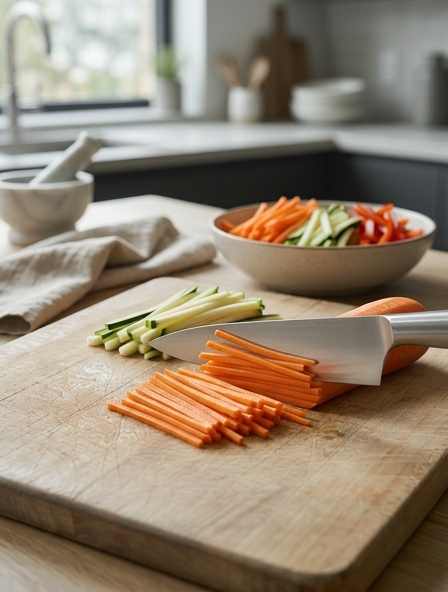
Achieving a perfect julienne cut begins with a fundamental understanding of knife mechanics and body positioning. Precision is not merely a product of a sharp blade, but rather the result of a coordinated effort between your dominant hand, your guiding hand, and your stance at the cutting board. To start, stand squarely before your workstation with your feet shoulder-width apart to ensure stability. Your dominant hand should employ the "pinch grip," where the thumb and forefinger grasp the bolster of the knife, providing maximum control over the blade's trajectory. This grip minimizes fatigue and allows for micro-adjustments during high-volume prep work.
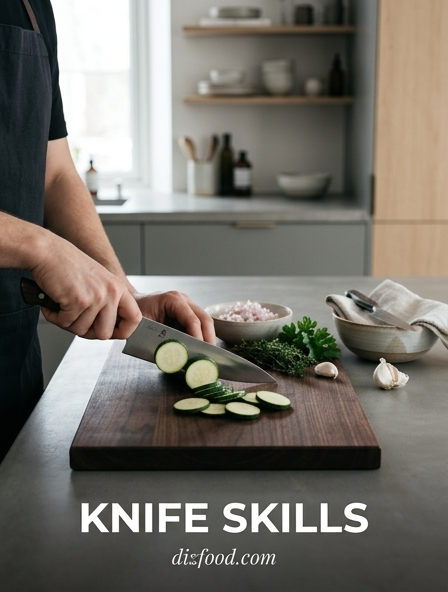
The guiding hand is equally critical, utilizing the "claw grip" to tuck fingertips inward, away from the cutting edge. By using the knuckles as a vertical guide for the blade, you create a physical barrier that prevents accidental nicks while maintaining a consistent distance for each slice. Mastery of the rocking motion-keeping the tip of the knife in contact with the board while the heel moves in a rhythmic arc-ensures that every cut is clean and complete. This foundational discipline transforms the knife into an extension of the arm, facilitating the high-level accuracy required for professional culinary standards.
Essential Tools for Professional Slicing
While skill is paramount, the quality of your output is significantly influenced by the tools at your disposal. A professional kitchen demands specific equipment to produce the uniform matchsticks characteristic of a true julienne. The centerpiece of this toolkit is a high-carbon stainless steel chef's knife or a specialized Nakiri. These blades offer the necessary edge retention and geometry to glide through dense root vegetables without wedging or veering off-course. Furthermore, the cutting surface must be considered; a heavy wood or high-density plastic board provides the necessary "give" to protect the blade's edge while remaining stable under pressure.
| Tool | Primary Function | Advantage |
|---|---|---|
| 8-inch Chef's Knife | General slicing and dicing | Versatility and leverage |
| Nakiri Knife | Vegetable preparation | Flat edge for clean contact |
| Honing Steel | Edge realignment | Maintains daily sharpness |
| Non-slip Mat | Board stabilization | Prevents workplace accidents |
In addition to the primary blade, maintenance tools like whetstones and honing rods are indispensable for ensuring the knife remains at peak performance. A dull knife requires more force, which compromises the delicate dimensions of the julienne cut. By selecting and maintaining the right instruments, a chef can achieve the repetitive precision necessary for elegant plating.
Step by Step Guide to Perfect Julienne
The transition from a whole vegetable to precise matchsticks involves a systematic deconstruction process. This method ensures that every strip is identical in length and width, which is vital for both aesthetic appeal and even cooking. Follow these steps to achieve professional results:
- Wash and peel the vegetable, removing any irregular outer layers or blemishes.
- Trim the ends to create a uniform cylinder or block, typically two inches in length.
- Squaring off: Slice a thin strip off one side to create a flat base, preventing the vegetable from rolling.
- Planking: Cut the vegetable lengthwise into even slices, approximately 1/8 inch thick.
- Stacking: Lay several planks on top of one another, ensuring they are perfectly aligned.
- Final Slicing: Cut through the stack lengthwise at 1/8 inch intervals to create the final matchsticks.
By adhering to this sequence, you eliminate the variability inherent in free-form cutting. The "squaring off" phase is the most critical, as it provides the geometric foundation for all subsequent slices. Consistent repetition of these steps builds muscle memory, eventually allowing for increased speed without sacrificing the 1/8 inch by 1/8 inch by 2-inch standard required in classical French cuisine.
Secrets to Consistent Uniform Slices
Uniformity in julienne cuts is the hallmark of a disciplined chef. The primary secret to consistency lies in the "squaring off" technique, where the vegetable is transformed into a rectangular cuboid before the final strips are produced. This removes the natural curves of the produce, which otherwise lead to tapered or uneven ends. When the base material is a perfect rectangle, every subsequent slice naturally mirrors its predecessor. Additionally, visual calibration is essential; use the width of your knife's spine or a small culinary ruler to verify your dimensions until the 1/8-inch measurement becomes second nature.
Another factor in consistency is the pace of the cut. Rushing often leads to "wedging," where the blade angles slightly outward, resulting in strips that are thicker at the bottom than the top. Maintaining a steady, rhythmic cadence ensures that the blade remains perfectly vertical throughout the entire downward stroke. This uniformity is not just for appearance; in dishes like stir-frys or slaw, identical dimensions ensure that every piece of vegetable reaches the desired level of tenderness at exactly the same moment, preventing the combination of overcooked and raw elements in a single bite.
Safety Tips for Rapid Dicing
Speed in the kitchen is a secondary goal that should only be pursued once safety and accuracy are mastered. High-speed julienne cutting carries inherent risks, primarily to the fingers of the guiding hand. Implementing rigorous safety protocols is the only way to maintain a fast pace without injury. The most critical rule is the maintenance of the "claw" position, where the fingertips are tucked under and the knuckles act as a vertical bumper for the side of the blade. This physical contact provides sensory feedback, letting you know exactly where the edge is at all times.
- Always use a sharp knife; dull blades are prone to slipping off the skin of vegetables.
- Keep the work area clean and free of vegetable scraps to prevent the board from becoming slippery.
- Ensure your cutting board is anchored with a damp paper towel or a rubber mat.
- Focus entirely on the task; distractions are the leading cause of knife-related accidents.
- Never attempt to catch a falling knife; step back and let it land on the floor.
By treating the knife with respect and maintaining a disciplined workspace, you can safely increase your tempo. Remember that professional speed is the result of efficiency in movement rather than frantic exertion. Smooth, deliberate motions eventually translate into the rapid-fire slicing seen in high-end culinary environments.
Choosing the Best Knife for Vegetables
Selecting the appropriate knife for julienne work depends on the density of the vegetable and the volume of the preparation. While a standard European chef's knife is a versatile workhorse, its curved belly is designed for a rocking motion that may not always be the most efficient for long, straight cuts. Many professionals prefer the Japanese Nakiri or Santoku for vegetable-heavy tasks. The Nakiri features a straight edge and a blunt tip, allowing for full contact with the cutting board from heel to tip, which is ideal for the "push-cut" technique often used in julienne prep.
The thickness of the blade also plays a significant role. A thinner blade, such as those found on Japanese knives, encounters less resistance as it passes through dense vegetables like carrots or sweet potatoes. This reduces the effort required for each slice and produces a cleaner surface on the vegetable. Conversely, a heavier German-style knife provides more downward force, which can be beneficial when processing large quantities of tougher root vegetables. Ultimately, the best knife is one that feels balanced in your hand and maintains a razor-sharp edge, allowing you to focus on the precision of your dimensions rather than fighting against the tool.
Advanced Techniques for Culinary Excellence
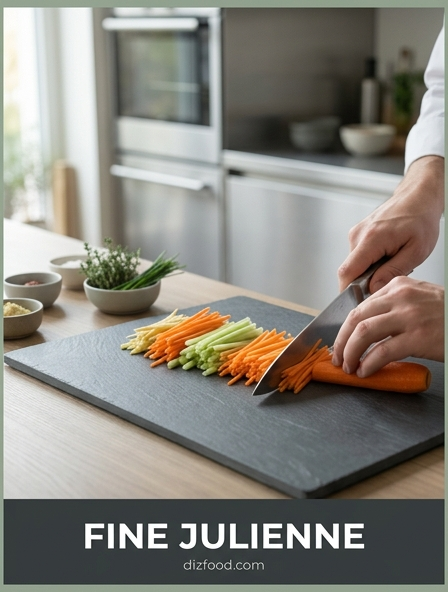
Once the standard julienne is mastered, a chef can progress to more demanding variations and related techniques. The most prominent of these is the "Fine Julienne" or "Allumette," which reduces the dimensions to a delicate 1/16 inch by 1/16 inch by 2 inches. This requires an even higher level of blade control and a perfectly honed edge, as the thinness of the strips leaves zero room for error. Mastering the fine julienne is often a prerequisite for creating the "Brunoise," the smallest standard dice in the culinary repertoire, which is achieved by bundling the julienne strips and cutting them into tiny, uniform cubes.
Advanced techniques also involve handling complex produce shapes. For example, julienning a bell pepper requires removing the inner ribs and skinning the flesh to create a flat surface, or using the "round-about" method for leeks to ensure all layers remain aligned. These methods demonstrate a chef's ability to adapt fundamental principles to the unique physical properties of different ingredients. Excellence in these techniques elevates a dish from simple home cooking to professional-grade cuisine, providing sophisticated textures and intricate visual patterns that enhance the overall dining experience through meticulous attention to detail.
Maintaining Your Blade for Sharp Results
A knife is only as good as its edge, particularly when performing precision tasks like the julienne cut. Regular maintenance is essential to prevent the blade from tearing the vegetable fibers, which can lead to rapid oxidation and poor presentation. Daily maintenance should involve the use of a ceramic or steel honing rod. This does not remove metal but rather realigns the microscopic "teeth" of the edge that become bent during use. Honing should be done at a consistent 15 to 20-degree angle, depending on the knife's original factory grind, to ensure the apex of the edge remains centered.
For long-term sharpness, periodic whetstone grinding is necessary to remove dull metal and establish a new edge. Professionals typically use a multi-grit system, starting with a coarse stone to reshape the edge and finishing with a fine-grit stone to polish it to a mirror finish. Proper storage is the final pillar of maintenance; knives should never be stored loose in a drawer where they can clash against other metal objects. Utilizing a magnetic strip, a knife block, or individual blade guards protects the integrity of the edge. By investing time in blade care, you ensure that every julienne slice is effortless and precise, preserving the quality of your ingredients.
From Prep Work to Plating Perfection
The julienne cut is more than just a preparation step; it is a critical component of dish composition and plating aesthetics. Because of their high surface-area-to-volume ratio, julienned vegetables cook incredibly quickly, making them ideal for high-heat applications like stir-frying or sautéing. In these contexts, the uniformity of the cuts ensures that no piece is overcooked or mushy, preserving a desirable "al dente" crunch. Beyond cooking, julienne strips are frequently used raw in salads, slaws, and garnishes, where their delicate shape adds a refined texture that is easier to consume than larger chunks.
In terms of plating, the julienne cut offers several creative opportunities. They can be bundled into neat haystacks to provide height to a dish, or scattered artfully to add a pop of color and architectural interest. For example, a nest of julienned leeks or carrots placed atop a seared protein provides a professional finish that signals culinary skill to the diner. The precision of the matchsticks creates clean lines and geometric patterns that are visually stimulating. Ultimately, the transition from the cutting board to the plate is where the technical discipline of the julienne cut pays off, transforming simple ingredients into a sophisticated culinary presentation.
Troubleshooting Common Cutting Mistakes
Even experienced cooks encounter challenges when striving for the perfect julienne. One of the most common issues is "tapering," where the strips are wider at one end than the other. This usually occurs because the vegetable was not properly squared off into a rectangle initially, or the knife is being angled during the stroke. To fix this, always prioritize the "planking" stage; if your planks are not perfectly rectangular, your final strips never will be. Another frequent mistake is "crushing" the vegetable rather than slicing it, which is a clear indicator that the knife is too dull or that the cook is applying too much downward pressure without enough horizontal movement.
Slippery or round vegetables, like peppers or onions, often cause stability issues. For peppers, always cut with the skin-side down on the board to prevent the blade from sliding off the waxy exterior. For onions, leave the root end intact as long as possible to hold the layers together during the initial slicing. If you find your stacks are sliding apart while you try to cut them, reduce the number of planks in each stack. It is better to make two stable stacks of three planks than one unstable stack of six. By identifying these common pitfalls and adjusting your technique, you can refine your process and achieve the level of precision required for professional-grade julienne work.

Comments