
When you're staring down a mountain of onions, carrots, and potatoes, the debate between an electric vegetable dicer and a food processor isn't just about kitchen gadgets-it's about reclaiming your evening. While a food processor is the undisputed heavy-hitter for emulsions, doughs, and purees, it often falls short when you need perfectly uniform cubes, frequently turning delicate veggies into mush if you over-pulse. On the other hand, a dedicated electric vegetable dicer is a specialized speed-demon designed for one specific goal: rapid, consistent geometry. If your meal prep focuses on bulk salads, soups, or stews, the dicer saves more time by eliminating the guesswork and providing "set it and forget it" uniformity. However, for those who need a jack-of-all-trades that can also shred cheese or knead bread, the food processor remains the versatile choice, even if the cleanup takes a bit longer.
| Feature | Electric Vegetable Dicer | Full-Size Food Processor |
|---|---|---|
| Primary Strength | Perfectly uniform cubes & sticks | High-speed slicing, shredding, & pureeing |
| Prep Speed | Instant results; no manual pulsing needed | Fast, but requires "pulse" monitoring |
| Texture Quality | Crisp, intact cellular structure | Risk of "bruising" or liquifying produce |
| Versatility | Low (specialized for chopping) | High (dough, sauces, nut butters) |
| Cleanup Time | Quick; minimal parts & small footprint | Moderate; multiple blades & bulky bowl |
| Best For | Weekly meal prep & bulk salads | Complex recipes & general cooking |
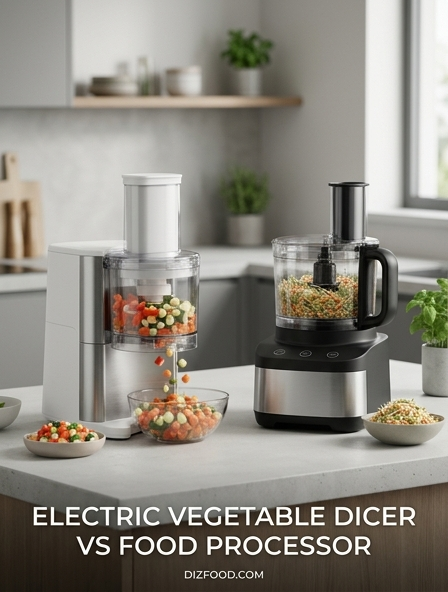
Electric Vegetable Dicer vs Food Processor Key Differences
The fundamental distinction between an electric vegetable dicer and a food processor lies in their primary engineering intent. An electric vegetable dicer is a specialized culinary tool designed specifically to produce uniform cubes, batons, or sticks from raw produce. It utilizes a high-torque motor to push vegetables through a fixed grid of sharp blades, ensuring that every piece is identical in size and shape. This specialization makes it a favorite for commercial environments or home cooks who prioritize the geometric consistency required for specific dishes like mirepoix or fruit salads.
Conversely, a food processor is a multi-purpose workhorse engineered for variety. Rather than focusing on a single shape, it utilizes a rotating S-blade or interchangeable discs to perform a wide array of tasks. While a food processor can chop, it does not naturally "dice" in the traditional sense unless it comes with a specific, expensive dicing attachment. Without such an attachment, a food processor typically produces irregular pieces or thin slices. The core differences are summarized below:
- Mechanical Action: Dicers use a linear "push" through a grid; processors use a high-speed "spin" with a blade.
- Output Consistency: Dicers provide 100% uniformity; processors offer variable textures from coarse chops to fine purees.
- Internal Capacity: Dicers often feature a continuous feed chute, whereas processors usually rely on a sealed work bowl.
- Ingredient Scope: Dicers are limited to firm produce; processors handle liquids, doughs, and soft cheeses.
Precision Uniformity vs Multi Functional Versatility
When evaluating these two appliances, the trade-off is between the precision of a specialist and the flexibility of a generalist. The electric vegetable dicer is the master of precision. In culinary arts, uniform dicing is not just about aesthetics; it ensures even cooking. When vegetables are the exact same size, they soften at the same rate, preventing the frustration of finding crunchy carrots alongside mushy onions in a stew. This precision is difficult to replicate with a standard food processor, where the blades may hit some pieces multiple times while leaving others large.
The food processor counters this with unmatched versatility. It is designed to be the only motorized tool many kitchens need. By swapping out the blade, a processor transforms from a vegetable slicer into a dough kneader or a nut butter maker. This makes it the superior choice for those who want to minimize the number of appliances on their countertop. The following table highlights how each tool excels in different kitchen roles:
| Feature | Electric Vegetable Dicer | Food Processor |
|---|---|---|
| Uniform Cubing | Excellent / Primary Function | Poor (without specific kits) |
| Emulsifying Liquids | Not Possible | Excellent |
| Kneading Dough | Not Possible | High Capability |
| Julienne Cutting | Excellent | Requires specific disc |
Speed and Efficiency in Bulk Meal Prep
Efficiency in the kitchen is often measured by the volume of produce processed per minute. The electric vegetable dicer shines in high-volume scenarios where repetitive tasks would otherwise take hours of manual knife work. Because many electric dicers use a continuous feed system, the user can drop a whole potato or onion into the chute and see it transformed into cubes in seconds. There is no need to stop the machine to empty a bowl, making it the superior option for "meal prep Sundays" or large family gatherings where five-pound bags of vegetables must be processed quickly.
Food processors are also incredibly fast, but they are often limited by the capacity of their work bowl. Once the bowl reaches its fill line, the machine must be stopped, the lid removed, the bowl emptied, and the unit reassembled. This intermittent workflow can slow down bulk preparation. However, for smaller, more complex recipes, the food processor is faster because it can handle multiple stages of a recipe-such as chopping garlic, then adding oil to create a dressing-all within the same container. For bulk prep, the workflow typically follows these steps:
- Selection of appropriate grid size or blade attachment.
- Pre-cutting large vegetables to fit the feed chute.
- Continuous feeding of produce into the motorized mechanism.
- Immediate collection in a large external container or bowl.
- Rapid transition to the next vegetable type without intermediate washing.
Comparing Blade Mechanics and Cutting Styles
The mechanics of how these machines cut food fundamentally changes the final product. An electric vegetable dicer uses a "grid-and-blade" system. The motor drives a pusher block that forces the vegetable through a stainless steel grid, while a rotating blade underneath shears off the piece at a set thickness. This two-step process creates a true cube. The blades move relatively slowly compared to a processor, which prevents the produce from being crushed or bruised, preserving the cellular structure and juice of the vegetable.
Food processors operate on centrifugal force and high-speed rotation. The S-blade spins at thousands of rotations per minute. This creates a chopping action that is more aggressive. While effective for breaking down tough fibers, the high speed generates heat and can cause delicate vegetables to become watery or "bruised." The cutting style is chaotic; the blade hits the food at various angles until the desired consistency is reached. Understanding these mechanical differences is key to choosing the right tool for specific textures:
- Dicer Blade: Fixed grid with a low-speed rotary shear for geometric precision.
- Processor Blade: High-speed S-blade for chopping, grinding, and pureeing.
- Dicer Physics: Compression-based cutting that maintains vegetable crispness.
- Processor Physics: Impact-based cutting that is better suited for breaking down tough ingredients.
Best Applications for Dicing vs Pureeing
Choosing between these tools often depends on the specific recipes in a cook's repertoire. Electric dicers are the gold standard for dishes where the appearance of individual ingredients matters. For example, a Pico de Gallo or a classic Greek salad requires distinct, firm chunks of tomatoes, cucumbers, and onions. If these ingredients were processed in a standard food processor, the tomatoes would likely turn into a pulpy juice before the onions were properly chopped. The dicer ensures each ingredient retains its identity and adds a professional, "chef-cut" look to the plate.
Food processors are indispensable for any recipe that requires a homogenous or semi-liquid texture. Pureeing is the processor's forte. Whether it is creating a smooth hummus, a creamy pesto, or a thick vegetable soup base, the high-speed blades can emulsify ingredients in a way a dicer cannot. The processor is also the correct choice for "hidden veggie" sauces, where the goal is to break the vegetables down so finely that they vanish into a sauce. Generally, the applications can be categorized as follows:
- Use a Dicer for: Salsas, stews, roasted root vegetables, fruit salads, and stir-fry prep.
- Use a Processor for: Hummus, nut butters, pie crusts, smoothies, and creamy salad dressings.
- Texture Goal: Dicer for "Individual Pieces"; Processor for "Combined Mass."
Cleanup Time and Ease of Maintenance
Maintenance is a significant factor in how often a kitchen appliance is actually used. Electric vegetable dicers can be notorious for cleanup challenges due to the dicing grid. Small pieces of vegetable skin or fiber can become lodged in the square holes of the grid, requiring a specialized cleaning tool or a stiff brush to dislodge. While most modern dicers come with a "push-out" cleaning tool, it still adds a step to the process. Furthermore, because these machines are often larger and have more intricate parts, they take up more space in the dishwasher.
Food processors generally have a more streamlined cleanup process. The work bowl, lid, and S-blade are usually large, smooth surfaces that are easy to wipe down or toss into the top rack of a dishwasher. There are fewer nooks and crannies where food can hide. However, caution is required when cleaning the S-blade manually, as it is exceptionally sharp and spans the width of the bowl. For those who prioritize quick maintenance, the following steps are typical for both:
- Immediate rinsing after use to prevent starches from drying and hardening.
- Disassembly of all removable plastic and metal components.
- Using a specialized brush for the dicing grid or the processor blade center.
- Checking the motor base for spills and wiping with a damp cloth.
- Ensuring complete dryness before reassembly to prevent oxidation on blades.
Storage Requirements and Countertop Footprint
Kitchen real estate is often limited, making the physical size of the appliance a major consideration. Electric vegetable dicers, particularly those designed for heavy-duty use, tend to have a taller profile and a larger footprint. They often include various grid sizes (8mm, 10mm, 12mm) and cleaning accessories that require their own storage container. Because of their height, they may not fit under standard kitchen cabinets, forcing the user to store them in a pantry or deep drawer, which can be a deterrent for daily use.
Food processors are more standardized in their dimensions. While professional models are heavy, they are designed to sit on the countertop under cabinets. The biggest storage challenge with a food processor is the collection of discs for slicing and shredding. Many manufacturers now provide compact storage cases for these accessories. When deciding between the two, consider the following space-related factors:
- Vertical Clearance: Dicers often require more height for the pusher assembly.
- Accessory Bulk: Processors have flat discs; dicers have thick, square grid blocks.
- Weight: High-end food processors are heavy to prevent "walking" on the counter during dough kneading.
- Frequency of Use: Choose the tool that justifies its "prime real estate" on your counter based on your cooking habits.
Impact on Food Texture and Presentation
The culinary impact of these tools extends beyond speed; it affects the sensory experience of the meal. A vegetable dicer preserves the "snap" of the produce. By cleanly slicing through the fibers rather than tearing them, the dicer prevents the loss of internal moisture. This results in a cleaner mouthfeel and a brighter visual presentation. In professional catering, the uniformity provided by an electric dicer is essential for high-end aesthetics, where every cube of beet or squash must look identical to its neighbor.
A food processor's impact on texture is more varied. While it is excellent for creating a "crumble" (like cauliflower rice), it can easily over-process ingredients into a mushy state if the pulse button is held too long. This creates a "watery" presentation as the blades rupture more cell walls, releasing juices that would otherwise stay inside the vegetable. For salads and garnishes, the difference is stark. The table below compares the textural output:
| Ingredient | Dicer Result | Processor Result |
|---|---|---|
| Onion | Crisp, dry cubes | Moist, irregular bits |
| Tomato | Perfectly shaped squares | Smashed pulp/liquid |
| Potato | Uniform home fries | Shredded or hashed |
| Carrot | Dense, even batons | Fine, wet grains |
Cost Analysis and Long Term Value
From a financial perspective, the food processor generally offers higher long-term value for the average home cook. Because a single machine can perform the tasks of a blender, a grater, a slicer, and a mixer, the price point (typically ranging from $100 to $500) covers a broad spectrum of kitchen needs. Investing in a high-quality food processor is an investment in a multifunctional platform that can evolve with your cooking skills through the purchase of additional attachments.
Electric vegetable dicers are often more expensive relative to their limited functionality. Specialized home models can cost as much as a mid-range food processor, yet they only perform one task. For a professional chef or someone who processes massive amounts of garden produce for canning and freezing, the price is justified by the hours of labor saved. However, for a casual cook, the "cost per use" of a dicer is often much higher. Key value considerations include:
- Replacement Parts: Processor blades are widely available; dicer grids are specialized and harder to find.
- Motor Durability: Dicers need high torque for hard vegetables; processors need high speed for purees.
- Warranty: Premium food processors often come with 10-year motor warranties.
- Versatility: Does the tool replace three other tools, or does it add to the clutter?
Choosing the Right Tool for Your Kitchen Needs
Ultimately, the choice between an electric vegetable dicer and a food processor should be dictated by your specific cooking style and the types of meals you prepare most frequently. If your kitchen routine involves a lot of baking, sauce making, and diverse vegetable prep, the food processor is the clear winner. Its ability to pivot between tasks makes it an essential "all-in-one" solution. Many high-end food processors now offer dicing kits as an add-on, which can provide a middle ground, though these kits are often less robust than a dedicated dicing machine.
On the other hand, if you are a "prep-heavy" cook who focuses on salads, soups, and stews, or if you find yourself spending hours every week trying to get the perfect dice with a chef's knife, the dedicated electric dicer is a life-changing investment. It removes the most tedious part of cooking and delivers restaurant-quality results that a processor cannot match. To make your final decision, consider the following hierarchy of needs:
- Identify your most frequent "bottleneck" task in the kitchen.
- Assess whether you value versatility over specialized precision.
- Check your available storage space for bulky specialized equipment.
- Determine if you prefer "set it and forget it" cleaning or detailed maintenance.
- Evaluate your budget relative to how often you will use the machine's specific functions.

Comments