
Whether you are refining your knife skills or following a classic French recipe, understanding the distinction between a Macedoine and a Parmentier cut is essential for achieving both visual harmony and even cooking. While both techniques yield precise cubes, the difference lies entirely in their scale: the Macedoine is a dainty small dice, typically measuring 4mm to 5mm, ideal for delicate garnishes, cold salads, or refined vegetable medleys where quick cooking and elegance are paramount. In contrast, the Parmentier is a robust medium dice of approximately 12mm, famously named after the man who popularized the potato in France, making it the go-to choice for hearty roasts, chunky stews, and sautéed dishes that require more time in the pan to develop a golden crust without losing their structural integrity.
| Feature | Macedoine (Small Dice) | Parmentier (Medium Dice) |
|---|---|---|
| Dimensions | 4mm x 4mm x 4mm (~1/4") | 12mm x 12mm x 12mm (~1/2") |
| Cooking Time | Flash (Very Fast) | Moderate to Long |
| Primary Use | Garnishes, Consommés, Fruit Salads | Roasts, Stews, Braises, Hash |
| Starting Cut | Macedoine (from Macédoine sticks) | Batonnet (modified thickness) |
| Skill Level | Advanced (Requires high precision) | Intermediate (Forgiving size) |
| Classic Ingredient | Carrots, Turnips, Beans | Potatoes, Squash, Root Vegetables |
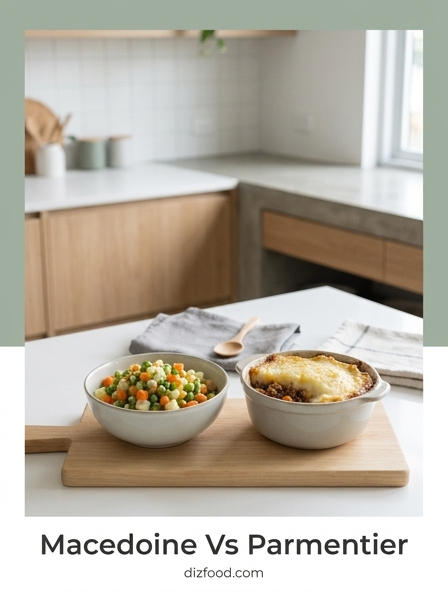
Macedoine vs Parmentier Culinary Cut Comparison
In the rigorous world of classical French cuisine, the precision of a vegetable cut determines more than just the visual appeal of a dish; it dictates the texture, cooking rate, and overall mouthfeel of the final product. Two of the most frequently confused cuts are the Macedoine and the Parmentier. While both are cubic in nature, they belong to different tiers of the dicing hierarchy. The Macedoine is a small-to-medium dice, typically derived from a batonnet, resulting in a cube that measures approximately 4 to 5 millimeters on each side. It is often used in delicate preparations where elegance and a refined bite are paramount.
Conversely, the Parmentier cut represents a medium dice, characterized by a larger 1-centimeter cube. This cut is named after Antoine-Augustin Parmentier, the famous French pharmacist and agronomist who promoted the potato as a food source in 18th-century France. Because of this historical connection, the Parmentier cut is most frequently associated with potato preparations. Choosing between these two depends largely on the "heartiness" of the dish being prepared. A chef might choose a Macedoine for a refined vegetable garnish in a clear consommé, whereas the Parmentier would be the standard choice for home-style roasted potatoes or a rustic vegetable ragout.
- Macedoine: Small-medium dice, roughly 1/4 inch (4-5mm).
- Parmentier: Medium dice, roughly 1/2 inch (10mm).
- Application: Macedoine for refinement; Parmentier for substance.
Defining the Macedoine Cube Dimensions
The Macedoine cut is an essential skill for any culinary student, serving as the bridge between the tiny Brunoise and the larger medium dice. To achieve a perfect Macedoine, one must first master the batonnet. A batonnet is a stick-shaped cut measuring approximately 4mm x 4mm x 5cm. By lining up several batonnets and slicing them crosswise at 4mm intervals, the chef creates the uniform 4mm to 5mm cubes that define the Macedoine. This precision ensures that every piece of vegetable in a mixture will cook at exactly the same rate, preventing the textural inconsistency of having some pieces mushy while others remain crunchy.
Achieving this dimension requires a sharp chef's knife and a steady hand. The process begins with "squaring off" the vegetable-removing the rounded sides to create a rectangular block. This minimizes waste in a professional environment if the scraps are used for stocks or purees. Once the block is formed, it is sliced into planks, then into batonnets, and finally into the cubes. The following steps outline the standard procedure:
- Wash and peel the root vegetable (carrots, turnips, or parsnips are common).
- Top and tail the vegetable to create flat ends.
- Square off the four sides to create a uniform rectangular prism.
- Slice the prism into 4mm thick planks.
- Stack the planks and slice into 4mm wide sticks (batonnets).
- Rotate the sticks and cut at 4mm intervals to produce Macedoine cubes.
Understanding the Parmentier Knife Cut
The Parmentier cut is perhaps one of the most versatile and recognizable dices in the kitchen. Measuring approximately 1 centimeter (or 1/2 inch) on all sides, it is large enough to retain its shape and internal texture during longer cooking processes, such as roasting or sautéing. Because it is named after the man who popularized the potato, it is the "gold standard" for potato dishes. When you see "cubed potatoes" in a classic French recipe, it almost certainly refers to the Parmentier dimension. This size provides a significant surface area for Maillard reaction browning while maintaining a fluffy, soft interior.
Beyond potatoes, the Parmentier is used for "mirepoix" in stews where the vegetables are intended to be served as part of the final dish rather than strained out. It is large enough to survive a 30-to-45-minute braise without disintegrating. Unlike the more delicate Macedoine, the Parmentier allows the diner to clearly identify the flavor of each individual vegetable in a spoonful. It strikes a balance between the rustic, large Carré cut (2cm) and the more formal small dice, making it the preferred choice for family-style bistro cooking and hearty winter soups.
- Dimension: 1cm x 1cm x 1cm.
- Primary Use: Roasted potatoes, stews, and hash.
- Historical Context: Named for Antoine-Augustin Parmentier.
- Texture: Allows for a crispy exterior and soft interior.
Key Size Differences Between Macedoine and Parmentier
While both are cubic cuts, the difference in volume between a Macedoine and a Parmentier is significant. A Parmentier cube is essentially double the linear dimension of a Macedoine, but because it is a three-dimensional object, the volume difference is even more pronounced. A 1cm cube (Parmentier) has a volume of 1,000 cubic millimeters, whereas a 5mm cube (Macedoine) has a volume of only 125 cubic millimeters. This means a single Parmentier cube occupies eight times the space of a Macedoine cube. This discrepancy drastically alters how the two interact with heat and seasoning.
In a professional kitchen, confusing these two can lead to disaster. If a chef asks for a Macedoine for a quick-sauteed garnish and receives a Parmentier, the vegetables will remain raw in the center by the time the service is over. Conversely, using a Macedoine in a slow-cooked beef bourguignon will result in the vegetables melting into the sauce, losing their identity entirely. The table below illustrates the standard measurements used in most culinary schools to distinguish between the two and their related precursors.
| Cut Name | Metric Dimension | Imperial Equivalent | Precursor Cut |
|---|---|---|---|
| Macedoine | 4mm - 5mm | 1/6" - 1/4" | Batonnet |
| Parmentier | 10mm (1cm) | 1/2" | Medium Baton |
| Brunoise | 2mm | 1/8" | Julienne |
| Carré | 20mm (2cm) | 3/4" | Large Baton |
When to Use Macedoine in Professional Cooking
The Macedoine cut is synonymous with elegance. It is most famously used in the dish "Macédoine de Légumes," a classic French salad where various root vegetables, peas, and beans are cut to this precise 4mm dimension and tossed in a mayonnaise or vinaigrette. Because the pieces are small, the dressing coats each cube evenly, providing a harmonious flavor in every bite. In the context of hot food, the Macedoine is the preferred choice for vegetable garnishes in clear soups like minestrone or paysanne-style broths, where the uniformity of the tiny cubes reflects the chef's technical proficiency.
Beyond aesthetics, the Macedoine is ideal for quick-cooking applications. Because of the high surface-area-to-volume ratio, these small cubes can be blanched in boiling water in under two minutes or sautéed in butter very quickly. This makes them perfect for "à la minute" cooking, where vegetables are tossed into a pan just before the dish is sent to the dining room. It is also the standard size for vegetables used in savory aspics or terrines, where large chunks would disrupt the structural integrity of the gelled dish. Professionals use the Macedoine when they want the vegetable to be a delicate accent rather than the main component of the plate.
- Salads: Macedoine de légumes, Russian salad.
- Soups: Consommés and fine vegetable broths.
- Stuffings: Fine farce for poultry or seafood.
- Garnish: Tossed in butter for refined plating.
Best Recipes for Parmentier Cut Vegetables
The Parmentier cut thrives in recipes where the vegetable needs to withstand high heat or long cooking times. The most iconic application is, of course, "Pommes Parmentier." This dish consists of potatoes diced into 1cm cubes, seasoned with salt, pepper, and herbs like rosemary or thyme, and then sautéed in clarified butter or roasted until golden brown. The size is large enough that the potato develops a distinct crust while the center remains steaming and starchy. This cut is also the foundation for a high-quality breakfast hash, where the cubes must be large enough to hold their shape against the heat of a cast-iron skillet.
In addition to potatoes, the Parmentier cut is excellent for roasted root vegetable medleys involving carrots, parsnips, and beets. When these vegetables are all cut to the 1cm Parmentier standard, they roast at a similar rate, allowing the sugars to caramelize without the smaller pieces burning. It is also the preferred dice for a "mirepoix" intended for braised meats like Pot-au-Feu or short ribs. In these recipes, the vegetables are meant to be eaten as a side dish alongside the meat, and the Parmentier size ensures they retain enough bite to satisfy the palate after several hours in the oven.
- Pommes Parmentier: Classic sautéed buttered potatoes.
- Vegetable Ragout: Hearty stewed seasonal vegetables.
- Oven Roasts: Uniformly sized root vegetables for even browning.
- Corned Beef Hash: Large enough cubes to survive high-heat searing.
Essential Knife Skills for Precision Cubing
Mastering the Macedoine and Parmentier cuts is less about speed and more about geometry. The first step toward precision is the "claw grip." By tucking your fingertips inward and using your knuckles to guide the blade, you ensure safety while maintaining a consistent distance for each slice. For these specific cubic cuts, the "rocking motion" of the knife is often replaced by a "push-cut" or "draw-cut" to ensure the corners of the cubes remain sharp and square. If the knife is dull, it will crush the cell walls of the vegetable rather than slicing them, leading to wet, ragged edges that won't cook evenly.
To achieve the uniformity required in professional kitchens, follow a disciplined sequence of movements. Accuracy is built in the initial stages of squaring off the vegetable. If the "block" you create isn't perfectly rectangular, the resulting cubes will be trapezoidal or irregular. This is known as "trimming to the square." While it may feel wasteful, the trimmings are almost always repurposed for stocks or purees to ensure a zero-waste kitchen. Consistency in your planks and batonnets is the only way to ensure consistency in your final Macedoine or Parmentier dice.
- Maintain a razor-sharp edge on a 8-to-10 inch chef's knife.
- Establish a flat "anchor" side on your vegetable to prevent rolling.
- Use a ruler or the markings on a specialized cutting board if practicing for a practical exam.
- Check your dimensions frequently against a reference cube.
- Apply consistent downward pressure to prevent the knife from "walking" or angling.
Visual Guide to French Vegetable Cuts
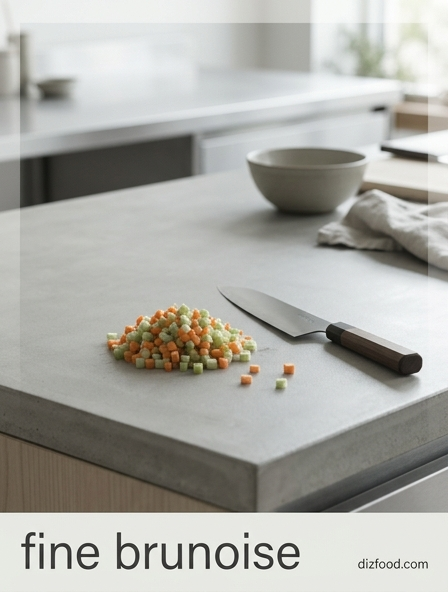
Visualizing the hierarchy of French cuts helps a chef choose the right tool and technique for the job. The system is designed like a mathematical progression. It begins with the Julienne (fine strips) and the Batonnet (thick sticks). These linear cuts are then turned into cubes. The Brunoise is the smallest, looking like tiny jewels, followed by the Macedoine, which is the "small dice." The Parmentier sits in the middle as the "medium dice," and the Carré serves as the "large dice." Seeing them side-by-side reveals how the Macedoine is refined and dainty, while the Parmentier is substantial and functional.
When plating, the visual difference is striking. A Macedoine of carrots and peas looks like a mosaic, often used in fine dining to create intricate patterns. A Parmentier cut, however, looks more rustic and generous, evoking feelings of comfort food and traditional home cooking. Understanding this visual language allows a cook to communicate the "mood" of a dish before the diner even takes a bite. High-end gastronomy often pushes for the smaller Macedoine to demonstrate technical mastery, while bistros and brasseries lean on the Parmentier for its satisfying, toothsome qualities.
- Fine Julienne: 1.5mm x 1.5mm x 5cm.
- Julienne: 3mm x 3mm x 5cm.
- Batonnet: 6mm x 6mm x 5cm (precursor to small dice).
- Macedoine: 4mm to 5mm cubes.
- Parmentier: 10mm (1cm) cubes.
- Carré: 20mm (2cm) cubes.
The Impact of Cut Size on Cooking Times
The physics of cooking is largely dictated by surface area. A smaller cut, like the Macedoine, exposes more of the vegetable's interior to the cooking medium (water, oil, or steam) relative to its total mass. This results in very rapid heat transfer. A Macedoine carrot will soften in boiling water in about 90 seconds, whereas a Parmentier-cut carrot may take 4 to 5 minutes to reach the same level of tenderness. This time difference is critical when creating a "mirepoix" or a vegetable medley where multiple types of vegetables are cooked together.
If you were to roast a tray containing both Macedoine and Parmentier cuts, the Macedoine would burn to a crisp before the Parmentier had even begun to soften. This is why uniformity is the hallmark of a professional cook. Beyond just timing, the size of the cut affects flavor release. Smaller cuts release their juices and sugars into a sauce more quickly, which is why a finer dice is used for aromatics in a quick sauce. Larger cuts like Parmentier hold their sugars inside, allowing them to caramelize on the exterior while remaining sweet and moist on the inside. The following table summarizes expected cooking times for common root vegetables.
| Cut Style | Boiling Time | Sauté Time | Roasting Time |
|---|---|---|---|
| Macedoine (5mm) | 1-2 Minutes | 3-4 Minutes | 10-12 Minutes |
| Parmentier (10mm) | 4-6 Minutes | 8-10 Minutes | 20-25 Minutes |
| Carré (20mm) | 8-10 Minutes | 15+ Minutes | 35-45 Minutes |
Mastering Classic French Vegetable Dice Techniques
The journey from an amateur cook to a professional chef is often measured in the uniformity of one's vegetable dice. Mastering the Macedoine and Parmentier requires a blend of patience, spatial awareness, and muscle memory. In a classic French brigade, a commis chef might spend hours every day dicing sacks of vegetables to these exact specifications. This repetitive practice is not busywork; it is the foundation of discipline. When every cube is identical, the chef has total control over the texture and presentation of the dish. It removes the element of "chance" from the kitchen.
To improve your skills, focus on the "wastage" aspect. A master of these techniques can produce a high yield of cubes with minimal offcuts. This is achieved by carefully selecting vegetables that are already somewhat uniform in shape and by using a sharp knife that requires minimal force, allowing for more precise control over the blade's path. Remember that the Parmentier is your workhorse for daily meals, providing bulk and texture, while the Macedoine is your "showcase" cut, used when you want to impress with your technical ability and attention to detail. Consistent practice will eventually allow you to switch between these two sizes instinctively.
- Always use a stable cutting board (use a damp paper towel underneath to prevent slipping).
- Focus on the "plank" stage; if your planks are uneven, your cubes will be too.
- Use your non-cutting hand to "feel" the thickness of the slices.
- Organize your workspace (mise en place) with a bowl for finished cuts and a bowl for scraps.
- Visualize the final cube within the vegetable before making the first cut.

Comments