
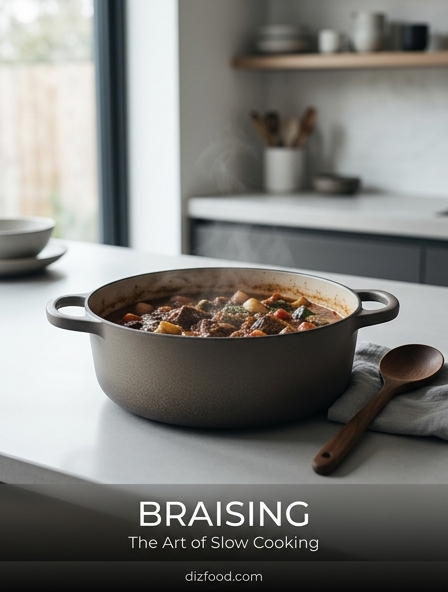
The Science of Surface Area
In the realm of braising, the ratio of surface area to volume is a fundamental principle that dictates the efficiency of the Maillard reaction and subsequent flavor development. When meat is cut into smaller pieces, the total surface area exposed to the hot pan increases, allowing for more extensive browning. This browning creates complex melanoidins that dissolve into the braising liquid, providing the characteristic depth associated with slow-cooked dishes. However, excessive surface area can also lead to rapid moisture loss before the liquid is added. Balancing the cut size is essential to ensure that the exterior develops a rich crust while the interior remains protected during the initial searing phase.
- Increased surface area enhances enzymatic browning and caramelization.
- Larger surface-to-volume ratios allow for faster heat penetration during the sear.
- Calculated spacing in the pan prevents steaming, ensuring optimal dry-heat contact.
- Soluble proteins interact more readily with the cooking medium when cuts are optimized.
Ultimately, the science of surface area informs how effectively a chef can layer flavors. By understanding how heat interacts with the geometry of the ingredient, one can manipulate the final intensity of the sauce and the succulence of the protein.
Large Dice for Low and Slow
Braising is a marathon, not a sprint. When preparing meats like chuck roast, pork shoulder, or lamb shanks, a large dice-typically between 1.5 to 2 inches-is preferred. This substantial size is necessary because the long, slow application of moist heat breaks down connective tissues like collagen into gelatin. If the pieces are too small, they will lose their structural integrity and disintegrate into the sauce long before the collagen has fully rendered. A larger cut ensures that by the time the meat is fork-tender, it still retains a satisfying, identifiable shape on the plate.
| Cut Size | Ideal Cook Time | Resulting Texture |
|---|---|---|
| 1-inch Cube | 1.5 - 2 Hours | Prone to shredding; better for quick stews. |
| 2-inch Cube | 3 - 4 Hours | Optimal integrity with gelatinous mouthfeel. |
| Whole Joint | 5+ Hours | Maximum moisture retention; requires carving. |
Choosing a large dice allows for a gradual temperature rise within the protein. This slow transition prevents the muscle fibers from tightening too aggressively, which can squeeze out moisture and result in a dry, stringy texture despite the presence of liquid.
Uniformity for Even Tenderness
Uniformity in knife work is not merely an aesthetic choice; it is a critical technical requirement for successful braising. When ingredients vary significantly in size, they cook at different rates. Small pieces may overcook and become mushy or dry, while larger pieces remain tough and under-rendered. In a braise, where the goal is a harmonious "spoon-tender" finish, inconsistency can ruin the balance of the dish. Achieving precision requires a focused approach to the initial prep work, ensuring every cube of beef or wedge of carrot mirrors its neighbor.
- Square off the ingredient by removing rounded edges to create a stable base.
- Slice the ingredient into even planks of the desired thickness.
- Stack planks and cut into consistent batons or strips.
- Rotate the batons and cut crosswise into perfect, uniform cubes.
By maintaining this level of discipline, the chef ensures that every bite reaches the peak of tenderness simultaneously. This consistency allows the cooking time to be calculated accurately, preventing the need to fish out overcooked pieces while waiting for others to soften. It also ensures a professional presentation where the components look intentional and refined.
Mirepoix Precision and Flavor Release
The mirepoix-a traditional blend of onions, carrots, and celery-serves as the aromatic foundation of a braise. The precision of these cuts directly impacts how the flavors are released into the pot. For a long braise, a medium to large dice (half-inch to three-quarter inch) is standard. If the vegetables are cut too fine, they will dissolve into the liquid, potentially thickening the sauce too much or creating a gritty texture. Conversely, the dice must be small enough to allow the natural sugars and aromatics to sweat out efficiently during the initial sautéing phase.
- Onions: Provide the sulfurous depth and natural sweetness.
- Carrots: Contribute earthiness and a subtle sugar content for browning.
- Celery: Adds a savory, herbal note that balances the richness of the meat.
- Sautéing: Proper dice allows for even caramelization without burning.
When the mirepoix is cut with precision, it browns evenly in the rendered fat of the meat. This step is vital for building a "fond"-the browned bits at the bottom of the pan-which is later deglazed to create the braising liquid's complex profile. Uniform aromatics ensure that the base of your stew is as sophisticated as the primary protein.
Impact of Cube Size on Moisture
The relationship between cube size and moisture retention is a cornerstone of meat science in the kitchen. During the braising process, heat causes muscle fibers to contract, which naturally forces out intracellular water. A larger cube has a lower surface area relative to its core volume, meaning the moisture trapped in the center has a longer distance to travel before escaping. This physical barrier helps keep the meat succulent. Smaller cubes, having more exposed surface per gram of weight, lose their moisture more rapidly, often resulting in a "mealy" texture if the braise is not perfectly timed.
| Feature | Small Cubes (0.5") | Large Cubes (2") |
|---|---|---|
| Moisture Loss | Rapid and high | Slow and controlled |
| Heat Penetration | Immediate | Gradual |
| Collagen Conversion | May be uneven | Consistent and deep |
While the braising liquid eventually replenishes some perceived moisture through the introduction of gelatin and fats, it cannot replace the natural juiciness of the meat fibers themselves. Therefore, maintaining a larger cube size is a strategic move to preserve the internal integrity of the protein throughout the hours of simmering.
Rough Chops for Rustic Stews
While precision is often lauded, the "rough chop" has its own place in the world of rustic, farmhouse-style braising. This technique involves cutting vegetables and meats into irregular, chunky pieces that vary slightly in shape and size. This approach is often used in traditional dishes like Coq au Vin or Beef Bourguignon, where a "homemade" feel is desired. The rough chop provides a variety of textures in the final dish; some edges might soften into the sauce, while the thicker cores remain distinct and toothsome. This contrast can make a stew feel more hearty and satisfying.
- Choose hardy vegetables like parsnips, turnips, or rutabagas.
- Cut at irregular angles to create varied geometric shapes.
- Avoid making pieces too thin, as they will vanish during a long simmer.
- Maintain a general "medium" scale to ensure everything eventually reaches a safe temperature.
The aesthetic of a rustic braise suggests a connection to the ingredients and the hearth. It prioritizes the soul of the dish over the rigid perfection of a commercial kitchen. However, even within a rough chop, a basic level of consistency is required to ensure that no piece remains dangerously undercooked or unpleasantly raw.
Optimizing Aromatics for Braising Liquids
Aromatics like garlic, ginger, leeks, and hardy herbs are the high notes of a braise. Optimizing these ingredients requires a different approach than the primary vegetables. Garlic, for instance, should often be smashed or sliced rather than minced. Minced garlic can burn easily during the initial sear or disappear entirely during a three-hour simmer. Slicing provides a more controlled release of oils. Similarly, leeks should be cut into thick rounds or halves so they can withstand the heat without disintegrating into mushy ribbons that get lost in the sauce.
- Smash garlic cloves to release oils while keeping the clove intact.
- Tie herbs like thyme and rosemary in a bundle (bouquet garni) for easy removal.
- Cut leeks into 1-inch rounds to maintain their structural layers.
- Slice ginger into thick coins to infuse the liquid without overpowering the palate.
By managing the size and shape of these aromatics, you control the rate of infusion. This prevents a single flavor from dominating the profile too early. Instead, the aromatics slowly yield their essence to the liquid, creating a balanced and layered background that complements the protein and primary vegetables.
Knife Skills for Root Vegetables
Root vegetables are the workhorses of the braising pot, but their dense, often irregular shapes require specific knife skills to handle safely and effectively. Vegetables like celery root, butternut squash, and large carrots can be difficult to navigate. The first step is always to establish a flat surface; rolling vegetables are a primary cause of kitchen injuries. Once stabilized, these vegetables should be cut into thick, heavy batons or large chunks. Because root vegetables contain significant amounts of starch and fiber, they can withstand long cooking times without losing their identity.
- Peel deeply to remove tough, woody exterior skins.
- Trim both ends to create flat, manageable surfaces.
- Use a heavy-duty chef's knife or a cleaver for dense vegetables like rutabaga.
- Cut into "oblique" or "roll cuts" to maximize surface area while keeping bulk.
Oblique cuts are particularly useful in braising; they create many facets for browning while maintaining a thick center. This allows the vegetable to glaze beautifully in the pot while the interior softens to a creamy consistency. Mastering these shapes ensures that your vegetables are as much a highlight as the meat.
Texture Retention in Slow Cooking
The primary challenge of braising is preventing the ingredients from becoming a monolithic, soft mass. Texture retention is achieved through a combination of cut size and timing. Hardier vegetables should be cut larger if they are added at the beginning of the cook, while more delicate vegetables should be cut smaller and added later. For example, a large-diced potato will hold its shape better than a small-diced one over a four-hour period. The goal is to reach a state where the vegetable is soft enough to be crushed against the roof of the mouth but firm enough to be picked up with a fork.
| Vegetable Type | Recommended Cut | Braising Behavior |
|---|---|---|
| Potatoes (Waxy) | 2-inch quarters | Holds shape; absorbs salt and fat. |
| Parsnips | 1.5-inch chunks | Becomes sweet and creamy; stays intact. |
| Pearl Onions | Whole (peeled) | Provides "pops" of flavor and distinct texture. |
Understanding the cellular structure of your ingredients allows you to predict their behavior. Starchy vegetables tend to slough off their outer layers, which can actually help thicken the braising liquid, acting as a natural roux while the core remains solid.
Essential Knives for Heavy Prep
Effective braising preparation requires the right tools to handle large quantities of tough proteins and dense vegetables. A standard 8-inch chef's knife is the most versatile option, providing the length and weight needed for most chopping tasks. However, for breaking down large cuts of meat like brisket or pork shoulder, a stiff boning knife is invaluable for removing excess silver skin and unwanted fat caps. When dealing with the heaviest root vegetables, some chefs prefer a Western-style cleaver, which uses its weight to breeze through thick fibers that might stall a thinner blade.
- Chef's Knife: The primary tool for dicing mirepoix and portioning meat.
- Boning Knife: Necessary for precision trimming and navigating joints.
- Honing Steel: Essential for keeping the edge sharp through repetitive heavy cuts.
- Paring Knife: Useful for peeling smaller aromatics like shallots or garlic.
Maintaining a sharp edge is critical; a dull knife requires more force, which increases the risk of slipping on a hard carrot or a fatty piece of meat. High-carbon steel knives are often preferred for their edge retention during long prep sessions. By investing in quality cutlery and keeping it maintained, the labor-intensive process of preparing a large-scale braise becomes significantly more efficient and enjoyable.

Comments