
Choosing between a knife roll and a magnetic knife strip isn't just about kitchen aesthetics; it's a vital decision for the safety and longevity of your professional-grade steel. While the magnetic strip offers an elegant, wall-mounted display that keeps your most-used tools within arm's reach, the classic knife roll remains the gold standard for culinary pros on the move, providing individual padded pockets that prevent damaging edge-to-edge contact. Whether you are a home cook looking to reclaim counter space or a traveling chef needing a secure mobile toolkit, understanding the trade-offs between open-air accessibility and heavy-duty portable protection is key to maintaining a razor-sharp edge for years to come.
| Feature | Knife Roll Bag | Magnetic Knife Strip |
|---|---|---|
| Best Use Case | Professional travel, catering, and safe long-term storage. | Home kitchens, high-volume stations, and quick-access needs. |
| Portability | High; features handles/straps for secure transport. | Zero; permanently mounted to walls or backsplashes. |
| Blade Safety | Superior; individual slots prevent friction and chipping. | Moderate; exposed blades; potential for magnetic scratching. |
| Space Footprint | High; requires counter space to unroll and access. | Minimal; utilizes vertical wall space to clear counters. |
| Hygiene/Care | Requires periodic deep cleaning of fabric/leather pockets. | Excellent; easy-to-wipe surface prevents bacteria buildup. |
| Capacity | Fixed; limited by the number of pre-sewn slots. | Scalable; limited only by the physical length of the strip. |
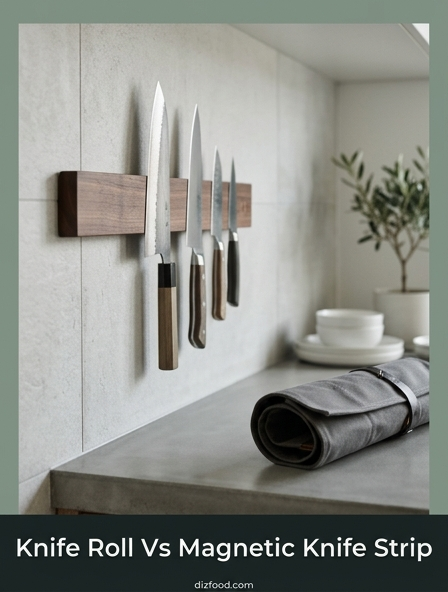
Knife Roll vs Magnetic Strip: Best Kitchen Storage
In the culinary world, the debate between the knife roll and the magnetic knife strip is a central topic for both professional chefs and home enthusiasts. Each storage solution offers distinct advantages tailored to different environments and user needs. Choosing the right method is not just about organization; it is about protecting a significant investment in high-quality cutlery. A knife roll provides a portable, secure, and enclosed environment, whereas a magnetic strip offers immediate access and a visual display that highlights the aesthetic of the blades.
The primary difference lies in the philosophy of the kitchen workspace. Those who prioritize a static, efficient workstation often lean toward the magnetic strip, while those who travel or work in varied environments depend on the knife roll. When evaluating these options, one must consider the frequency of use, the number of knives in the collection, and the physical constraints of the kitchen. Both systems aim to replace the traditional wooden knife block, which is often criticized for harboring bacteria in its deep, inaccessible slots. By moving toward either a roll or a strip, cooks can ensure a more hygienic and organized approach to tool maintenance. Understanding the nuances of each will help determine which method supports your specific culinary workflow and keeps your blades in peak condition for years to come.
The Professional Edge: Why Chefs Prefer Knife Rolls
For the professional chef, a knife is more than a tool; it is an extension of the hand. Because many professionals bring their own equipment to various kitchens, the knife roll is the industry standard for transport and security. These rolls are designed to withstand the rigors of a commercial environment, offering a rugged exterior that protects expensive steel from the bumps and grinds of daily commuting.
- Portability: A roll allows a chef to carry a complete set of tools, including shears, honing rods, and specialty tweezers, in a compact format.
- Security: Many high-end rolls feature locking mechanisms or heavy-duty buckles that prevent tools from sliding out during transit.
- Personal Organization: With individual pockets, chefs can organize their tools exactly how they like, ensuring they can reach for a paring knife or a boning knife by touch alone.
- Protection from Elements: The enclosed nature of a roll protects blades from humidity and accidental contact with other metal objects that could cause chipping.
Beyond utility, the knife roll also serves as a professional badge of honor. A well-worn leather or canvas roll tells a story of years spent in the trenches of the hospitality industry. It provides a sense of "home" for the chef's tools, regardless of whether they are working in a five-star restaurant, a catering event, or a private home. This sense of ownership and reliability is why the roll remains the top choice for those who earn their living with a blade.
Space Saving Style: Advantages of Magnetic Knife Strips
In smaller kitchens where counter space is at a premium, the magnetic knife strip is a revolutionary storage solution. By utilizing vertical wall space, these strips clear the clutter of bulky blocks and free up valuable work surfaces for food preparation. This approach is particularly popular in modern kitchen designs where minimalism and clean lines are prioritized. The strip allows the knives to become a part of the decor, showcasing the craftsmanship of the steel and the beauty of the handles.
Safety and visibility are also major advantages. Unlike a drawer where knives might be jumbled together, a magnetic strip keeps every blade visible and separated. This prevents the "blind reach," where a user might accidentally cut themselves while searching for a specific tool. Additionally, the open-air design promotes better hygiene. Because the knives are not tucked away in a dark, damp pocket or block, they dry quickly after washing, which significantly reduces the risk of rust and corrosion. For the home cook who prepares meals daily, the ability to simply reach up and grab the exact knife needed without unrolling a bag or digging through a drawer provides an unmatched level of convenience. This streamlined access encourages more efficient cooking and a more enjoyable experience in the heart of the home.
Portability vs Accessibility: A Storage Showdown
The choice between a knife roll and a magnetic strip often comes down to a direct trade-off between how easily you can move your tools and how quickly you can grab them. This showdown highlights the functional priorities of the user. If you are a stationary cook who does all your prep in one place, accessibility is king. If you are a mobile cook, portability is the non-negotiable factor. The following table illustrates the key differences in their utility profiles.
| Feature | Knife Roll | Magnetic Strip |
|---|---|---|
| Primary Use | Travel and Transport | Stationary Storage |
| Access Speed | Slow (must unroll) | Instant (grab and go) |
| Blade Visibility | Hidden when closed | Fully Visible |
| Capacity | Fixed number of slots | Variable based on length |
| Protection | High (enclosed) | Moderate (exposed) |
While the knife roll excels at keeping tools safe during a bumpy car ride or a walk to the station, it can be a hindrance in a fast-paced home kitchen where you need to switch between a chef's knife and a serrated blade in seconds. Conversely, a magnetic strip offers no portability; if you need to take your knives to a friend's house for a dinner party, you will still need a secondary storage solution like a roll or blade guards to transport them safely. Therefore, many serious enthusiasts eventually invest in both: a strip for their daily drivers and a roll for their full collection or travel needs.
Protecting Your Blades: Knife Roll Safety Benefits
The safety of a knife roll extends to both the user and the blade itself. When a knife is placed into a fitted pocket, the sharp edge is completely shielded by heavy material, such as leather, heavy-duty canvas, or synthetic ballistic nylon. This prevents the edge from coming into contact with other knives, which is the leading cause of micro-chipping and dulling in drawer storage. For high-carbon steel knives, which are more brittle and prone to damage, this level of individual padding is essential for maintaining a razor-sharp edge over long periods.
From a user-safety perspective, the knife roll is the gold standard for moving sharp objects. Attempting to wrap knives in towels or plastic wrap for transport is a recipe for disaster. A professional roll ensures that even if the bag is dropped or shifted, the points and edges remain contained. Many rolls also include a "flap" or "cover" that folds over the handles before the roll is tied or buckled, providing a secondary layer of protection that prevents the knives from sliding out of the top. This design is particularly important for chefs who work in crowded environments or must transport their tools through public spaces. By keeping the blades entirely enclosed, the roll eliminates the risk of accidental cuts during the setup or breakdown of a kitchen station, making it the most responsible choice for any cook on the move.
Magnetic Knife Strip Pros and Cons for Home Cooks
Magnetic strips are a favorite for home cooks, but they come with a specific set of considerations that must be balanced. Understanding these can help you decide if your kitchen layout and knife collection are suitable for this type of exposed storage.
- Pro: Hygiene and Airflow. Unlike blocks, strips are easy to wipe clean, and knives are exposed to air, preventing moisture buildup.
- Pro: Immediate Recognition. You can see the size and shape of every blade, which speeds up the selection process during complex recipes.
- Con: Potential for Chipping. If a knife is "slapped" onto the magnet incorrectly, the edge can hit the metal strip, causing small chips in the steel.
- Con: Magnet Strength Issues. If the magnet is too weak, heavy knives may slip. If it is too strong, you may strain the blade or your wrist trying to remove it.
- Con: Child Safety. Exposed knives on a wall can be a hazard if mounted within reach of children.
Despite these cons, the magnetic strip remains a top-tier choice for those who value efficiency. To mitigate the risks, many experts recommend wooden magnetic strips. These have the magnets embedded behind a layer of walnut or maple, providing a softer surface for the knife to land on while still offering the same strong hold. This prevents metal-on-metal contact and preserves the finish of the blade. For a home cook with a modest collection of 5 to 7 essential knives, a 15-inch magnetic strip is often the perfect balance of utility and aesthetic appeal.
Durability and Material: Leather Rolls vs Steel Strips
When investing in storage, the durability of the materials used is paramount. Knife rolls are typically made from three types of materials: canvas, synthetic fabrics, or leather. Canvas is classic and lightweight but can eventually be punctured by sharp tips if guards aren't used. Synthetics like Cordura are incredibly durable and easy to clean with a damp cloth. Leather, however, is the premium choice. A high-quality leather roll can last a lifetime, developing a patina over time and offering the best physical protection against impacts. However, leather requires maintenance with conditioners to prevent it from drying out or cracking.
Magnetic strips are generally constructed from stainless steel, aluminum, or wood. Steel strips are the most common and are virtually indestructible, though they can be harsh on the knives. Wood-faced magnetic strips are the most "gentle" option and are highly durable if kept away from excessive steam and moisture. The internal magnets are usually neodymium, which is known for its long-lasting magnetic force. While a knife roll might eventually show wear in the stitching or the pockets, a well-mounted magnetic strip has no moving parts and can theoretically stay on a kitchen wall for decades without losing its effectiveness. The choice between them often comes down to whether you prefer a material that ages with character (leather) or one that remains clinical and unchanged (steel).
Which Knife Storage Solution Saves Most Counter Space
In the quest for a clutter-free kitchen, the magnetic knife strip is the undisputed champion of space-saving. Traditional knife blocks occupy a significant footprint on the countertop, often taking up the space where a cutting board or a bowl of ingredients should be. By shifting the storage to the wall, the magnetic strip utilizes "dead space" that is otherwise unused. This is especially beneficial in urban apartments or galley kitchens where every square inch of counter space is a premium commodity. It allows for a more open, airy feel in the kitchen, making the room appear larger and more organized.
A knife roll, while portable, does not technically "save" space in the same way during active use. In fact, a knife roll requires a significant amount of flat surface area to be fully spread out so the chef can access the tools. In a cramped kitchen, unrolling a 20-inch bag can be nearly impossible. However, the roll excels at "compacting" space for storage. When the work is done, the roll can be tucked away in a drawer, a shelf, or a locker, leaving the kitchen surfaces completely bare. If your goal is to have nothing on the walls and nothing on the counters, the knife roll is the better option for long-term storage. But for the cook who wants a clear workspace while they are actually in the process of cooking, the magnetic strip is the most effective tool for reclaiming the counter.
Maintaining Sharpness: Roll and Strip Comparison
The primary enemy of a sharp knife is contact with hard surfaces. When comparing rolls and strips, one must consider how each interaction affects the microscopic edge of the blade. In a knife roll, the blade is held snugly in a pocket. If the pocket is too loose, the knife can shift, and the edge can rub against the fabric. To maintain maximum sharpness in a roll, it is highly recommended to use plastic blade guards (edge guards) on every knife. This adds a layer of protection that ensures the edge never touches anything but the guard, preserving the results of your latest sharpening session.
With a magnetic strip, the risk to sharpness occurs during the "grab and release" motions. To safely use a magnetic strip, one should always lead with the spine of the knife when placing it on the magnet and pull the handle away so the spine is the last thing to leave the strip when removing it. This prevents the sharp edge from "clicking" against the metal or wood surface, which can roll the edge or cause tiny chips. If used correctly, the magnetic strip is actually better for sharpness than a drawer or a block because there is no friction involved in the storage process itself. The blade simply hangs in the air, untouched by other tools. Ultimately, both methods are far superior to a kitchen drawer, but the roll requires guards for safety, while the strip requires a specific technique to ensure the magnets don't inadvertently damage the delicate edge.
Choosing the Right Storage for Your Knife Collection
Deciding between a knife roll and a magnetic strip ultimately depends on your lifestyle and the specific knives you own. If you have a collection of heavy German steel knives and you do most of your cooking at home, a heavy-duty magnetic strip is likely your best bet. It will handle the weight and provide the accessibility you need for daily chores. If you own delicate, high-end Japanese blades and find yourself traveling to culinary classes, friend's houses, or working professionally, a padded knife roll is an essential investment to protect those thin, brittle edges from the world at large.
Consider the following questions to make your final choice: Do you have wall space available near your main prep area? Do you value the "display" aspect of your cutlery? Do you frequently take your knives out of your own kitchen? If you have a very large collection-upwards of 12 or 15 pieces-a single magnetic strip might not be enough, and a large roll might become too heavy. In such cases, many enthusiasts use a magnetic strip for their 3 or 4 most-used knives and keep the specialty blades (like cleavers, bread knives, or fillet knives) in a roll. By diversifying your storage, you get the best of both worlds: the lightning-fast access of the strip for your daily chef's knife and the maximum protection of the roll for your prized specialty tools. Whichever you choose, moving away from a cluttered drawer is the first step toward better knife maintenance.

Comments