
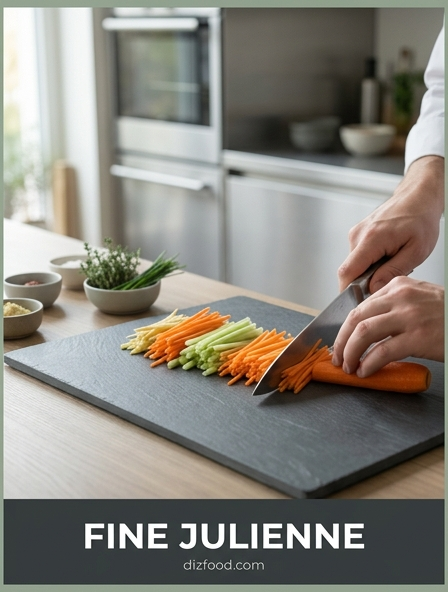
Mastering the Professional Chef Knife Grip
Achieving a precise fine julienne begins with how a chef holds the primary tool. The pinch grip is the industry standard, providing maximum control and leverage over the blade. By gripping the heel of the knife with the thumb and the side of the index finger, the cook bridges the gap between the handle and the steel. This technique shifts the balance point forward, allowing for more nuanced movements required for 1/16-inch cuts.
Proper hand placement reduces fatigue during high-volume prep sessions and increases overall safety. A firm but relaxed grip prevents the hand from cramping while ensuring the knife does not slip when encountering resistance from dense root vegetables. Mastery of this grip is the first step toward achieving the architectural precision found in professional garnishes.
- Place the thumb on one side of the blade's bolster.
- Wrap the index finger around the opposite side of the bolster.
- Curl the remaining three fingers comfortably around the handle.
- Keep the wrist flexible to allow for a smooth rocking motion.
Essential Blade Sharpness for Precision Cutting
A fine julienne demands a blade edge that can transition through cell walls without crushing them. When a knife is dull, it requires more downward pressure, which often results in the blade slipping or the vegetable bruising. For the specific dimensions of 1/16 inch by 1/16 inch by 2 inches, a razor-sharp edge is non-negotiable. Regular maintenance using whetstones and honing rods ensures the edge remains perfectly aligned and capable of surgical precision.
Maintaining different grits for sharpening allows a chef to refine the edge specifically for delicate tasks. A higher grit provides a polished finish that glides through onions and peppers with minimal resistance. Below is a guide for maintenance frequency to ensure the knife is always ready for precision work.
| Tool Type | Purpose | Frequency |
|---|---|---|
| Honing Steel | Realignment of the edge | Every 15 minutes of use |
| 1000 Grit Stone | General sharpening | Weekly or as needed |
| 6000 Grit Stone | Polishing for fine cuts | Monthly for refinement |
Creating a Stable Base for Safety
Stability is the foundation of consistency in the kitchen. Before attempting a fine julienne, the ingredient must be secured against the cutting board to prevent rolling or sliding. Most vegetables used for julienne, such as carrots, parsnips, and potatoes, are naturally cylindrical. Attempting to cut a round object increases the risk of injury and guarantees irregular dimensions. By removing a thin slice from one side of the vegetable, the cook creates a flat surface that anchors the food to the board.
Once the base is established, the vegetable can be placed flat-side down, providing a solid platform for the subsequent squaring-off process. This stability allows the chef to focus on the thickness of each slice rather than struggling to keep the ingredient in place. Following a systematic approach ensures safety during every repetition.
- Wash and peel the vegetable thoroughly.
- Trim both ends to create flat vertical edges.
- Cut a thin longitudinal slice from one side.
- Rotate the vegetable onto the newly created flat side.
- Check for any wobbling before proceeding with the first plank.
The Anatomy of the Perfect Dice
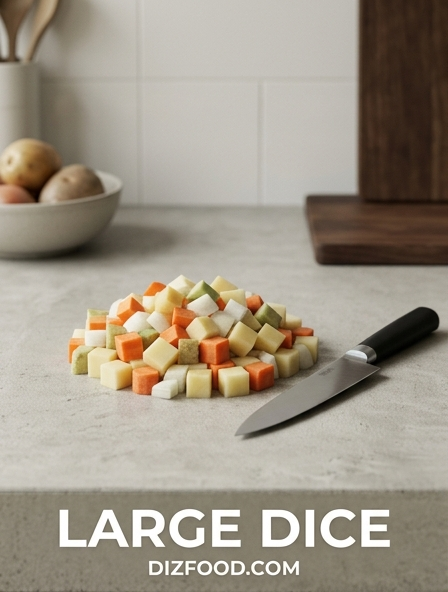
The relationship between the fine julienne and the fine brunoise is symbiotic. A perfect dice is only possible if the preceding julienne strips are uniform in every dimension. In professional culinary terms, the fine julienne serves as the intermediate stage for the smallest of all standard dice. If the strips are tapered or uneven, the resulting cubes will be asymmetrical, leading to uneven cooking and poor visual presentation.
Understanding the geometry of these cuts allows a chef to transition seamlessly between different recipe requirements. The fine julienne measures 1/16 inch squared, which, when turned 90 degrees and sliced again at 1/16 inch, produces the classic fine brunoise. This progression highlights the importance of maintaining strict measurements from the very first cut to the final cube.
- Fine Julienne: 1/16" x 1/16" x 2"
- Fine Brunoise: 1/16" cube
- Allumette: 1/8" x 1/8" x 2"
- Small Dice: 1/4" cube
Squaring Off Vegetables for Uniformity
To achieve the professional look of a fine julienne, one must first transform the natural, irregular shape of a vegetable into a perfect rectangular prism. This process, known as squaring off, involves trimming the rounded exterior surfaces until only right angles remain. While this may seem to create food waste, these scraps are typically reserved for stocks, purees, or mirepoix where shape is less critical. The goal is to produce a "block" that can be sliced into identical planks.
Precision at this stage dictates the quality of the final product. If the block is not perfectly rectangular, the outer julienne strips will have curved edges, failing the standard of culinary excellence. A systematic approach to squaring off ensures that every strip produced thereafter is a mirror image of the others.
- Establish the length of the cut, usually 2 inches.
- Trim the top and bottom to reach this desired length.
- Slice off the four rounded sides to create a box shape.
- Ensure all angles are 90 degrees.
- Utilize the rectangular block for consistent planking.
The Batonnet Foundation for Small Cubes
While the fine julienne is thinner, understanding the batonnet provides the necessary context for scaling down knife skills. The batonnet is essentially the larger cousin of the julienne, measuring 1/4 inch by 1/4 inch by 2 to 2.5 inches. By practicing the larger batonnet first, a cook develops the muscle memory required to maintain straight lines and parallel cuts before moving to the much more delicate fine julienne. This scaling approach is a fundamental part of culinary education.
Comparing these dimensions helps the chef visualize the precision required for the fine julienne. The level of focus required increases significantly as the dimensions shrink. Below is a comparison of the primary stick-shaped cuts used in professional kitchens to help differentiate the scale of work.
| Cut Name | Width | Thickness | Length |
|---|---|---|---|
| Batonnet | 1/4 inch | 1/4 inch | 2 - 2.5 inches |
| Julienne | 1/8 inch | 1/8 inch | 2 inches |
| Fine Julienne | 1/16 inch | 1/16 inch | 2 inches |
Executing Horizontal and Vertical Slices
The execution of a fine julienne is a two-step slicing process. First, the squared-off vegetable block is cut into thin sheets, often called planks. These planks must be exactly 1/16 of an inch thick. To ensure consistency, the chef should use a slight rocking motion or a forward draw-cut, depending on the vegetable's texture. Once the planks are created, they are stacked neatly on top of one another to prepare for the final vertical cuts.
The second stage involves slicing through the stack. Because the planks are thin and light, they can slide easily; therefore, maintaining downward pressure with the guide hand is critical. The knife moves vertically through the stack at 1/16-inch intervals. This creates the characteristic "matchstick" appearance. Success in this phase relies on the synchronization between the rhythmic movement of the knife and the micro-adjustments of the guide hand.
- Maintain equal thickness for every plank produced.
- Stack no more than three or four planks to prevent slipping.
- Use a consistent "locomotive" motion with the blade.
- Keep the tip of the knife in contact with the board for better control.
Maintaining Consistent Dimensions Across Ingredients
Consistency is the hallmark of a professional chef. When preparing a fine julienne for a dish that includes multiple vegetables-such as carrots, leeks, and celery root-every ingredient must match perfectly. This is not merely for aesthetics; ingredients cut to the same dimensions will cook at the same rate. In a quick sauté or as a delicate garnish in a consommé, even a slight variation in thickness can result in some pieces being crunchy while others are overcooked.
To maintain this level of uniformity, chefs often use a reference piece. After cutting the first perfect strip, it is set aside or kept near the workspace as a visual guide. Periodically checking the current batch against the reference ensures that the dimensions do not "drift" as the prep session continues. This discipline is what separates home cooking from high-end culinary production.
- Cut a reference strip to the exact 1/16" x 1/16" x 2" standard.
- Align the reference piece frequently with new cuts.
- Group finished strips to check for outliers in thickness.
- Adjust the guide hand position if the width begins to vary.
The Role of the Guide Hand
While the hand holding the knife provides the power, the guide hand provides the precision. The "claw grip" is essential when performing a fine julienne. By tucking the fingertips inward and using the knuckles as a vertical guide for the blade, the chef ensures that the fingers are never in the path of the sharp edge. The knife actually rests against the flat part of the knuckles, which act as a fence to regulate the width of each slice.
The guide hand moves backward incrementally after every cut. For a fine julienne, these movements are miniscule-only 1/16 of an inch at a time. This requires highly developed fine motor skills. The coordination between the knife hand's rhythm and the guide hand's retreat is what allows a chef to produce hundreds of identical strips in a matter of minutes.
- Tuck the thumb behind the fingers to keep it out of the way.
- Keep the fingernails pointed away from the blade.
- Use the middle knuckle as the primary contact point for the knife.
- Ensure the guide hand remains firm to prevent the vegetable from shifting.
Advanced Drills for Improving Cutting Speed
Speed in the kitchen is a byproduct of accuracy, not a replacement for it. To improve speed for fine julienne cuts, chefs engage in repetitive drills designed to build muscle memory. One common drill involves cutting through dense vegetables like potatoes, focusing on maintaining a steady, rhythmic "tap-tap-tap" sound. The goal is to keep the rhythm perfectly consistent, which indicates that the guide hand and knife hand are moving in perfect synchronization.
Another advanced drill focuses on the "low-lift" technique, where the blade barely leaves the cutting board between slices. This minimizes unnecessary movement and significantly reduces the time taken per cut. As the chef becomes more comfortable, the pace can be increased, but only if the 1/16-inch dimensions remain flawless. Over time, the process becomes instinctive.
- Start with a slow, deliberate pace to ensure perfect 1/16-inch width.
- Incorporate a metronome or internal beat to find a consistent rhythm.
- Practice "ghost cutting" without vegetables to refine the motion.
- Record prep times for a specific quantity to track improvement.
- Transition to softer vegetables like peppers to practice delicate pressure.

Comments