
Keeping your kitchen knives razor-sharp is less about constant grinding and more about choosing the right tool to maintain the integrity of your blade's edge. While a honing rod is designed to realign a "rolled" edge without removing significant metal, a pull-through sharpener acts as an abrasive shortcut, shaving off steel to create a brand-new V-shape. Understanding the trade-off between the gentle, preservative nature of a honing steel and the aggressive, convenient speed of a pull-through device is essential for anyone looking to extend the life of their cutlery while ensuring effortless slicing during meal prep.
| Feature | Honing Rod (Steel/Ceramic) | Pull-Through Sharpener |
|---|---|---|
| Primary Action | Realigns the existing microscopic edge. | Grinds and removes metal to create a new edge. |
| Metal Removal | Zero to minimal (non-destructive). | High; significantly thins the blade over time. |
| Difficulty Level | Moderate; requires consistent 15-20° angle. | Low; pre-set angles for "plug-and-play" use. |
| Blade Longevity | Extends life by preserving factory steel. | Shortens life due to aggressive abrasion. |
| Usage Frequency | Daily or before every significant task. | Rarely; only when the blade is truly dull. |
| Best For | High-end forged knives and routine upkeep. | Budget knives or quick restorative fixes. |
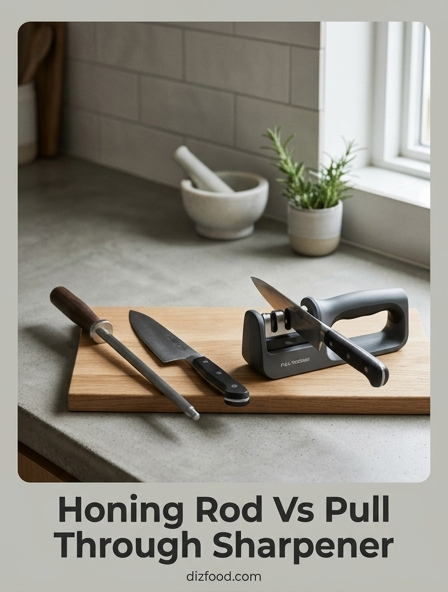
Honing Rod vs Pull Through Sharpener Key Differences
Understanding the distinction between a honing rod and a pull-through sharpener is essential for any home cook or professional chef. While both tools aim to improve the cutting performance of a knife, they operate on entirely different mechanical principles. A honing rod, often erroneously called a sharpening steel, is primarily a maintenance tool designed to realign the existing edge of a blade. In contrast, a pull-through sharpener is a corrective tool that removes metal to create a brand-new edge. This fundamental difference dictates how often each should be used and the impact they have on the longevity of your cutlery.
| Feature | Honing Rod | Pull-Through Sharpener |
|---|---|---|
| Primary Function | Realigns the microscopic edge | Grinds away metal to sharpen |
| Frequency of Use | Before or after every use | Once every few months |
| Material Removal | Negligible to none | High |
| Skill Required | Moderate (Angle control) | Low (Fixed guides) |
The choice between these two tools depends heavily on the condition of your knife. If a knife is "dull" because the edge has simply folded over-a common occurrence during standard chopping-a honing rod will restore its "bite." However, if the edge is truly rounded off or chipped, a honing rod will do nothing, and a pull-through sharpener or whetstone becomes necessary to shave away the damaged steel and reveal a fresh, sharp apex.
How a Honing Rod Realigns Your Knife Edge
When you use a knife, the thin, sharp edge of the blade eventually begins to fold or curl at a microscopic level. This phenomenon is known as "rolling." Even if the steel is still technically sharp, a rolled edge will feel dull because the apex is no longer centered and cannot make direct contact with the food. A honing rod functions by gently pushing this microscopic "burr" or fold back into a straight, centered position. This process does not involve significant abrasion; rather, it is a form of metal manipulation that extends the time between actual sharpening sessions.
To use a honing rod effectively, one must maintain a consistent angle, typically between 15 and 20 degrees, depending on the knife's original grind. By swiping the blade from the heel to the tip across the rod, you apply just enough pressure to stand the edge back up. Because this process removes almost no metal, it is safe to perform daily. Most professional chefs hone their knives every time they pull them out of the bag to ensure peak performance. There are different types of rods available, including stainless steel, ceramic, and diamond-coated versions. While steel rods only realign, ceramic and diamond rods provide a very mild abrasive quality, offering a hybrid experience that can slightly sharpen while it hones.
The Mechanics of Pull Through Sharpeners
Pull-through sharpeners are designed for speed and simplicity. They typically feature one or more V-shaped notches containing abrasive materials such as tungsten carbide, ceramic, or diamond-coated stones. The mechanics are straightforward: as you pull the knife through the notch, the abrasive surfaces shave off a layer of steel from both sides of the blade simultaneously. This aggressive removal of material creates a new, sharp V-shaped edge at a fixed angle determined by the tool's construction.
- Coarse Stage: Usually utilizes tungsten carbide blades to quickly strip away dull metal and repair nicks.
- Fine Stage: Uses ceramic rods to polish the newly ground edge and remove small burrs left by the coarse stage.
- Fixed Angles: Most manual pull-through devices are set to a standard 20-degree angle, which is ideal for Western-style knives but may be too wide for delicate Japanese blades.
Because these devices rely on friction and high-pressure abrasion, they can be quite harsh on the steel. They are designed to be used when a knife has lost its ability to be revived by a honing rod. While they are incredibly effective at bringing a dead blade back to life in seconds, the trade-off is the physical depletion of the knife's width over time. For many home cooks, this trade-off is acceptable for the sake of convenience and safety, as a sharp knife is significantly safer to use than a dull one that might slip during a cut.
Pros and Cons of Manual Honing Rods
Manual honing rods are a staple in professional kitchens for a reason, but they come with a specific set of advantages and challenges. The primary benefit is the preservation of the knife's lifespan. Since a steel honing rod does not grind away the blade, you can use it hundreds of times without thinning the knife. This makes it the ideal choice for maintaining expensive, high-carbon steel or heirloom-quality cutlery where metal conservation is a priority. Additionally, honing rods are highly portable and do not require a flat surface to operate, allowing for quick adjustments mid-task.
However, the disadvantages are centered on the user's skill level. Mastering the correct angle is difficult; if you hold the knife too steeply, you risk dulling the edge further or even scratching the side of the blade. If the angle is too shallow, the rod will not make contact with the apex, rendering the effort useless. Furthermore, honing rods are ineffective on knives that are truly dull. If the edge has been worn down to a rounded profile, you can hone it for an hour and never achieve a sharp result. This tool requires a "preventative maintenance" mindset rather than a "repair" mindset, which can be frustrating for those who only think about knife care once their tools stop cutting entirely.
Why Pull Through Sharpeners Are More Convenient
For the average home cook, convenience is often the deciding factor in kitchen maintenance. Pull-through sharpeners excel in this area because they remove the guesswork associated with knife maintenance. There is no need to find the perfect angle or develop the muscle memory required for a honing rod. The device provides a stable, guided path that ensures the blade is sharpened evenly on both sides. This "plug and play" nature allows someone with zero technical knowledge of metallurgy or blade geometry to achieve a functional edge in less than a minute.
Another aspect of convenience is the compact design. Most pull-through sharpeners are small enough to fit into a kitchen drawer, unlike long honing rods that may require a knife block or magnetic strip for storage. They are also incredibly fast; while a proper sharpening session with whetstones can take thirty minutes, a pull-through sharpener can restore a set of steak knives in the time it takes for water to boil. For busy families or individuals who view cooking as a chore rather than a hobby, the pull-through sharpener provides the path of least resistance to a safer, more efficient kitchen environment. It bridges the gap between professional-grade maintenance and the practical realities of a fast-paced domestic life.
Knife Blade Longevity and Metal Removal
The lifespan of a kitchen knife is directly tied to the method of sharpening used over the years. Metal removal is a zero-sum game; every time you sharpen a knife using an abrasive method, you are effectively "eating" the blade. Pull-through sharpeners are notoriously aggressive in this regard. They often produce visible metal shavings-tiny curls of steel that represent the literal reduction of your knife's width. If used too frequently, a pull-through sharpener can turn a wide chef's knife into a narrow utility knife within a few years.
| Tool Type | Impact on Metal | Expected Blade Life |
|---|---|---|
| Steel Honing Rod | Minimal to none | 20+ Years |
| Ceramic Rod | Very Low | 15-20 Years |
| Pull-Through (Manual) | High | 5-10 Years |
| Electric Sharpener | Very High | 3-7 Years |
To maximize the longevity of your cutlery, the goal should be to remove the least amount of metal possible to achieve the desired sharpness. This is where the honing rod becomes your best friend. By using a honing rod daily, you keep the edge aligned and sharp for longer, thereby reducing the number of times the knife needs to be subjected to the aggressive grinding of a pull-through sharpener. For those owning high-end knives, understanding this relationship is the key to ensuring those tools last a lifetime.
Which Tool is Safer for Expensive Knives
When it comes to high-end cutlery-particularly Japanese knives or custom-forged pieces-the honing rod (specifically ceramic) is generally considered the safer option. Expensive knives are often made of harder, more brittle steel. When these blades are pulled through a manual sharpener with tungsten carbide teeth, the pressure can cause the steel to chip or "chatter," resulting in a jagged, damaged edge that requires professional repair. The fixed angles of most pull-through sharpeners are also problematic for high-end knives, which often feature a 15-degree angle rather than the standard 20-degree angle used in budget tools.
Using a pull-through sharpener on a $300 knife can permanently alter its geometry and degrade its performance. In contrast, a honing rod allows the user to manually adjust the angle to match the specific requirements of the blade. For very hard steels (60+ Rockwell hardness), a ceramic honing rod is preferred because it is harder than the steel itself but much gentler than a carbide V-notch. It provides a light polish and realignment without the risk of catastrophic chipping. If you have invested significant money into your kitchen tools, learning to use a rod or a whetstone is a necessary skill to protect that investment, whereas a pull-through sharpener should be reserved for "beater" knives or budget sets.
Skill Level Needed for Different Sharpening Tools
The learning curve for knife maintenance varies significantly between tools. The pull-through sharpener is designed for the absolute beginner. Its "foolproof" design means that anyone, regardless of hand-eye coordination, can use it. Conversely, the honing rod requires a certain level of finesse and practice. Most beginners struggle with the "feel" of the rod and the consistent application of pressure across the entire length of the blade.
- Beginner (Pull-Through): Requires only the ability to pull a knife toward oneself in a straight line. The tool handles the angle and pressure.
- Intermediate (Honing Rod): Requires the user to maintain a consistent 15-20 degree angle. Often learned through the "matchbook" method or by watching tutorials.
- Advanced (Whetstones/Guided Systems): Requires total control over angle, pressure, and the management of "slurry" or grit levels.
If you are uncomfortable with the idea of free-handing an angle, the honing rod can be intimidating. However, many find that once the motion is mastered, it becomes a meditative part of the cooking process. For those unwilling to invest the time to learn, the pull-through sharpener remains the only viable option to prevent the use of dangerous, dull blades. It is always better to use a "lower skill" tool correctly than a "higher skill" tool incorrectly, as the latter can actually do more damage to the knife's edge than no maintenance at all.
Maintenance Schedules for Your Kitchen Cutlery
A functional kitchen relies on a consistent maintenance schedule. Many people wait until a knife is visibly struggling to cut a tomato before they think about sharpening, but by then, the edge is often severely damaged. A proactive approach involves a combination of both honing and sharpening at different intervals. The frequency depends on how often you cook and the types of surfaces you use for cutting; for instance, glass or marble cutting boards will dull a knife much faster than wood or plastic.
- Daily/Every Use: Use a honing rod. This keeps the microscopic edge straight and ensures the knife feels "brand new" every time you cook.
- Every 3-6 Months: Use a pull-through sharpener or professional service. This is necessary when the honing rod no longer improves the cutting performance.
- Annually: Deep inspection for chips or thinning. If the blade has become too thick near the edge (due to repeated pull-through use), it may need professional thinning.
To test if your knife needs attention, use the "paper test." A well-honed knife should slice through a piece of printer paper with a clean, effortless motion. If it catches or tears the paper, try honing it again. If honing does not fix the catch, it is time for the pull-through sharpener. By following this tiered schedule, you balance the immediate need for a sharp edge with the long-term goal of preserving the steel.
Choosing the Best Sharpener for Your Needs
Ultimately, the choice between a honing rod and a pull-through sharpener comes down to your personal priorities: do you value the longevity of your knives, or do you prioritize speed and ease of use? If you own a set of expensive German or Japanese knives, you should almost certainly choose a ceramic or steel honing rod. The precision and gentleness of a rod will keep your high-quality steel in top condition for decades. Learning the proper technique is a small price to pay for the vastly superior edge and the preservation of your cutlery's value.
On the other hand, if you use a standard, budget-friendly knife set and you have a busy lifestyle, a high-quality pull-through sharpener is a perfectly valid choice. It ensures your tools remain functional and safe with minimal effort. Many households actually benefit from owning both: a honing rod for the "good" chef's knife used for delicate prep, and a pull-through sharpener for the utility and paring knives that see heavy, daily abuse. By matching the tool to the knife and your own skill level, you can ensure that every meal begins with a sharp, efficient blade. Consider your budget, your patience for learning a new skill, and the quality of your current knife collection before making your final decision.



Comments