
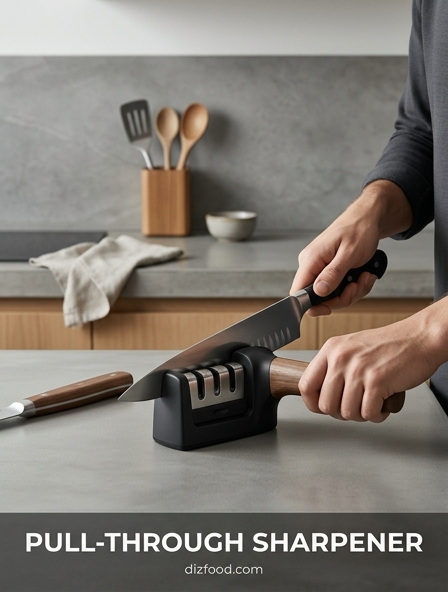
The Mechanics of Pull Through Sharpening
Pull-through sharpeners operate on a straightforward mechanical principle designed for speed and user accessibility. These devices typically feature V-shaped notches containing abrasive materials like tungsten carbide or ceramic. When a blade is drawn through the slot, the fixed angle of the abrasives forces the metal to conform to a specific geometry. Unlike whetstones, which require manual angle control, these tools dictate the bevel angle automatically, making them popular in busy home kitchens.
The sharpening process occurs through friction and material displacement. As the knife moves across the abrasive inserts, the primary cutting edge is either shaved down or ground away to reveal a fresh, sharp apex. Most modern pull-through units employ a multi-stage approach, starting with a coarse abrasive to reshape a dull edge and finishing with a finer grit to polish the steel. While efficient, the mechanical force applied is often perpendicular to the edge, which differs from the longitudinal strokes used in traditional methods. This design prioritizes convenience, ensuring that even novice cooks can achieve a functional edge without years of practice or specialized training in blade smithing.
Impact on Blade Edge Longevity
While pull-through sharpeners offer immediate results, they can significantly influence the long-term health and lifespan of kitchen cutlery. The primary concern regarding longevity is the aggressive nature of the metal removal. Because these tools are designed to work quickly, they often strip away more steel than is strictly necessary to restore sharpness. Frequent use can lead to a visible narrowing of the blade profile over time, eventually reaching the thicker part of the knife's bolster or spine.
- Accelerated metal fatigue due to high-friction grinding.
- Potential for uneven wear if pressure is inconsistent during the pull.
- Thinning of the blade's primary grind, leading to a "recurve" shape.
- Increased susceptibility to chipping if the edge becomes too thin too quickly.
To maximize the life of a knife when using these tools, it is crucial to use the coarse stage sparingly. Over-reliance on the heavy-duty tungsten slot can effectively "eat" the knife, reducing a high-quality chef's knife to a shadow of its former self within a few years of regular maintenance. Proper technique involves using the minimum number of strokes required to achieve the desired bite.
Tungsten Carbide vs Ceramic Discs
The choice of abrasive material within a pull-through sharpener dictates both the speed of the sharpening process and the quality of the final edge. Most consumer models utilize either tungsten carbide or ceramic discs, each serving a distinct purpose in the maintenance cycle. Tungsten carbide is an extremely hard material, often harder than the steel of the knife itself, allowing it to shave off metal ribbons with very little effort. This makes it ideal for repairing damaged or extremely dull blades.
| Feature | Tungsten Carbide | Ceramic Discs |
|---|---|---|
| Purpose | Heavy metal removal and reshaping | Refining, polishing, and honing |
| Edge Finish | Aggressive and slightly rough | Smooth and refined |
| Material Hardness | Exceptionally high | High, but smoother surface |
Ceramic discs, conversely, act more like a traditional honing stone. They remove very little material and instead focus on smoothing out the burrs left behind by the carbide stage. A ceramic finish results in a cleaner cut and a more durable edge for daily dicing tasks. Using both in sequence provides a balance between rapid repair and refined finishing.
How Sharpening Affects Dicing Precision
Precision in the kitchen is directly proportional to the keenness of the knife's edge. When a blade is sharpened using a pull-through device, the goal is to create a crisp apex that can bite into the surface of vegetables like onions or tomatoes without sliding. A dull knife requires the cook to apply downward force, which often results in crushing the cellular structure of the food rather than slicing through it. This not only ruins the aesthetic of a fine dice but can also alter the flavor and texture of the ingredients.
A well-maintained edge from a sharpener ensures that the blade initiates the cut at the exact point of contact. For tasks like brunoise or julienne, where uniformity is essential, the "bite" provided by a fresh sharpening session is invaluable. If the sharpening is uneven, the blade may wander during the stroke, leading to tapered cuts or inconsistent thicknesses. Therefore, maintaining a consistent sharpening routine is not just about safety; it is a fundamental requirement for high-level culinary execution and professional presentation in vegetable preparation.
Metal Removal Rates in Manual Sharpeners
The rate at which a manual pull-through sharpener removes metal is a critical factor for users to understand. Unlike electric models that use high-speed spinning wheels, manual sharpeners rely on the physical force and speed of the user's hand. Despite this, the metal removal rate can be surprisingly high, especially in units equipped with coarse carbide blades. These "scrapers" essentially peel a layer of steel off the edge to create a new bevel, which is much faster but more destructive than the gradual abrasion of a whetstone.
- Coarse Stage: Removes significant material to fix nicks or extreme dullness.
- Medium Stage: Moderates the edge by smoothing the deep scratches from the coarse stage.
- Honing should be performed frequently, potentially before every use.
- The ceramic stage of a pull-through sharpener acts as a honing tool.
- Regular honing extends the time between aggressive sharpening sessions.
- Proper honing reduces the "drag" felt when slicing through fibrous vegetables.
Understanding these rates helps in preventing unnecessary wear. If a knife is only slightly dull, skipping the coarse stage entirely is often the best approach. By limiting the metal removal to the finer ceramic or diamond-coated slots, the user maintains the structural integrity of the knife while still achieving a functional level of sharpness for daily dicing and slicing chores.
Comparing Bevel Angles and Edge Geometry
Edge geometry is the science of how the two sides of a blade meet at the point. Most pull-through sharpeners are manufactured with a fixed angle, commonly set at 20 degrees per side for a total inclusive angle of 40 degrees. This is the standard for most Western or German-style kitchen knives, providing a robust edge that can withstand heavy-duty chopping. However, many specialized Japanese knives feature a steeper 15-degree angle, which allows for much finer slicing but requires a more delicate edge.
Using a 20-degree sharpener on a 15-degree blade will effectively "re-bevel" the knife, making it more durable but significantly less precise. Conversely, using a 15-degree sharpener on a standard 20-degree utility knife might create an edge that is too thin, leading to premature dulling or rolling. It is essential to match the sharpener's fixed angle to the factory specifications of the cutlery. Some high-end pull-through models now offer adjustable angles or specific slots for different styles of knives to accommodate these geometric differences and ensure optimal performance across a diverse knife roll.
Risks to High End Forged Cutlery
High-end forged knives, often made from high-carbon steel or premium stainless alloys, are tempered to a high degree of hardness. This hardness makes the steel brittle compared to cheaper, softer stamped blades. When these knives are pulled through a standard carbide sharpener, the aggressive "shaving" action can cause micro-chipping along the edge. Instead of a smooth, continuous line, the blade may develop tiny serrations that are invisible to the naked eye but can be felt during use as a "snagging" sensation.
Furthermore, many forged knives feature a full bolster-the thick metal part where the blade meets the handle. Because pull-through sharpeners require the blade to sit deep in a notch, it is often impossible to sharpen the portion of the edge closest to the bolster. Over time, this leads to an uneven edge profile, where the heel of the knife remains thick while the rest of the blade is ground down. This creates a "frown" in the blade, preventing the knife from making full contact with the cutting board. For these reasons, many enthusiasts prefer manual stones or professional services for their most expensive forged tools.
The Role of Honing in Edge Maintenance
It is important to distinguish between sharpening and honing, as pull-through devices often perform both tasks in separate stages. Sharpening is the process of removing metal to create a new edge, while honing is the process of realigning the existing edge. During use, the microscopic tip of the blade can fold over, a condition known as "rolling." A honed edge is straighter and more efficient, even if no new metal has been exposed.
By utilizing the fine ceramic or diamond-honing slots of a pull-through device daily, cooks can maintain a high level of performance without the destructive metal loss associated with the coarse sharpening slots. This maintenance-heavy approach ensures that the knife remains "scary sharp" for dicing while preserving the blade's thickness for as long as possible.
Choosing the Right Sharpener for Your Steel
Not all steel is created equal, and the effectiveness of a pull-through sharpener depends heavily on the Rockwell hardness (HRC) of the knife. Standard kitchen knives typically fall between 54 and 58 HRC. These softer steels are malleable and respond well to the aggressive carbide inserts found in most basic pull-through models. They "take" an edge quickly because the material is easy to move and shave. However, premium knives with an HRC of 60 or higher require a different approach.
For harder steels, diamond-coated abrasives are often necessary. Diamond is one of the few materials capable of efficiently grinding the super-hard alloys found in high-end cutlery. Using a cheap carbide sharpener on a 62 HRC Japanese blade is likely to result in more damage than improvement. When selecting a sharpener, check the manufacturer's recommendations regarding steel type. If you own a mix of Western and Asian blades, look for a multi-stage sharpener that offers both diamond abrasives for hardness and ceramic slots for finishing. This versatility ensures that regardless of the steel's composition, you can achieve a functional edge without compromising the integrity of the metal.
Maintaining a Razor Sharp Dicing Edge
The secret to a razor-sharp edge for consistent dicing lies in the technique of the pull and the frequency of the maintenance. When using a pull-through sharpener, consistent pressure is vital. Many users make the mistake of pressing down too hard, which can cause the blade to chatter or result in an uneven bevel. Instead, a light, fluid motion from the heel of the knife to the tip is the most effective way to ensure the abrasive surfaces engage the steel evenly across the entire length of the blade.
Consistency is also about timing. Rather than waiting until a knife is completely dull and requires heavy grinding, brief and regular sessions in the fine or ceramic slot will keep the edge peaked. A simple test involves slicing through a vertical sheet of paper; if the knife catches or tears, it is time for a quick pass through the sharpener. By integrating this into a kitchen routine, the user ensures that every onion, carrot, and herb is cut with maximum precision, reducing fatigue and improving the overall quality of the prepared food. A sharp knife is a safe knife, as it requires less force and provides more control during complex dicing tasks.




Comments