
Whether you are a professional chef aiming for culinary excellence or a high-volume facility looking to streamline operations, choosing between hand dicing and mechanical dicing is a critical decision for your kitchen's productivity. Hand dicing remains the gold standard for artisanal precision and ingredient integrity, allowing for customized cuts that preserve the delicate cellular structure of premium produce. However, for those prioritizing high-output efficiency and absolute uniformity, mechanical dicing offers an automated solution that drastically reduces labor costs and preparation time. By evaluating the balance between the tactile control of a chef's knife and the rapid-fire scalability of commercial equipment, you can optimize your workflow to achieve the perfect blend of speed and precision in every dish.
| Feature | Hand Dicing | Mechanical Dicing |
|---|---|---|
| Output Speed | Low (approx. 2-5 kg per hour) | High (up to 500+ kg per hour) |
| Cut Uniformity | Variable (dependent on chef skill) | Precise & standardized dimensions |
| Initial Investment | Low ($50-$300 for quality knives) | High ($500-$5,000+ for equipment) |
| Labor Intensity | High (requires constant manual effort) | Low (automated with minimal supervision) |
| Ingredient Waste | Minimal (high recovery via manual trim) | Moderate (fixed blades may cause trim loss) |
| Versatility | Infinite shapes and custom sizes | Limited to specific blade/grid sets |
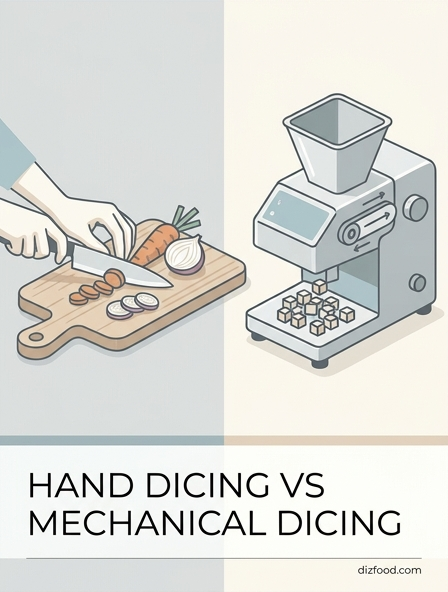
Comparing Precision in Hand vs Mechanical Dicing
The debate between manual precision and mechanical uniformity begins with the fundamental control of the blade. Hand dicing allows a chef to adjust the angle and pressure of a knife based on the specific resistance and internal structure of each individual vegetable or fruit. This level of granular control is essential when dealing with ingredients that have irregular shapes or varying ripeness levels. A skilled chef can navigate the core of a tomato or the fibrous layers of a leek to ensure every cube is geometrically perfect, minimizing the "tapered" edges often found in mass-produced prep work.
Mechanical dicing, conversely, relies on fixed grids and circular blades that prioritize mathematical uniformity over individual adjustment. In a mechanical system, the product is forced through a dicing grid, which ensures that every piece is exactly the same dimensions as the next. While this lacks the "artisan" touch, it eliminates human error and variability. For high-end garnishes where a brunoise must be exactly two millimeters, a master chef's hand is often superior. However, for general mise en place where the goal is a consistent 1/2-inch cube across fifty pounds of potatoes, the mechanical dicer provides a level of uniformity that the human hand simply cannot sustain over long periods without fatigue degrading the results.
Ultimately, the precision of hand dicing is qualitative, responding to the ingredient, while mechanical precision is quantitative, adhering strictly to the machine's calibration. The choice often depends on whether the dish requires a soul of craftsmanship or the rigorous standard of industrial perfection.
Speed and Efficiency Performance Benchmarks
In a fast-paced commercial kitchen, time is the most valuable commodity. When comparing the throughput of a seasoned prep cook against a high-output mechanical dicer, the discrepancy in volume is staggering. A professional chef might take ten minutes to perfectly dice five pounds of onions, whereas a commercial-grade continuous feed food processor can process that same volume in less than thirty seconds. This efficiency allows the kitchen staff to pivot to more complex tasks, such as sauce reduction or protein fabrication, rather than spending hours on basic vegetable prep.
| Ingredient (10 lbs) | Manual Dicing Time | Mechanical Dicing Time |
|---|---|---|
| Yellow Onions | 15-20 Minutes | 1-2 Minutes |
| Russet Potatoes | 12-15 Minutes | 45 Seconds |
| Hard Carrots | 20-25 Minutes | 2 Minutes |
| Bell Peppers | 15 Minutes | 1 Minute |
While the machine clearly wins on raw speed, the benchmark must also include the time required for setup and sanitation. For small batches of two or three items, the time spent assembling, disassembling, and cleaning a mechanical dicer can often exceed the time it would take to simply use a chef's knife. Efficiency benchmarks are therefore highest for mechanical methods during bulk preparation, whereas hand dicing remains more efficient for "on-the-fly" needs or low-volume service periods where the cleanup overhead of machinery is not justified.
Analyzing Labor Costs and Operational Impact
Labor is typically the highest expense in any culinary operation, and the dicing method chosen directly impacts the bottom line. Utilizing highly skilled labor for repetitive dicing tasks is often viewed as an inefficient use of payroll. When a sous chef or lead line cook spends three hours a day dicing vegetables, the operation is paying a premium for a task that could be automated. By shifting to mechanical dicing, kitchens can often reduce their prep shift hours or reallocate that labor toward revenue-generating activities like house-made charcuterie or pastry programs.
- Direct Labor Savings: Reducing prep time by 70% can lead to fewer labor hours required per shift.
- Skill Level Optimization: Entry-level staff can operate machinery to produce professional results, saving expert staff for finishing touches.
- Consistency in Costs: Mechanical dicing provides a predictable output rate, making it easier for management to calculate labor costs per dish accurately.
- Employee Longevity: Reducing the physical strain of repetitive knife work can lower the risk of burnout and chronic use injuries among staff.
However, the operational impact of mechanical dicing includes the initial capital expenditure. A high-quality dicing machine can cost several thousand dollars. Operations must perform a break-even analysis to determine if the labor savings over twelve to twenty-four months justify the upfront cost. For smaller bistros with limited menus, the investment might be slow to return, whereas for a catering hall or hotel, the machine often pays for itself within a single season through reduced payroll and increased throughput.
Consistency Standards for Professional Food Presentation
Professional food presentation relies heavily on the visual rhythm created by uniform shapes and sizes. In the culinary world, "consistency" means that the guest receives the exact same experience every time they order a dish. When dicing is done by hand, the consistency is subject to the chef's focus, energy levels, and even the time of day. Toward the end of a long shift, a chef's knife work may naturally become less precise, leading to variations in the size of the dice. This not only affects the visual appeal of a plated dish but also the mouthfeel and cooking rate of the ingredients.
Mechanical dicing ensures a standardized aesthetic that is vital for multi-unit operations and large-scale events. When hundreds of plates are served simultaneously, the uniformity provided by a machine ensures that every bowl of minestrone looks identical. This level of standardization is particularly important in buffet settings where ingredients are displayed in large quantities; unevenly cut vegetables can make a high-end display look unpolished or amateur. Furthermore, uniform dicing ensures that every piece of a vegetable cooks at the same rate. This avoids the common problem of some pieces being mushy while others remain raw, a flaw that is immediately apparent to discerning diners.
For fine dining establishments, however, the "too perfect" look of mechanical dicing can sometimes feel clinical or processed. In these environments, the slight, intentional variations of hand-cut vegetables are often prized as a hallmark of "from-scratch" cooking. The choice of method must therefore align with the brand's identity-whether it values the flawless repetition of a machine or the bespoke character of artisanal knife work.
Safety Protocols and Injury Risk Mitigation
The safety profile of a kitchen is significantly altered by the choice between manual and mechanical dicing. Hand dicing involves prolonged exposure to sharp blades and requires high levels of concentration. As fatigue sets in, the risk of lacerations increases. Conversely, while mechanical dicers are designed to handle high volumes, they introduce risks related to moving parts and powerful motors. Proper safety protocols must be established for both methods to ensure a healthy working environment.
- Hand Dicing: Staff must be trained in proper "claw" grip techniques to keep fingertips away from the blade and must use stabilized cutting boards to prevent slipping.
- Mechanical Guarding: All machines should be equipped with interlocking safety switches that prevent the motor from running when the hopper or blade housing is open.
- Lockout/Tagout: During deep cleaning or blade replacement, machines must be completely disconnected from power sources to prevent accidental activation.
- PPE Requirements: Manual prep often requires cut-resistant gloves, while mechanical prep requires staff to avoid loose clothing or jewelry that could be caught in the feed.
Mechanical dicing often reduces the frequency of minor nicks and cuts associated with daily knife work, but it increases the potential for more severe injuries if safety mechanisms are bypassed or if the machine is improperly maintained. A comprehensive training program is required for any staff member operating a commercial dicer, emphasizing that the speed of the machine should never lead to a shortcut in safety. By centralizing the dicing task into a machine, the overall "sharp edge" exposure time for the kitchen staff is reduced, which can lead to a measurable decrease in workers' compensation claims over time.
Material Waste and Yield Optimization Comparison
Yield optimization is a critical factor in maintaining food cost percentages. Hand dicing is generally superior for maximizing yield because a chef can see and react to the specific geometry of the produce. For instance, when dicing a bell pepper by hand, a cook can cut around the seeds and ribs with surgical precision, leaving behind minimal waste. The chef can also utilize "off-cuts" immediately for stocks or purees, ensuring that nearly 100% of the edible material is diverted to a productive use.
Mechanical dicing, while faster, often results in higher waste levels or "fines." Because the machine forces the product through a fixed grid, the outer edges of the vegetable that do not align with the grid may be crushed or cut into unusable slivers. In some machines, the pressure of the pusher can bruise delicate items, leading to moisture loss and a reduction in the weight of the final usable product. This "crush factor" is particularly prevalent with softer items like tomatoes or ripe mangoes, where a dull mechanical blade can turn a significant portion of the fruit into pulp rather than clean cubes.
To optimize yield in mechanical systems, kitchens must ensure that the size of the raw produce is somewhat compatible with the hopper size to prevent excessive trim. Despite the higher potential for small-scale waste, the sheer speed of mechanical dicing often compensates for the loss in high-volume environments. However, for expensive, high-quality ingredients, the surgical precision of hand dicing remains the most cost-effective method to ensure that every gram of product reaches the guest's plate.
Equipment Maintenance vs Manual Tool Care
Maintaining the tools of the trade is a daily ritual in any professional kitchen, but the requirements for knives and machines differ drastically. Knife care is a personal responsibility for most chefs; it involves regular honing on a steel and periodic sharpening on whetstones. The simplicity of a knife makes it easy to maintain, but it requires a high level of skill to do correctly. A well-maintained knife can last a lifetime, providing a consistent edge with minimal financial investment beyond the initial purchase and a few stones.
Mechanical equipment requires a more rigorous and technical maintenance schedule. Because these machines have motors, belts, and complex blade assemblies, they are prone to mechanical failure if not properly serviced. Maintenance for a dicing machine includes:
- Daily Sanitization: Full disassembly to remove food particles from crevices that could harbor bacteria.
- Lubrication: Regular application of food-grade grease to moving parts to prevent friction and overheating.
- Blade Inspection: Frequent checks for nicks or dullness, as a single damaged blade in a grid can ruin the output of an entire batch.
- Electrical Safety: Periodic inspections of cords and switches to ensure the unit remains grounded and safe for use in wet environments.
The cost of maintaining a machine is significantly higher than that of a knife. Replacement blade grids can cost hundreds of dollars, and professional repairs require specialized technicians. If a machine breaks down during a peak prep period, it can paralyze the kitchen's workflow if the staff is no longer accustomed to high-volume manual dicing. Therefore, a kitchen utilizing mechanical dicing must have a contingency plan and a budget for both routine maintenance and emergency repairs.
Impact on Ingredient Texture and Structural Integrity
The physics of the cut can significantly alter the flavor and shelf life of an ingredient. Hand dicing, when performed with a razor-sharp chef's knife, involves a slicing motion that shears through the plant's cell walls cleanly. This clean cut minimizes the release of enzymes and fluids, which helps the vegetable retain its structural integrity and prevents premature oxidation. For example, a hand-diced onion will "bleed" less juice, resulting in a crisper texture and a less pungent, more refined flavor profile in the finished dish.
Mechanical dicing often relies more on "impact" or "crushing" force than a pure slicing motion. As the vegetable is pushed through the dicing grid, the pressure can rupture more cell walls than a sharp knife would. This leads to increased moisture loss and can cause the diced pieces to become soggy more quickly. In the case of aromatics like garlic or onions, the increased cell damage can accelerate the development of bitter or overly strong flavors. This is why many high-end sauces and delicate salads still rely on hand-cut components; the goal is to keep the juices inside the vegetable until the moment of consumption.
Furthermore, the heat generated by a high-speed motor can sometimes be transferred to the product during mechanical dicing. For sensitive items like herbs or certain fruits, this slight rise in temperature can trigger wilting or discoloration. While modern, high-quality dicing machines have mitigated many of these issues with sharper, thinner blades and better motor insulation, the fundamental difference in the "action" of the cut means that hand-diced ingredients generally stay fresher for longer periods in cold storage.
Scalability for High Volume Production Environments
Scalability is the primary driver for the adoption of mechanical dicing. In environments such as university dining halls, large hotels, or commercial food production facilities, the sheer volume of produce required makes manual dicing an impossibility. To produce 500 gallons of vegetable soup, a kitchen would need a massive team of prep cooks working for several days if they were limited to knives. A single industrial dicing machine can accomplish this task in a fraction of a shift, allowing the facility to scale its production without a linear increase in labor costs.
Mechanical systems also offer the advantage of "process scaling." Once a dicing machine is integrated into the workflow, the kitchen can handle sudden spikes in demand-such as a last-minute banquet for 1,000 guests-without the need to hire temporary staff. The machine provides a fixed capacity that is far higher than the ceiling of human performance. This predictability allows management to accept larger contracts and expand their service capabilities with confidence.
However, scalability is not just about the machine; it is about the entire system. A high-volume dicing operation requires a "line" mentality, including washing stations, peeling machines, and large-capacity storage containers to handle the rapid output of the dicer. Without this supporting infrastructure, the speed of the mechanical dicer can actually create a bottleneck, as the rest of the prep team struggles to keep up with the volume of processed vegetables. For an operation looking to grow, the transition from hand dicing to mechanical is often the first step in moving from a traditional "brigade" kitchen to a high-efficiency production model.
Choosing the Right Dicing Method for Your Workflow
Deciding between hand dicing and mechanical dicing requires a nuanced understanding of your kitchen's specific needs, volume, and culinary philosophy. There is no one-size-fits-all solution; many of the world's best kitchens actually utilize a hybrid approach, leveraging the strengths of both methods to optimize their mise en place. The decision-making process should be guided by a few key considerations that balance quality, cost, and speed.
- Daily Volume: If your kitchen processes more than 50 pounds of a single ingredient daily, a mechanical dicer is almost always a necessary investment.
- Culinary Style: Fine dining and "farm-to-table" concepts often prioritize the texture and "soul" of hand-cut vegetables to justify premium pricing.
- Labor Availability: In markets with high labor costs or a shortage of skilled prep cooks, mechanical dicing can bridge the gap in talent.
- Space Constraints: Small kitchens may lack the counter space for bulky machinery and the three-compartment sink space required for frequent sanitization.
A hybrid workflow often proves most effective. A kitchen might use a mechanical dicer for the base vegetables of stocks, stews, and mirepoix-where the exact shape is less critical-while reserving hand dicing for visible garnishes, tartares, and delicate salads. This approach allows the kitchen to benefit from the speed of automation without sacrificing the artisanal quality that defines their brand. By matching the tool to the task, chefs can ensure that their workflow is as sharp and efficient as the blades they use.


Comments