
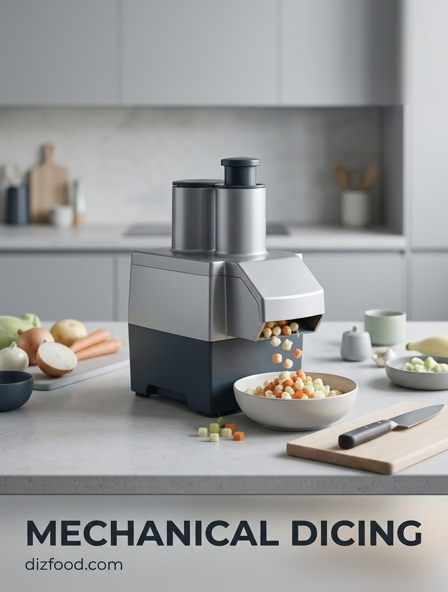
Industrial Dicing Solutions for Massive Output
In the realm of large-scale food production, industrial dicing solutions are the backbone of efficiency. These high-capacity machines are designed to process thousands of pounds of produce per hour, ensuring that supply chains remain unbroken. Unlike manual preparation, industrial dicers utilize heavy-duty stainless steel components and high-torque motors to handle everything from soft fruits to the densest root vegetables. The integration of these systems into a production line allows for a continuous flow of product, which is essential for frozen food manufacturers, canning facilities, and industrial catering services.
- Continuous feed hoppers for uninterrupted operation.
- Adjustable circular and crosscut knife spindles for versatile sizing.
- Heavy-duty construction to withstand 24/7 production cycles.
- Integrated conveyor systems for seamless product transport.
The engineering behind these machines focuses on minimizing cellular damage to the produce. By utilizing razor-sharp, precision-honed blades, industrial dicers ensure that juices and nutrients remain locked within the cube, enhancing the shelf life and quality of the final product. As global demand for processed vegetables rises, these massive output solutions provide the necessary scalability for modern food enterprises to thrive.
Automating the Art of the Perfect Cube
Achieving the perfect cube is a culinary requirement that demands extreme precision, a task that is increasingly being handed over to automated systems. In a commercial environment, the "art" of the dice is defined by mathematical uniformity. Automation removes the variable of human fatigue, ensuring that the first cube of the day is identical to the last. This level of consistency is vital for even cooking times and professional presentation in high-end food service and retail packaging.
| Feature | Benefit |
|---|---|
| Uniform Dimensions | Ensures consistent cooking and texture. |
| Minimized Fines | Reduces food waste and increases yield. |
| Clean Shear Action | Preserves the structural integrity of the vegetable. |
Modern automated dicers use a three-dimensional cutting principle. The product is first sliced to a specific thickness, then cross-cut into strips, and finally diced into cubes by a secondary set of knives. This systematic approach eliminates the jagged edges associated with lower-quality equipment. By automating this process, kitchens can guarantee a superior aesthetic that meets the rigorous standards of the modern food industry while significantly reducing labor costs.
Scaling Food Prep with High Speed Dicers
Scaling a food business requires a transition from manual labor to high-speed mechanical solutions. High-speed dicers are engineered to bridge the gap between small-batch preparation and industrial-scale manufacturing. These machines utilize centrifugal force and high-velocity blade rotations to accelerate the dicing process without compromising the quality of the cut. For businesses seeing a surge in demand, such as meal kit providers or large-scale salad producers, the speed of processing directly impacts the freshness of the delivered product.
The speed of these machines is often measured in rotations per minute (RPM) and tons per hour (TPH). By adjusting the feed rate and knife speed, operators can fine-tune the output to match the specific requirements of different produce types. For instance, firmer vegetables like carrots can be processed at higher speeds, while delicate items like tomatoes require a more calibrated approach. Scaling with high-speed equipment also allows for better inventory management, as raw ingredients can be processed and packaged in a fraction of the time, reducing the window for potential spoilage and maximizing the utility of the kitchen floor space.
Precision Cutting at Commercial Scale
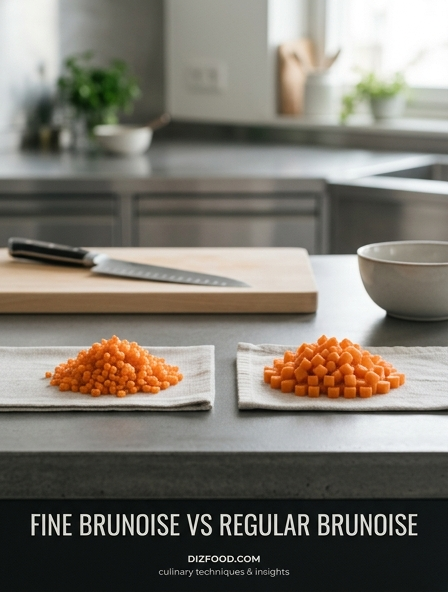
Precision is the hallmark of professional food processing. At a commercial scale, even a millimeter of deviation can lead to significant waste or inconsistent product quality. Modern dicing equipment utilizes advanced engineering to maintain tight tolerances across thousands of cycles. This precision is achieved through the use of hardened stainless steel blades and synchronized drive systems that ensure the product is positioned perfectly before each cut. Whether the requirement is a fine 3mm brunoise or a large 20mm cube, the machine must deliver exact results every time.
- Selection of the appropriate knife set for the desired cube size.
- Calibration of the feed belt speed to match the cutting frequency.
- Rigid mounting of blades to prevent vibration and deflection.
- Regular sharpening protocols to maintain clean cutting edges.
When operating at scale, precision also involves the reduction of "fines"-the small, unusable bits of produce generated during the cutting process. High-precision dicers are designed to minimize this bypass, ensuring that the maximum percentage of the raw ingredient ends up in the final package. This efficiency is a critical factor in maintaining profit margins in the highly competitive commercial food sector.
Streamlining High Volume Vegetable Processing
Streamlining a high-volume processing line involves more than just fast cutting; it requires a holistic approach to the workflow. From the moment vegetables enter the facility to the point they are packaged, every step must be optimized for speed and sanitation. Mechanical dicing systems play a central role in this optimization by acting as the primary processing node. By integrating dicing machines with upstream washers and downstream vibratory screens, a kitchen can create a seamless hands-free environment that maximizes throughput.
The layout of a streamlined facility often follows a linear or "U-shaped" configuration to minimize product travel. Mechanical dicers are placed at the heart of this line, often equipped with quick-change parts that allow operators to switch between different vegetables and cut sizes in minutes. This versatility is essential for facilities that handle a rotating seasonal menu. Furthermore, streamlining includes the implementation of Clean-In-Place (CIP) systems, where the dicing equipment is designed for rapid teardown and sanitization. This reduces downtime between shifts, ensuring that the high-volume output is maintained without compromising the stringent food safety standards required in modern commercial kitchens.
Robotic Precision in Large Scale Dicing
The integration of robotics into large-scale dicing represents the cutting edge of food technology. Unlike traditional mechanical dicers that rely on fixed blade paths, robotic systems can use vision sensors and AI to adapt to the size and shape of individual pieces of produce. This allows for a level of precision that was previously impossible. A robotic dicing arm can identify the orientation of a bell pepper, remove the core with surgical accuracy, and then dice the remaining flesh into perfectly uniform pieces, all while minimizing waste.
- 3D vision systems for real-time product analysis.
- Adaptive cutting paths to accommodate irregular produce shapes.
- Multi-axis robotic arms for complex cutting maneuvers.
- Real-time data logging for quality control and traceability.
Robotic dicing also enhances safety by removing human operators from the immediate vicinity of high-speed cutting tools. These systems are capable of working in refrigerated environments or high-humidity zones without fatigue, providing a consistent output that manual labor cannot match. As the technology becomes more accessible, robotics will likely become the standard for facilities that prioritize both high-speed production and the highest possible yield from their raw ingredients.
Maximizing Throughput with Automated Food Prep
Maximizing throughput is the primary objective of any commercial kitchen looking to increase its bottom line. Automated food prep equipment, particularly mechanical dicers, is the most effective way to achieve this. Throughput is not just about the speed of the blades; it is about the total volume of finished product that passes through the system in a given timeframe. To maximize this, machines are designed with high-volume feed chutes and powerful discharge conveyors that prevent "logjams" of product during peak operation.
| Operational Factor | Throughput Impact |
|---|---|
| Feed Rate Optimization | Prevents machine stalling and ensures steady flow. |
| Tool-less Changeovers | Reduces downtime when switching products. |
| Motor Efficiency | Maintains consistent torque under heavy loads. |
To truly maximize throughput, operators must also consider the "dwell time" of the product. Automated systems ensure that vegetables spend the least amount of time possible in the processing phase, which preserves freshness and color. By synchronizing the dicing speed with the packaging line, a facility can achieve a "just-in-time" production model that reduces the need for large storage areas and minimizes the risk of product degradation.
Future Proofing Your Commercial Kitchen Workflow
In an evolving food industry, future-proofing your kitchen workflow means investing in dicing technology that is modular, efficient, and technologically advanced. The next generation of mechanical dicers is designed with "Industry 4.0" in mind, featuring sensors that monitor blade wear, motor heat, and vibration levels. This predictive maintenance capability allows kitchen managers to schedule repairs before a failure occurs, ensuring that the production line never grinds to a halt unexpectedly. Future-proofing also involves choosing equipment that can grow with your business.
Modular dicing systems allow for the addition of new cutting heads or conveyor extensions as production needs increase. Additionally, energy efficiency is becoming a major factor in long-term viability. Newer machines utilize variable frequency drives (VFDs) to consume only the power necessary for the task at hand, significantly reducing utility costs over the life of the machine. By selecting equipment that offers both digital connectivity and mechanical flexibility, commercial kitchens can ensure they remain competitive as market demands and labor availability continue to shift in the coming years.
Rapid Fire Dicing for High Volume Facilities
For facilities that operate under intense time constraints, such as those supplying daily fresh-cut produce to grocery stores, "rapid fire" dicing is a necessity. This approach utilizes ultra-high-speed centrifugal dicers that can process tens of thousands of units per hour. The product is fed into a rotating drum where centrifugal force pushes it against a stationary slicing blade. The resulting slices then move through a series of circular and crosscut knives at incredible speeds. This process happens so quickly that the vegetable is diced almost instantly upon entry.
- High-velocity intake for bulk produce dumping.
- Centrifugal alignment for consistent slicing thickness.
- Immediate discharge into cooling flumes or packaging belts.
- Automated waste separation to remove seeds or peels.
The key to rapid fire dicing is the stability of the equipment. At these speeds, even the slightest imbalance can cause significant damage. Therefore, high-volume facilities invest in precision-balanced cutting wheels and vibration-dampening frames. This technology allows for the processing of massive quantities of onions, potatoes, or peppers with a level of speed that would require dozens of manual laborers, providing a massive advantage in fast-turnover markets.
Eliminating Bottlenecks with Automated Dicing Systems
Bottlenecks in a commercial kitchen often occur at the prep station, where manual dicing cannot keep up with the speed of cooking or packaging. Automated dicing systems eliminate these bottlenecks by providing a predictable and high-speed supply of ingredients. When the dicing process is mechanized, the "human factor" is removed from the critical path, allowing managers to allocate labor to more complex tasks such as quality control or culinary development. This shift transforms the prep area from a point of congestion into a streamlined conduit for productivity.
Furthermore, automated systems eliminate the safety-related bottlenecks caused by workplace injuries. Manual dicing is a repetitive and inherently dangerous task; by moving this work to a machine, kitchens reduce the risk of accidents and the subsequent downtime they cause. The reliability of mechanical dicing means that the production schedule can be calculated with mathematical certainty. With a clear understanding of exactly how many kilograms of diced product can be produced per hour, facilities can plan their logistics and delivery schedules with total confidence, ensuring that the entire operation runs like a well-oiled machine.



Comments