
Choosing the right cutting surface is the most important decision you can make for the longevity of your premium kitchen knives. While edge grain boards are crafted from wood strips laid horizontally-offering a beautiful, budget-friendly, and warp-resistant surface-they provide a tougher landing for your blades which can lead to faster dulling. On the other hand, end grain boards are the gold standard for professional chefs; by orienting the wood fibers vertically, the surface acts like a firm cushion that parts when the knife strikes and "self-heals" afterward. Understanding the balance between the rugged durability of edge grain and the knife-friendly, self-mending properties of end grain is key to selecting a board that suits both your culinary style and your tool maintenance routine.
| Feature | Edge Grain Board | End Grain Board |
|---|---|---|
| Grain Direction | Horizontal (parallel to surface) | Vertical (ends of wood blocks) |
| Knife Longevity | Moderate; fibers resist the blade | Superior; fibers part for the edge |
| Durability | High; less prone to warping | Extreme; "self-healing" surface |
| Maintenance | Low to Moderate oiling required | High; thirsty fibers need frequent oil |
| Visual Scarring | Shows visible knife marks over time | Hides scratches and cuts effectively |
| Price Point | Affordable / Mid-range | Premium / Investment piece |
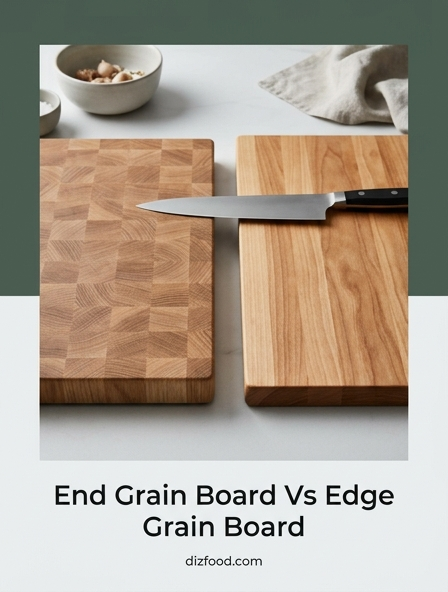
Understanding End Grain and Edge Grain Basics
In the world of culinary equipment, the distinction between end grain and edge grain boards begins with the orientation of the wood fibers relative to the cutting surface. An edge grain cutting board is constructed by laying strips of wood side-by-side and gluing them together so that the long, horizontal grain of the wood faces upward. This results in a surface where the wood fibers run parallel to the knife's edge. This construction is common in many household kitchens because it is structurally stable and utilizes the natural length of the timber effectively, often showcasing long, flowing grain patterns.
End grain boards, however, are made by gluing together small blocks of wood with the "ends" facing upward. Imagine a bundle of straws standing vertically; your knife cuts down into the open ends of those straws rather than across them. This orientation is generally considered the hallmark of professional-grade butcher blocks. Because the fibers are arranged vertically, the board presents a unique "checkerboard" aesthetic where the growth rings of the tree are visible on the surface. Understanding these basics is essential for any cook, as the fiber direction dictates how the board will interact with steel, how it will absorb moisture, and how long it will last under heavy daily use. While edge grain boards are typically thinner and more lightweight, end grain boards require significant thickness to maintain their structural integrity across the many glue joints required for their complex assembly.
Durability and Impact on Knife Blade Longevity
One of the most significant advantages of end grain construction is its symbiotic relationship with high-end cutlery. When a chef uses a knife on an edge grain board, the blade essentially acts as a tiny saw, slicing across the horizontal wood fibers. Over time, this action dulls the knife's edge relatively quickly because the steel is constantly meeting the resistance of severed wood grain. Furthermore, because the fibers are being cut, the board itself develops deep grooves that can eventually lead to splintering or a "fuzzy" texture on the surface.
End grain boards are much more forgiving to the knife's edge. As the blade strikes the surface, it slides between the vertical wood fibers rather than cutting through them. This significantly reduces the friction and impact on the microscopic edge of the knife, allowing it to stay sharp for much longer periods. For home cooks who invest in expensive Japanese or German steel, an end grain board is often seen as an essential companion to protect that investment. The following table summarizes the key performance differences regarding durability:
| Feature | Edge Grain Board | End Grain Board |
|---|---|---|
| Knife Edge Retention | Moderate to Low | Superior |
| Surface Scarring | High (Fibers are severed) | Low (Fibers are parted) |
| Board Longevity | Moderate | High (with proper care) |
| Resistance to Deep Grooves | Prone to deep cuts | Resistant due to self-healing |
The Science of Self Healing Wood Fibers
The term "self-healing" is frequently used to describe end grain boards, and while it sounds like magic, it is actually a result of the biological structure of the wood. Because the wood fibers are oriented vertically, they possess a degree of flexibility and "memory." When a sharp knife enters an end grain board, it pushes the fibers apart. Once the blade is removed, the resilient nature of the wood allows these fibers to spring back toward their original position. This process is aided by the natural oils and moisture within the wood, which help the cells maintain their elasticity.
This self-healing mechanism provides several practical benefits for the kitchen environment:
- Reduced Visible Marks: Minor nicks and scratches seem to disappear over time as the fibers close back up.
- Structural Integrity: By not severing the fibers, the board maintains its density and mass even after years of heavy chopping.
- Hygienic Surface: Because the fibers close, there are fewer deep, permanent crevices where food particles can become trapped.
In contrast, edge grain boards lack this ability. Once an edge grain fiber is sliced, it remains sliced. This leads to a cumulative degradation of the surface. While sanding can restore an edge grain board, an end grain board naturally resists the need for frequent resurfacing by keeping its fibers intact. This characteristic is why antique butcher blocks, often several decades old, are almost exclusively end grain construction.
Visual Differences and Aesthetic Appeal
The visual impact of a cutting board can be a deciding factor for many homeowners, as these items often double as semi-permanent countertop decor. Edge grain boards are characterized by their linear, clean look. They highlight the long, sweeping curves of the wood's natural grain, making them a popular choice for modern, minimalist kitchens. They are often made from a few long planks, giving them a uniform and predictable appearance that feels like an extension of the cabinetry or wooden furniture.
End grain boards offer a much more dramatic and complex aesthetic. Because they are assembled from many small rectangular blocks, they naturally form a mosaic or checkerboard pattern. The surface displays the cross-section of the wood, showing the concentric growth rings of the tree in every block. This creates a high-contrast, artisan look that is often the focal point of a kitchen island. Beyond the pattern, end grain boards are typically much thicker-often two to four inches-which gives them a sense of weight, permanence, and professional utility. While edge grain boards are sleek and subtle, end grain boards are bold and textural. Some manufacturers even mix wood species in an end grain layout to create intricate geometric designs that are essentially functional pieces of wood art. This visual density makes end grain boards particularly well-suited for serving charcuterie or acting as a centerpiece during dinner parties.
Comparing Manufacturing Complexity and Cost
The price discrepancy between end grain and edge grain boards is rooted in the labor-intensive nature of their production. Manufacturing an edge grain board is a relatively straightforward process. It involves milling boards to a specific thickness, ripping them into strips, gluing the edges together, and sanding the result. The waste is minimal, and the time required for glue-ups is significantly lower, leading to a more affordable consumer product.
End grain boards require a much more demanding multi-step process:
- Initial Lamination: Wood is first glued into an edge grain configuration.
- Cross-Cutting: That laminated board is then cut into cross-sections (slices).
- Rotation and Re-gluing: Each slice is flipped 90 degrees so the grain faces up and then glued back together.
- Precision Alignment: Ensuring the checkerboard pattern aligns perfectly requires immense precision and clamping pressure.
- Extensive Sanding: End grain is notoriously difficult to sand, requiring more time and abrasive materials to achieve a smooth finish.
Because of this "double glue-up" process and the increased volume of wood required for their typical thickness, end grain boards can cost three to five times more than an edge grain equivalent. Furthermore, the amount of high-quality waterproof glue and the specialized machinery needed to plane end grain safely adds to the overhead, making these boards a premium investment for the serious home cook.
Maintenance and Care for Different Wood Grains
Proper maintenance is the key to preventing wooden boards from cracking, warping, or harboring bacteria. However, the frequency and intensity of care differ significantly between the two types. Because end grain boards consist of open fibers facing upward, they are much more "thirsty" than edge grain boards. The vertical capillaries act like a sponge, wicking moisture and oil deep into the center of the board. This means an end grain board requires more frequent applications of food-grade mineral oil or board cream to keep it saturated and prevent the wood from becoming brittle.
Edge grain boards have a more closed surface because the long fibers run horizontally, offering more resistance to liquid penetration. While they still require regular oiling, they don't consume oil at the same rate as end grain. For both boards, the cleaning process should remain the same: hand wash only with mild soap and warm water, and never submerge them in a sink or place them in a dishwasher. To ensure longevity, consider the following care routine:
- Oiling: Apply mineral oil once a month for edge grain, or every two weeks for end grain if used daily.
- Conditioning: Use a beeswax-based cream to create a moisture barrier on the surface.
- Drying: Always dry boards upright on their edge to allow airflow to both sides, preventing uneven drying and warping.
- Deodorizing: Use a coarse salt and lemon scrub periodically to remove food odors and surface stains.
Moisture Resistance and Board Stability
Wood is a dynamic material that expands and contracts with changes in humidity. The way a board reacts to moisture is largely determined by its grain orientation. Edge grain boards are generally more stable in terms of overall movement. Because the fibers run the length of the board, they are less prone to the rapid "wicking" of water that can cause internal stress. However, if an edge grain board is thin, it is more susceptible to "cupping" or bowing if one side gets wetter than the other.
End grain boards are more sensitive to environmental changes because the open grain is highly absorbent. If an end grain board is not kept properly oiled, it can absorb water during washing, causing the individual blocks to swell. Because there are so many glue joints, this swelling can create immense internal pressure, potentially leading to cracks or "checking" if the board dries out too quickly. This is why end grain boards are made so thick; the mass helps counteract the movement of the fibers. To maximize stability, many end grain boards are equipped with rubber feet. This serves two purposes: it prevents the board from sliding during use and, more importantly, it ensures that air can circulate underneath the board. This prevents moisture from being trapped between the board and the countertop, which is the most common cause of warping and rot in professional butcher blocks.
Sanitation and Bacterial Resistance Comparison
A common misconception is that plastic boards are more sanitary than wood. In reality, hardwoods like maple, walnut, and cherry possess natural antimicrobial properties. When bacteria are drawn into the wood through capillary action, they become trapped in the cellular structure where they eventually die due to a lack of moisture and the presence of natural tannins. This process occurs in both grain types, but the efficiency varies based on the "self-healing" factor.
In an edge grain board, deep knife scars can provide a permanent home for food particles and bacteria. Because these fibers do not "close," the only way to truly sanitize a heavily scarred edge grain board is to sand it down to a fresh layer. End grain boards, by closing their fibers after the knife leaves the surface, effectively push out or seal off debris more efficiently. However, the open-pore nature of end grain means that if the board is not properly sealed with oil, it can absorb raw meat juices deeper into its core. This makes a strict oiling regimen vital for sanitation. As long as the board is well-maintained and seasoned, the vertical grain structure provides an excellent defense against cross-contamination by drawing moisture away from the surface where bacteria thrive. Regardless of the grain type, using a dedicated board for raw proteins and another for produce is always the safest culinary practice.
Best Use Cases for Each Cutting Board Type
Choosing between end grain and edge grain often depends on the specific tasks you perform most frequently in the kitchen. Edge grain boards are the "workhorses" for general prep. They are lighter, easier to move from the counter to the stove, and take up less storage space. They are ideal for slicing bread, dicing vegetables, or light dicing. Because they are often thinner, they are also more convenient for quick tasks where you don't want to haul a heavy block out of the cupboard.
End grain boards are designed for heavy-duty prep and precision work. Their weight provides a stable, non-slip surface for vigorous chopping, such as mincing herbs or breaking down poultry. They are the preferred choice for "mise en place" because their large, thick surfaces offer plenty of room. Additionally, their aesthetic quality makes them the perfect choice for presentation. Many cooks use an end grain board as a permanent fixture on their counter, serving as both a primary prep station and a decorative element. Below is a list of recommended tasks for each:
- Edge Grain: Slicing fruit, cutting sandwiches, serving cheese, light vegetable prep, and kitchens with limited storage.
- End Grain: Heavy cleaver work, high-volume chopping, carving large roasts (due to juice-catching abilities of the grain), and protecting expensive custom knives.
Choosing the Right Wood Grain for Your Kitchen
The final decision between end grain and edge grain comes down to a balance of budget, maintenance commitment, and culinary priorities. If you are a casual cook who values convenience and affordability, an edge grain board is likely the best fit. It offers a beautiful, natural wood surface that is easy to handle and store, requiring only moderate care to last for several years. It is a practical upgrade from plastic or glass without the high price tag of a professional block.
For the serious home chef or those who own high-quality knives, the investment in an end grain board is usually justified. While the initial cost is higher and the maintenance requires more oiling, the benefits to your knife edges and the "self-healing" longevity of the surface provide better long-term value. An end grain board is not just a tool; it is a piece of kitchen furniture that can last a lifetime if treated correctly. Consider your kitchen habits: do you leave your board on the counter, or do you tuck it away? Do you sharpen your knives every month, or do you prefer low-maintenance gear? By answering these questions, you can choose a board that matches your workflow. Regardless of your choice, opting for a high-quality hardwood like North American Maple or Walnut will ensure that your kitchen has a safe, durable, and beautiful surface for years to come.

Comments