
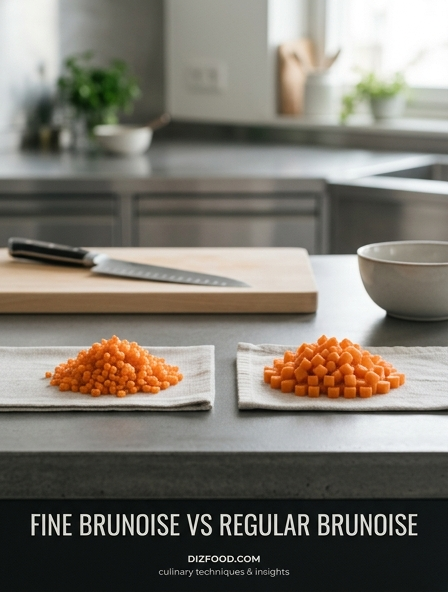
If you've ever wondered how top-tier chefs achieve that mesmerizing, uniform look in a consommé or a fine tartare, the secret lies in mastering the distinction between brunoise and fine brunoise. While both represent the pinnacle of precision knife skills, the difference is all in the dimensions: a standard brunoise yields tiny 1/8-inch cubes, whereas the elite fine brunoise demands microscopic 1/16-inch precision. Elevating your culinary game from "home cook" to "pro" often comes down to these tiny details, as the smaller the cut, the more rapidly flavors release and the more sophisticated your plating appears. Whether you're sweating aromatics for a delicate sauce or garnishing a Michelin-style appetizer, choosing the right cube size ensures your dish has the perfect texture and professional-level visual impact.
| Feature | Regular Brunoise | Fine Brunoise |
|---|---|---|
| Dimensions | 3mm x 3mm x 3mm (1/8") | 1.5mm x 1.5mm x 1.5mm (1/16") |
| Starting Cut | Small Julienne | Fine Julienne (Alumette) |
| Primary Use | Soups, stews, and hearty sauces | Garnishes, clear broths, and tartares |
| Flavor Release | Moderate; holds shape during cooking | Instant; melts into sauces/dressings |
| Skill Required | Intermediate knife proficiency | Advanced culinary precision |
| Typical Produce | Carrots, celery, leeks, onions | Shallots, peppers, firm root vegetables |
Defining Fine and Regular Brunoise Dimensions
In the hierarchy of classical French knife cuts, the brunoise represents the pinnacle of precision dicing. To understand the distinction between fine and regular brunoise, one must look at the specific mathematical dimensions required in professional kitchens. A regular brunoise is defined as a cube measuring approximately 3 millimeters on each side, which translates to roughly 1/8 of an inch. This size is large enough to retain a distinct structural integrity during brief cooking processes while remaining small enough to be considered a delicate refined cut. It is often the standard for aromatic bases in high-end restaurant preparations.
Conversely, the fine brunoise, also known as the "brunoise fine," is a microscopic version that demands significantly more dexterity and a sharper blade. Its dimensions are roughly 1.5 millimeters on each side, or 1/16 of an inch. Achieving this size requires the chef to first produce a fine julienne, sometimes referred to as an allumette or "matchstick" cut, before cross-cutting into tiny, uniform cubes. The comparison between the two can be seen in the following table:
| Cut Type | Metric Dimensions | Imperial Dimensions | Prerequisite Cut |
|---|---|---|---|
| Regular Brunoise | 3mm x 3mm x 3mm | 1/8" x 1/8" x 1/8" | Julienne |
| Fine Brunoise | 1.5mm x 1.5mm x 1.5mm | 1/16" x 1/16" x 1/16" | Fine Julienne |
Because the margin for error is so slim with these cuts, even a millimeter of deviation can move a piece of vegetable from one category to another. This precision is not merely for aesthetics; it dictates the mouthfeel and the rate of vegetable integration into a dish.
Knife Technique Differences for Precise Cuts
The transition from a regular brunoise to a fine brunoise involves more than just smaller measurements; it requires a fundamental shift in knife handling and pressure control. For a regular brunoise, a chef typically utilizes a standard 8-inch or 10-inch chef's knife, using the "claw" grip to guide the blade against the knuckles. The rhythmic motion is steady and follows a vertical plane, where the weight of the knife does a portion of the work. Because the 3mm dimensions provide a slightly wider target, the chef can maintain a moderate speed while ensuring each cube is uniform.
When executing a fine brunoise, the technique becomes much more specialized. Many chefs prefer a thinner blade, such as a Japanese petty knife or a narrow-profile gyuto, to reduce the surface friction against the vegetable. The "fine" cut requires micro-adjustments in the guiding hand. The fingers must retreat in increments so small they are barely visible to the naked eye. Lateral stability is paramount; any slight wobble in the blade will result in trapezoids or rectangles rather than perfect 1.5mm cubes. The pressure applied must be minimal to avoid crushing the cellular structure of delicate vegetables like shallots or peppers, which would cause them to bleed moisture and lose their crisp edges. Mastering the fine brunoise is often considered the "bar exam" of the prep kitchen, signifying that a cook possesses the ultimate level of fine motor control and blade maintenance.
Measurement Standards for Professional Brunoise
In the professional culinary world, "close enough" is not an acceptable standard for brunoise cuts. Consistency is the hallmark of a disciplined kitchen, as it ensures that every bite a guest takes is identical in texture and flavor distribution. Culinary schools and Michelin-starred establishments often employ specific benchmarks to test a cook's proficiency in these cuts. To maintain these rigorous standards, the following criteria are generally observed:
- Uniformity: Every single cube must be identical to its neighbor. If a handful of brunoise contains varying sizes, it is often discarded or relegated to a stock pot where appearance is irrelevant.
- Geometric Integrity: The cuts must feature 90-degree angles. Tapered ends from the natural curve of a carrot or onion must be "squared off" before the final dicing begins to avoid irregular shapes.
- Waste Management: While precision is key, a professional must also demonstrate the ability to minimize food waste by maximizing the usable portion of the vegetable before reaching the "scrap" stage.
- Sharpness Verification: A clean cut without frayed edges indicates a properly honed blade. Ragged edges lead to faster oxidation and a duller visual appearance.
To assist in training, many prep cooks use culinary rulers-small stainless steel tools marked with precise millimeter increments-to check their work during the first few minutes of a shift. This calibration ensures that their eyes and hands are aligned with the executive chef's expectations. Over time, this becomes muscle memory, allowing the chef to produce perfect dimensions by sight alone under high-pressure service conditions.
Impact of Cut Size on Flavor Release
The science of flavor extraction is heavily influenced by the surface-area-to-volume ratio of the ingredients. When a vegetable is cut into a fine brunoise, the total surface area exposed to the cooking medium (oil, butter, or stock) or the palate is significantly increased compared to a regular brunoise. This has a profound impact on how flavors are perceived. In a fine brunoise, the cell walls are ruptured at more frequent intervals, allowing essential oils and sugars to leach out almost instantly upon contact with heat or acid. This makes it an ideal choice for raw applications, such as a vinaigrette, where you want the sharp bite of a shallot to permeate the oil quickly without the crunch of a large piece of onion.
A regular brunoise, while still small, offers a more gradual release of flavor. The slightly larger interior of the 3mm cube acts as a reservoir for juice, providing a "burst" of flavor when bitten into rather than a continuous infusion. This size is better suited for dishes where the vegetable needs to stand up to a longer sauté, such as a risotto or a hearty grain salad. In these instances, the regular brunoise provides enough mass to balance the seasoning of the surrounding components. If a fine brunoise were used in a long-simmered sauce, it might dissolve entirely, losing its unique flavor profile and contributing only a generic sweetness to the liquid. Therefore, the choice between fine and regular is as much a chemical decision as it is an aesthetic one.
Culinary Applications for Fine Versus Regular
Determining whether to use a fine or regular brunoise depends largely on the intended role of the vegetable in the final dish. Because the fine brunoise is so delicate, it is rarely used as a primary structural ingredient. Instead, it serves as a sophisticated garnish or a component in emulsions. Conversely, the regular brunoise is robust enough to act as a texture-defining element in various classic recipes. The following list outlines the typical use cases for each:
- Fine Brunoise Applications:
- Consommé garnishes where the cubes must float delicately.
- Compound butters (maître d'hôtel butter) for seamless spreading.
- Raw seafood preparations like tartare or ceviche.
- Infusing oils or making high-clarity vinaigrettes.
- Regular Brunoise Applications:
- Traditional mirepoix for sauces like Espagnole or Velouté.
- Fillings for savory pastries, such as empanadas or small quiches.
- Garnishing thick pureed soups (e.g., butternut squash or potato leek).
- Adding texture to risotto, pilafs, or couscous.
In fine dining, the fine brunoise is often used as a "dusting" of vegetables over a finished plate, providing a pop of color and a hint of aromatics without overwhelming the palate. The regular brunoise remains the workhorse of the kitchen, providing the foundational flavor for braises and stews where the vegetable needs to survive the heat long enough to be identified by the diner.
From Julienne to Brunoise Execution Steps
The path to a perfect brunoise is a linear progression that requires discipline at every stage. You cannot achieve a square cube without first creating a square stick. The process is identical for both fine and regular sizes, with the only difference being the initial thickness of the slices. Following these steps ensures that the final result meets professional standards:
- Wash and Peel: Clean the vegetable and remove the outer skin. For root vegetables like carrots, removing the rounded exterior is essential.
- Squaring (Le Pont): Cut the vegetable into manageable rectangular blocks, roughly 2 inches in length. Trim the rounded sides so the vegetable sits flat on the board and has four squared faces.
- Slicing (Planches): Slice the block lengthwise into thin, uniform planks. For regular brunoise, make these 3mm thick; for fine, make them 1.5mm thick.
- Julienning (Batonnet/Allumette): Stack the planks and cut them lengthwise again into matchsticks of the same width as the thickness of the planks.
- The Final Dice: Turn the matchsticks 90 degrees. Gathering them tightly with your guiding hand, cut across the sticks to create the final cubes.
Maintaining a tight "bundle" of julienne strips during the final stage is the hardest part of the process. If the strips spread out on the cutting board, the resulting cubes will be uneven. Professional chefs often use the side of the knife to frequently "nudge" the strips back into a neat pile before continuing the cut.
Visual Presentation Differences in Fine Dining
Visual appeal is one of the primary reasons a chef will opt for a fine brunoise over a regular one. In the world of haute cuisine, the size of the cut is often a silent communicator of the kitchen's technical prowess. A fine brunoise of colorful vegetables-such as red pepper, zucchini skin, and carrot-resembles jewels or confetti scattered across a plate. Because the pieces are so small, they do not obscure the main component of the dish; rather, they add a layer of intricate detail that invites the diner to look closer. The 1.5mm size creates a texture that appears almost like a shimmer on the surface of a sauce or a piece of protein.
A regular brunoise presents a more rustic, though still refined, appearance. It conveys a sense of "handmade" quality that works well in bistro-style settings or more substantial courses. When plated, the 3mm cubes have enough height to create shadows and three-dimensional depth, which can be useful when building a "mound" of garnish. In contrast, the fine brunoise tends to lay flat. Furthermore, the regular brunoise is much easier to see against a dark sauce, making it a better choice for contrast. Chefs often use the regular cut when they want the vegetable to be an equal partner in the visual composition, whereas the fine cut is used when the vegetable is meant to be a subtle, elegant accent.
Heat Distribution and Cooking Speed Variations
The thermodynamic behavior of a vegetable changes drastically between a 3mm and a 1.5mm cut. Because a fine brunoise has such a small mass, the heat from a pan or a warm liquid penetrates to the center of the cube almost instantaneously. This means that a fine brunoise of carrot can be "cooked" in as little as 10 to 15 seconds in a hot sauté pan. If left for a minute, it will likely lose its color and turn into a soft paste. This rapid cooking speed is advantageous for "à la minute" preparations where the chef adds the aromatics at the very last second to preserve their vibrant color and fresh "snap."
The regular brunoise offers a much wider window for heat management. The 3mm cubes can withstand several minutes of sautéing, allowing them to undergo the Maillard reaction and develop a caramelized exterior while still maintaining a firm "al dente" center. This makes them far superior for building "fond" in a pan before deglazing. The following list summarizes the heat-related characteristics of these cuts:
- Fine Brunoise (1.5mm):
- Cooks in 10-30 seconds.
- Best added at the end of cooking.
- High risk of burning or overcooking.
- Excellent for raw infusions in hot liquids.
- Regular Brunoise (3mm):
- Cooks in 2-4 minutes.
- Can be used for sweating and light browning.
- Maintains shape in short simmers (10-15 mins).
- Provides a consistent bite in warm dishes.
Essential Tools for Consistent Small Dicing
Achieving consistency in brunoise cuts is as much about the equipment as it is about the cook's skill. You cannot produce a 1.5mm fine brunoise with a dull, thick-bladed knife; the blade will wedge into the vegetable rather than slicing through it, causing the pieces to fly apart or crush. A high-carbon steel knife with a thin "behind the edge" geometry is the preferred tool. Such knives can be sharpened to a razor-like finish, allowing for the effortless, clean strokes required for micro-dicing. Additionally, the cutting surface plays a vital role. A heavy, end-grain wooden cutting board provides the necessary stability and grip, preventing the vegetable planks from sliding during the julienne stage.
Beyond the knife and board, several supplementary tools are common in professional kits. A stainless steel bench scraper is essential for moving the tiny cubes without bruising them. Many chefs also keep a damp kitchen towel (side towel) nearby to frequently wipe the blade, as the starch and sugars from vegetables like potatoes or carrots can cause the knife to stick, ruining the precision of the next cut. Finally, for the ultimate in precision, some kitchens use "chinois" or fine-mesh strainers to rinse the brunoise, removing any "dust" or irregular shards that might have been created, ensuring that only perfect cubes make it to the final plate. Consistency in tools inevitably leads to consistency in the final product.
Choosing the Right Cut for Your Recipe
The decision to execute a fine brunoise versus a regular brunoise is ultimately a balance between the desired aesthetic, the available prep time, and the functional requirements of the recipe. A regular brunoise is the practical choice for most kitchen tasks. It offers a sophisticated look without being overly labor-intensive, making it suitable for high-volume service where hundreds of portions must be prepared. It is the "standard" for a reason-it fits perfectly on a spoon, provides a satisfying texture, and holds up well under various cooking methods. When in doubt, the 3mm regular brunoise is almost always a safe and professional choice.
The fine brunoise should be reserved for moments of true culinary artistry or when the recipe specifically demands an instant flavor release without visible bulk. If you are preparing a delicate clarified soup where every element is under a literal magnifying glass, the extra effort of the 1.5mm cut is justified. It is also the correct choice for garnishing small hors d'oeuvres or canapés, where a regular 3mm cube might look clunky or be difficult to balance on a small cracker or spoon. By evaluating the "scale" of the dish-both in terms of visual size and flavor intensity-a chef can choose the cut that best enhances the final dining experience. In the end, whether fine or regular, the most important factor is that the choice is intentional and executed with unwavering uniformity.

Comments