
Understanding the Precise Definition of Brunoise
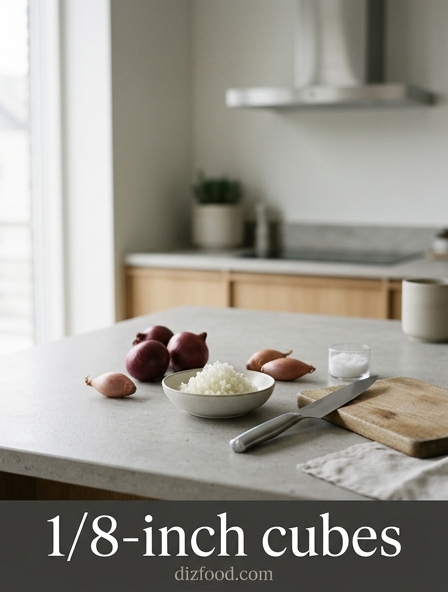
The brunoise cut represents the pinnacle of precision in classical French culinary technique. It is defined as a tiny cube measuring exactly 1/8 inch on all sides, or approximately 3 millimeters. This technique is not merely an aesthetic choice; it reflects a chef's mastery over their blade and an understanding of structural uniformity. Achieving a true brunoise requires the chef to first transform a vegetable into a julienne-long, thin strips-before turning those strips ninety degrees to dice them into perfect miniature cubes. Unlike a rough chop or a standard small dice, the brunoise is reserved for the most refined presentations where elegance and texture are paramount.
In a professional kitchen, the brunoise serves as a benchmark for consistency. If the cubes are irregular, they will not cook at the same rate, potentially compromising the integrity of a delicate sauce or a clear consommé. While the dimensions are incredibly small, the impact on a dish is significant. This cut is most frequently applied to firm aromatics such as carrots, celery, leeks, and turnips, ensuring that every bite contains a balanced distribution of flavor and a sophisticated visual appeal that elevates the overall dining experience.
Essential Tools for Professional Knife Work
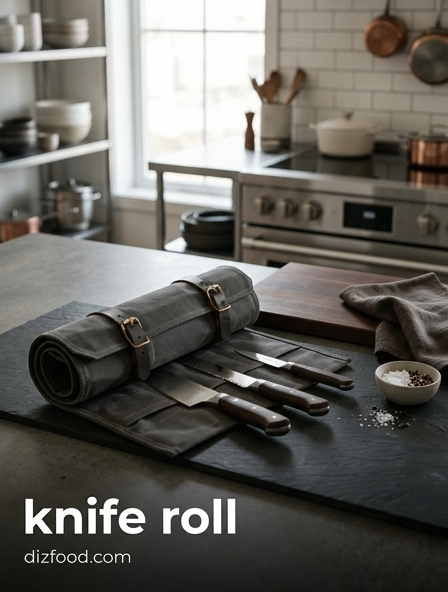
To execute a flawless 1/8-inch brunoise, a chef must rely on high-quality tools that offer both sharpness and control. A dull blade is the enemy of precision, as it requires more downward pressure, which can cause the vegetable to slip or crush rather than slice cleanly. A well-maintained 8-inch chef's knife or a Japanese Santoku is typically preferred for this level of detail. Additionally, the cutting surface must be stable and spacious to allow for the organized movement of ingredients from the whole state to the finished dice.
| Tool | Function in Brunoise |
|---|---|
| Chef's Knife | Primary tool for squaring and dicing. |
| Honing Steel | Maintains the edge alignment during use. |
| Bench Scraper | Clears the board without dulling the blade. |
| Damp Cloth | Placed under the board for total stability. |
Beyond the knife itself, a ruler or a specialized culinary cutting guide can be helpful for beginners to calibrate their eyes to the exact 1/8-inch requirement. Consistent sharpening ensures that the blade glides through dense root vegetables with minimal resistance, which is essential when performing hundreds of repetitive micro-cuts in a high-volume kitchen environment.
Mastering the Uniform Julienne Base
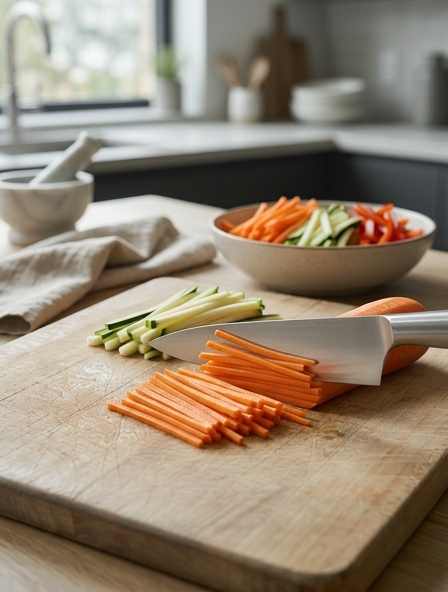
The secret to a perfect brunoise lies entirely in the quality of the preceding cut: the julienne. Without a uniform set of matchsticks, the final cubes will inevitably be lopsided or irregular. The process begins by "squaring off" the vegetable, removing the rounded exterior to create a rectangular block or "baton." This provides a flat, stable base that prevents rolling, ensuring safety and accuracy. Once the vegetable is stabilized, it is sliced into 1/8-inch thick planks, which are then stacked and sliced again into 1/8-inch strips.
- Wash and peel the vegetable to ensure a clean working surface.
- Trim the ends and sides to create a consistent rectangular shape.
- Slice the block lengthwise into even planks exactly 1/8-inch thick.
- Stack the planks neatly and slice lengthwise again to create matchsticks.
- Align the matchsticks horizontally to prepare for the final crosswise cuts.
During this stage, focus is critical. Any deviation in the thickness of the planks will translate into a failure of the final cube's dimensions. Professional chefs often save the trimmings from the squaring process for stocks or purees to ensure that no food is wasted while striving for geometric perfection.
Exact Measurements for Standard Brunoise Dimensions
Precision is what separates a professional brunoise from a simple home-cooked dice. In the hierarchy of French knife cuts, dimensions are strictly codified to ensure culinary harmony. The 1/8-inch measurement is the standard for a regular brunoise, though some high-end kitchens may even call for a "fine brunoise," which is a staggering 1/16-inch cube. Understanding where the brunoise fits within the spectrum of dicing helps a cook choose the right technique for the specific recipe requirements.
| Cut Name | Dimensions (Inches) | Metric Equivalent |
|---|---|---|
| Fine Brunoise | 1/16 x 1/16 x 1/16 | 1.5 mm |
| Brunoise | 1/8 x 1/8 x 1/8 | 3 mm | 1/4 x 1/4 x 1/4 | 6 mm |
Achieving these measurements requires a "vertical" approach to the knife, where the tip remains in contact with the board or follows a smooth rocking motion. Because 1/8 inch is so small, even a slight tilt of the knife can result in a trapezoidal shape rather than a cube. Consistently checking the size of your cuts against a ruler during practice sessions helps build the necessary visual muscle memory for high-speed production.
The Role of Consistency in Even Cooking
The primary functional reason for dicing vegetables into 1/8-inch cubes is to ensure uniform heat distribution. When every piece of food is the exact same size, they all reach the desired level of doneness at the same moment. In dishes like a classic risotto or a fine vegetable soup, a consistent brunoise ensures that no single piece of carrot is crunchy while another is overcooked and mushy. This level of uniformity is particularly vital when sautéing aromatics, as the small surface area allows for rapid caramelization and flavor extraction without burning.
Furthermore, the brunoise cut maximizes the surface area of the vegetable relative to its volume. This allows the heat to penetrate the center of the cube almost instantly. In professional saucier work, this allows the essence of the vegetable to infuse into the liquid more efficiently. Whether used as a garnish that gently softens in a hot broth or as a base for a delicate stuffing, the consistency of the 1/8-inch dimensions ensures a professional mouthfeel where no single element distracts from the cohesion of the dish.
Selecting the Best Vegetables for Fine Dicing
Not all vegetables are suitable for the rigorous demands of a 1/8-inch brunoise. The ideal candidate must possess a firm, dense structure that can withstand multiple precise cuts without collapsing or bruising. Soft or high-moisture vegetables tend to turn into a pulp when sliced so thinly, making it nearly impossible to achieve distinct, sharp-edged cubes. Root vegetables are the traditional choice for this technique because their cellular walls are sturdy enough to maintain geometric integrity after being processed.
- Carrots: The most common choice due to their firmness and vibrant color.
- Parsnips: Offer a similar texture to carrots with an earthy, sweet profile.
- Celery: Provides a distinct crunch, though the fibers require a very sharp knife.
- Turnips and Radishes: Their crisp white flesh creates beautiful visual contrast.
- Onions and Shallots: While layered, they can be diced finely by following their natural lines.
When selecting vegetables, freshness is the most important factor. A limp carrot or a soft bell pepper will resist the blade, leading to ragged edges. For the best results, use chilled, turgid vegetables that "snap" when broken, as these will produce the cleanest 1/8-inch cubes with the least amount of effort and waste.
Knife Grips and Safety for Miniature Cuts
Safety is the most critical component when performing miniature cuts like the brunoise. Because the knife is moving close to the fingertips, the "claw grip" is an absolute requirement. This involves tucking the fingertips inward and using the knuckles as a guide for the blade. The side of the knife should rest against the flat part of the knuckles, ensuring that the sharp edge never comes into contact with the skin. This technique allows the chef to feel the position of the blade without having to look directly at it, facilitating both speed and security.
The "pinch grip" on the knife handle provides the secondary level of control needed for precision. By pinching the bolster of the knife between the thumb and the index finger, the cook gains a more direct connection to the blade's movement. This reduces fatigue and prevents the knife from wobbling during the fine 1/8-inch increments. Maintaining a relaxed shoulder and a steady stance further enhances control, allowing the hand to execute the repetitive, rhythmic motions required to transform a stack of julienne strips into a mountain of perfect, uniform cubes.
Culinary Uses for Brunoise in Gourmet Dishes
In the world of fine dining, the brunoise is used to add sophistication and concentrated bursts of flavor to a dish. It is rarely the main component of a meal; instead, it serves as a refined accent. One of the most classic applications is as a garnish for a clear consommé. In this context, the floating 1/8-inch cubes showcase the chef's technical skill while adding a subtle texture that does not overwhelm the clarity of the broth. The small size ensures that the vegetables are cooked through simply by the residual heat of the liquid.
Other gourmet applications include:
- Stuffings for delicate proteins like quail or stuffed sole.
- Incorporation into tartar or ceviche for a crunchy contrast to raw fish or meat.
- Aromatics for a classic beurre blanc or other emulsified butter sauces.
- Colorful garnishes for savory custards and vegetable terrines.
Because the brunoise is so small, it releases its flavors almost instantly when it hits the palate. This makes it an excellent choice for cold salads or as a finishing touch on a plated appetizer where visual detail is just as important as the taste profile itself.
Troubleshooting Common Dicing Inconsistencies
Even experienced cooks can encounter difficulties when trying to maintain a perfect 1/8-inch dice over a large quantity of produce. One common issue is "tapering," where the cubes gradually get larger or smaller as the chef moves down the length of the vegetable. This usually happens when the knife is held at a slight angle rather than perfectly perpendicular to the cutting board. Periodically stopping to check the alignment of the blade can help correct this habit. Another frequent problem is "shingling," where the planks or strips slide apart, leading to uneven cuts.
To combat sliding, ensure the vegetable has been squared off sufficiently to create a flat base. If the pieces are still moving, try dicing smaller stacks at a time. If the edges of the cubes appear crushed or frayed, the culprit is almost certainly a dull knife. A blade that does not effortlessly slice through the fibers will force the cook to use a sawing motion, which ruins the geometric precision. Regular honing and professional sharpening are the best defenses against these common dicing errors, ensuring that every 1/8-inch cube remains crisp and sharp.
Practicing Speed Without Sacrificing Precision
The transition from a slow, methodical brunoise to a fast, professional pace is a matter of muscle memory and rhythm. Many culinary students make the mistake of trying to move too quickly before they have mastered the mechanics, leading to inconsistent sizes and potential injury. The adage "slow is smooth, and smooth is fast" applies perfectly here. By focusing on the exact 1/8-inch increments at a deliberate pace, the brain and hand eventually sync up, allowing the speed to increase naturally over time without a loss in quality.
To practice effectively, start with high-yield, low-cost vegetables like potatoes or carrots. Use a steady, rhythmic rocking motion with the knife, keeping the tip on the board if using a Western-style chef's knife. Focus on making the cuts rhythmic, like a heartbeat. As you become more comfortable, you will find that you can maintain the 1/8-inch dimensions while increasing the frequency of the strokes. In a professional kitchen, speed is essential, but it never takes precedence over the uniformity of the cut, as a fast brunoise that is irregular is ultimately useless for high-end service.

Comments