
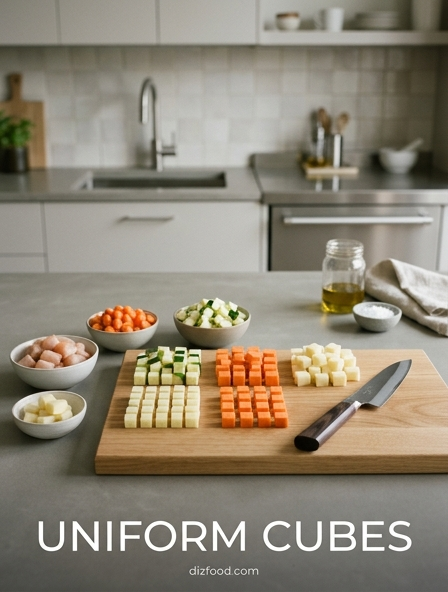
Selecting the Right Dicing Attachment
Achieving the perfect uniform cube begins with selecting the appropriate dicing attachment for your food processor or commercial dicer. These attachments typically consist of a slicing blade and a dicing grid that work in tandem to produce precise geometric shapes. The selection process should be guided by the desired dimensions of the final product, as grids commonly come in sizes like 8mm, 10mm, and 12mm. Choosing a grid that is too large for delicate ingredients may result in tearing, while a grid that is too small for dense root vegetables might cause the motor to strain.
When evaluating attachments, consider the build quality and material. Stainless steel is the industry standard due to its durability and resistance to acidic juices found in many vegetables. A high-quality kit should include a cleaning tool specifically designed to fit the grid gaps, as this prevents damage during maintenance. Consider these primary factors during your selection:
- The specific model compatibility with your base motor unit.
- The thickness of the slicing blade, which dictates the cube's height.
- The sharpness of the vertical grid wires or blades.
- The ease of disassembly for frequent sanitization.
Preparing Vegetables for Consistent Results
The secret to perfectly uniform cubes often lies in the preparation of the raw ingredients before they ever touch the dicing blade. Most vegetables are naturally irregular in shape, which can lead to partial cubes or "slivers" if not addressed. To ensure every piece is a complete square, you must transform the vegetable into a manageable, geometric precursor. This process, often called "squaring off," involves trimming the rounded ends and sides of the produce to create a rectangular block that fits snugly within the machine's feed tube.
Proper preparation also involves managing the internal structure of the produce. For instance, removing the core of a bell pepper or the tough seeds of a large cucumber prevents the dicing grid from snagging on fibrous tissues. Follow these steps for optimal preparation:
- Wash and peel all produce to remove skins that might catch on the grid.
- Trim the vegetable to a width slightly narrower than the feed tube.
- Flat-cut the leading edge to ensure the first slice is stable.
- Remove any pith or internal seeds that could cause clogging.
The Importance of Chilling Produce
Temperature management is a frequently overlooked aspect of achieving culinary precision. When vegetables are at room temperature, their cellular structures are often more flexible and prone to deformation under the pressure of a blade. This can lead to ragged edges or "mushing," especially in produce with high water content like tomatoes or cucumbers. By chilling your vegetables in the refrigerator before dicing, you firm up the cell walls, allowing the blade to pass through with a clean, shearing action rather than a crushing force.
For certain items like onions or soft cheeses, a brief stint in the freezer-approximately ten to fifteen minutes-can provide the necessary rigidity for a clean cut. This chilling process also helps to retain the internal juices of the produce, ensuring that the flavor remains inside the cube rather than being squeezed out onto the work bowl. Consistent temperature ensures that every batch processed behaves identically, which is critical for high-volume meal preparation where uniformity is the primary aesthetic and functional goal.
Mastering Feed Tube Loading Techniques
The way an ingredient enters the dicing assembly determines its orientation and final shape. To produce uniform cubes rather than rectangular planks, the feed tube must be loaded with care. Ingredients should be packed tightly enough to prevent them from tilting or tumbling during the slicing process, but not so tightly that they require excessive force to move. If a vegetable wobbles as the blade hits it, the resulting cubes will be diagonal and irregular.
Vertical alignment is key for elongated items like carrots or celery. For larger items like potatoes, centering the item in the tube ensures the most efficient use of the grid surface. Consider these loading strategies for better output:
- Use the small feed tube for narrow vegetables to prevent tipping.
- Stack multiple small items together to create mutual support.
- Place the flat-trimmed side down to establish a firm base against the disc.
- Apply steady, even pressure using the pusher rather than quick pulses.
Optimizing Speed Settings for Texture
Speed control is the primary variable in managing the texture and integrity of your diced cubes. High-speed settings are generally reserved for hard, dense vegetables that require significant centrifugal force to pass through the dicing grid. Conversely, soft or delicate items require a slower approach to prevent the impact of the blade from shattering the produce. Operating at the wrong speed can lead to bruised edges or "shingling," where slices fail to clear the grid efficiently.
The relationship between motor RPM and vegetable density is summarized in the following table to help guide your settings:
| Vegetable Type | Recommended Speed | Reasoning |
|---|---|---|
| Root Vegetables | High | Requires force to penetrate dense fibers. |
| Pome Fruits | Medium | Balances skin resistance with flesh softness. |
| Soft Fruits/Cucumbers | Low | Prevents crushing and juice loss. |
Using Pulse Control for Precision
Manual pulse control offers a level of oversight that continuous running cannot match. When the motor runs indefinitely, it is easy to over-process the ingredients or fail to notice a clog forming in the dicing grid. Pulsing allows the operator to observe the flow of cubes into the work bowl and adjust the pressure on the pusher in real-time. This technique is particularly useful when dealing with a mix of textures or when the work bowl is approaching its maximum capacity.
By using short, two-second bursts, you allow the blade to reach its optimal speed before it makes contact with the produce, ensuring a clean shear. This intermittent action also helps the motor maintain its torque without overheating. Pulse control is the preferred method for finishing a batch of vegetables, as it prevents the last few pieces of produce from being spun around the bowl erratically, which often results in "fines" or unwanted small scraps that ruin the uniformity of the tray.
Preventing Overcrowding in the Work Bowl
Maintaining a clear path for diced cubes is essential for preserving their shape. As the work bowl fills, the accumulated cubes can begin to pile up against the bottom of the dicing grid. If the cubes cannot fall freely from the grid, they will be pushed back up into the path of the spinning blade, leading to secondary cuts and a "mushed" appearance. This overcrowding is the most common cause of poor results in high-volume dicing tasks.
To avoid this, it is vital to monitor the fill line closely and empty the bowl frequently. Follow these steps to manage bowl capacity:
- Stop the machine when the bowl is two-thirds full.
- Gently shake the bowl to level the contents if they are mounding on one side.
- Empty the cubes into a separate container before they touch the underside of the disc.
- Clear any stray pieces from the central spindle before restarting.
Maintaining Sharp Blades and Grids
A dicing kit is only as effective as the sharpness of its edges. Over time, the slicing blade and the vertical wires of the dicing grid will dull, especially when processing starchy or gritty vegetables. Dull blades do not cut; they tear and compress. This results in cubes with ragged, greyish edges and a significant loss of moisture. Furthermore, a dull blade requires more pressure from the operator, which increases the risk of mechanical failure or slipping.
Regular inspection of the dicing grid is necessary to ensure that no wires have been bent or nicked. If the slicing blade has visible dents, it should be professionally sharpened or replaced. Proper maintenance includes hand-washing these components, as the harsh chemicals and high heat of a dishwasher can accelerate the dulling process. Storing the blades in a protective case prevents them from knocking against other metal tools, ensuring that the precision-honed edges remain intact for every culinary project.
Cleaning Tips for Clog Free Dicing
Clogging is the enemy of uniformity. When fibers or starch build up in the corners of the dicing grid, subsequent pieces of produce are forced through a narrower opening, leading to deformed cubes. To maintain a clog-free environment, it is best to rinse the attachment immediately after use, before residues have a chance to dry and harden. Starch-heavy vegetables like potatoes and carrots are particularly prone to leaving a sticky film that can trap other debris.
Use the following cleaning routine to ensure your equipment remains in peak condition:
- Use the manufacturer-provided "pusher" tool to clear the grid holes.
- Rinse with cold water first to remove starches, then warm soapy water for oils.
- Use a soft-bristled brush to reach into the crevices of the slicing blade.
- Air dry completely to prevent any oxidation or rust on the cutting surfaces.
Never use metal skewers or knives to poke out clogs, as this can permanently damage the precision alignment of the dicing grid.
Troubleshooting Common Uniformity Issues
Even with high-quality equipment, issues with cube uniformity can arise due to mechanical or technique-based errors. If you notice that your cubes are coming out as thin slivers, it usually indicates that the produce was not properly oriented in the feed tube or that the pusher was not used. If the cubes appear bruised or "wet," it is a sign that the blades are dull or the produce was too warm. Troubleshooting requires a systematic look at the variables involved in the dicing process.
The following table identifies common problems and their likely solutions:
| Issue | Likely Cause | Resolution |
|---|---|---|
| Tapered Cubes | Ingredient tilting | Use a smaller feed tube or trim base flat. |
| Mashed Results | Dull grid/blade | Sharpen or replace the cutting assembly. |
| Partial Cubes | End of vegetable | Square off the produce before loading. |
| Excessive Juice | High speed/Warmth | Chill produce and lower the motor speed. |



Comments