
When you're slicing and dicing in the kitchen, the choice between using a mechanical finger guard or mastering the classic claw grip can be the difference between a perfect julienne and a trip to the emergency room. A stainless steel finger guard acts as a literal physical shield, offering a "fail-safe" barrier that is ideal for children, beginners, or those who feel nervous around high-carbon steel blades. Conversely, the professional claw grip-where you tuck your fingertips inward and use your knuckles to guide the knife-is the gold standard for culinary precision, allowing for maximum speed and tactile feedback. While the guard provides immediate peace of mind without a learning curve, the claw grip eventually offers superior control and versatility across all food shapes, making it the ultimate skill for anyone serious about kitchen safety and efficiency.
| Feature | Finger Guard (Tool) | Claw Grip (Technique) |
|---|---|---|
| Safety Method | Physical metal/plastic barrier | Anatomical positioning (tucked tips) |
| Learning Curve | Instant; no practice required | Moderate; requires muscle memory |
| Tactile Control | Low; barrier limits food feel | High; knuckles guide blade depth |
| Cutting Speed | Steady but restricted | High-speed professional potential |
| Versatility | Limited by guard size/shape | Universal for all ingredients |
| Best For | Beginners & occasional cooks | Chefs & serious home cooks |
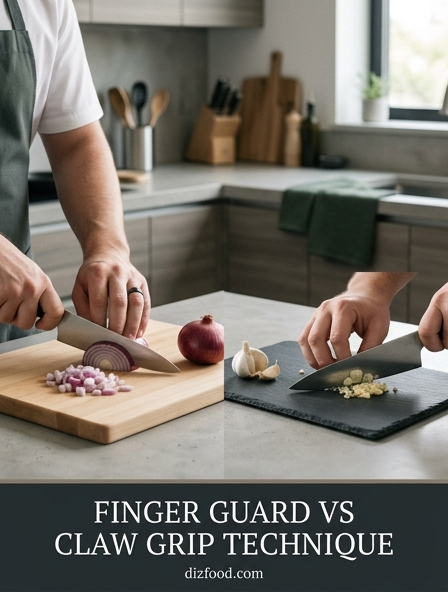
Finger Guard vs Claw Grip Essential Knife Safety
Knife safety is the cornerstone of culinary proficiency, distinguishing a seasoned chef from a casual home cook. The primary objective is to protect the non-cutting hand, which is often more susceptible to injury than the hand wielding the blade. Two primary methods dominate the kitchen: the mechanical finger guard and the manual claw grip technique. While both aim to prevent lacerations, they represent different philosophies of kitchen safety. A finger guard is a physical barrier, usually made of stainless steel or durable plastic, that fits over the fingers to shield them from the knife's edge. Conversely, the claw grip is a fundamental skill where the fingers are tucked inward, using the knuckles as a guide for the blade.
Understanding the essential differences between these two is vital for anyone looking to improve their prep work. The following points summarize the core safety concepts:
- Physical Barrier: The finger guard provides a hard shield that makes it nearly impossible for the blade to reach the skin.
- Skill-Based Protection: The claw grip relies on muscle memory and anatomical positioning to keep vulnerable tips away from the edge.
- Tactile Feedback: Manual gripping allows for a direct feel of the ingredient, whereas a guard introduces a layer of separation.
- Versatility: The claw grip can be applied to any ingredient at any time, while a guard must be located and fitted before use.
Choosing between them often depends on one's comfort level and the specific task at hand. While beginners may find the finger guard reassuring, the claw grip remains the industry standard for those seeking long-term efficiency and mastery over their kitchen tools.
Mastering the Claw Grip for Professional Precision
The claw grip is often regarded as the "gold standard" in professional kitchens worldwide. Mastering this technique allows a cook to work with remarkable speed without sacrificing safety. To execute a perfect claw grip, one must curl the fingertips inward toward the palm, creating a shape reminiscent of an eagle's claw. The middle segments of the fingers, particularly the knuckles, should be the only part of the hand that comes into contact with the side of the knife blade. This creates a vertical plane that guides the knife up and down, ensuring the sharp edge stays well away from the soft tissue of the fingertips.
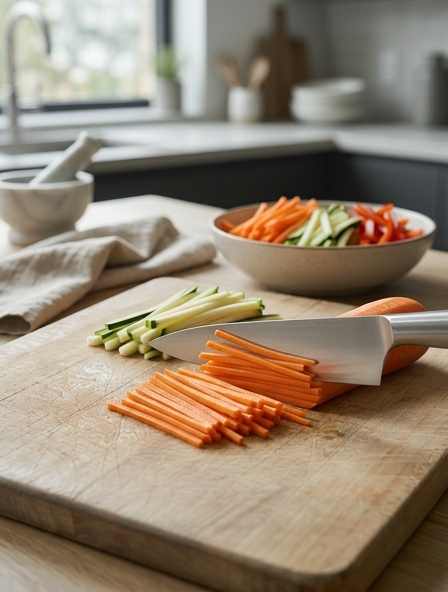
Precision is the hallmark of this technique. By using the knuckles as a guide, you can control the thickness of each slice with microscopic accuracy. As you move the knife, your hand "walks" backward across the ingredient, maintaining a consistent distance between the blade and your hand. This rhythmic movement is essential for high-volume prep work, such as julienning carrots or chiffonading herbs. Furthermore, the thumb plays a critical role; it must be tucked behind the other fingers to act as an anchor, preventing the food from sliding around on the cutting board. Without proper thumb placement, the stability of the claw grip is compromised, increasing the risk of the ingredient rolling and causing the knife to slip. Developing this muscle memory takes time and patience, but the resulting precision is what separates professional output from amateur efforts.
Benefits of Using a Finger Guard for Beginners
For those just starting their culinary journey or individuals who may have a fear of sharp knives, a finger guard offers an invaluable layer of protection. This simple tool acts as a literal shield, allowing the user to focus on the mechanics of the cutting hand without the constant anxiety of a potential injury. One of the most significant benefits is the immediate confidence it instills. Beginners often hesitate or use incorrect posture because they are afraid of the blade; the finger guard removes this mental barrier, permitting them to practice their dicing and slicing motions in a controlled environment.
In addition to psychological benefits, the finger guard is highly practical for specific populations. Children learning to cook, individuals with fine motor skill challenges, or elderly cooks with decreased hand stability find these devices particularly helpful. They are generally inexpensive and easy to clean, making them a low-stakes investment for home safety. Many finger guards feature an adjustable ring on the back that fits various finger sizes, ensuring a snug and secure fit during use. While a guard may limit the tactile connection between the cook and the food, it ensures that the learning process is bloodless and encouraging. It serves as a "training wheel" for the kitchen, providing a safe transition period before one feels comfortable enough to attempt the manual claw grip technique on more complex or slippery ingredients.
Comparing Knife Control and Cutting Speed
When evaluating the effectiveness of a finger guard versus the claw grip, two metrics stand out: control and speed. The claw grip provides superior control because the cook maintains direct contact with the ingredient, allowing them to feel the texture, density, and stability of the item being sliced. This tactile feedback is crucial when working with irregular shapes like bell peppers or ginger. In contrast, a finger guard can feel somewhat clunky, as the thickness of the shield can obscure the cook's view and dampen the sensation of the food's movement under the hand.
| Feature | Finger Guard | Claw Grip |
|---|---|---|
| Learning Curve | Immediate / Low | Moderate / High |
| Slicing Speed | Limited by Tool | Potentially Very Fast |
| Tactile Sensation | Low (Shielded) | High (Direct Contact) |
| Ingredient Versatility | Best for Small Items | Universal Application |
| Safety Level | High (Physical Barrier) | High (Technique Dependent) |
In terms of speed, the claw grip is the clear winner for experienced users. Once the "knuckle-guide" motion is internalized, the knife can move in a rapid, rhythmic cadence that a physical guard simply cannot facilitate. The guard requires repositioning and can sometimes snag on the blade if not aligned perfectly. However, for a novice, the speed of the finger guard is effectively higher because it prevents the frequent pauses caused by fear or uncertainty. Ultimately, the transition from guard to grip is usually motivated by a desire for greater speed and professional-grade uniformity in cuts.
How the Claw Grip Prevents Kitchen Injuries
The mechanics of the claw grip are specifically designed to negate the most common causes of kitchen lacerations. Most accidental cuts occur when the fingertips extend beyond the protective line of the knuckles or when the knife "jumps" over the ingredient. By tucking the fingertips and thumb, the cook effectively hides the most vulnerable parts of the hand. The knife blade rests against the flat surface of the knuckles; since the blade is kept vertical, it cannot physically reach the skin as long as the fingers remain curled. Even if the knife slips upward, it hits the broad, bony part of the knuckle rather than the sensitive tip or the nail bed.
Another injury prevention aspect is the stability the claw grip provides to the ingredient. By pressing down with the fingertips while they are curled, the cook creates multiple points of contact that "lock" the food onto the cutting board. This prevents the food from rolling or sliding, which is a frequent precursor to a knife slip. The thumb, positioned behind the ingredient, acts as a backstop, ensuring the item moves only when the cook intends. Furthermore, this technique encourages the cook to keep the tip of the knife on the cutting board (using a rocking motion), which keeps the blade's path predictable and controlled. By aligning the hand's anatomy with the knife's movement, the claw grip creates a systematic safety zone that remains consistent regardless of the sharpness of the blade or the toughness of the vegetable.
Finger Guard vs Claw Grip Which Is More Efficient
Efficiency in the kitchen is measured by the time taken to complete prep work and the quality of the final result. While a finger guard is highly effective at preventing cuts, it can be viewed as less efficient in a high-speed environment. The necessity of finding the guard, fitting it onto the hand, and adjusting it for different sized ingredients adds seconds to every task. Over a long shift, these seconds accumulate. Furthermore, a finger guard can be difficult to use with very small items like garlic cloves or shallots, where the bulky nature of the shield might actually interfere with the blade's path, forcing the cook to revert to manual methods anyway.
The claw grip, once mastered, is the epitome of efficiency. It requires no external equipment, meaning a cook can switch from dicing an onion to slicing a tomato instantly. Because the fingers are always in contact with the food, the cook can adjust their grip in real-time to account for changes in the food's shape. This fluidity is essential for "mise en place," the practice of having all ingredients prepared before cooking begins. Additionally, the claw grip facilitates better cleaning efficiency; there are no extra tools to wash, and the hand can be quickly rinsed. However, for a home cook who only prepares one meal a day, the time saved by the claw grip may be negligible compared to the peace of mind offered by a finger guard. Efficiency is therefore subjective, depending largely on the volume of work and the user's technical proficiency.
The Anatomy of a Safe Knife Technique
A safe knife technique is not just about the hand holding the food; it involves the entire body's alignment. To properly execute safety measures, one must understand the relationship between the shoulder, elbow, wrist, and fingers. The cutting arm should be relaxed, with the elbow close to the body, allowing the weight of the knife to do most of the work. The non-cutting hand-the "anchor" hand-must be positioned firmly. In the claw grip, the distal phalanges (the tips of the fingers) are flexed, while the proximal phalanges provide the vertical surface for the knife to rest against. This anatomical configuration creates a "shield" out of bone and skin that is much tougher than the sensitive pads of the fingers.
Proper posture also dictates that the cook stands square to the cutting board, with feet shoulder-width apart. This provides a stable base and prevents leaning, which can lead to fatigue and loss of focus. The "pinch grip" on the knife handle (holding the bolster between the thumb and forefinger) works in tandem with the claw grip on the other hand to create a closed loop of control. When these anatomical elements are aligned, the knife moves in a consistent arc. If the cook uses a finger guard, the anatomy changes slightly as the device alters the natural curve of the fingers. Regardless of the chosen method, the goal is to maintain a 90-degree angle between the blade and the cutting board, ensuring that any lateral movement is minimized. This structural approach to safety ensures that even if a lapse in concentration occurs, the physical positioning of the hands acts as a failsafe against injury.
Transitioning From Finger Guards to Manual Grips
Moving from the total protection of a finger guard to the skill-based claw grip is a significant milestone for any home cook. This transition should be gradual to ensure safety and build muscle memory without the risk of injury. The first step is to practice the claw motion without a knife. Simply placing the hand on a flat surface and practicing the "walk" across the board helps the fingers become accustomed to the curled position. Once this feels natural, the cook can begin practicing with soft, stable ingredients that won't roll, such as a block of cheese or a halved zucchini.
- Start Slow: Speed is the enemy of the learner. Focus entirely on the shape of the hand rather than the speed of the cut.
- Use a Guide: Initially, keep the knife blade in constant contact with the knuckles to get used to the feeling of the metal against the hand.
- Focus on the Thumb: Many beginners forget to tuck the thumb. Make a conscious effort to keep it behind the index and middle fingers.
- Practice with Large Items: Larger vegetables like potatoes provide more surface area for the hand to grip, making the claw easier to maintain.
- Gradual Removal: Use the finger guard for the first half of the prep and the claw grip for the second half to slowly build confidence.
Consistency is key during this phase. It is better to spend ten minutes slicing slowly and correctly than to rush and revert to dangerous "flat-finger" habits. Over time, the tucked position will become the default, and the finger guard can be retired to the back of the kitchen drawer.
Common Mistakes in Finger Positioning and Knife Safety
Even with the best intentions, many cooks fall into habits that compromise their safety. One of the most common errors is the "lazy thumb." While the other fingers may be tucked into a claw, the thumb often drifts outward toward the blade, leaving it exposed to a painful "nick." Another frequent mistake is the "collapsing claw," where the fingers start tucked but slowly flatten out as the cook becomes tired or distracted. When the fingers flatten, the tips are once again in the line of fire. It is essential to periodically check the hand's tension to ensure the fingertips remain safely away from the edge.
Other common errors include:
- Lifting the Knife Too High: If the spine of the knife rises above the height of the knuckles, it can come down directly on top of the fingers.
- Ignoring the Ingredient's Shape: Trying to use a claw grip on a round, rolling onion without first cutting a flat base is a recipe for disaster.
- Over-tightening the Grip: Excessive tension in the hand can lead to cramping and a loss of fine motor control, making slips more likely.
- Looking Away: Kitchen accidents happen in a split second. Never take your eyes off the blade while it is in motion, regardless of the technique being used.
Identifying these mistakes early is crucial. Often, a cook doesn't realize their technique has slipped until an accident occurs. Regularly filming oneself or practicing in front of a mirror can provide the visual feedback necessary to correct these small but dangerous deviations in form.
Choosing the Best Protection for Your Cutting Style
The choice between a finger guard and the claw grip ultimately depends on your personal goals in the kitchen and your current skill level. There is no one-size-fits-all answer; instead, there is a "right for now" answer. If you are a casual cook who only prepares meals occasionally and feels anxious around sharp tools, a finger guard is a brilliant and affordable solution that ensures you stay safe. It allows you to enjoy the process of cooking without the stress of potential injury. For those who cook daily or aspire to professional standards, investing the time to learn the claw grip is far more beneficial in the long run.
Consider the following factors when making your decision:
- Frequency of Cooking: Daily cooks benefit more from the speed and versatility of the claw grip.
- Task Complexity: Simple slicing is easy with a guard, but intricate dicing and mincing often require the tactile control of a manual grip.
- Equipment Quality: If you use exceptionally sharp, high-end knives, the precision of the claw grip helps maintain the blade's edge and your safety.
- Physical Comfort: Some individuals may find the claw grip position uncomfortable due to arthritis or other hand conditions, making a finger guard the more ergonomic choice.
Ultimately, the best technique is the one that you can perform consistently and safely. Many experienced cooks keep a finger guard in their kit for specific tasks or for when they are teaching others, proving that both tools have a valid place in a well-rounded kitchen safety strategy.


Comments