
Choosing between a Santoku and a Gyuto is a foundational step in mastering Japanese cutlery, as each blade offers a distinct approach to culinary precision. The Santoku, translated as "three virtues," is a compact powerhouse designed for slicing, dicing, and mincing with a flatter edge that excels at vertical push-cuts. In contrast, the Gyuto is the Japanese evolution of the Western chef's knife, featuring a longer profile and a curved belly that facilitates a fluid rocking motion for versatile prep work. Whether you prioritize the nimble, space-saving design of a Santoku for vegetable-heavy tasks or the multi-purpose reach of a Gyuto for breaking down proteins and large produce, selecting the right tool will fundamentally transform your kitchen efficiency and cutting technique.
| Feature | Santoku Knife | Gyuto Knife |
|---|---|---|
| Meaning | "Three Virtues" (Meat, Fish, Veg) | "Cow Sword" (Beef Sword) |
| Blade Length | 5 to 7 inches (130mm - 180mm) | 8 to 12 inches (210mm - 300mm) |
| Edge Profile | Flat edge; minimal "belly" curve | Curved edge; pronounced belly |
| Tip Design | Downturned "Sheep's Foot" tip | Sharp, pointed "Saber" tip |
| Cutting Style | Vertical push-cut or chopping | Rocking motion or long draws |
| Best For | Small kitchens & precision veg prep | Large proteins & high-volume tasks |
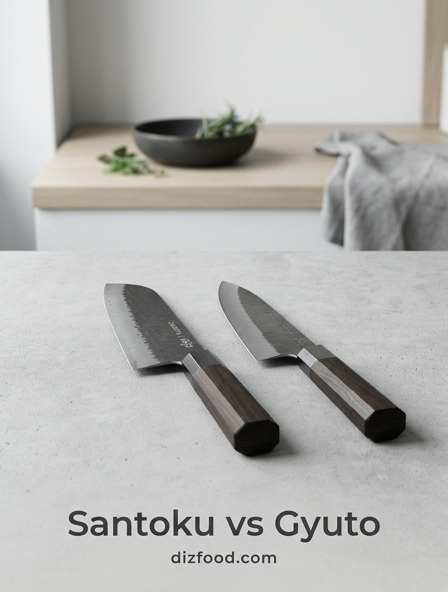
Santoku vs Gyuto Key Differences Explained
The culinary world often highlights the Santoku and the Gyuto as the two most essential Japanese knives for any kitchen. While both serve as multi-purpose tools, their origins and fundamental designs differ significantly. The Santoku, which translates to "three virtues," is traditionally designed for slicing, dicing, and mincing. It is a quintessential household knife in Japan, favored for its compact size and efficiency with vegetables. In contrast, the Gyuto is the Japanese equivalent of the Western chef's knife, often referred to as a "cow sword," implying its prowess in processing larger cuts of meat and proteins.
- Origin: The Santoku is a domestic evolution of the traditional Nakiri, while the Gyuto is a Japanese adaptation of French and German chef's knives.
- Primary Use: Santokus excel in upward and downward chopping of produce; Gyutos are designed for versatile slicing across all food groups.
- Size: Santokus are generally shorter and more agile, whereas Gyutos offer more length for substantial tasks.
Understanding these differences is crucial for any cook looking to invest in high-quality cutlery. The Santoku offers a safer, more controlled experience for beginners, whereas the Gyuto provides the reach and tip precision required by professional chefs. Choosing between them often comes down to your primary ingredients and the specific physical mechanics you prefer when standing at the cutting board. While they can often overlap in utility, their distinct geometries dictate how you will interact with your ingredients on a daily basis.
Understanding Blade Shape and Geometry
The most striking difference between the Santoku and the Gyuto lies in their silhouette. The Santoku features a "sheep's foot" design, where the spine curves down dramatically to meet the edge at the tip. This results in a very slight belly, making the edge relatively flat. This geometry is optimized for vertical contact with the cutting board, ensuring clean cuts through vegetables without the need for a long drawing motion. The lack of a sharp, pointed tip also makes it a safer option for crowded kitchens or less experienced users.
| Feature | Santoku | Gyuto |
|---|---|---|
| Tip Style | Sheep's Foot (Blunt) | Pointed (Acute) |
| Blade Profile | Flat Edge | Curved Belly |
| Spine Design | Downward Curve | Straight/Tapered |
The Gyuto, conversely, maintains a more traditional pointed tip and a curved edge profile, often referred to as a "belly." This curvature allows the knife to rock back and forth smoothly. The pointed tip of the Gyuto is also much thinner and sharper, allowing for intricate work like deboning small poultry or performing fine horizontal cuts in an onion. The geometry of the Gyuto is focused on versatility and speed, utilizing the full length of the blade to create a mechanical advantage when slicing through tough fibers or large produce.
Blade Length and Kitchen Maneuverability
Blade length is a practical consideration that affects how much space you need on your cutting board and how much control you feel over the tool. Most Santoku knives range between 160mm and 180mm (roughly 6 to 7 inches). This shorter length makes the knife feel like an extension of the hand, providing excellent maneuverability in tight spaces or smaller home kitchens. Because the blade is shorter, the center of gravity is usually closer to the handle, which reduces wrist fatigue during repetitive tasks like dicing a mountain of onions.
- Compact Control: The Santoku's shorter blade is easier to guide for precise, straight-down cuts.
- Extended Reach: The Gyuto's length allows for slicing through large items in a single stroke.
- Space Requirements: Larger Gyutos require significant board space and clearance from kitchen backsplashes.
Gyutos typically start at 210mm and can go up to 270mm or more, with 210mm to 240mm (8 to 9.5 inches) being the standard for home and professional use. The added length is a major advantage when slicing large roasts or breaking down a watermelon. However, the extra length can feel intimidating or "clunky" to those with small hands or limited counter space. The maneuverability of a Gyuto comes from its tip; while the heel handles heavy work, the forward third of the blade is used for detail. Choosing the right length is often a balance between the size of the ingredients you typically prep and the physical constraints of your workspace.
Rocking Motion vs Push Cutting Techniques
Your preferred cutting technique should be the primary driver in your choice between these two knives. Because the Santoku has a flatter edge, it is designed for "push cutting" or "tap chopping." In this motion, the knife moves forward and down or straight down in a clean stroke. This is incredibly efficient for vegetables, as the flat edge makes full contact with the board simultaneously, preventing "accordion" cuts where the skin of a vegetable remains attached. It is not well-suited for rocking, as the tip can dig into the board or the heel can lift too early.
The Gyuto is built for the "rocking motion," a technique common in Western professional kitchens. The curved belly allows the cook to keep the tip of the knife in contact with the cutting board while the heel moves up and down to slice through herbs or small vegetables. Beyond rocking, the Gyuto is also superior for "draw-slicing," where you pull the knife through the food using the entire length of the blade. This is essential for proteins, where a clean, single-pass cut prevents tearing the delicate fibers of the meat. If you find yourself naturally rocking your knife back and forth, the Gyuto will feel much more intuitive. If you prefer a rhythmic, vertical chop, the Santoku will be your preferred companion.
The Versatility of the All Purpose Gyuto
The Gyuto is widely considered the "king" of the Japanese kitchen due to its sheer versatility. While it was originally adapted for meat, its design has evolved to handle almost any task. The height of the blade at the heel provides enough knuckle clearance for chopping on a board, while the elongated profile makes it excellent for slicing fish or carving poultry. This "jack-of-all-trades" nature is why many professional chefs choose a Gyuto as their primary workhorse; it can transition from fine julienne work to heavy-duty prep without a change of tools.
- Protein Processing: Ideal for trimming silver skin, slicing steaks, and portioning fish.
- Fine Detail: The sharp, thin tip is perfect for scoring fat or precision vegetable work.
- High Volume: The longer edge allows for more efficient processing of large quantities of food.
Because the Gyuto is often thinner than its Western counterparts, it glides through hard vegetables like carrots or potatoes with minimal resistance. This thinness, combined with the length, allows for a level of finesse that a Santoku occasionally lacks. For a cook who only wants to own one high-quality knife that can perform every task from the most delicate to the most robust, the Gyuto is the standard recommendation. It rewards the user who takes the time to master various cutting styles, offering a range of utility that covers the gaps left by more specialized blades.
Why Home Cooks Prefer the Santoku
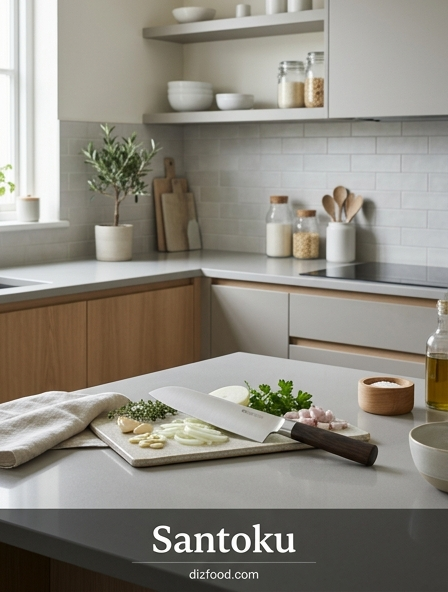
The Santoku has gained immense popularity in home kitchens worldwide, and for good reason. For many home cooks, a 10-inch chef's knife feels oversized and dangerous. The Santoku offers a more approachable alternative that feels balanced and lightweight. Its "three virtues" (meat, fish, and vegetables) cover the vast majority of daily home cooking needs. Many Santokus also feature a "Granton edge"-divots along the side of the blade-which create air pockets to prevent wet vegetables like cucumbers or potatoes from sticking to the steel during fast-paced chopping.
Furthermore, the Santoku is exceptionally well-suited for the "pinch grip," where the thumb and index finger hold the blade itself. This grip, combined with the Santoku's shorter length, provides a high degree of control that boosts confidence in the kitchen. Home cooks who primarily prepare plant-based meals find the Santoku's flat edge and height perfect for scooping diced ingredients off the board. It is a tool that prioritizes comfort and efficiency for the average person preparing a family meal, where speed and safety are often more important than the specialized techniques required in a professional setting.
Edge Profile and Bevel Comparison
The edge profile of a knife determines how it enters and exits the food. Japanese knives like the Santoku and Gyuto are traditionally sharpened to a much finer angle (usually 12 to 15 degrees) than Western knives. While both are generally double-beveled-meaning they are sharpened on both sides-the way that edge is distributed along the blade differs. The Santoku's edge is almost entirely linear until it reaches the very end. This maximizes the contact area for vertical cuts but requires the user to be more precise with their wrist angle to ensure the entire blade hits the board.
| Property | Santoku Edge | Gyuto Edge |
|---|---|---|
| Curvature | Very Low (Flat) | Moderate to High |
| Contact Point | Uniform along middle | Varies with rocking |
| Grind Type | Often includes Granton divots | Typically smooth/flat grind |
The Gyuto features a distal taper, where the blade gets thinner from the heel to the tip. This allows the heel to be slightly more robust for heavier tasks, while the tip remains laser-thin for precision. The edge profile of the Gyuto is more forgiving; if your technique is slightly off, the curve of the belly will usually compensate, ensuring the cut is completed. Understanding the bevel and edge profile is essential for maintenance, as the Santoku's flat edge is easier for beginners to sharpen on a whetstone, while the Gyuto's curve requires a more nuanced "sweeping" motion during the sharpening process.
Weight and Balance in the Hand
Weight and balance are subjective but critical components of a knife's "feel." Santokus are generally lighter than Gyutos of the same height because they are shorter. This lightness is a hallmark of Japanese cutlery, designed to reduce fatigue. The balance point on a Santoku is often located right at the bolster or slightly forward, making the knife feel "blade-heavy," which assists in the downward chopping motion. This weight distribution allows the gravity of the knife to do some of the work during prep.
- Wa-Handle (Traditional): Lightweight wood, usually octagonal or D-shaped, shifts balance forward.
- Yo-Handle (Western): Heavier, riveted handle, shifts balance toward the hand.
- Overall Mass: Santokus favor nimbleness; Gyutos favor momentum and stability.
The Gyuto, being longer, has a more complex balance profile. A 240mm Gyuto with a traditional Japanese "Wa" handle will feel very light in the hand but significantly blade-forward. This is preferred by many because it provides better feedback from the tip. Conversely, a Gyuto with a Western "Yo" handle will feel more substantial and anchored in the palm. When testing these knives, the "pinch grip" is the best way to assess balance. A well-balanced knife should feel like it wants to stay level in your hand, neither dipping aggressively at the tip nor pulling back toward the wrist, allowing for fluid, effortless movement.
Maintenance and Sharpening Requirements
Both the Santoku and Gyuto require a higher level of care than standard stainless steel knives found in department stores. Because they are typically made from harder steel (measured on the Rockwell Scale), they hold an edge longer but are more prone to chipping if used on bones or frozen foods. Maintenance begins with proper cleaning; these knives should always be hand-washed and dried immediately to prevent rust, especially if they contain carbon steel. Never put a high-quality Japanese knife in the dishwasher, as the heat and chemicals will ruin the handle and dull the edge.
- Whetstone Sharpening: Use a medium grit (1000) for regular sharpening and a fine grit (6000) for polishing.
- Honing: Use a ceramic rod rather than a steel one, as steel rods can be too aggressive for hard Japanese blades.
- Storage: Use a magnetic rack or a wooden "Saya" (sheath) to protect the fine edge from contact with other tools.
Sharpening a Santoku is generally more straightforward for those new to whetstones because the straight edge allows for consistent contact. The Gyuto, with its varying belly and thin tip, requires a more advanced technique to ensure the entire curve is sharpened evenly without rounding off the point. Regular maintenance ensures that the knife remains a joy to use. A dull Japanese knife is actually more dangerous than a sharp one, as it requires more force to cut, increasing the likelihood of the blade slipping and causing injury.
How to Choose Your Perfect Kitchen Knife
Deciding between a Santoku and a Gyuto ultimately depends on your personal cooking style and your physical comfort. If your diet is primarily plant-based and you find yourself doing a lot of chopping and dicing of vegetables, the Santoku is likely the better choice. Its compact size and flat edge make vegetable prep fast and efficient. It is also the ideal choice if you have a smaller kitchen or prefer a knife that feels light and easy to control. The Santoku is the "friendly" knife that most home cooks reach for instinctively for quick daily tasks.
However, if you view cooking as a craft and want to master professional techniques, the Gyuto is the superior investment. Its length and pointed tip offer a level of versatility that the Santoku cannot match, particularly when it comes to processing meats or performing intricate decorative cuts. The Gyuto grows with you as your skills improve. Consider the size of your cutting board as well; a large Gyuto on a small board is a recipe for frustration. If possible, hold both types in a pinch grip to see which balance feels more natural. Regardless of which you choose, investing in a high-quality Japanese blade will fundamentally transform your experience in the kitchen, making every slice more precise and every meal more enjoyable to prepare.

Comments