
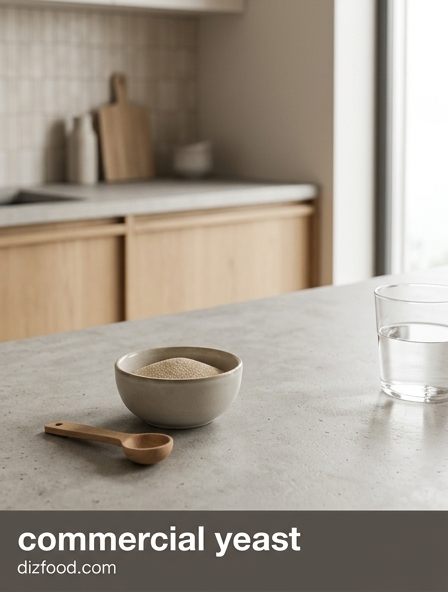
Rapid Rise Times for Busy Schedules
In the fast-paced environment of a modern kitchen, time is often the most constrained resource. Commercial yeast, particularly instant and rapid-rise varieties, addresses this challenge by significantly accelerating the fermentation process. Unlike traditional sourdough starters that may require twelve to twenty-four hours to fully leaven a loaf, commercial yeast can achieve a double-volume rise in as little as forty-five minutes. This biological efficiency is achieved through the selection of high-activity strains of Saccharomyces cerevisiae, which are processed to react quickly when exposed to moisture and warmth.
For the home baker or the professional pastry chef, this speed facilitates a "straight dough" method where ingredients are mixed, kneaded, and proved in a single, continuous afternoon. This eliminates the need for overnight refrigeration or multi-day planning, making it possible to produce fresh rolls, pizza dough, or sandwich bread on short notice. The rapid production of carbon dioxide ensures that the dough structure is established quickly, allowing for a tight production schedule that fits into the gaps of a busy workday without sacrificing the quality of the final crumb.
Predictable Results in Every Batch
One of the primary advantages of utilizing commercial yeast is the high level of standardization it brings to the baking process. Each granule of active dry or instant yeast contains a specific, concentrated amount of living organisms designed to perform under controlled conditions. This precision allows bakers to follow recipes with the confidence that the dough will behave exactly as expected every time. When using wild yeast, environmental factors like ambient humidity and local bacteria can cause wild fluctuations in performance, but commercial yeast is engineered to bypass these variables.
- Consistent Lift: The volume of the bread remains uniform across different batches.
- Controlled Timing: Proofing stages occur within a specific window, usually plus or minus ten minutes.
- Uniform Crumb: The internal hole structure of the bread is more regular and predictable.
By removing the "luck" factor from fermentation, commercial yeast allows for better troubleshooting. If a loaf fails to rise, the baker can more easily isolate the variable-such as water temperature or salt content-because the potency of the yeast is a known constant. This reliability is the backbone of commercial bakeries that must produce hundreds of identical loaves daily.
Zero Maintenance Compared to Sourdough
Maintaining a sourdough starter is often compared to keeping a small pet; it requires regular feeding, monitoring, and temperature management to remain viable. Commercial yeast, however, requires absolutely no maintenance between baking sessions. It exists in a dormant, dehydrated state that remains stable until the moment it is introduced to water. This "set it and forget it" nature makes it an ideal choice for the occasional baker who might go weeks or even months between projects.
There is no need to "discard" half of the culture, nor is there a requirement to plan your life around a feeding schedule. When the urge to bake strikes, the yeast is simply measured out of a jar or packet and added to the flour. This convenience frees up refrigerator space and eliminates the guilt associated with a neglected starter that has turned gray or developed an unpleasant odor. For those who prioritize a clean, low-maintenance kitchen, the absence of a bubbling ferment on the counter is a significant benefit that allows for a more streamlined and less demanding culinary workflow.
Long Shelf Life and Storage Ease
Commercial yeast is a triumph of food science packaging, offering an incredibly long shelf life that far exceeds that of fresh or wild alternatives. Because it is processed into dry granules with very low moisture content, the yeast cells remain in a state of suspended animation. When kept in its original vacuum-sealed packaging, commercial yeast can remain potent for two years or more. Even after opening, the yeast remains highly effective if stored correctly, making it a reliable pantry staple that is always ready for use.
| Storage Location | Expected Shelf Life | Best Practices |
|---|---|---|
| Pantry (Unopened) | Up to 2 Years | Keep cool and dry. |
| Refrigerator | 4 to 6 Months | Use an airtight container. |
| Freezer | 6 to 12 Months | Protect from moisture. |
This longevity ensures that the baker always has a leavening agent on hand without needing to visit the store frequently. The compact nature of yeast packets or small glass jars means they take up minimal real estate in the kitchen, offering maximum leavening power in a tiny footprint.
Reliable Performance for Beginner Bakers
For those just beginning their journey into the world of bread making, the learning curve can be intimidating. Commercial yeast serves as an essential safety net, providing a reliable foundation for success. The complexity of managing a wild ferment often leads to early failures that can discourage new hobbyists. In contrast, commercial yeast is designed to be resilient and forgiving. It works across a broad range of temperatures and can withstand slight inaccuracies in measurement or technique that might otherwise ruin a more delicate sourdough loaf.
By using commercial yeast, beginners can focus on mastering the fundamental skills of baking, such as proper kneading, dough shaping, and oven management. Once these tactile skills are developed, the baker can then choose to explore more complex fermentation methods if they wish. The immediate gratification of a successful, well-risen loaf builds the confidence necessary to continue experimenting in the kitchen. It simplifies the biological aspect of baking into a repeatable step, turning a potentially frustrating science experiment into an enjoyable and rewarding culinary activity that yields delicious results on the very first try.
Consistent Fermentation Without the Guesswork
The process of fermentation in bread making is essentially a chemical reaction where yeast consumes sugars and releases carbon dioxide and alcohol. With commercial yeast, the rate of this reaction is highly standardized. This eliminates the "guesswork" that often plagues bakers using artisanal or wild methods. Because the concentration of live cells is so high and uniform, the timing of the "bulk ferment" and the "final proof" becomes a matter of following a clock rather than deciphering vague visual cues like the texture of the bubbles or the smell of the dough.
This consistency is particularly useful when baking in varying climates or seasons. While a cold kitchen might slow down commercial yeast slightly, it will not stall it entirely as it might with a less vigorous wild culture. Bakers can use warm water to "bloom" active dry yeast, effectively jump-starting the biological process and ensuring the dough begins rising immediately. This level of control allows for a disciplined approach to baking, where the results are dictated by the baker's intent rather than the whims of the environment, ensuring that the crumb structure is perfectly aerated every time.
Versatility Across Diverse Bread Recipes
Commercial yeast is an incredibly versatile ingredient that serves as the engine for an enormous variety of baked goods. Its neutral flavor profile and reliable lifting power make it suitable for everything from the leanest baguettes to the richest, most butter-laden brioche. Unlike sourdough, which imparts a distinct tang that may not be desirable in all contexts, commercial yeast allows the natural flavors of the flour, grains, and enrichments to shine through. This makes it the preferred choice for sweet breads, donuts, and delicate pastries where a sour note would be out of place.
- Enriched Doughs: Perfect for cinnamon rolls and challah where a high sugar content is present.
- Flatbreads: Ideal for rapid-turnaround pizza doughs and focaccia.
- Deep-Fried Goods: Provides the quick lift needed for airy, light yeast-raised donuts.
- Whole Grains: Strong enough to lift heavy, dense flours like rye or whole wheat.
This adaptability ensures that a single jar of yeast in the pantry can be used for a Saturday morning pancake session, a Sunday loaf of white bread, or a midweek batch of dinner rolls, proving its worth as a multi-purpose tool.
Standardized Leavening Power for Perfection
Precision is the hallmark of professional baking, and commercial yeast provides the standardized leavening power necessary to achieve perfection. Manufactured under strict laboratory conditions, these yeast strains are isolated for their vigor and purity. This means that every gram of yeast used provides the same amount of biological "work." In a commercial setting, this standardization is vital for scaling recipes; a formula that works for one loaf will work exactly the same way when scaled up to one hundred loaves, provided the yeast ratios remain constant.
Furthermore, the standardized nature of the product means that nutritional labels and calorie counts remain accurate. Because the yeast consumes a predictable amount of carbohydrates during its timed fermentation, the final sugar content of the bread is easier to calculate. This scientific approach to leavening removes the variables of mutation and contamination that can occur in domestic starters. For the perfectionist baker who views the kitchen as a laboratory, commercial yeast is an indispensable reagent that ensures every experiment produces a high-quality, repeatable outcome without the interference of unpredictable microbial competitors.
Efficiency in Modern Home Kitchens
The modern home kitchen is often a site of multitasking, where dinner must be prepared alongside homework, work calls, and other household chores. Efficiency is paramount. Commercial yeast fits perfectly into this lifestyle by offering "active" time that is very low compared to "passive" time. Because the rise is so vigorous and fast, the window during which the baker must be physically present to shape or bake the dough is narrow and predictable. This allows for better meal planning and time management.
Moreover, the use of instant yeast allows for the "no-bloom" method, where the yeast is mixed directly into the dry ingredients. This saves the extra step of proofing the yeast in warm water, reducing the number of bowls used and shortening the preparation time. In an era where "convenience" is often synonymous with "lower quality," commercial yeast stands out as a product that offers extreme convenience while still allowing the baker to produce a high-quality, artisanal product from scratch. It bridges the gap between the ancient art of baking and the high-speed requirements of contemporary life.
Eliminating the Need for Starter Feeding
The removal of the starter feeding ritual is perhaps the most significant lifestyle benefit of using commercial yeast. For many, the "burden" of a sourdough starter-the need to feed it every day or every week-is enough to prevent them from baking altogether. Commercial yeast eliminates this entry barrier entirely. There is no waste generated from discarding starter, and no constant mental load of remembering when the last feeding occurred. This makes baking an "on-demand" activity rather than a continuous commitment.
By eliminating the need for a starter, the baker also reduces the risk of kitchen contamination. Fermentation jars can sometimes attract fruit flies or develop mold if not handled with extreme hygiene. Commercial yeast, stored in its dry and dormant state, is hygienic and contained. It allows for a "clean break" between baking sessions; once the bread is out of the oven and the bowls are washed, the baking process is truly finished until the next time you decide to pick up a bag of flour. This freedom makes the kitchen a more flexible space, catering to the baker's whims rather than the yeast's biological requirements.



Comments