
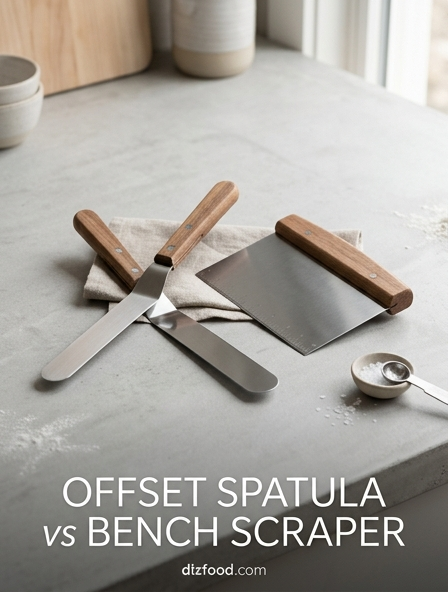
When it comes to achieving professional-grade pastry results, the debate between the offset spatula and the bench scraper centers on the balance between delicate finesse and structural efficiency. The offset spatula, with its signature angled neck and flexible blade, is your go-to instrument for precision tasks like smoothing silky Swiss meringue buttercream or spreading thin layers of batter with surgical accuracy. Conversely, the bench scraper is the heavy-duty hero of the bakehouse, designed for high-leverage tasks such as portioning dense bread dough, cleaning work surfaces, and creating those perfectly vertical, razor-sharp finishes on tiered cakes. Understanding how to leverage the flexible reach of the spatula against the rigid stability of the scraper is the ultimate secret to mastering both the artistry and the mechanics of high-end baking.
| Feature | Offset Spatula | Bench Scraper |
|---|---|---|
| Core Function | Spreading, smoothing & lifting | Cutting, scraping & leveling |
| Blade Design | Flexible, thin stainless steel | Rigid, wide rectangular blade |
| Primary Motion | Horizontal sweeping & gliding | Vertical chopping & scraping |
| Edge Type | Blunt, rounded safety edges | Sharp, straight beveled edge |
| Best Application | Detailing cakes & filling pans | Dough scaling & surface cleaning |
| Pro Result | Seamless, swirl-free frosting | Crisp, 90-degree cake corners |
Offset Spatula vs Bench Scraper Key Differences
While both the offset spatula and the bench scraper are indispensable tools in a professional or home kitchen, they serve fundamentally different purposes based on their design and structural integrity. An offset spatula features a narrow, flexible metal blade that is bent near the handle. This "offset" design allows the user's hand to remain elevated and clear of the surface being smoothed, providing better visibility and preventing knuckles from dragging through frosting or batter. Its primary strength lies in its flexibility and precision, making it ideal for delicate tasks that require a soft touch.
In contrast, a bench scraper is a sturdy, rectangular piece of stainless steel with a handle running along the top edge. It is rigid and lacks the "give" found in a spatula. Its primary function is to act as a heavy-duty extension of the hand, capable of moving large amounts of weight or clearing a work surface. The differences in their physical properties dictate their specific roles in the baking process, as outlined in the comparison below.
| Feature | Offset Spatula | Bench Scraper |
|---|---|---|
| Flexibility | High; bends easily to follow contours | None; rigid and sturdy |
| Primary Shape | Long, narrow, and angled blade | Wide, rectangular, and flat |
| Material | Thin stainless steel | Thick stainless steel or plastic |
| Edge Type | Blunt and rounded | Sharp and straight |
Best Uses for an Offset Spatula in Baking
The offset spatula is the surgeon's scalpel of the baking world. Its main advantage is its ability to maneuver in tight spaces and provide a smooth finish on uneven surfaces. Because the blade is thin and tapered, it can slide under delicate cookies or tarts without causing them to crack. Bakers often rely on various sizes of this tool, ranging from mini versions for cupcakes to long blades for multi-tiered wedding cakes.
- Frosting Cakes: The angled blade makes it easy to spread buttercream across the top of a cake while keeping your hands away from the icing.
- Smoothing Batter: Ensuring that cake or brownie batter is perfectly level in a pan before baking helps achieve an even rise.
- Lifting Delicate Pastries: The flexibility allows the tool to slide under thin tuiles or fragile sugar cookies without snapping them.
- Filling Piping Bags: It is excellent for scooping frosting or mousse from a bowl and cleanly depositing it into a pastry bag.
- Creating Decorative Swirls: By using the tip of the blade, bakers can create artistic textures and patterns in thick ganache or frosting.
Ultimately, any task that requires finesse rather than force is a job for the offset spatula. It is the tool that bridges the gap between raw ingredients and a polished, professional aesthetic.
Essential Functions of a Kitchen Bench Scraper
If the offset spatula is the scalpel, the bench scraper is the workhorse. This tool is often the first thing a baker reaches for when starting a project and the last thing used during cleanup. It is designed to handle the "heavy lifting" of the kitchen, specifically when working with dough and large quantities of ingredients. Its straight, sharp edge is perfect for interacting with flat surfaces like marble, wood, or stainless steel worktops.
- Dividing Dough: The sharp bottom edge easily cuts through bread, pizza, or pastry dough into equal portions without tearing the gluten.
- Cleaning Surfaces: It acts as a giant razor to scrape dried flour and bits of dough off the counter, making cleanup significantly faster.
- Transferring Ingredients: Once vegetables are chopped or nuts are crushed, the wide blade allows you to scoop them up and transport them to a bowl or pan efficiently.
- Measuring: Many bench scrapers have ruler markings etched into the metal, allowing bakers to measure the thickness of rolled-out dough or the height of a cake.
- Creating Sharp Cake Edges: When held vertically against a rotating cake stand, it strips away excess frosting to create a perfectly smooth, professional side.
The bench scraper's rigidity is its greatest asset, allowing it to withstand pressure that would permanently bend or snap an offset spatula.
Choosing the Right Tool for Cake Decorating
When it comes to decorating a cake, the choice between a bench scraper and an offset spatula depends entirely on the desired finish. Professional decorators rarely choose one over the other; instead, they use them in tandem to achieve a flawless look. The offset spatula is generally used for the "crumb coat" and the initial application of the final frosting layer. Its flexibility allows it to push frosting into gaps and smooth it over the rounded top of the cake with ease.
However, if the goal is to achieve the razor-sharp "industrial" look seen on modern cakes, the bench scraper is the superior choice for the sides. By holding the scraper at a 45-degree angle against the side of the cake while spinning a turntable, you can remove the perfect amount of icing to reveal a flat, vertical surface. The scraper's height ensures that the side is uniform from bottom to top, something that is difficult to achieve with the narrower blade of a spatula. For the very top edge of the cake, decorators often return to the offset spatula, using it to gently pull the "lip" of frosting toward the center for a clean corner. Mastering both tools is the key to moving from amateur results to professional-grade presentation.
Managing Dough with a Metal Bench Scraper
Bread making and pastry work involve sticky, heavy materials that can be difficult to manage with just your hands. This is where the metal bench scraper becomes essential. Unlike plastic scrapers, a metal version provides the weight and sharpness needed to slice through dense dough. When working with high-hydration sourdough or sticky brioche, the scraper acts as a non-stick interface between the counter and your skin, preventing the dough from clinging to your fingers and losing its shape.
- Folding Dough: Use the scraper to lift the edge of a wet dough and fold it over itself to build strength without adding excess flour.
- Preserving Surface Tension: In bread shaping, the scraper can be used to tuck the dough under itself, creating a tight outer skin that leads to a better oven spring.
- Removing Residue: Even the stickiest bits of caramelized sugar or dried flour are no match for a stainless steel edge, preserving your countertops from scratches and wear.
The ergonomic handle of a bench scraper also allows for a firm grip, reducing hand fatigue during long sessions of portioning hundreds of rolls or biscuits. Because it is usually made from a single piece of steel or has a securely riveted handle, it can survive the rigorous demands of a high-volume bakery environment.
Precision Leveling with an Offset Spatula
One of the most overlooked benefits of the offset spatula is its ability to level dry ingredients and batters with extreme precision. When a recipe calls for a "level cup" of flour, the flat edge of a small offset spatula is the perfect tool to swipe across the measuring cup, ensuring an accurate volume. In the oven, precision leveling is equally important. For items like Swiss rolls or jelly rolls, the batter must be spread into a perfectly thin, even sheet to ensure it bakes uniformly and rolls without cracking.
The "offset" handle is crucial here because it allows the blade to lay completely flat against the batter while your hand remains above the rim of the baking sheet. If you used a straight spatula, your fingers would dig into the batter, ruining the level surface. This precision extends to non-baking tasks as well, such as leveling off a layer of lasagna or smoothing out mashed potatoes on a shepherd's pie. The tool provides a tactile feedback that allows the baker to feel the thickness of the material underneath, making it easier to identify thin spots that need more coverage. It is this sensitivity and reach that makes the offset spatula a favorite for detailed finishing work.
Bench Scraper vs Offset Spatula for Pastry Work
Pastry work, such as making pie crusts or puff pastry, requires keeping the dough cool and the fats intact. The bench scraper and offset spatula play different but complementary roles in this delicate process. The bench scraper is often used during the initial mixing phase to "cut" cold butter into flour. Its cold metal surface and sharp edge allow the baker to break down the fat without the heat of their hands melting it, which is the secret to a flaky crust.
| Task | Recommended Tool | Reasoning |
|---|---|---|
| Cutting butter into flour | Bench Scraper | Sharp edge mimics a pastry blender. |
| Lifting rolled-out pie dough | Offset Spatula | Thin blade slides under dough without tearing. |
| Cleaning flour off marble | Bench Scraper | Rigid blade clears large areas quickly. |
| Spreading jam in a tart | Offset Spatula | Angled reach is better for recessed pans. |
During the rolling process, if a piece of dough sticks to the table, the bench scraper can quickly release it. Meanwhile, the offset spatula is the better choice for tucking edges into a tart tin or spreading a thin layer of frangipane or fruit preserves. Together, they ensure that the pastry is handled as little as possible, preserving the integrity of the layers.
Common Baking Tasks for Each Tool
Understanding which tool to grab can save a baker precious time during a busy project. While there is some overlap, most tasks have a clear "winner" in terms of efficiency. The offset spatula is the king of spreading and smoothing, while the bench scraper is the master of cutting and clearing. Below are common scenarios encountered in the kitchen and the tool best suited for the job.
- Glazing Donuts: Use an offset spatula to spread a thick maple or chocolate glaze evenly over the top of a warm donut.
- Slicing Brownies: A bench scraper can be pressed straight down into a pan of brownies to create perfectly square cuts with clean edges.
- Tempering Chocolate: Both tools are used here; the scraper moves the chocolate across the marble, while the spatula helps clean the scraper and manage smaller amounts.
- Removing Cookies: A large offset spatula acts as a thin turner to lift soft cookies off a baking sheet.
- Gathering Scraps: Use a bench scraper to quickly pile up dough scraps for re-rolling when making biscuits or sugar cookies.
By categorizing tasks into "detail work" and "bulk work," you can intuitively decide which tool to use. This organized approach reduces the risk of damaging delicate bakes or struggling with heavy doughs.
Durability and Design of Spatulas vs Scrapers
The physical construction of these tools reflects their intended lifespan and usage. Bench scrapers are typically built to be indestructible. Most are made from high-gauge stainless steel that does not rust or pit easily. The handles are often molded plastic or bolted wood, designed to withstand the downward pressure required for cutting through dough. Because there are no moving parts and the blade is thick, a quality bench scraper can literally last a lifetime in a kitchen.
Offset spatulas, however, are more specialized and require a bit more care. The thinness of the blade that makes them so useful also makes them susceptible to bending if used incorrectly. If you try to use a small offset spatula to scrape a heavy, dried-on mess from a counter, you may permanently warp the metal or snap it at the offset bend. Most modern versions feature dishwasher-safe plastic handles, but traditional ones with wooden handles require hand-washing to prevent the wood from splitting. When purchasing, look for "tapered ground" blades on spatulas, which provide maximum flexibility at the tip while maintaining strength near the handle. For scrapers, look for a comfortable, non-slip grip, as you will often be using it with flour-covered hands.
Ultimate Comparison Guide for Home Bakers
For the home baker just starting to build their toolkit, the question often arises: do I need both? The answer is almost certainly yes, as they are not interchangeable. However, if you must prioritize, your choice should depend on what you bake most often. If you are a bread enthusiast, the bench scraper is your priority. If you are a cake decorator, the offset spatula is your most vital asset. In a well-rounded kitchen, these tools provide the control needed to elevate basic recipes into professional-looking creations.
- Storage: Bench scrapers are flat and easy to store in a drawer, while offset spatulas can be awkward due to their length and bend. Consider a magnetic knife strip for both.
- Maintenance: Keep the edge of your bench scraper clean and dry to prevent nicks that could snag on dough. Check your spatula for any rust spots near the handle.
- Versatility: Don't be afraid to use these tools for savory cooking, such as flipping small items in a pan with the spatula or dicing soft butter with the scraper.
Investing in high-quality versions of both tools is a relatively low-cost way to significantly improve your baking efficiency. They are the primary instruments of texture and shape, transforming a messy pile of ingredients into a structured, beautiful final product.

Comments