
Achieving that elusive steakhouse-quality "edge-to-edge pink" used to be a gamble, but the debate between sous vide and reverse sear has turned the perfect cook into a repeatable science. Both methods prioritize a low-and-slow approach to prevent the dreaded grey band of overcooked meat, yet they excel in different ways: sous vide offers foolproof precision by submerging meat in a temperature-controlled water bath, while the reverse sear utilizes dry oven heat to dehydrate the surface for a world-class crust. Whether you value the "set-it-and-forget-it" convenience of a precision circulator or the superior Maillard reaction triggered by an oven-to-cast-iron finish, mastering these techniques ensures your steaks are consistently tender, juicy, and perfectly rendered every single time.
| Feature | Sous Vide | Reverse Sear |
|---|---|---|
| Precision | Absolute; accurate to 0.1°F via water bath. | High; requires a digital meat probe. |
| Searing Quality | Surface is wet; needs drying for a good sear. | Superior; oven air dries the pellicle for a faster crust. |
| Texture | Uniformly buttery; softens connective tissue deeply. | Traditional steakhouse "bite" with intense flavor. |
| Time Flexibility | Can hold at temp for hours with no overcooking. | Time-sensitive; must be pulled exactly at target. |
| Required Gear | Immersion circulator, vessel, and vacuum bags. | Oven, wire rack, and a reliable meat thermometer. |
| Best For | Lean cuts (Filet) or long-term tenderizing. | Thick-cut, fatty steaks (Ribeye) at least 1.5" thick. |
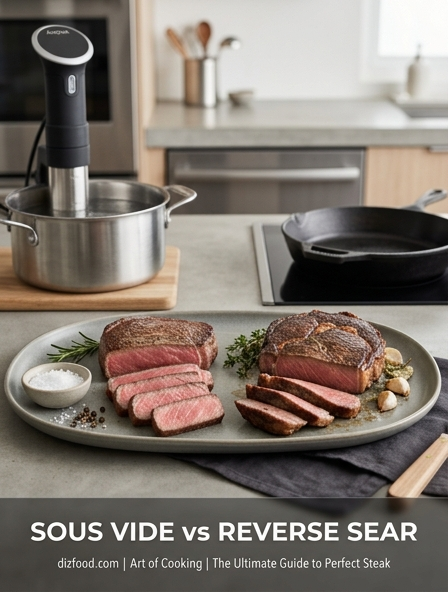
Sous Vide vs Reverse Sear Which Cooking Method Is Best
In the modern kitchen, the quest for the perfect steak has evolved into a technological debate between two dominant low-and-slow techniques: sous vide and reverse sear. Both methods depart from the traditional high-heat pan-searing approach, which often results in a "bullseye" effect of overcooked outer rings. Instead, these contemporary methods prioritize internal temperature accuracy to ensure the meat is cooked evenly from the center to the very edge. While they share the same goal of precision, their execution and final results offer distinct characteristics that appeal to different types of home cooks and professional chefs.
Choosing the "best" method often depends on the specific cut of meat and the desired textural outcome. Sous vide utilizes a circulating water bath to maintain a constant temperature, while reverse searing relies on a low-temperature oven followed by a high-heat finish. Key factors to consider when comparing these methods include:
- Consistency: Sous vide is virtually impossible to overcook, providing a safety net for expensive cuts.
- Surface Texture: Reverse searing often produces a superior crust due to the dry environment of the oven.
- Flavor Profile: The enclosed environment of a vacuum bag intensifies aromatics, whereas the oven develops fat rendering.
- Convenience: Sous vide allows for long holding times, while reverse sear requires more active monitoring of the internal probe.
Ultimately, the battle between sous vide and reverse sear isn't about which is objectively superior, but rather which tool is most appropriate for the task at hand. Whether you are preparing a lean filet mignon or a thick, marbled ribeye, understanding the nuances of these techniques is essential for achieving restaurant-quality results in a domestic setting.
Understanding the Science of Precision Temperature Control
The core philosophy behind both sous vide and reverse sear is the manipulation of thermal energy to prevent the tightening of muscle fibers. When meat is exposed to high heat immediately, the proteins contract violently, squeezing out moisture and creating a tough texture. By applying heat gradually, the proteins denature slowly, allowing the cook to target the exact temperature where collagen begins to soften without reaching the point of total fiber contraction. The science differs, however, in how that heat is transferred.
In a sous vide setup, water acts as the medium. Because water is significantly more dense than air, it conducts heat with incredible efficiency and stability. Once the water bath reaches 130°F (54.4°C), the meat inside the vacuum-sealed bag will eventually reach that exact temperature and stay there, never rising a degree higher. This equilibrium allows for precise control over enzymatic activity, specifically calpains and cathepsins, which help tenderize the meat during the long cooking process. This is a form of "conduction" cooking where the environment is perfectly regulated.
Reverse searing utilizes "convection" in a low-temperature oven. While air is a poor conductor of heat compared to water, the dry environment facilitates surface evaporation. As the meat warms slowly, the exterior becomes dehydrated. This lack of moisture is a critical scientific advantage for the final sear, as it bypasses the energy-intensive process of evaporating surface water before the Maillard reaction can begin. While the oven is less precise than a water bath and requires a digital thermometer to track progress, the gradual rise in temperature offers a similar gentle protein denaturation that preserves the integrity of the meat's cellular structure.
Edge to Edge Doneness Comparing Internal Consistency
The most visually striking difference between modern low-heat methods and traditional pan-searing is the internal gradient. Traditional methods often result in a "rainbow" of doneness: a charred exterior, a thick band of grey overcooked meat, and a small pink center. Both sous vide and reverse sear eliminate this inefficiency, aiming for a uniform color from the top surface to the bottom. However, the level of "perfection" varies slightly between the two techniques based on the heating medium's stability.
| Feature | Sous Vide Consistency | Reverse Sear Consistency |
|---|---|---|
| Gradient | Absolute zero gradient; 100% uniform. | Minimal gradient; 95% uniform. |
| Risk of Overcooking | Negligible; water temp is the cap. | Moderate; requires probe monitoring. |
| Internal Color | Bright pink/red throughout. | Slightly deeper red/brown near the edge. |
Sous vide is the undisputed champion of edge-to-edge consistency. Because the meat is submerged in a medium that cannot exceed the target temperature, there is no chance of the outer layers becoming hotter than the core. This results in a steak that looks identical at every millimeter of its cross-section. It is particularly effective for thick-cut steaks (2 inches or more) where the thermal lag in a traditional pan would be massive.
Reverse sear comes remarkably close to this ideal. By using a very low oven temperature (around 225°F), the heat penetrates slowly enough that the center stays close to the surface temperature. However, because the oven air is still significantly hotter than the target internal temperature of the steak (e.g., 225°F vs 130°F), a very slight gradient can form if the meat is not pulled at the exact right moment. For most enthusiasts, this tiny discrepancy is outweighed by the benefits of the crust, but for pure visual uniformity, sous vide remains the benchmark.
The Quest for the Perfect Crust and Maillard Reaction
The Maillard reaction is a chemical reaction between amino acids and reducing sugars that gives browned food its distinctive flavor. Achieving this "crust" is the final, crucial step in both sous vide and reverse sear. However, the two methods present very different starting points for the sear, which significantly impacts the quality of the bark. Moisture is the enemy of the Maillard reaction; as long as there is water on the surface of the meat, the temperature cannot rise above 212°F (100°C), which is too low for effective browning.
- Sous Vide Surface: The meat emerges from the bag dripping with juices. Even after patting dry with paper towels, the fibers remain saturated, often requiring a longer sear time that can inadvertently overcook the interior.
- Reverse Sear Surface: The low-heat oven acts as a dehydrator. By the time the steak reaches its target temperature, the surface is leather-dry and primed for the pan. This allows for an incredibly fast, intense sear.
- Fat Rendering: Reverse sear typically renders intramuscular fat more effectively during the slow roast, leading to a crispier, more flavorful exterior.
Because the reverse sear involves dry heat, the proteins on the surface begin to break down and dry out throughout the entire cooking process. When the steak finally hits a smoking-hot cast-iron skillet, it develops a thick, crunchy crust almost instantly. In contrast, sous vide steaks often have a "weaker" crust. To compensate, sous vide enthusiasts often use a blowtorch or a "chimney starter" to apply extreme heat very quickly, but the lack of a pre-dried surface remains a physical hurdle. For those who prioritize the tactile crunch and the deep, roasted flavors of a well-seared steak, the reverse sear provides a distinct advantage that is difficult to replicate in a water bath.
Equipment Requirements for Water Baths and Ovens
The barrier to entry for these methods differs significantly in terms of cost and specialized gadgets. Sous vide is a "gear-heavy" technique that requires specific investments to ensure safety and precision. To get started with sous vide, a cook typically needs an immersion circulator-a device that clips onto a container to heat and move the water. Additionally, you need a way to seal the food, such as a vacuum sealer and BPA-free plastic bags, or at the very least, high-quality freezer bags used with the water displacement method. A dedicated plastic tub or a large stockpot is also necessary to hold the water bath.
In contrast, the reverse sear is a "low-tech" method that utilizes tools already found in most kitchens. The primary requirement is a standard oven capable of maintaining low temperatures (ideally between 200°F and 250°F). However, the success of a reverse sear is entirely dependent on an accurate digital meat thermometer, preferably a leave-in probe that allows you to monitor the internal temperature without opening the oven door. A wire cooling rack set over a rimmed baking sheet is also essential; this allows hot air to circulate under the meat, ensuring it dries out and cooks evenly on all sides.
While the reverse sear is more accessible, the equipment for sous vide offers more versatility beyond just steaks, such as making temperamental sauces, yogurt, or perfectly poached eggs. Conversely, the reverse sear equipment is multi-purpose and requires no additional storage space for bulky electronics. If you are a minimalist, the reverse sear is the clear winner; if you enjoy the precision of modern culinary tech, the sous vide kit is a rewarding investment for the home kitchen.
Time Management and Preparation Workflows for Each Method
Time management is perhaps the most significant practical difference between these two workflows. Sous vide is characterized by "passive time." Once the steak is bagged and submerged, it requires zero attention. You can leave a steak in a water bath for two, three, or even four hours without any degradation in quality. This makes it ideal for entertaining; you can prep the meat long before guests arrive and simply sear it when you are ready to serve. The "holding window" of sous vide is a luxury that few other cooking methods provide.
- Seasoning: Both start with salt and aromatics, though sous vide requires less salt as it doesn't wash away.
- Heating: Sous vide takes 1-2 hours; Reverse sear takes 45-90 minutes depending on thickness.
- Resting: Reverse sear requires a short rest before the sear or no rest after; Sous vide requires a "chill" or drying phase.
- The Finish: Both require a high-heat sear in a pan, on a grill, or with a torch.
The reverse sear workflow is more linear and requires tighter timing. While the oven does most of the work, you must be present to pull the meat when the thermometer hits the target. If you forget it for twenty minutes, the steak will overcook. However, the reverse sear is generally faster overall than sous vide for a single steak. Furthermore, the reverse sear doesn't require the "patting dry" labor that sous vide does. Because the steak comes out of the oven dry, you can move directly to the searing station. For a weeknight meal where you have a 90-minute window, the reverse sear is often more efficient, whereas sous vide shines when the serving time is unpredictable.
Texture and Moisture Retention in Premium Cuts of Meat
The physical sensation of eating a steak cooked via these two methods is subtly different. Sous vide meat is often described as "buttery" or "tenderized." Because the meat is cooked in its own juices within a vacuum, there is virtually zero moisture loss during the primary cooking phase. This makes it exceptionally effective for leaner cuts like tenderloin or top sirloin, which lack the fat to stay moist under traditional high-heat methods. The immersion in liquid and the lack of air also prevent the oxidation of fats, leading to a very clean, pure beef flavor.
The reverse sear, however, excels with highly marbled premium cuts like ribeye or New York strip. The dry, warm air of the oven helps render the intramuscular fat (marbling) more effectively than the moist environment of a sous vide bag. When fat renders, it coats the muscle fibers, creating a rich, silky mouthfeel that many steak enthusiasts prefer. While the reverse sear does lose a small amount of weight due to moisture evaporation (roughly 5-10%), this loss actually concentrates the beefy flavor, resulting in a steak that tastes "meatier" than its sous vide counterpart.
Texture-wise, some find that long-duration sous vide can make meat almost *too* soft, losing the traditional "chew" associated with a great steak. This is particularly true if the meat is left in the bath for over four hours. The reverse sear maintains a more traditional steakhouse texture-firm yet tender. Ultimately, if you want the juiciest possible result for a lean cut, sous vide is the path. If you want the most flavorful fat and a traditional bite on a fatty cut, the reverse sear is the superior choice.
When to Choose Sous Vide for Foolproof Results
Sous vide is the ultimate insurance policy for the home cook. There are specific scenarios where the precision of a water bath far outweighs the benefits of an oven roast. The most prominent example is when cooking for a large group. Trying to time six or eight steaks to finish simultaneously in an oven is a logistical nightmare, especially if guests are late. With sous vide, you can drop all the steaks in the bath hours in advance and pull them out whenever the side dishes are ready. The steaks will all be perfectly medium-rare, regardless of whether they were in the water for one hour or three.
Another ideal use case for sous vide is "tough" cuts that require extremely long cook times to become tender. Short ribs, brisket, or chuck roast can be cooked sous vide for 24 to 48 hours at a precise 131°F. This results in meat that has the texture of a steak but the tenderness of a slow-braised roast-a feat that is impossible to achieve with a reverse sear in an oven, as the meat would eventually dry out over such a long period. Choose sous vide when:
- Cooking for dinner parties with unpredictable timing.
- Preparing lean cuts like Filet Mignon or venison.
- Experimenting with long-duration tenderization of tough muscle groups.
- You want to infuse specific flavors, like garlic or rosemary, directly into the meat fibers.
In short, sous vide is the "set it and forget it" solution. It removes the anxiety of the "perfect pull" and guarantees a result that is technically flawless every single time, making it the best choice for beginners or those who value consistency above all else.
Why Enthusiasts Prefer the Traditional Reverse Sear
Despite the high-tech appeal of sous vide, many seasoned steak enthusiasts and professional pitmasters remain loyal to the reverse sear. The primary reason is the flavor profile. The dry heat of the oven allows for a slight "roasting" effect that simply cannot happen inside a plastic bag. As the exterior dries and the fat begins to bubble and render, the steak develops a complex depth of flavor. Furthermore, many purists argue that the "baggy" environment of sous vide can sometimes result in a "boiled" flavor if the searing step isn't executed with enough intensity.
The reverse sear also allows for the addition of smoke. Many enthusiasts perform the "low and slow" portion of the reverse sear on a smoker or a charcoal grill set to indirect heat. This adds a layer of wood-fired flavor to the steak that sous vide cannot replicate. There is also a tactile satisfaction in the reverse sear process; it requires the cook to engage with the meat, checking the temperature and observing the changes in the crust. For many, the kitchen experience is as much about the process as it is about the final meal.
Finally, the reverse sear avoids the "plastic" aspect of sous vide. While modern sous vide bags are safe, some cooks prefer to avoid cooking their food in plastic for several hours. The simplicity of meat, salt, and heat in an open-air environment feels more "natural" to traditionalists. If you have a high-quality, thick ribeye and a reliable digital thermometer, the reverse sear offers a more "steakhouse-authentic" experience with a crust that is consistently superior to what most home cooks can achieve with sous vide.
Final Verdict Selecting the Right Technique for Your Steak
The choice between sous vide and reverse sear ultimately comes down to a trade-off between textural precision and crust quality. Neither method is a failure; both represent a significant upgrade over high-heat pan cooking. To make the final decision, look at the cut of meat sitting on your counter. If it is a lean, expensive Filet Mignon, the moisture-retention capabilities of sous vide will ensure that every bite is succulent and tender. If you are preparing a thick-cut, bone-in Ribeye with plenty of fat, the reverse sear will better honor the meat by rendering that fat and providing a crunchier, more flavorful exterior.
Consider your lifestyle and kitchen environment as well. If you are a gadget lover who enjoys the "science lab" approach to cooking and wants the freedom to walk away from the kitchen for hours, sous vide is a perfect fit. If you are a culinary purist who believes that the best flavor comes from the interaction of dry heat and fat, the reverse sear is your best bet. Some cooks even combine the two, using the sous vide for the internal cook and then thoroughly chilling and drying the meat before a very aggressive sear to try and get the best of both worlds.
Regardless of which you choose, the transition to low-temperature starting methods is the single biggest step you can take toward steak mastery. By separating the "cooking" (internal temperature) from the "searing" (external texture), you gain total control over the variables. Experiment with both, and you will soon find that the "best" method is the one that makes you most confident in your own kitchen.

Comments