
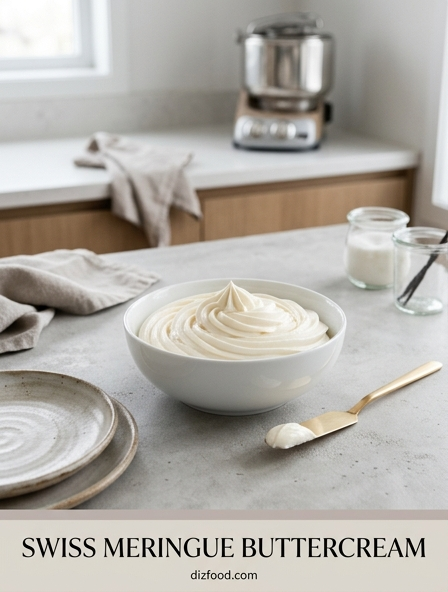
Mastering Temperature Control for Optimal Emulsification
Successful Swiss meringue buttercream relies heavily on the precise management of thermal energy during the two primary phases of production. Initially, the egg whites and granulated sugar must reach 160°F (71°C) in a double boiler. This temperature ensures the proteins are denatured and the sugar crystals are fully dissolved, creating a stable base for the meringue. If the mixture is underheated, the resulting texture will be gritty; if overheated, the whites may scramble.
Once the meringue reaches stiff peaks, it must cool to approximately 70°F (21°C) before the introduction of fats. Adding butter to a warm meringue results in a soup-like consistency that lacks structural integrity. Conversely, if the meringue or the butter is too cold, the emulsion will break, leading to a curdled appearance. Maintaining an ambient kitchen temperature of 68°F to 72°F facilitates the slow incorporation of unsalted butter, allowing the fat molecules to suspend perfectly within the protein matrix for a stable, velvety finish.
Essential Precision Tools for Seamless Application
The quality of a buttercream finish is often a direct reflection of the implements used during the decorating process. A professional-grade rotating turntable with a weighted base is non-negotiable for achieving consistent motion. Without a smooth spin, the pastry chef cannot maintain the constant pressure required for an even coat. Additionally, stainless steel bench scrapers provide the necessary rigidity to square off the sides of a cake, which plastic alternatives often fail to provide due to their flexibility.
| Tool Name | Primary Function | Key Feature |
|---|---|---|
| Digital Thermometer | Monitoring egg white and butter temps | Instant-read accuracy |
| Offset Spatula | Distributing frosting between layers | Flexible blade for leveling |
| Bench Scraper | Smoothing vertical surfaces | 90-degree precision edge |
| Paddle Attachment | Removing air and emulsifying | Broad surface area contact |
Each tool serves a specific mechanical purpose. The offset spatula allows for lateral movement without the chef's knuckles contacting the delicate surface, while the bench scraper acts as a vertical guide to ensure the cake does not taper at the top or bottom during the final smoothing stages.
Achieving the Perfect Silky Consistency for Spreading
The hallmark of Swiss meringue buttercream is its incomparable silkiness, a state achieved through mechanical agitation and fat saturation. After the meringue is cooled and the butter is fully incorporated, the mixture often goes through a "curdled" stage. This is a natural part of the emulsification process where the water in the whites and the fat in the butter are struggling to bond. Persistence is key; continued whipping at a medium-high speed eventually forces these elements together into a cohesive, glossy frosting.
To ensure the consistency is optimal for spreading, the buttercream should hold a soft peak that yields easily to a spatula. If the frosting is too stiff, it will pull at the cake's surface, causing tearing. If it is too soft, it will bulge between layers. A final mix on the lowest speed for five to ten minutes is recommended to collapse large air pockets, resulting in a dense, creamy texture that mimics the appearance of satin. This specific viscosity allows the buttercream to glide over the cake surface with minimal friction.
Foundation Strategies for a Flawless Crumb Coat
A crumb coat serves as the structural primer for any professional cake design. This thin, initial layer of Swiss meringue buttercream is applied to the bare cake to trap loose fragments and seal the crumb, preventing debris from migrating into the final decorative layer. To execute this effectively, the buttercream should be slightly softer than the final coat to ensure it adheres to the cake's pores without dragging. A small offset spatula is the ideal tool for pushing the frosting into the gaps between layers.
- Apply a 1/8-inch layer across the entire surface.
- Fill any internal gaps between the cake rounds to prevent air pockets.
- Use a bench scraper to remove excess frosting until the cake layers are visible.
- Refrigerate the cake for at least 30 minutes until the coat is firm to the touch.
Once chilled, the crumb coat provides a rigid, chilled foundation that helps set the subsequent layer of buttercream more quickly. This thermal contrast helps the final thick coat maintain its shape and verticality during the smoothing process.
Advanced Bench Scraper Techniques for Vertical Alignment
Achieving perfectly vertical sides requires a marriage of hand-eye coordination and geometric precision. The bench scraper must be held at a 45-degree angle relative to the cake's surface. Holding it at a 90-degree angle will scrape off too much frosting, while an angle too shallow will simply smear it without leveling. The non-dominant hand rotates the turntable in one fluid, continuous motion while the dominant hand remains completely stationary, braced against the work surface for stability.
Success in vertical alignment is found in the "bottom-to-top" inspection. The scraper's base must remain flush with the turntable to ensure the cake does not develop a conical shape. As the turntable spins, the chef should look for gaps between the scraper's edge and the cake's surface; these gaps indicate areas where more buttercream is needed. By repeating this process and cleaning the scraper blade after every single pass, the technician eliminates ridges and build-up, resulting in a perfectly cylindrical form ready for sharp-edge refinement.
Engineering Razor Sharp Edges with Cold-Set Methods
The signature "sharp edge" on a professional cake is rarely achieved through spreading alone; it is engineered through temperature manipulation. After the final coat of Swiss meringue buttercream is applied and smoothed, the cake should feature a "crown" or lip of frosting that extends slightly above the top edge. Instead of smoothing this down immediately, the cake is placed in a refrigerator until the buttercream is completely hard. This cold-set state allows the chef to manipulate the frosting without it smearing or losing its shape.
- Apply the final side coat, leaving an intentional overhanging lip at the top.
- Chill the cake for 45 to 60 minutes until the fat in the butter has solidified.
- Use a sharp, heated bench scraper or a specialized trimming blade to shave the lip.
- Pull the excess frosting from the outer edge toward the center in a swift motion.
Because the buttercream is cold, it breaks cleanly rather than stretching, creating a crisp 90-degree angle. This technique eliminates the rounded edges commonly associated with amateur baking and provides a clean, modern aesthetic.
Thermal Smoothing for a Mirror-Like Surface Finish
While a bench scraper creates a level surface, it can often leave behind microscopic lines or a matte texture. Thermal smoothing uses residual heat to slightly melt the outermost micron of the buttercream, resulting in a mirror-like sheen. This is achieved by dipping a stainless steel bench scraper or offset spatula into boiling water, drying it thoroughly so no moisture touches the frosting, and then passing the warm metal over the chilled cake. The heat softens the butter solids instantly, erasing any imperfections.
This process must be done with extreme care; if the tool is too hot, it will cause the buttercream to break or yellow. The goal is a gentle "buffing" action. This technique is particularly effective for removing "ghosting," where the crumbs or darker cake layers are slightly visible through the frosting. The slight melting of the surface increases the opacity and creates a seamless, porcelain-like finish that is highly desirable for wedding cakes and high-end pâtisserie displays. Once the heat is applied, the cake should be returned to the fridge briefly to reset the shine.
Eliminating Air Bubbles through Manual Paddle Manipulation
Air bubbles are the primary antagonist of a smooth Swiss meringue buttercream finish. These bubbles are introduced during the high-speed whipping of the meringue and the subsequent addition of butter. If left unaddressed, they appear as small craters or "pockmarks" on the surface of the cake. To eliminate them, the buttercream must undergo a de-gassing phase once the emulsion is stable. This involves switching from a whisk attachment to a paddle attachment, which has a smaller surface area and does not incorporate air.
Set the stand mixer to its lowest possible speed and allow the paddle to turn for 10 to 15 minutes. During this time, use a silicone spatula to manually press the buttercream against the sides of the bowl. This mechanical pressure forces the trapped air to the surface where it can escape. The result is a dense, heavy frosting that behaves more like a thick paste. When applied to the cake, this de-gassed buttercream yields a flawlessly flat surface without the need for excessive patching or re-smoothing later in the decorating process.
Strategic Structural Layering for Multi-Tier Stability
When stacking cakes frosted with Swiss meringue buttercream, structural engineering is paramount due to the high fat content of the frosting. At room temperature, the buttercream is soft; under the weight of multiple tiers, it can compress or "blow out" at the seams if not properly supported. Each tier must sit on its own cake board, and the weight of the upper tiers must be transferred to the cake drum via a system of dowels or straws. These supports should be cut exactly flush with the top of the buttercream to ensure the board above rests on the dowels, not the frosting.
- Use wide-gauge bubble tea straws or wooden dowels for vertical support.
- Center a primary dowel through all tiers to prevent lateral shifting.
- Ensure the buttercream is chilled and firm before stacking to prevent sliding.
- Apply a small amount of fresh buttercream as "glue" between the board and the tier below.
By creating a load-bearing skeleton within the cake, the delicate Swiss meringue buttercream remains a decorative element rather than a structural one, ensuring the cake remains upright during transport and display.
Professional Troubleshooting for Texture Refinement
Even the most experienced pastry chefs encounter texture issues with Swiss meringue buttercream, usually stemming from environmental factors. The two most common problems are a broken (curdled) emulsion and a soupy, melted consistency. A broken emulsion occurs when the butter is too cold; the fat chunks separate from the meringue. To fix this, remove a small portion of the frosting, melt it in the microwave, and then slowly stream it back into the mixing bowl while whipping. This raises the overall temperature just enough to allow the fats to bond.
Conversely, if the mixture is soupy, the meringue was likely too warm when the butter was added. In this scenario, place the entire mixing bowl in the refrigerator for 20 minutes to allow the butter to begin solidifying, then re-whip until the desired volume and stiffness are achieved. For buttercream that feels too "greasy," a pinch of salt or a boost in flavoring can help balance the palate. Understanding these corrective measures ensures that no batch of buttercream is ever truly lost, regardless of kitchen conditions or minor technical errors during the mixing process.


Comments